Some Observations on Plant Totems vs. Animal Totems

If you’re at all familiar with my writing, you’ll know I’ve been writing about animal totems for years. Animal totemism has been a foundation of my practice pretty much from the beginning, way back in the 90’s. I’ve always had some connection to plant totems as well, but they’ve had more of a background presence in my life. A lot of that is due in part, no doubt, to the fact that I am an animal, and therefore I resonate more easily with other species of animal. So it’s been harder for the plants to get through to me; sadly I’ve seen them more as scenery in my journeys and other works than as active participants.

White trillium near Triple Falls, Oregon. Photo by Lupa, 2012.

Over the past few years, though, and especially as I’ve been spending more time in deeper wilderness, I’ve been more aware of the bioregional nature of the spirit realm. Animal totems don’t just exist as disembodied spirits in a void somewhere, but in spiritual ecosystems with the totems of plants, fungi, stones, and various other spiritual beings. What I’ve become aware of is that there were deep connections with plant totems all along, and I just wasn’t appreciating them for what they were. For a while now I’ve been spending more time meditating on those relationships and really getting a feel for them, and now I feel ready to share my thoughts.*

Some of this is due to the way in which the plant totems have tended to relate to me. Animal totems are very active and pro-active. Like their physical counterparts, they’re frequently on the move, going from place to place, and they’re used to making the first contact with a person. They view the world often as a series of tasks, challenges, and things to do. And we humans follow suit. Plant totems, on the other hand, have a much different perspective. They are often acted upon (though certainly there are examples of plants acting on animals, and definitely on other plants). While a plant totem can make itself known to me, it’s usually after I’ve made the first contact. In my last post here I talked about how White and Red Clovers came to me and talked to me about some of our early experiences together, but it was only after I thought about them and gave them that opening.

So we often take for granted that a totem being will come to us if there’s something important to know. I wonder, though, how many plant totems have messages and conversations ready for us that go unheard because we don’t pay attention? And what sort of attention should we pay, anyway? Most of the things I have learned from plants and their totems have been through a sort of experiential osmosis–absorbed in my senses and pores without consciously realizing them, inhaled and digested as a matter of daily goings-on, rather than being actively sought and observed with animals. Yet these can be incredibly powerful and moving lessons, and I am amazed at just how much I didn’t realize I have gained from plant totems over the years.

Another consideration is that a plant is rooted in one place, something that is alien to most animals (especially terrestrial ones). Other than a few house plants that get repotted, plants generally stay in the same place their entire lives. Even widespread plant colonies that expand their boundaries through growth still have limited “travel” by our standards; most of us couldn’t think of living our entire lives on a single acre, never mind being rooted in the same place for life. Not that plants know nothing of the world; part of my unverified personal gnosis is that plants (or, at least, their spirits) communicate through their intricate root systems. Plants do move. They grow, they shed, they expand, they move with the wind. A plant is not a still being. We can’t see it with the naked eye, but plants breathe, and they convert sunlight to food. Like the depth of understanding, plants know how to make the most of the spot they’ve taken root. Forests, for example, are a living race upward, each plant jockeying for the best spots to get sunlight.
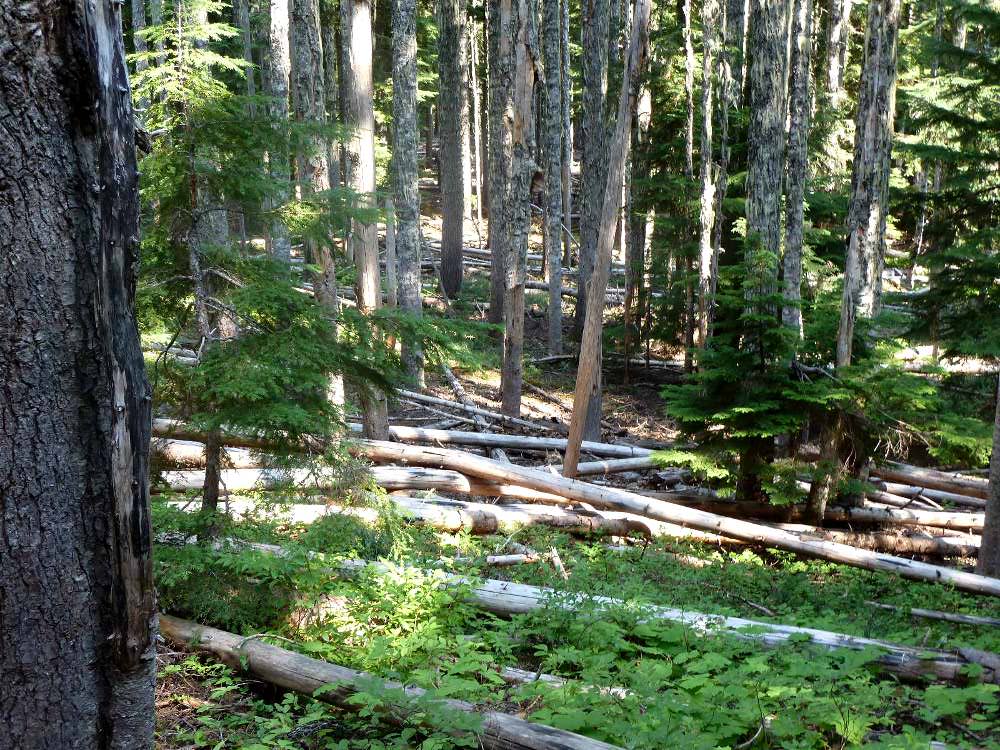
Photo of Douglas fir forest on Mt. Hood near Barlow Pass, Oregon. Photo by Lupa, 2011.

And the plant totems, being connected to every individual of their species, can often have a very deep understanding of many places and what goes on there. Tree totems in particular can be very significant wells of knowledge of places. That’s another thing that can throw us humans off about plant totems. Animals have comparative breadth of knowledge about a place; they can know their territory intimately, but it’s still limited primarily to the surface (or water, or tunnels, or whatever their primary habitat is), and they can be easily removed from their territory by rivals, by a lack of food, by humans, and so forth. Plants, on the other hand, know one place very deeply, investing an entire lifetime in one spot, one view. A plant can be uprooted and moved if young enough, of course, but left to its own devices it will concentrate on the one place it’s rooted until it dies. And so we don’t always understand the “depth” observation that plants take versus our “breadth” animal understanding.

When the Clovers were talking to me about how I still carry the lessons I learned early on, even though one of the places I learned them has been destroyed and others are off-limits, that was a testament to the plant totems’ patient, long-distance way of perceiving. Like a tree rooted in a forest, some of the features and beings around me and my life would change, but I remained. (And, likewise, I may someday be one of those features in someone else’s life that goes away, while they themselves remain.) I really had to stop and think about what they were seeing in me, and more importantly how they were seeing me. Where I was caught up in a piece of my lateral landscape that had changed forever, they were taking a longitudinal assessment of me as a constant factor.

There’s a lot of value in the alternative style of perception and understanding that plant totems have. It can be difficult to engage sometimes because I’m not used to it. But the more I consciously engage with what the plant totems have been sharing with me without me realizing it, the more grateful I am to them for it, and for the patient, ongoing contributions of their physical counterparts.

* Incidentally, I’m also working on exploring my experiences with fungi totems, stone totems, spirits of places, and other not-animal, not-plant beings as a greater exploration of the spiritual ecosystem, and I intend for my writing to unfold and reveal these explorations over time, traveling deeper into the foundations of the ecosystem. But for now–you gt my thoughts on plants, because I’m just linear that way. Plus it’s a lot easier for many people to start wit what’s familiar and progressively move outward, and I figure it’ll be better for everyone if I take this progression from “more like me” to “less like me”.

Clarification

Regarding that last post–I was NOT speaking ONLY of human beings, or only recent human cultures. I certainly wasn’t saying that non-urban or less centralized cultures are more “wild”, and I’m well aware that we do not hold the monopoly on technologies and innovations and correct ways of thinking. That sort of ethnocentricity is NOT something I wish to be associated with, thank you.

When I was speaking of the wildness and risk inherent to life, I was speaking of ALL life that has ever existed on this planet, of which humans–ALL humans–are a tiny, miniscule fraction. For most of these beings that have EVER existed, life was/is a much riskier proposition than we generally experience. And when I say “we”, I mean those of us who live relatively comfortable, secure lives. So I’m rather frustrated that people translated this into such an anthropocentric view, forgetting that I was speaking of much more than humans.

Please re-read the previous post. I spoke quite a bit of “living beings”, and nowhere was I only comparing the standard of living I and others enjoy ONLY to other human beings. Nor was I saying that even this comfortable life is without risk. But I feel risk is more resonant of our wild heritage–not just HUMAN heritage–than the outer trappings and symbols I spoke of. All this was was some musings I had about what (usually white, urban) people like to call “wildness” like wearing dead animals and worshiping nature deities, compared to the risks of being a wild animal; and drawing casual, loose comparisons between the *slightly* greater risk of self-employment and how that makes me feel a little closer to the wild because I could see similar challenges between the ebbs and flows of my income, and the successes or failures of a day’s hunt–by ANY predator, not just human ones.

Animal Heritage, Employment, and Being Wild

As I write this, I am taking a brief break from what I call an “artwork frenzy”. As a full-time self-employed artist and author, I spend a great deal of my time in creative pursuits. However, there are times when I am relatively free of immediate deadlines and scheduling static, where I am free to spend several days buried in a particular project or set of projects. I refer to these as artwork or writing frenzies. It’s during these times where, unfettered by the needs and expectations of others, I can write the bulk of a book manuscript in the space of a few weeks, or dance back and forth among several art projects adding a little paint here, checking a sealant there, giving my hands a break from yards of hand-braiding, and so on. It’s really where I do my best work.

I am preparing for an event I’ll be vending at this weekend; while I have more than enough artwork to fill my booth, I always like to have new offerings to debut. It gives me an excuse to show off, and often breaks me out of creative ruts. As I’m taking hides and antlers, paint and yarn, and creating a variety of ritual wear and tools and other such things, I have Netflix going with a steady stream of shows about history, prehistoric animals, geology, cosmology, and the origins of life itself. It takes me temporarily out of this moment and is the closest I can get to travelling and exploring somewhere new.

But it also gives me context for where we as a species are right now. Just a few thousand years ago there were only a small handful of humans scattered across the land, just one more species of wild animal amid the rest. So much time was spent by all creatures either procuring food, or avoiding becoming someone else’s meal. Jack London’s dour law of “eat or be eaten” that ruled his canine character Buck in The Call of the Wild may seem extreme to those of us who are used to buying food at a supermarket or convenience store, and who do not have to spend every waking moment looking over our shoulders in case some other being leaps upon us and tears us to pieces. But for most living beings that have graced this planet, today and before and beyond, life is full of unpredictability, and constantly at risk of being brutally brought to a close. We here enjoy a level of safety and security very rarely experienced by any beings throughout the planet’s history.

Similarly, in the half-year and change since I became fully self-employed, I’ve gotten the barest reminder of the aforementioned unpredictability. While overall I’ve been a success, I’ve also had to learn to weather the ebbs as well as the flows of the business. There’s only so much I can do on my end to bring in enough income to keep my household going. I can make a ton of art, I can promote it, and get out to events to vend. But at the end of it all, none of it works if there are no customers buying what I create. In the same way, the most powerful and crafty hunter, the most skilled scavenger, and the most resourceful grazer or browser, cannot eat if the food is not there. No matter how much they may roam, how many chases they may make, how many miles they tread in search of prey or carcasses or edible plants, there are still days where they go to sleep with empty stomachs.

This is unlike domestic animals, and people employed by others who receive a regular wage. They have more security in that someone else rations out the food–or money–they get on a regular basis. Sure, there’s the chance the farm may fold or the business may collapse; famine and downsizing are both dangers. But one of the amazing recent creations of humans are societies in which you can more or less know exactly how much of a given resource you’re going to have access to depending on the current arrangements you’ve made. If your job is secure and you get consistent pay and hours, you likely know when payday is and how much you’re getting. That’s pretty damned impressive in the grand scheme of things, and almost unprecedented in the Earth’s entire history.

I am not a wild animal. I am happily domesticated, for the most part. I’m happy in an apartment, where I have easy access to food and medicine and warmth and companionship–and, for that matter, where I’m unlikely to get eaten by a saber-toothed cat. But I do like to think a little about my wild heritage, and that of our species as a whole. See, I don’t think it’s the trappings of wildness that make us wild. I could run around Portland wearing my creations, and seek out ever more dangerous and untamed deities and spirits, and spend nights backpacking in the woods. But if I’m still coming back to the security of home, if I know I have that secure base to come back to, it really doesn’t make me any more of a feral human being than I was before. It would just make me a dilettante.

What I feel brings me just a shade closer to myself as a wild animal is the uncertainty I’ve taken on. This ebb and flow of income and resources is just a touch closer to what my distant ancestors went through their entire lives out of lack of any other option. Granted, even this slightly greater risk is still somewhat of an affectation. Even with Portland’s crappy economy, I have enough formal education and matching experience in multiple professional fields, and the ability to relocate if need be, that I have more than one potential fallback if I need it. (Specialization is for insects, as Heinlein said.) But in this moment, where the ability to pay for the food that comes onto the table is dependent on a much more variable income, I can appreciate what my ancestors, what many of my fellow human beings today, and what almost all other wild animals, experience on a daily basis–just a tiny bit, anyway. I can’t know what it’s like for sure to be any of these others, but it’s a bit of a wake-up call here in my privileged, comfortable urban lifestyle.

And most attempts on the part of my fellow domesticated humans to “be wild” are affectations to some degree. Going out to the woods to play overnight is not the same as having your home, your source of food, your security suddenly disappear. Those who are unwillingly homeless, or who otherwise fight every day to survive with no safety net, are closer to the wild than those of us secure in our homes and full pantries. No amount of fur and feathers, or fake hipster war paint, or trance-dancing at drum circles, or worshiping ancient deities of natural phenomena, brings us closer to wildness than having one’s life in more danger than before, even a bit. The more I know of the violent and dangerous track that life on Earth took to get to this moment, the more I appreciate that the wild is built on risk and threat, nowhere near as romantic as society would make it.

I don’t intend, of course, to give everything up and go live in a cabin in the woods and eat only what I can hunt and gather. And I don’t feel that being self-employed has somehow turned me into the Wild She-wolf of the Northwest. It’s just a tad bit riskier than having a day job, and I contemplate that risk, and greater risks, in this moment.

Silent Totems

Recently I was given a very old jaguar hide as a gift. I was rather stunned, as I had been told by the person who gave it to me that it was a “spotted cat hide”, but not specifying which sort. So when I opened the package and saw the distinctive rosettes, my heart skipped a beat.

See, Jaguar is what I call a Silent Totem. Silent totems are totems who are not necessarily active participants in my life. They don’t come to me in dreams, and I don’t call on them in rituals. But their influence is still there in the background, and the distance doesn’t always mean a weak “signal”, either. Sometimes a silent totem need not do anything but be present and observe in order to make a great impact.

Take Jaguar, for instance. Jaguar is connected to my shamanic practice, not as an active guide, but as one who represents the gravity of the work that I do. I am reminded that the foundational practices of shamanism were forged in much more dangerous times and settings, in places where being attacked and eaten by large wild animals was (and is) a real threat, where the shaman was the main line of defense against illnesses where there were no refined antibiotics and other high-tech medicines, where the life expectancy was much lower than it is for me. Jaguar is also the reminder that the spirit world is not a safe place to be, and that although I have good companions on my journeys, none of them are a complete proof against threats by malign beings.

And all it takes is a glimpse, in the back of my head where the wild things are, of black spots on yellow fur sliding through dappled underbrush–for just a moment–to make that reminder clear. There are other silent totems as well. Anna’s Hummingbird can be felt in periods of high energy, where I’m dashing from one task to the next as quickly as I can, drawing on my reserves to meet the demands at hand. Common Octopus carries the ephemeral nature of mortality, to not take for granted what is here before it’s gone, and to not underestimate something short-lived–in other words, to seize the day and make the most of it.

None of these or other silent totems normally come out of their places in the shadows of my mind, but they are there nonetheless. I will be interested to see whether Jaguar decides to come forth; there was a decided “spark” when I first touched the jaguar hide, and I felt an almost overwhelming energy for just a moment. If I do start more work with Jaguar, it promises to be intense.

I Am Not There; I Do Not Sleep.

One of my very favorite poems has been making the rounds over on Tumblr. While often attributed to “anonymous”, with several versions floating around the internet and elsewhere, the creator Mary Elizabeth Frye’s definitive version of “Do Not Stand At My Grave and Weep” is as follows:

Do not stand at my grave and weep,

I am not there; I do not sleep.

I am a thousand winds that blow,

I am the diamond glints on snow,

I am the sun on ripened grain,

I am the gentle autumn rain.

When you awaken in the morning’s hush

I am the swift uplifting rush

Of quiet birds in circling flight.

I am the soft star-shine at night.

Do not stand at my grave and cry,

I am not there; I did not die.

This reminded me of Cat Chapin-Bishop’s No Unsacred Place post from a few weeks ago about green burial as well. I especially thought of the line “I would like you to find me in fresh strawberries, blood-red beets, tenacious bitter dandelions, and the shape of a robin’s breakfast”.

I also thought of Aaron Freeman’s essay, You Want a Physicist to Speak At Your Funeral. It may seem a little odd and out of place in a discussion about spirituality and the afterlife, but here’s a choice line from this beautiful piece of writing: “And at one point you’d hope that the physicist would step down from the pulpit and walk to your brokenhearted spouse there in the pew and tell him that all the photons that ever bounced off your face, all the particles whose paths were interrupted by your smile, by the touch of your hair, hundreds of trillions of particles, have raced off like children, their ways forever changed by you.” Yes. This fits as well.

I cling to these poetic-prose statements because they’re so rare. Most of the time when people speak of what happens after death, at least in sentimental terms, they talk about heavens or paradises, places where you’ll get to see your loved ones who have gone before you, even your deceased pets. Near-death testimonies aside, we don’t have any hard evidence that these post-mortem places exist, or even that there is anything once our brains go dark for the last time.

Why do we tell the bereaved to remember these places, then? Because when someone we care for dies, we miss them terribly, and we wish they were there with us. But since we can’t see them any more, or touch them, or speak with them, at least not in the way we used to, we hold onto a hope that once we die we’ll be reunited. In fact, the afterlife is sort of the big reset button that so many religions and spiritualities promise us. All the crappy things that happen in life are supposed to be left behind once we shuffle off the mortal coil (assuming you’re not of the belief that you’ll get punished for any wrongdoing, no matter how small, from this life). Regardless, the afterlife is seen as some degree of escape from the realities and challenges of this world, and most afterlife discussions almost exclusively focus on incorporeal things.

Yet it is the raw physicality of another sort of life after death that comforts me when I think about my mortality and that of those I care for. I can guarantee that the temporary collective of molecules that has made up my body—and perhaps my entire being—will fall apart over time after my death. All these bits and pieces, nutrients and atoms, that have been in countless beings and places and things for billions of years, will continue their journeys into new conglomerates. There is, of course, no way to track where individual molecules go, just as right now I can’t trace the ones that leave me through elimination or exhalation or shedding of dry, dead skin cells.

But the general process is what’s important. This body, this form that people have held and touched and loved and interacted with, will disseminate back into the wider cycles of the universe. I will feed other living beings. I will become the building blocks of mountains, or perhaps coral reefs. I will join rivers and the ocean. And who knows where I’ll be? I like to think that my loved ones will remember me not in a specific raindrop, but whenever the sun-parched land is soaked with the autumn’s first showers.

You see? I will still be here. There’s no need to wait til your own death for me to be around. My imprint is saved in the “constellations of electromagnetically charged neurons whose energy will go on forever”, as Freeman said.

And why waste that opportunity waiting for something else that may or may not ever happen? We don’t know for sure if there’s an afterlife, and we won’t know until we each reach that threshold. But we do know that all of us, alive or dead, are a part of that ongoing series of cycles of creation and destruction, matter and energy, that has been occurring since the Big Bang.

I hope that when I have my own green burial, that my loved ones will stand over that piece of land, touch the grass, and know that I am there—and that I’ll be forever expanding my influence from that place onward. Who knows where the molecules that were me for a while may end up next? When I am gone, look to the birds and the snow and the wind to see me again, and remember what I once was.

How Wolf Fed the Scavengers

Once, when this place was still new, a great famine struck the land. The sun broiled the earth, and the plants were so thirsty in the drought that they could barely keep their stems and trunks straight, never mind grow enough fruits and leaves for everyone to eat. The plant-eaters were always hungry and they grew thin, and the meat-eaters could barely find anything other than bones to gnaw on, their prey was so wasted away. All the animals grew desperate, and fell to fighting each other more than they ever had before.

So it was decided that the animals needed a king. This king would decide who got how much to eat. The plant eaters argued that because they were the closest to the plants, that they knew them better and should get to have control over who got what. The meat eaters opposed them, saying that as they were at the top of the food chain, they had a better view of the situation. Those who ate both plants and meat were split right down the middle, some siding with the plant eaters, and some with the meat eaters.

Bone stag wall hanging by Lupa, 2010

The arguing lasted for three days and three nights, until at the end Whitetail Deer was made the king. All the animals brought forth all the plants that were ready to eat. “Since I am king,” he said, “I will take the first portion since I need my wits about me to keep an eye on our food supply. Then the rest will be divided up among the plant eaters according to size. But the meat eaters may only eat those animals who die of starvation and disease; from now on, hunting will be banned.” This caused much dismay among the meat-eaters, but what could they do? He was their king, too, and he said these words while shaking his mighty antlers with their sharp points.

So the plant eaters were able to leave the meeting with as much food as they were able to get, and all the animals were to collect more plants as they were ready to harvest, even the smallest berry or seed. Each day the food would be brought to Deer’s home, where he would divide it up, and send the plant eaters home with food while the meat eaters only had a scant few bony carcasses to squabble over.

Then it was decided that the meat eaters were not even allowed to be at the food collection except to bring what they had gathered and pick at the bones of the starved, and the plant eaters began to venture out of Deer’s home only to bring the collected food in, protected by their king’s antlers. The only ones who stayed out were the dead, who were left on the edge of Deer’s home, and over time there were fewer and fewer carcasses left out each day.

Wolf totem headdress by Lupa, 2012

Soon the meat eaters began to hoard what food they could. The bigger ones, by bullying and stealing food from others, ended up with the most and stayed strongest, while the little scavengers grew more and more hungry over time. Only Timber Wolf did not participate in this; she only took enough to feed herself, her mate, and her pups, and often ate the least of all her family. She grew sadder as she saw how the animals fought each other over so little.

The little scavengers noticed that of all the big meat eaters, she was the only one to let them have their own food. So they sent Raven, who was the bravest of them, to go speak with Wolf and ask her for help, since she was a great hunter, swifter than all the other meat eaters, and perhaps she would know what to do. She was given the last of the scraps to take to Wolf as an offering.

Raven flew to Wolf’s home as quickly as her weakened wings would carry her. She landed at the front of Wolf’s den, and croaked to her, “Lady Wolf, great huntress, brave warrioress, I am here on behalf of all the little scavengers, those of us who are too small to hunt big game. We are hungry, and we are too weak to steal our food back from the other big meat-eaters. You have the greatest hunting skills, and you are powerful. Will you help us to get food so that we may not starve to death and all become food ourselves? Soon none of us will be left!”

Wolf, curled with her mate and pups in her den, heard Raven’s pleas, and it was enough for her. She was tired of seeing the little scavengers creeping around and crying. Her hackles raised, she stalked out of the den, and met Raven there.

“Yes, I will help you. Let us go to our king, and ask him why we are unable to hunt. Let us ask him why we are not allowed to be at the food collection any more, other than to bring what we spend our days collecting in the hopes that we will be given bones to gnaw. My young cry for food, and your young barely live. It is too much.”

So they shared the scraps so Raven could recoup her strength from her flight, and Wolf could be ready for the trip. Raven perched on Wolf’s back, and they went to Deer’s home. When they got there, all the plant-eaters were inside, and no one was guarding the door since all the meat eaters were so weak that no one thought they could get in.

But Wolf got in, and Raven with her, and before anyone could speak or stop them, Wolf strode straight to where Deer sat, one antler shed and lying on the ground, the other shaking on top of his head. He was surrounded by all manner of food. The stores were piled from the floor to the ceiling; there were enough plant eaters that had died that even the small amount the famine-stricken plants could produce was more than what they could all eat. She looked at Deer, and all the plant eaters around him, and noticed how fat all of them were. And she grew enraged.

“How dare you?” she cried. “How dare you leave us out here to starve? You threw out all of those who nibbled at the edges of your leavings, and you only gave us your dead. Now that so many of you have died and you have more than enough food for all who remain, you keep it locked away here! You are no fit king!” And with this she fell upon them all, with bared teeth and fiery eyes.

She slew a tenth of the rabbits, and a tenth of the wild sheep, and a tenth of the elk. She hunted and killed a tenth of all the plant eaters, and the smell of the blood brought all the meat eaters together to feed. Then Deer himself, huge and fat and no longer so fierce without his antlers, got up and ran away, and Wolf chased him, with the little scavengers in their wake.

She chased him through the forest, and she tore away his toe, and the weasels fed upon it. Then she chased him through the mountains, and in a clearing she tore away his tail, and all the ravens came to take a piece of it. Then she chased him through the desert, and she tore away his remaining antler, and all the mice came and chewed at it.

Detail from wolf totem headdress by Lupa, 2012

And finally they circled back around to the mountains, where Wolf chased Deer all the way to the top of the highest peak, and there she overtook him and slew him. And his coppery blood rushed down the mountain in all directions, and he had grown so big that there were great, gushing rivers of it. The blood flooded all the land, from the mountains to the desert to the forest, and such was its power that it brought an end to the famine, and the plants thrived again.

And when Wolf came down from the mountain she brought Deer with her. She fed her young and her mate and herself and she tore what was left of Deer to pieces and gave all the little scavengers enough to feed themselves and their families.

Then she addressed all the animals, “I have killed our king, which makes me queen. I have only one decree—that we all go back to the way things were before the famine so that plant-eaters eat only what plants they gather, and meat-eaters eat only what meat they hunt or find.” And so it was.

But all the little scavengers followed Wolf around from that day on, for whenever she made a kill, she remembered their plight and how their food had been stolen from them, and always left them something to eat. And for her part in bringing back balance, Raven and her children were allowed to eat with Wolf and her kin for the rest of time.

The Core of my Spirituality

I’ve been on a HUGE artwork tear the past few days, in prep for something nifty I’m unveiling this Monday–Lupa-calia (yes, there’s a hint–it’s art-related!) While I’ve been doing so, I’ve been watching a LOT of various nature documentaries on Netflix. I find it entertaining that they call the sorts of things I like to watch “cerebral”, especially as some of what I’ve been watching has been things about the evolution of Homo sapiens. However, it’s ranged from that, to disasters that shaped the Earth and made life here possible, to what the nature of death is and how it’s ultimately defined.

The more I find out about the world, and indeed, the universe we live in, the more I fall in love with it and the more precious it becomes. On an immediate level I worry for the very near future of this planet and its inhabitants. The only people denying climate change caused by humans are the most stubborn and least willing to listen, those who desperately grope for anything to support their continued denialism.

But on a broader scale, all this research–and it is a form of research–is making my perspective continually less anthropocentric, and more awe-struck by the immense scale of time and space. We are not all-powerful beings, though our ability to manipulate our environments and ourselves is impressive. For example, if another asteroid like the one at the K-T boundary at the end of the Cretaceous hits the Earth, we would be just as dead as the dinosaurs; the animals that survived the chain reactions of natural disasters that resulted were mostly small burrowers. And yes, the Earth and the existence of life on it have survived several mass extinctions, but the scale of time it has taken to recover from these has been almost unfathomable, measured in millions of years. Being relatively large, calorie-hungry critters would definitely be a hindrance to our survival as a species if a disaster on that scale occurred–and if we keep up our actions, we may cause enough global climate change to test that hypothesis.

I am also less and less enamored of the claim that the Earth loves us, and that Nature cares about us. We are but a tiny brief blip in history; on the one-year calendar that represents all of time, we exist in the last few seconds of New Year’s Eve. We’re really not all that important, and why should we be more important than species that lasted for many more millions of years than we have? But I also don’t think “Nature” is angry with us, either. We’re talking about a planet that routinely obliterates entire ecosystems with massive volcanic eruptions and the like. While the Earth isn’t in as much of a state of upheaval as it was a couple of billion years ago, it’s still not exactly the safest it could be.

We’ve gotten complacent in the past couple of hundred years as the Industrial Revolution has caused some of us to live longer and be more insulated against illness, injury, and other such problems. For me, being more mindful of where we are in all of this has contributed a certain level of humility to my perspective. On a short-term level, sure, we’re doing some neat things, and there’s no reason not to try to make human existence as universally good as it can be as long as we’re here. And yes, the fact that we are conscious, aware, observant on a level that perhaps no other animal has ever been, is a damned impressive thing.

But we are just one of a plethora of amazing, fascinating, and uniquely skilled species that have graced this planet. Most are gone now. But as I trace the lines of my ancestors and their relatives far, far back, all the way to tiny bacteria, and before that, perhaps, chemicals that gave rise to DNA–my sense of my place in all this is that I am a much smaller, younger, and less overarching being than many humans would claim.

And I’m alright with that. They say spirituality is about feeling one with something bigger than the self. All metaphysics and otherworldly things aside, knowing that I am a part of this ever-evolving macro-eco-system Planet Earth, in an impossibly vast Universe, is enough of a spiritual core for me.

First Hike of 2012

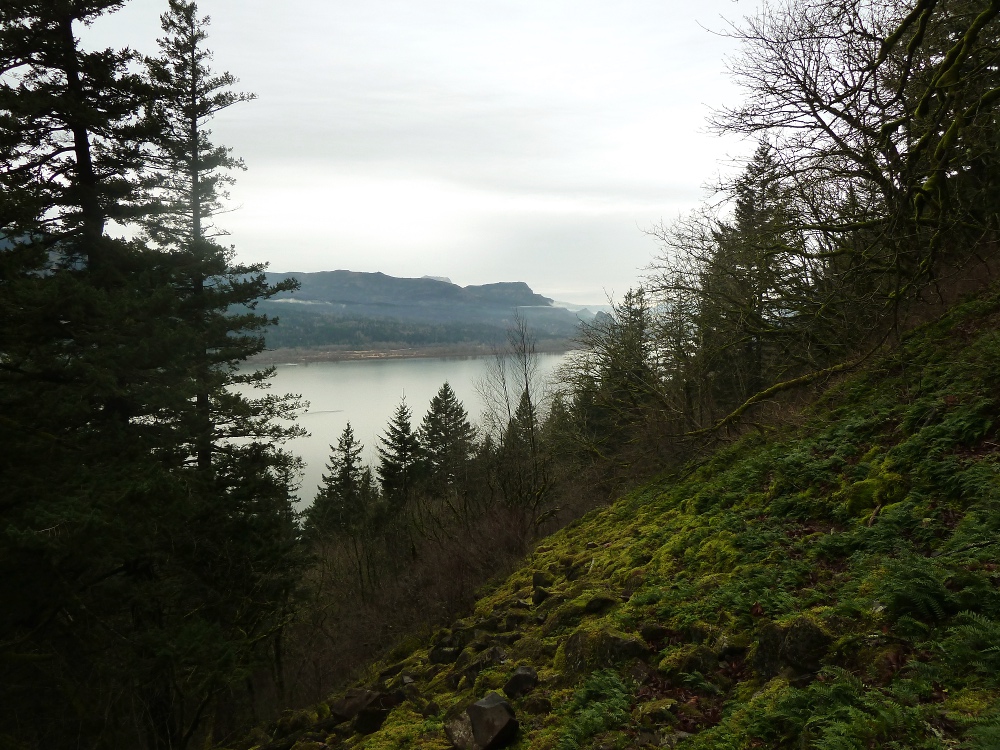
I have been stuck indoors too much as of late, between book revisions and artwork frenzies. So today we had a warm enough day (in the low 50s) that I decided to venture out to the Gorge for a hike. I had originally intended to do something relatively low-altitude like Triple Falls, since I wasn’t sure how far down the snowline would be out in the Gorge area. However, as I drove further out I didn’t see snow on the lower peaks, and so I decided my first hike of the year should be one of my very favorites–the Multnomah-Wahkeena Loop.

Now, I’ve rather out of condition. Up until this past September, I was running 5k three times a week. However, once I graduated with my M.A., I hit the ground running on some creative projects, and unfortunately let the running lapse (though I have been on some hikes in the meantime). So it’s only been in the past couple of weeks that I’ve started to run again, and I’m nowhere near the condition I was before. I was prepared to turn around and go back if necessary. Happily, not only did I make it around the entire loop in three hours, but a lot of my slow-down was due to adjusting my hip pack, taking entirely too many pictures, food/water breaks, etc. I actually did less resting than I normally do, probably due in part to the cooler air, as well as having been cooped up inside too long!

I’ve never done this hike later than late November, when it was still a bit fall-like, and if I recall correctly, sunny and warm. (Autumn likes to stay warm here for a while.) So it was a real treat getting to see what this place is like in full dormancy. The only (not-human and not-dog) animal I saw the entire time was a single female dark-eyed junco in some brush near the end. However, the plant life was incredible! The firs and other conifers were still spreading their branches for sun and mist, and the ferns had nothing left green except their newest fronds, so they were these spectacularly bright green arrays against the dark brown of dead leaves and soil.

One new development was that as I was hiking, and observing everything around me, my mind kept accessing information that I’ve been picking up from science-based TED Talks, Carl Sagan’s Cosmos, and other videos on YouTube from various scientists. I listen to these and watch what I can while I’m making artwork. Having enriched my store of knowledge about everything from geology to biology to physics and then some, I felt as I hiked that I had more of the backstory to this place I was a part of for that time. It wasn’t distraction, though. Rather, knowing things like just how long the processes of evolution have taken to get to this point only served to make me appreciate my fellow beings more. I could look at the canyons I hiked through and imagine how the rivers and streams had slowly cut down the earth over time, wearing these enormous grooves over thousands and even, in some cases, millions of years. I consciously shared breath with the trees, ferns, moss and other plants in this well of oxygen. I observed the formation of rain clouds in the sky. I knew the fleeting, short lifespan of the little songbird who greeted me so briefly before flitting away and was blessed even more by her presence.

The knowledge of this world is sometimes downplayed for sake of more ethereally “spiritual” interests. One of the points I made in Deep Ancestral Totemism, Part One over at No Unsacred Place is that so much of religion and spirituality is aimed at transcending or otherwise escaping this world, as though it has nothing to offer. The idea is that this world is so flawed that we are encouraged to look to a “perfect” world that comes next. Or, alternately, while we are here we are supposed to transcend and avoid anything of our more animal nature, trying to be “spiritual beings having a physical experience”. And, of course, there’s the very mundane practice of escaping “nature” for the comforts of human technology, which often distracts us from the needs of our bodies, or negates those needs temporarily.

The problem is that so many people are trying to escape the physical realm for various other places that our detachment causes us to take what is physical for granted. Because we can conveniently ignore the world around us, we lose that sense of connectivity. The idea of a polluted river or strip-mined mountain is so distant because most of us in the US don’t have to think about them. And so these actions are allowed to continue unabated because we’re more interested in our selves and our needs and the things that let us continue ignoring, transcending, ignoring, transcending, etc. The more we focus on the mind, too, and virtual reality, and spiritual reality, the more this reality suffers.

So it was a great relief to me to find that the knowledge I had absorbed through modern media had only deepened my connection to the physical Land. I had felt yearnings and appreciations even when I was holed up in my apartment listening to these things, but being out in the wilderness today really confirmed that knowing more = appreciating more.

Anyway–like any good trail, this essay rambles.

My favorite part of the hike was actually the last two miles, coming down the mountain alongside Wahkeena Stream. Why? Because it was raining! I love hiking in the rain, provided it’s not close to freezing. I admit that, selfishly, I like having the trail to myself when possible. But more than that, it reminds me that this area is a rain forest, and to only visit here when it’s clear is to miss out on what truly gives life to this place.

And so that was what grew within me as I hiked, and this is what it became:

Sometimes I think the Northwest is best
When it is being the Pacific Northwet.
The rain soaks into the sun-parched pigments of the soil,
And glazes the fern leaves in a hydrous kiln,
Until all the colors remember themselves more fully.
Even the sky cordially removes his blue cloak,
And gently wraps the sun in a sheet of gray
So that it is the rain forest who shines the most.

You can see more pictures from the hike here.

The Foxes of the Four Seasons

A long time ago, the world was a lot different than it is now. There were no seasons, no changes in the weather. If you wanted snow, you had to go to one part of the world. If you wanted sun, you had to go to another. And everybody had to bring back rain from the only place in the world that had it, though it got enough for everybody. Since the animals couldn’t only have rain or only sun, there was a lot of moving around, and you didn’t have so many animals who stayed in one place. Some animals hardly ever saw another of their kind, but others would organize reunions every so often so as to not get lonely.

So it was that every seven years, all the foxes of the world would come together in one place for one great conclave. Long-separated friends caught up with each other, families introduced their youngest kits, disputes were addressed and resolved, and at night there was much celebration to be had. It was all rather a busy affair, as one might imagine would happen with that many foxes in one place.

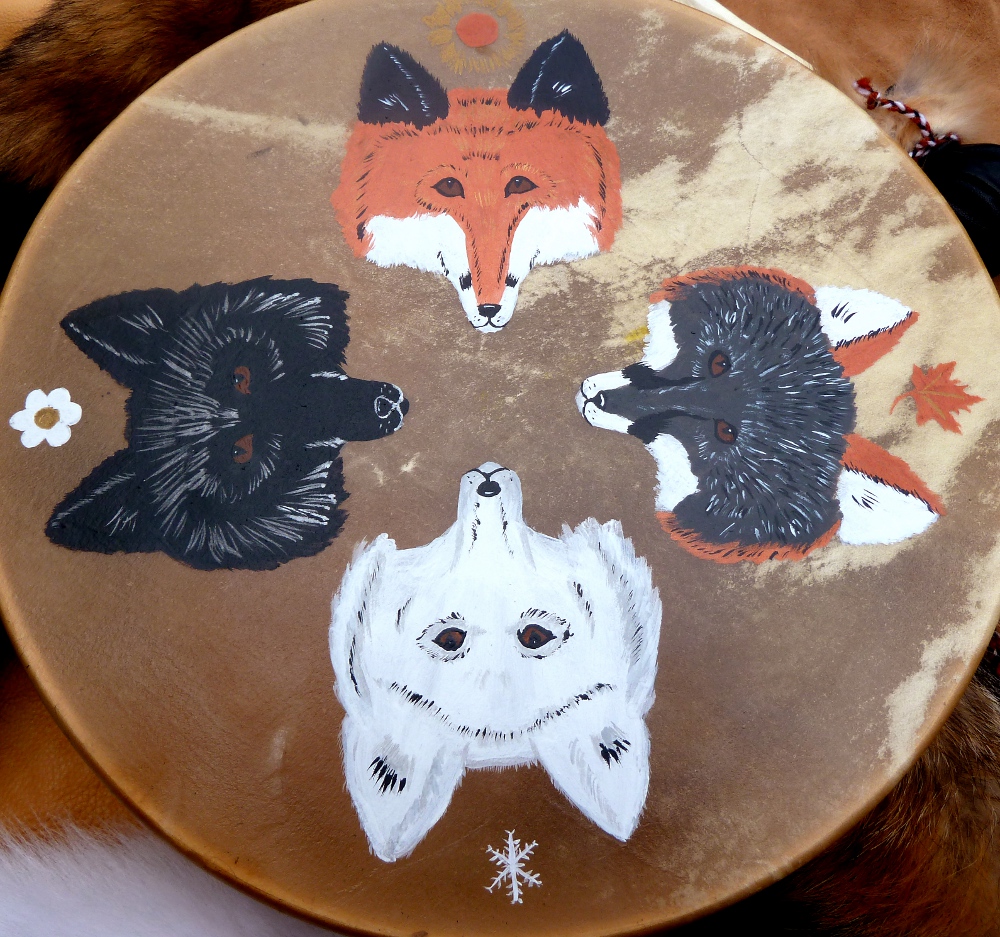
It just so happened that one year, there was a contest over which fox was most beloved by the Earth, who gave the foxes’ paws somewhere to go. Finally, it came down to White Fox from the North, Black Fox from the East, Red Fox from the South, and Gray Fox from the West. Everyone agreed that these were the very best, cleverest, swiftest and strongest foxes of them all. They spent an entire day debating who was going to be elected the best fox when the Earth would make her presence known that night. They had heard that the very best fox would receive a special gift from the Earth, and they each wanted to prove they deserved it.

“She’ll choose me,” White Fox said, “because I am the only one who holds the cold snow and ice with my tall, proud mountains!” And everyone agreed that his mountains were indeed quite impressive.

“Nobody likes being cold, silly thing,” said Black Fox. “She’ll choose me, because I carry the soft, warm winds that help new seedlings to grow.” And all the foxes assembled thought she made a very good point.

“Ha! Just a little warmth? I’ll give you all the warmth you need with all the sunshine you could ever want!” declared Red Fox. “That’s why I’ll be chosen!” There was a good deal of agreement with that, as basking in the sun was a favorite activity of foxes all over.

“Surely we cannot have any snow or plants or cooling off from the sun without rain,” said Gray Fox. “I have the most water, which means that I’m sure to be the one the Earth will choose.” And the other foxes licked their chops at the thought of cool, refreshing rain water to drink.

But who would be chosen? The four foxes fell to arguing amongst each other, and had almost come to blows when there was a great trembling beneath their paws, and the Earth made her spirit present as a great, glowing golden Fox. “Dear children, what are you doing?” she asked.

“We were trying to figure out who you were going to choose as your favorite fox, and we can’t all be your favorite!” the four foxes said.

The Earth thought a moment and looked at each of the little foxes at her feet, each one so strong and talented in her or his own way. Then she smiled.

“Of course you can all be my favorites. Why choose one among you when all four of you have so much to offer?

My lovely Black Fox, you are the deep, rich soil which allows all the plants to grow healthy and strong. You take what has died and rebirth it as new living things. Your warm winds help to bring life to the land. Therefore, I will give you the first part of the year, when my friend the Sun is on his journey back here.

And you, bright Red Fox, you give the Sun a place to show us his strength the best. You allow him a place to set down the burden of rays on his back, and unwrap them so that all of us may see them and enjoy their warmth. To you, I give the second part of the year so the Sun may share with us every year.

Dear Gray Fox, your rains are invaluable to us all; without water we would be parched. I give you the third part of the year, where your rains may be the tears that bid farewell to the Sun as he leaves again, and your bright colors will be reflected in the leaves of the trees as they wear their finery to see him off.

Oh, beautiful White Fox, I haven’t forgotten you! Your cold climate cries out to the Sun for what warmth he will give, and your snows reflect his rays so that he can see this land no matter where he goes. To you, I give the final part of the year, to remind the Sun of us when he is at the farthest part of his travels, while we await his return here.”

And so it was that every year after that, all the places of the world received the gifts of the four foxes, each one in turn. Of course, each Fox had her or his own favorite places where they might tarry a little longer. But the animals no longer had to travel so far just to get sunshine or rain, or to get out of the cold or the heat. And so all but the most adventurous were able to settle down and create nests and dens, and allow the seasons to come to them.

Fox drum, acrylic on deerskin with fox tails, by Lupa, 2011

I Am in Awe

This past weekend I set up a vending booth at the Yule Bazaar. The first day was held down at the Unitarian Universalist church in Salem, OR, and the branch of organizers there had arranged for a group of traditional Aztec dancers to come and share some of their dances. These weren’t white people “inspired by” the Aztecs; these were folks in the broader Hispanic community here in the area who had connections with people in Mexico who had still hung onto pieces of the indigenous Aztec lore. This was knowledge that had gone underground as a result of the genocide perpetrated by Spanish invaders, and over the past fifteen years or so there’s been more of an effort to try to combine what’s left and recreate the traditions.

One of the dancers spent a good amount of time giving a lot of context for how the knowledge had been revived, and what the importance of the practices was. I was especially fascinated by the assertion that each footstep, each move, in each dance had its own special meaning and piece of lore; the shell-covered ankle cuffs the dancers wore that made lovely ringing noises as they moved represented the various sounds that running water makes–not just THE sound, but many sounds. The spear that one of the dancers carried wasn’t a weapon, but a tool to pierce through to truth. And so forth. I paid close attention to each individual step and move, the voices, the conch shells and other tools, how everything flowed. I was awed and humbled.

It’s not my first time watching other cultures’ dances; I’ve seen dancers at powwows, for example, though it’s been many years. However, probably due to my age and better context this moved me even more than those earlier beautiful experiences.

What struck me the most was just how rich in symbolism and meaning every element of the dance was. I realized that what I am creating here in some ways pales by comparison, not because I’m not sincere or not trying hard enough, but because what I was watching had been developed from the observations, experimentations, and sheer creativity of thousands upon thousands of people over many generations. All of those people had contributed their day by day observation of the sounds of rivers, or the bright colors of bird feathers. These were woven into centuries of myth and legend, art and dance and other expression.

So many of us practicing neoshamanisms simply don’t have that sort of shared community support. Getting together once a week for a drum circle, or once a month for a full moon ritual, can’t compare to a community living on the same piece of land with the same people for many lifetimes. We can have good friends, and we can have good family, but so many of us live far away from our families, or have families who are not supportive of our paths. Friends move away; we move, too. I have moved an average of once a year since 2001, and am now in my fourth state. I can keep up with old friends online, but it’s not the same.

This is not to say that I am deterred. But it does offer me some idea of what is missing in much of neoshamanism, and some direction in further developing my own practice. I can’t necessarily create community, and it’s highly unlikely that I would given how much of a solitary I tend to be. But I can at least explore Meaning more deeply, and connect it to more than just intellectual understanding of “This is what North means”. Which is a lot of what I’ve been doing anyway, but I have more inspiration now. Not taking from the Aztec dancers, of course, but looking at my own relationships.