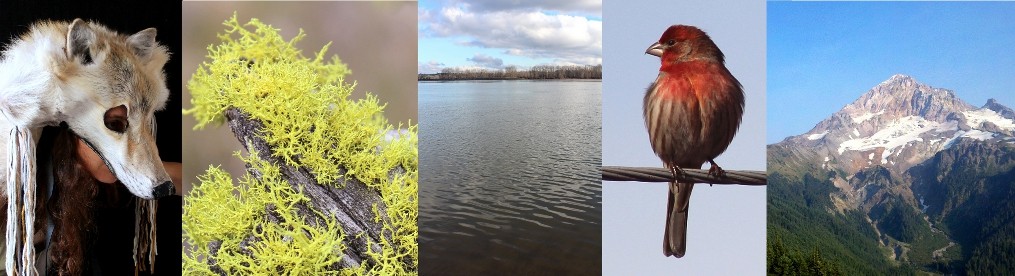
Shamanism and Subjectivity

I think I’m just going to give up on trying in any way to prove that my spirituality/belief system/etc. has any direct validity for anyone besides me, and anyone who agrees to take part in my subjective spiritual reality. The seeds for this post took root while I was detangling the thoughts for the last one. I started thinking about the subjectivity of nonindigenous shamanic experience. On the one hand, you have core shamans and their ilk who experience shamanism as a relatively safe, defanged thing compared to traditional shamanisms. On the other, you have people who are doing their best to emulate traditional shamanisms, particularly the most dangerous parts thereof. And then I thought about my own experiences, which are somewhere in the middle.

I look at where my path diverges significantly from these two ends of the spectrum. I do experience journeying as being riskier than what a lot of core shamans describe. However, I don’t do the complete submission to the spirits that I’ve seen on the other end. I do my best to not take the spirits for granted, but I also maintain autonomy–as in D/s, I have hard limits to my vulnerability, and ways to enforce them. And that is what has worked well for me, even before I began working with shamanism. I haven’t had experiences that have deviated significantly from that balance. And the thing is, the people at each end of the spectrum could probably say the same thing for themselves, that their experiences fit within a particular style of shamanism. Additionally, they could probably all find other people and sources that corroborate with their own experiences.

Really, how can I prove any of them are wrong, that they haven’t had the very experiences they claim to have had? How can I necessarily say that my experiences with shamanism are more objectively valid when in the end I really don’t have more proof of being right than anyone else? Sure, there’s looking at the shamanisms of other cultures–but that’s other cultures. To an extent, cultural context is crucial. And if a large portion of shamanic practitioners in this culture are reporting a certain way of doing things, then I should not dismiss that simply because it doesn’t corroborate entirely with the ways other cultures have described their practices. There’s something going on there, and beyond a certain point I cannot judge the veracity of what’s happening. Maybe someone really is working with harmless spirits, and another with savage ones.

But what’s the point of trying to judge the objective reality of the experiences themselves? Sure, I can discuss the conflation of neoshamanisms with indigenous shamanisms, and explain that certain practices found in the former are in no way, shape or form a part of any of the latter. But how can I judge whether someone else’s journey was valid for them or not? And, more importantly, does it really matter whether it’s valid for me if it’s not my experience (and I’m not the client or otherwise involved)?

All I can really say for sure is that my subjective reality is real to me, and that it is necessarily filtered through my subjective perceptions. I would wager that a good part of the reason that other practitioners experience things so differently in a lot of ways is because their perceptions–if not their experiences in their entirety–are also subjective. I would also add that it’s very likely that as my expectations about the world, conscious and otherwise, shape my experiences, that it’s also likely that others’ experiences are shaped by their own conscious and unconscious expectations. If you expect that shamanism is like in anthropological accounts where it’s a highly violent, dangerous thing, then that raises the chances that your shamanic experiences are going to be violent and dangerous. Likewise, if you expect that journeying is safer than dreaming, then you’re more likely to have safer experiences.

I can clearly see where my own expectations about reality, and spirituality, and related concepts, resemble my experiences as a shaman. And I can see where my perceptions also shape these experiences. Therefore, at this point I’m going to maintain that while it’s not impossible that there’s an objective spiritual reality, I strongly believe that spirituality is heavily subjective regardless of the existence (or not) of objectivity. I can see the physical world around me, the trees, the stones, the animals, and can agree on that objective reality for the most part with other people–but the animistic
end of things, that’s another story entirely.

And I’m okay with that. I’m tired of the endless wrangling over who’s right, regardless of what spiritual reality is being argued over. I’d rather focus on developing my subjective spiritual reality, which I know is real for me, and which is effective for me. I’m not sure I really care how real it is for anyone beyond those who have agreed to take part in it, whether to learn more about it, or even adapt it to their own practices. Beyond those functions and practicalities, is it really all that important that I try to prove that the journeys and so forth that I describe here actually happened beyond the scope of my own perception? And is it important for me to measure my shamanic practice up against those of others for experiential (rather than historical or other factual) veracity? If I didn’t have the exact same sickness, or have the spirits treat me the same way, does it really matter?

I look at all the time people spend trying to get external validation. And I’m really thinking it’s a waste of time, at least for me. The need to prove an objective spiritual reality has been a weight I’ve been carrying too long. So–at this point, my running theory is that spiritual realities are largely subjective, and any objectivity is hidden to some extent by subjective perceptions. The quest for objectivity, in addition, is overrated. (YMMV, of course.)

Environmentalism as a Spiritual Practice

Recently I was at Fred Meyer (your usual grocery/department/everything else store, only unionized and with more sustainable choices). While picking up some socks for my husband, I happened to walk by a sale rack that was full of knee-high white socks with various environmental slogans on them (25% off, even!). “Oh, those are cute!” was my first thought. I almost thought about picking up a pair, but then read one of the slogans a little more closely: “Protect the Earth”, it said. That made me stop and think about the potential purchase. Just what was I about to buy? Socks made in China, out of cotton (which is one of the least sustainable fabrics due to the amount of resources used in processing it)–and since I mainly see socks as a necessary liner for shoes and boots in cold weather, I didn’t exactly need “cute” socks.

So I decided, “Okay, I’ll protect the Earth–by not buying a pair of probably-sweatshop-made, not-even-organic cotton socks that I don’t really need right now”. And walked away. I felt better about myself for having done that, not just because it’s better for the budget right now, as well as my attempt to lower my impulse spending, but because I did feel I made the more ethical choice in that case.

But it also made me feel more in line with my spiritual path. I claim to practice a nature-based path; multifaceted, but still focused primarily on the sanctity of nature. Environmentalism is one of the most physical manifestations of what it is I believe about reality. I do the things I do not only because of the physical realities (reducing waste means less in the landfill, etc.) but what I perceive as spiritual realities in my path (everything has a spirit, and one honors the Earth-as-a-being by reducing and even reversing the negative impact on it).

So I decided to assess my approach to environmentalism as a religion in and of itself, focusing on a few particular areas:

The Divine: I am unapologetically pantheistic. The Divine–whatever its nature may be–manifests itself in all things. “God” is not a presence up in heaven, with an antithesis in hell. “God” is right here, in every being, in every thing; just as each of our cells is a part of us, so are we all a part of the Divine. Now, is the Divine a personal deity who cares about every single one of us? Or is “the Divine” a catch-all metaphor for the sum total of Everything That Is, perhaps with collective awareness (or some other cohesive connection that we may or may not be able to comprehend)?

For me, I find my connection to the Divine/God/whatever label you wish to use in the intricate ecosystems that wrap around the Earth. This includes human beings; we may pretend we aren’t a part of Nature any more, but any time a person catches a disease, or eats, or breathes, they are participating in the local ecosystem. That ecosystem may be largely dominated and shaped by humanity, but humans cannot live separate from all other beings in total. Nor can we subsist without “non-living” natural resources.

Maybe the only hell is the physical and psychological illnesses that often result from attempting to isolate the self from everything else. My attraction to ecopsychology is largely due to the perception that I and others have had that A) disconnection from the natural environment (and other ecosystems) very often has a damaging effect on people, individually and culturally. and B) many people respond favorably to exposure to natural ecosystems to whatever degree they are comfortable (factoring in things like agoraphobia, associations between wilderness and trauma, etc.). I want to help facilitate people’s reconnection to ecosystems, natural and otherwise, because as a general culture most Americans are suffering from one degree of disconnection or another–I know I have my own issues to work through in that regard, and I’ve seen it countless times in others. Rugged individualism is not good for the soul (literal or metaphorical).

Everyday environmental actions help me with this reconnection to the Divine/Everything That Is. Whether I’m in the garden growing the most locally available food there is, or making decisions in purchases based on sustainability, or repurposing an item that may be too worn for its original role, these things remind me of my connection, that I’m not just acting for myself.

Dogma: Because our understanding of the environment is constantly changing, both due to the tools at our disposal, and the changes in the environment itself, there’s no room for unchanging dogma, beyond “Do what is best for the environment without destroying yourself” (though there are a few extremists who believe the best thing would be for the entire human species to commit self-extinction). And I like that lack of overall dogma. It can be easy to fall into dogmatic, repetitive patterns, however, particularly where other people are concerned. It’s tempting to point out another’s flaws, to say “Hey–you didn’t recycle that piece of paper! For shame!” And we do need to speak up to others about the issues at hand, and what people can realistically do to help (as well as holding corporations, some of the worst offenders, accountable for their part in all this mess).

But few people like being forcibly converted to any belief system, whether it’s a recognized religion, a philosophy, or so forth. And the thing that I’ve learned as an environmentalist is that that whole adage about flies and honey is true. Just by blogging about my garden on my Livejournal, I’ve convinced several people to try their own hands at gardening. That’s a more concrete result than the times I’ve gotten up on my soapbox to preach the Good Green Word–I’ve mainly just gotten agreement from those who were already on board, and occasionally some disagreement from others. The constructive approach does indeed work better.

If someone doesn’t do things my way, I have to accept that that’s the reality. Trying harder to get through to that person isn’t going to help; if anything it’s going to alienate them. And my job is not to change people’s minds; my job is to offer information and set an example–and if someone chooses to emulate that example out of their own free will, to do what I can to help. People can convert themselves just fine without my help.

Mythos: A mythos isn’t necessary to environmentalism in general (and in fact some environmentalists distance themselves even from things like the Gaia Hypothesis, for fear of getting accused of idolatry by their own faith communities). For me, personally, though, the mythos grew alongside with my environmental action.

I have a whole other post brewing about subjectivity and belief, but for the moment here’s what I’ll say to this: The mythos of therioshamanism and my paganism in general provides me with additional meaning to the everyday actions I take, both with regards to environmentalism and with other aspects of my life. I don’t believe my actions are dictated by other beings, spirits and deities and such. But the purpose of the mythos, and the rituals and other practices surrounding it, is to find and define meaning apart from the actual physical activities and chains of events themselves.

Why? Why do we create art? Or music? Why do we indulge in this thing called “love”, instead of only thinking of it as a mess of hormones meant to bind people for survival reasons? Not that love doesn’t contain the hormones and messiness, but we don’t have to romanticize it in order to survive. Neither do I have to work with the mythos and spiritual beliefs that mesh with my physical everyday life. But I have the mythos, and I believe in love, because I want to, and I like to, and these things make me happy. And, as mentioned, they add meaning, and additional structure, which are also valuable.

The Afterlife: I’m really not sure, honestly, what I think about the afterlife. I know that my body, which is made of all sorts of molecules that have been all kinds of things, will decompose and go on to become other things. Beyond that? Who knows for sure? I’ve mostly decided that I’m just going to wait until I die, and then I’ll know for sure. Yes, I have my experiences with spirits, which some think should prove to me that there is a spirit world. But I have no way of knowing that those spirits are real for anyone besides me. That’s not enough of a basis to form an afterlife on.

People have a hard time with impermanence. Even I have moments where I’m utterly terrified that there’s nothing beyond this life. But I try hard to avoid compromising the lives of others out of my fear of impermanence. If I want to convince someone that a particular practice is better for the Earth, I’m not doing it for the purpose of racking up bonus points with the Divine. I’m doing it because it’s something I feel will benefit those of us right here, right now–and future generations to come. I’d rather focus on this world while I’m in it, rather than looking forward to another world that may not even exist. I’d rather plant a garden than buy an indulgence.

Sin: I dislike the concept of sin. It’s such a dualistic concept. In my view, we make mistakes, we (hopefully) learn from them, we move on. I would say that deliberate destruction and greed are definitely bad things–but I hate the concept of “sin”, like something is automatically and completely antithetical to “the RIGHT way to do things”. Some things are most certainly bad for the environment, but referring to any action that’s supposedly anti-environmental as “a sin” seems too simplistic. Sometimes people make honest mistakes. Others don’t have the resources to be as green as they’d like. And since our understanding of what is environmentally friendly is constantly changing, what may be “bad” at one point may actually turn out to be better, or vice versa.

This could be a lot more complete, to be sure. I’m no expert theologian. But I wanted to get these thoughts out in their raw form; there may very well be more polished versions in the future. Constructive feedback is always appreciated.

Shamanism and Psychology

This is something I originally wrote up in a locked post on my Livejournal. I figured since it has some related ideas, I’d share it as well. Enjoy!

**************

I’ve noticed that since I started grad school, that (not surprisingly) I’m leaning more towards psychological explanations for spiritual things, though these have always been important to some extent. I haven’t entirely abandoned the concept of a relatively objective, autonomous spiritual reality of some sort. I’ve been down the road of entirely and exclusively embracing the psychological model of magic, and found it to be emotionally and spiritually unfulfilling. Additionally, there have been experiences I’ve had in my path that have given me cause to believe that it’s not just in my head, that to an extent I’m interacting with something other than myself, but interacting in a subjective manner.

I am less likely to surmise about the reality of spirituality outside of my own experiences through the lens of my subjective perception, however. There are certain things that are pet peeves, admittedly, like Michael Harner claiming that journeying is safer than dreaming (which, if you’ve ever read Eliade or any other accounts of traditional shamanism, is bullshit). But even so, I also factor in that my own experiences with journeying are filtered through my own mind, and so have to be subjective to some extent out of sheer necessity.

Even with the Harner thing, though, there’s a certain amount of leverage that psychology provides my basic argument against his claims. Let’s limit, for the moment, my shamanism to my psyche, regardless of what may or may not be going on outside my brain. In dreaming, most people are simply processing the events of the day. We may have nightmares, but most people are not trauma survivors dealing with debilitating flashbacks. For the majority of people, ordinary dreaming is a relatively benign, if occasionally weird or unsettling, experience. We can say that it’s “safe” for the most part.

Journeying, however, is something entirely different. Psychologically speaking, a shaman is a person who alters hir state of consciousness (usually, though not always, deliberately), often through potentially hazardous methods–entheogens (which, at the wrong dosage, may be very harmful), dancing and other physical exertion, deliberate mortification of the flesh, etc. Apart from the physical effects this may have, if you assume journeyers travel inwardly instead of outwardly, you are talking about someone who is exploring the depths of hir own psyche. The archetypes and motifs experienced along the way are the brain’s method of structuring the psyche.

In many indigenous societies, shamans are trained by their predecessors. This includes methods of not going batshit insane (and yes, these cultures generally know the difference between a shaman/holy person/medicine person/etc., and someone who is simply mentally ill to the point of impaired functioning). However, most core shamans don’t have a psychological background of any sort, and core shamanism such as it is is a woeful substitute, comparatively speaking. While this doesn’t render all core shamans ineffective, it does mean that often the seriousness and potential danger of journeying is underestimated.

Part of why I went into psychology as a career is to be a better shamanic practitioner. It’s also because “therapist” is one of the roles in this culture that approximates that of the shaman in indigenous cultures. However, honestly, I went into psychology for the significant reason of my own mental health. Specifically as a (neo)shaman, I know that I’m doing a lot of messing around in my head, regardless of whether that’s all there really is, or whether it’s a bridge into another reality external of my mind. Definitely not as safe as dreaming is for me.

I don’t see psychology as being diametrically opposed to spirituality; on the contrary, I see the latter as necessarily including a healthy dose of the former when it’s at its best. And, because I don’t agree with the claims that core shamanism is “culturally neutral”*, I believe that I need to have a paradigm for working as a shaman in this culture, the one I am a part of–and core shamanism doesn’t cut it. Yes, I know there are core shamans who are also psychological practitioners. That doesn’t mean I agree with their approach to shamanic practice.

* There’s no such thing as “culturally neutral”. The people who espouse “cultural neutrality” are generally middle class, often but not always academically trained, white people of privilege who deny that they have a culture because they’re blind to the fact that they are the dominant culture. Core shamanism is, at its root, an academic white guy interpretation of shamanism.

Shamanism and the Modern Attitude Towards Nature

I was talking over lunch with someone about what shamanism actually is, and specifically what I think it is. My initial explanation involved contrasting indigeneous shamanisms and modern neoshamanisms, especially core shamanism. My general working definition of a shaman is someone who is an intermediary between humanity, and the spirit world/nature. I equate the spirit world with nature, because I am an animist. However, I also perceive the dichotomy between the spirit world/nature, and humanity, as artificially created and perceived rather than actual. (I will sometimes refer to spirits and nature separately for the purposes of this essay.)

In indigenous cultures, particularly prior to industrialization, life was/is a lot tougher, with shorter lifespans. While there was/is certainly natural medicine, herbal remedies, etc., there’s still a higher chance when you’re in a remote area of dying if, say, you get a cut that gets infected. Nature wasn’t/isn’t just something pretty that you look at out a window; it’s your life. It’s what you rely on. And you’re aware of that. This does not equate a romanticized view of nature as being all-loving and awe-inspiring. What it does entail is a more realistic perspective, and a rougher view of animism–spirits (nature) are to be placated because they can fuck you up. Spirits don’t exist just to help us happy little humans progress on our spiritual path. While indigenous spiritualities may involve structures for individual growth and change, they aren’t anywhere near the same as a lot of the crap you get out of New Age conventions and so forth.

What I’m trying to get at is that nature was never traditionally seen as nice and pretty to the exclusion of also being harsh and dangerous. This is completely a modern creation. And it is possible only because we postindustrial humans have convinced ourselves that we are separate from nature–and therefore we believe that nature’s nature has changed accordingly. Nature hasn’t changed, though. We’ve beaten it back to an extent with our technologies. However, if you put most modern citizens of the United States in the middle of a forest without a cell phone or other form of getting help, they’ll die. Natural disasters such as hurricanes, wildfires, and so forth are a reminder that we can still be very vulnerable to nature. All it takes is a dam breaking, a wall not holding, a lightning strike (or human error) in an area where brush has been allowed to build up, and you have something out of our control that we thought we had handled. Which is part of why these occurrences are so traumatic for the people they happen to–not just because bad things have happened, but because bad things have happened that we’ve convinced ourselves aren’t really a danger any more. Our illusion is safety has been shattered, rudely and violently. While I will agree that we’ve managed to insulate ourselves from certain effects to the point where we have longer lifespans and better overall quality of life (at least some of us, anyway), our place is pretty damned precarious.

And it’s the same way with spirits. I don’t agree with the core shamans who say that journeying is safer than dreaming, any more than I agree with people who think that nature can never hurt us because we have cities. The spirits haven’t changed much, just as nature in and of itself hasn’t changed. What has changed has been our attitudes towards them. Look at most books on totemism, or neoshamanism, or spirit work in general, and you get the impression that anybody can work with these beings with no problem, and that they exist to help us along our spiritual journeys–or at least are uniformly willing to do so because we are special little snowflakes. Yet when people read Eliade, or Vitebsky, or any other anthopological recording of traditional shamanisms, what gets glossed over are the dangers inherent in journeying, and the fact that in many traditions the spirits aren’t automatically your best friend.

In this culture, spirits and nature are seen in highly romanticized, “safe” manners, because we have fooled ourselves into thinking we can do so–just as we have fooled ourselves into thinking we no longer need to worry about nature, and are no longer part of natural cycles. Yet part of the reason I am being so damned cautious when starting out in my journeywork is because the shamanic practitioners I respect the most very often report that the deeper your experience journeying is, the more risk there is. In the same way, the more immersed we get in nature as it really is, the more risks there are. You’re less safe in the mountains than you are in a well-manicured lawn–but you’re also getting a diluted experienced of nature.

In the same way, I would argue that shamanic practitioners who “play it safe” aren’t getting nearly as much depth of experience as they could. While I’m still a relative neophyte specifically to shamanism, I have had years of experience with working with totems and other spirits in multiple spiritual and magical paradigms. And I know from that experience that the deeper you go, the harder and more potentially dangerous it is. The spirits that are working with me in therioshamanism are deliberately going easy on me for the time being, but it won’t always be that way.

So I have to wonder, when people talk about how loving and good and nice the spirits are, and how lovely and romantic nature is, just how deeply they’re opening themselves up to those phenomena. When core shamans talk about how safe journeying is, are they really getting that deeply into the Otherworld, to the point where they’re able to significantly detach from their own expectations? When people talk about how wonderful nature is, are they going out into places where they could ostensibly die–or at least being aware of them?

This is not to say that every “real” shamanic experience must automatically be a “KILLYOUANDEATYOU!” one. But we as modern shamanic practitioners in nonindigenous cultures need to be damned well aware that these things can and do happen, including during journeying. It is NOT safer than dreaming. It is NOT the same as guided meditation. And the fact that people, even in hospitals, and even spiritually “advanced” people, die from bacterial and viral infections, shows that nature surely isn’t always nice and loving to us special humans. I don’t think we need to resort to doing nothing but placation and DOOM. However, some healthy respect to balance out the “the spirits love us and just want to help us!” attitude would be a good balance.

Burying My First Cache

Tonight I decided to take Fox’s suggestion about creating caches of items in the Middle world for use while journeying. Something Ravenari mentioned to me at one point is taking the “essence” or “spirit” of a physical item with you while journeying, and so I wanted to experiment with that concept. So when I sat down to drum, I held in my lap my antler handled ritual knife that I’ve been using for over a decade through the various permutations of my magical/spiritual practice. Of all my ritual tools, I have the strongest connection to it, and the greatest amount of my energy soaked into it, so I thought it would be a good choice for something to hide and then find again. Granted, I might have taken something I was less attached to in case things didn’t work, but I wanted something I’d have a good chance of not losing.

I drummed, and when I got to my starting point, Fox arrived shortly thereafter. S/he took me to a particular pile of stones, made hirself small, and leaped down into the crevice. I did the same, and followed after hir, though not until I spent a few moments pawing at the crevice, trying to figure out how to make myself small, and hoping I didn’t get left behind! Fox led me back further under the rocks, and we got smaller and smaller and smaller, until we got to the very back of where we were going. There I saw a glowing patch of golden light, and Fox told me to place the spirit of the knife there. So I did, nudging it into place with my muzzle. I asked Fox who could see the cache, and s/he told me only s/he and I could. I asked why s/he could see it, if it was my cache, and s/he said “Because I’m the one who showed it to you, that’s why!” So now I’m wondering if Fox will show me more caches, or if other totems or spirits will, or if I’ll be finding or making some on my own, or some combination thereof.

Then we came back out from under the rocks and returned to the starting point. I had forgotten to bring food for Fox, so I went off hunting and caught a Douglas squirrel for hir. S/he appreciated it, and ran off with the food. I then headed back.

To my understanding, caching the spirit of the knife (or any other thing I choose to take there) has two purposes. It allows me to access that thing while I’m journeying; I plan on stockpiling various things over there, such as things for offerings for the various beings I may work with. It also allows me more connections to the spirit world through the physical items themselves. The physical item and its spirit are still connected; the spirit’s just been moved to where I journey. I should probably find out if there are any specific things I should do to take care of the physical items, or any other considerations.

I have a few other specific things I’ll be taking over in subsequent journeys, things the spirits have told me are good for this sort of work. I want to keep exploring the Middle world, too, to see what’s out there.

Replying to Owl, and Fox’s Tour

I journeyed again today to tell Owl about my answer regarding the Upper World. When I arrived, Fox and Scrub Jay were there, asking for my attention. I asked them to please wait until I could give Owl my answer, and they told me they would wait with me for hir arrival. So I called to Owl, and asked hir to please share hir time with me, if s/he was willing. S/he flew overhead, and told me s/he’d give me time if I’d catch a mouse for hir.

So I ran off into the underbrush, trying to scent out a mouse. I found where they were hidden deep in the earth, and also places where they had once been, but weren’t any more. Fox then came and said, “I can show you where you can get a mouse easily–follow me!” So I did, running up the mountain with hir. S/he showed me where there was a hollow log with a family of mice inside. I chased them from end to end, until one finally slipped out, a little confused, then realized hir mistake and tried to burrow under the log. I caught hir before s/he could get out of reach, and carried hir in my mouth. I was a little lost by that point, but Fox came back and led me back down to where Owl waited. I was a bit concerned that Mouse would be unhappy about me catching one of hir young, but Fox told me, “Mice get eaten all the time, including by Owl. That’s just the way of things.”

So I brought the mouse to Owl, who told me to kill the mouse. I did, and gave the mouse to Owl, who ate the carcass in two bites. Then Owl told me to tell hir my answer. I explained that my only reason for wanting to go to the Upper World was out of curiosity and a desire to know what was up there. Owl laughed and said, “That’s good enough for me. Now, when you feel you’re ready to go up there, let me know and I’ll show you how”. Then s/he flew away.

Fox then told me to come with hir. S/he took me down the trail to the west, and showed me where Mole lived–a recluse, and not easy to get to come out, but valuable to know. Then we went to the waterfall, and watched the river dragons leaping ecstatically over the cliff, laughing gleefully as they did so. I got the feeling they were analogous to the spirits that showed up as blue flames on the trail to the Upper World, that the river dragons guarded the way to the Lower World. This was one point where I could meet with them when the time came to go there.

Then Fox took me back up the trail a ways to a place that I had been interested in before. I couldn’t go there in waking time, but I was perfectly able to do so while journeying. I sniffed around there a bit, and Fox told me that this would be a good place to “put things, create things, build things”. Basically anything from a shelter for myself, to a place to do a ritual as needed, and most importantly, one of many places I could cache things I might need later on. I need to have some things on hand for offerings and gifts, and also have the spiritual “versions” of certain ritual items that I possess physically. Plus, in case I receive any gifts in return, it would be a good idea to have a place to keep them. Fox told me things should be safe so long as I hide them well; there really aren’t many other people who journey there.

Then Fox and I went back to the starting place, and I came back home. I noticed that while I still waver in and out of my altered state of consciousness while I journey, I’m doing it less, and staying focused on the journey more consistently. Practice makes perfect, right? (Or a reasonable facsimile thereof.)

You Mean I Have To Give a Reason?

I’ve started journeying again since the year turned over. Only once, but it was an important one.

I showed up at my starting place, in the form of a wolf per usual, and was met by the Animal Father. He carried me inside himself up the mountain to his home (no, it wasn’t squishy and I wasn’t making elbow room amid spiritual internal organs or whatnot–more like floating/flying up the trail, but feeling surrounding by the energy I associate with him). Then he set me down on the ground, and we began to talk about why I hadn’t journeyed in four months–or, rather, he began snarling at me about it. In fact, he ended up turning into a significantly larger wolf, bared fangs and all. This served primarily to put me on the defensive, rather than listening to what he had to say.

So he ended up turning into a mouse instead, which relaxed me quite a bit. We discussed the need for me to be journeying much more often–short version is, no more four month absences. This being the first week of school, I didn’t do the best job of increasing the amount of journeying I do, but now that I have a better idea of what my time commitments and schedule will be like, I have a better idea of where I can fit it in.

After this, he asked me how my progress on getting to the Upper world was, since I’d been trying to figure out that conundrum. I told him I was still stuck, and he suggested talking to the resident Owl, one of the totems specific to the area I start my journeys in. So he called hir to show up, and we were joined by Great Grey Owl (totems, for me, are species-specific). S/he and I had a conversation about the Upper world, and why I was having trouble accessing it.

The main thing s/he asked me, and which I puzzled over afterwards, was “Why do you need to get up there, anyway?” And I honestly couldn’t give hir a good answer beyond “To find information”. Owl told me to come back when I had a better answer for hir, and flew away. For my part, I ran back down the mountain with this question burning in my mind. Scrub Jay (the totem this time, not just a scrub jay spirit) and Red Fox both showed up. They offered their help in navigating this world, and Scrub Jay additionally told me s/he could help with the Upper World when the time came. I noted this, thanked them for the offer, and ended up needing to head back home.

For a few days, I couldn’t really come up with a decent answer for Owl’s question. Then one day, as I was on a walk, it hit me–why did I need to get to the Upper World, anyway? I didn’t have a specific reason, a particular piece of information to seek out. The only reason I could think of was “Because it’s part of what shamans are supposed to do–right?” Same thing with the Lower World. And here we get to one of the downsides to not being a part of an established shamanic paradigm–there’s no one to explain why, specifically, I might need to go to one or the other, or neither for that matter. I could read books, but even there the material is limited. I can talk to other practitioners, but how much of what they experience will be relevant to me?

To be sure, journeying is intensely personal, and I think there’s more subjectivity to it than a lot of practitioners want to admit. This means I can potentially look at the different worlds in the shamanisms of other cultures. But would these motifs and experiences be relevant to me, in my cultural context? And how much standardization is there, really? After all, there are other things that are “supposed” to happen in shamanism that haven’t quite matched my experiences. For example, according to most texts on neoshamanism, you’re “supposed” to climb up and down a tree to travel to the various worlds. I climb a mountain instead, one that I’ve visited frequently in waking time. And what I am practicing isn’t necessarily what other people are practicing; I am developing my relationships with the spirits from scratch, not following someone else’s template of expectations. In fact, most of the examples of neoshamanism I’ve seen have a lot of fundamental differences compared to what I’m doing.

This still left me with the problem: if I don’t know what’s in the Upper World or what to expect there, how do I know why I would want to go there? And then it hit me, as I was walking–right after I was presented with that problem, Scrub Jay and Red Fox offered me a solution: Don’t worry about the Upper World right now. Look for answers and explorations in this world first. It’s the closest, and the one I’m most familiar with. Where better to get more practice with journeying than the layer of reality that I’m most accustomed to? Not that everything will be a cakewalk, of course. But it makes a lot of sense.

I’m willing to bet that I’m not the first novice (neo)shaman to get caught up in the “Oooooh, I get to explore the Other worlds!” thing, to the point of neglecting this world. Now, I do tend to be a fairly pragmatic person. I’m the kind who will take mundane solutions before leaping into magical practice. So it’s not surprising to me, this concept of checking around the spiritual portions of this world first, before travelling further afield. I think I just got caught up in that whole “Shamans travel to the Upper and Lower worlds” concept a little too much.

Some of the Middle world stuff will no doubt be “mundane” things–like my venturing into psychology as a profession, for example, or finding other “everyday” solutions. However, I would imagine that journeying, as with various forms of divination, will help expand my perception of possible solutions (altered states of consciousness are good for that). I won’t make too many assumptions, but I think for now my journeys are going to be focusing on what Jay and Fox have to show me. They’ve offered, and I’ll follow. I should probably go to Owl and let hir know my current answer (“I actually don’t have a need to go there yet”) as well.

Wolves and Dogs and Therianthropy

Part of my personal mythology involves identifying myself as a wolf therian–basically, I believe that on some nonphysical level of myself, I am more wolf than human. This is something that goes wayyyyyy back to a very young age; therianthropy is just the general framework that I’ve been using to explore and explain it in the past several years. I’ve been evolving into more a personal mythology framework the past couple of years–but not completely disavowing “therianthropy” as a concept. I’m currently explaining it (in my case) as a part of the metaphorical story (that is also true–more on that in a minute) I tell about myself, rather than trying to take the (relatively) literalist perspective of “There’s something wrong with my neurobiology, and that of every other therian, that causes a fundamental miswiring related to identity/senses/etc.”, or the other popular opinion, “I was a wolf in a past life/my soul is that of a wolf”.

Let me make something very clear: I believe that metaphor and mythology are not “just made up”. They come from a complex interplay of the mind and the environment, to include what I believe to be autonomous beings. The modern Western conception of myth/metaphor is that it’s “all in the head’, with no bearing on the real world. I believe these are as much a part of the fabric of reality as physics, and other more materialistic things. I choose to believe that metaphor/myth have autonomous existences independent of the human mind, but that there is interdependence as well. This is a case of both/and instead of either/or. I make this choice A) because I have experienced things that prove to me as an individual that this is true in my subjective reality, and B) because my spiritual path functions much better when I believe this is true.

So. Back to the topic at hand.

As I said, myself-as-wolf is a significant part of my personal mythology. It explains to me a number of traits that “human” doesn’t quite fit–or, at least, that “wolf” fits better. Taylor brought up to me a few weeks ago the concept of myself-as-dog, however. I have a lot more experience working with dogs than I do with wolves, and being a somewhat domesticated critter myself, “dog” may be something to explore in more depth.

What is a dog? One way of looking at it is essentially a domesticated wolf. That’s a very simplistic explanation, but it’s a starting point. A dog is what happens when wolves interact over a long period of time with humans, becoming interdependent. If I am a wolf in human form, interacting within a human paradigm for a lifetime, wouldn’t that create some kind of change in the self-as-wolf? After all, I can’t say that I am only wolf, and while I can guess at how close I am to the experience of being wolf, it’s all conjecture in the end. No on can prove that my experiences when I am in a more wolfish mindset are anything more than my mind’s approximation of what I might assume to be “wolf” things.

Dogs, though, are more of a known quantity. Again, I can’t get inside the head of a dog, but I can observe doggish behavior more often and have a better idea of what a dog is. And from a purely analytical viewpoint, I can compare the outsider’s perspective on wolves and dogs to see where the similarities and differences are.

So working with Dog energy may be an interesting way to get a better handle on myself-as-wolf, filtered through myself-as-human. It’s not a complete parallel, since that part of myself still identifies as wolf rather than dog. However, dogs are the closest things to wolves I have access to on a regular basis. It can’t hurt to at least explore the connections.

Totemically, I may also try working with the totems of different breeds of domestic dog. I’ve always had a particular fondness for more primitive, wolfish breeds–I had German shepherds growing up, and also like malemutes, huskies, and other such breeds. I’m still undecided about what I think about wolf hybrids; I haven’t had much experience with them, and I’ve heard lots of both good and bad testimonies to their temperaments and safety. Still, I’d much rather be around a German shepherd than a Bichon Frise.

I don’t think that I’ll ever give up embracing “wolf” as the primary theme in my life, though the work with “dog” may bring some interesting perspectives. “Wolf” is too deeply ingrained in my fundamental self, and there are certain things that I know will always fit “wolf” better than “dog”. However, I’ve also been embracing the concept of feralness again, the idea of a once-wild being (or lineage of beings) that has been brought into captivity, and then released to the wild again. Your average dog is not feral, but has the capacity to be. It may be that I can find some parallel patterns in my own life as I find once again the part of myself that was born wild, was made captive, and is only now finding itself free again. Given that this part of me is very closely tied to myself-as-wolf, this work with wolf and dog and related concepts may be valuable indeed.

Current-surfing

Okay, okay–I know I’ve been damned quiet lately. I’ve actually been taking a temporary hiatus from “active” shamanic work (e.g., journeying) the past several weeks. Between returning to school, and a few other significant shakeups in my life that have required me to adjust my equilibrium, I’ve taken a break from active shamanizing. The spirits haven’t been particularly upset about this; considering it’s my belief that they’ve had their hands (paws? wings?) in on at least some of the changes, it’s not surprising that they’ve been patient while I’ve gotten my bearings. Shamanism is still on my mind, though, and once the time is right I have a whole slew of things I want to do. I was pretty active for an entire year, so a break isn’t such a bad idea anyway.

One thing I have been thinking about is my approach to magic. Many pagans think of magic as only something you do through a specific ritualized process, whether it’s a simple spell, or pulling out the stops for a high ceremonial explosion. Either way, it’s an action in which to some extent you step out of your everyday process of doing things, and do something you normally wouldn’t do–how many of us, for example, routinely stitch together little poppets of herbs, or utter intonations in various languages while walking down the street? (I fully expect some smartass answers to that particular question.)

While I do very much enjoy the process and art of ritual, I’ve found that the older I get, the less ritual work I do. However, I’m still working a good bit of magic. Let me see how I can explain this best–it’s hard to find words for something that more makes sense to me in visual images in my head, and quasi-tactile sensations. A metaphor that I use for explaining reality is currents. Basically, a movement/energy/recurring pattern of a particular, unique type. All currents weave together into what we know as reality. A decision may change the current one is in, even if only slightly.

Magic, for me, has become a process of trying to live my life with the greatest possible awareness of the current I am in, and the currents that intersect it to create possibilities. What ritual work has done is trained me to recognize these currents, to the point where I don’t need a full ritual to be able to work with them. Instead, it’s a process of “tasting” (if you’ll forgive the inaccurate sensory comparison) the currents to see which one will work best for my purposes. I then act–in my everyday life, not in a ritual format–according to what my observations tell me. It’s worked quite well–in fact, I’m often getting better results for less effort this way.

See, what I’m doing is instead of dictating how I think reality must be, regardless of what the extenuating circumstances are, I am getting a sense of the extenuating circumstances, and then acting based on the information I have. Instead of trying to bend reality to my will, I am learning to harmonize myself with it. This allows me to take into account not only my own needs, but the needs of other beings/intelligences/etc. that are potentially affected by my choices. That is the information that the currents carry; they are interconnection.

How does this come into play with shamanism? Well, for one thing, magic is not the primary focus of my practice. It’s still important, but the single most important element is the relationships that I am developing with the spirits. Apart from the everyday current-surfing I do, the ritual work that I do is dependent upon healthy relationships with the totems and other beings I work with. It’s not that I couldn’t do other forms of magic; if I wanted to, I could pull out some good old Chaos magic and work from a purely psychological perspective. However, because I have a specific aim with therioshamanism, it best behooves me to stick to the spiritual model of magic and to focus on the relationships with the spirits.

See, that’s the thing about shamanism. Core shamans have this tendency to elevate the techniques above all else–open most books on core shamanism, and you get a bunch of how-tos. You might get a few techniques for how to meet your power animal, and maybe a few other guides, but there’s precious little material on how to actually develop relationships with these beings–and why it’s so important. In my experience (such as it is), the techniques come out of the relationships with the spirits, not the other way around. If I work with a particular totem, for example, I want to get an idea of how s/he best operates. I don’t want to just come in with a bunch of preconceived notions and hope s/he’ll agree. (A well-rounded magician of any stripe has a wide array of techniques in hir arsenal to begin with, and this is one reason why–what if your one-trick pony doesn’t work?)

Current-surfing allows me to get a sense of when it would be a good idea to work ritual magic, take a journey, etc. It also helps me to keep tabs on the spirits I work with, since my relationship to them includes aligning my own current to theirs. (Hmmm–this sounds a little like an RSS feed 😉 ) I then already have a good idea of what sort of context I’ll be working ritual in, as well as what I perceive to be the best way to focus said ritual. I also find that I don’t do rituals for things that simply require me to make everyday decisions in a conscious manner.

Less effort, better results. Works for me.

Fried Brains and a Side of Expectations

Ugh. This grad school thing is quite possibly one of the most challenging endeavors I’ve ever taken on. I spent last Friday through Monday spending every day, all day, at school, getting my brain stuffed full of information. Not that this is horrible, of course, but other events have left me with little time to process all of it.

Saturday and Sunday were all ecopsychology. I got a LOT out of the two days, both theoretical and experiential. I’m already finding ways to weave it into my shamanic stuff as well, and in fact was able to work some of the material into my 21st Century Animism workshop at esoZone on Saturday night. I haven’t been doing much in the way of journeying and other formalities this month, since school has taken precedence. However, part of the reason I’m in grad school in the first place is to help integrate my spiritual/magical life in with the rest. The role of therapist is about the closest this culture has to a shamanic figure, and so it fits in neatly with everything else in my path. That being said, I’m not going to stop journeying entirely; however, I’m not going to kick myself too much for going a few weeks without when I’m occupied with activities that also contribute to my work with spirits. (The spirits themselves haven’t complained, either, FTR.)

As for expectations…I was thinking a couple of weeks ago about the motif of dismemberment and rebirth in shamanic practice. This is something that neoshamanisms have really latched on to; some people swear up and down that you cannot be a True Shaman (TM) unless you have gone through this experience–never mind that there are traditional shamanisms that lack this experience, or even any ordeal whatsoever.

I’ve seen this motif pop up in neoshamanic literature to the point where it’s become almost a cliche’. Often it’s used as part of guided meditations (not journeys), which are carefully scripted and there’s not a lot of room for individual experience outside of the script. I’ve even had it happen to me in things that clearly weren’t Major Initiation Rituals wherein my life was changed forever and I became a Real Live Shaman. Nor did I spend days and days recovering from the experience, and I’m guessing that most neoshamanic writers aren’t going to lead people through things that can potentially leave them insane and/or otherwise fucked up long-term.

So is this merely a watering-down of yet another traditional shamanic experience brought on by softer living? Or is it because this is one of the motifs that shows up commonly in anthropological literature about traditional shamanism, and therefore since the experts say it’s so, we come to expect it as part and parcel of any shamanic experience? Do we just expect that if we go through the right paces, say the right things, do the right rituals and read the right books, that we’ll someday find ourselves being eaten by bears, down to our bones, only to be recreated into an authentic being?

I have to wonder, too, about other patterns that neoshamans often expect to be there. Take journeying, for example. This is par for the course for Siberian and other shamanisms. However, it’s not universal. Korean shamans, for example, are more prone to channeling than flight, taking in rather than going out. And the same could be said for “sucking shamanism”, healing through the removal of illnesses by literally sucking them out of the patient’s body; or drumming; or the Upper, Middle and Lower Worlds attached by a World Tree; or shamanic sickness; and so forth.

Do we experience these things because they are objectively and near-universally shamanic? Or do we experience them because we expect to, because that’s what other people have experienced and we want to be like them? How much do we, even subconsciously, let our expectations control what we experience?

Food for thought…