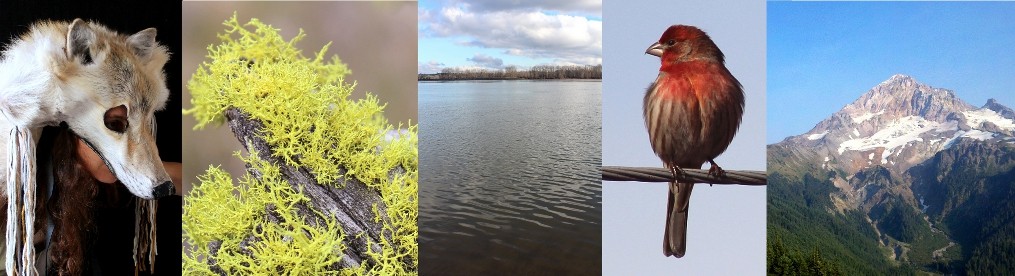
I Went For a Walk in the Rain

I went for a walk in the rain today. We’re getting into the rainy season here in Portland–which means it’ll be soaking wet now til probably early to mid June. (And you wonder why the Pacific Northwest is so green!) I walked over to the park, watching the fox squirrels foraging for acorns and other things to store away for Winter. The sky was a very pale grey, almost white, and almost perfectly smooth except for the occasional lower-hanging cloud adding just a slightly darker grey splotch.

I deliberately went out while it was raining. I’m one of those people who prefers warm, sunny weather–summer’s my time. I’ve generally tended to see anything cooler than 70 degrees Fahrenheit as too cold for my tastes, and I usually walk around in several layers all throughout Autumn, Winter, and most of Spring. Plus, having worked in a few occupations where I was outdoors a good bit of the time, I’ve come to appreciate shelter.

I spent a good bit of today reading Ecopsychology, edited by Theodore Roszak, in preparation for my ecopsych class. I’m reading through the entire book, rather than only the assigned portions, because this is really what my main interest is in my grad school career. I’m thoroughly enjoying it, to be sure.

One of the themes that has really leaped out at me is that of the excessive, even neurotic, need for control in Western cultures, America in particular. One particular thread that I’ve been following is that of the need to control one’s environment to an excessive degree, even to the point of destroying other beings. Because we feel the need to exert our control over the environment, we have so manipulated the world around us that entire ecosystems have been utterly destroyed. Even if you consider global warming to be a natural phenomenon, there’s no denying the huge amount of deforestation going on worldwide, including in crucial rain forest areas–or the extinction of multiple species by human interference–or pollution in waterways (Cuyahoga River FTL!). We have most decidedly left our mark, and not in the best way possible.

Compared to other cultures, modern Western cultures are incredibly out of touch with the interconnected world we live in; we have done a marvelous job of denying any connection whatsoever (except for those we find to be convenient). American culture in particular has taken independence and self-centeredness to an extreme–some would say neurotic–state. Because of this, we have lost, as a culture, the ability to interconnect, not even just with the environment, but with other people. Any form of dependence on others is assumed to be bad, weak, and a threat to the strictly-held boundaries of SELF. And it’s that deep divide between Self and Other that really screws us over. Instead of having a permeable boundary that allows for fluid connections depending on context, we stay in the perceived safety of Cartesian dualities because we’re too afraid to venture beyond the known.

We have a deeply-ingrained terror of losing ourselves in the world. We grasp our precious control so tightly that we never learn what it is to really let go, and simply experience. Instead, any mention of loosening the grip at all causes a kneejerk reaction. Suggest to the modern American that as a culture we’re addicted to consumerism (and as a culture are in denial about it), and you’ll get a bunch of–you guessed it–denial. People don’t want to question their nice, safe boundaries.

Reading some of these essays today made me want to go outside of those boundaries. I’ve already been working against some of the cultural assumptions that, as an American, I’ve had pushed onto me from day one. I’ve been trying to slowly decrease my isolationist dependence on technology, even as I try to acknowledge my interdependence with other people, other animals, other beings, and recognize the impact my actions have (even if I don’t always make the best choices every single time). And I’ve been trying to make my boundaries between my Self and Everything Else less rigid, more permeable–but without the either/or terror that says “If you don’t maintain your boundaries just so, you’ll be swallowed up!” (I’ve been working on destroying my dualistic assumptions and replacing them with continuums for a while now.)

So today I took a walk in the rain to see if it was really all that bad, if it was everything I feared it would be. And you know what? I really enjoyed it. I wore proper clothing to keep me from getting utterly soaked, though in places where the rain did soak in to my skin, I relished the feeling of water, right next to my skin. I listened to the sound of the rain pattering down on my hat, on the ground, on the leaves in the trees. I thought about how the rain brings fertilization–not just in hydration, but in the fact that every rain drop forms around a particle of dust or other stuff, and this falls to the Earth to help replenish the soil. The rain captures nourishment that is afloat in the air–topsoil blown away, minute bits of bio-material–and returns it to the Earth. How can this be bad, in and of itself?

And as I swam through the ocean of air that we all are submerged in, nestled amid trees and grass and birds and squirrels and hills, I recognized what Laura Sewall, a perceptual psychologist, was talking about in her essay “The Skill of Ecological Perception”–that we do not live on the Earth–we live in it. Our perception of depth is anthropocentric–it starts from our own head, and expands outward. Yet we can reframe that depth perception in other ways, and see the world in a wholly different light.

“Wholly” is a wholly appropriate word here. When I allow myself to perceive that I am in the Earth and not just on it, when I see myself as within my environment and not merely looking at it, immersed without losing myself and my subjective perspective, I am not veering off into the other end of the dualistic perception of “inside/outside” or “Self/Other”. Rather, I am perceiving from a place of “both/and”. I am mySelf, and I am also part of the Other. There is no contradiction in this. It is the sticking point of dualism that makes the automatic assumption that you can’t be in two places at once–yet it’s all in how you perceive things.

As for the rain being “bad”? Sure, I don’t like being soaked to the bone on a cold day. But to borrow a thought from object relations theory–the well-adjusted person is one who merges both the good and the bad traits of something that is perceived. A mentally unhealthy person is one who literally cannot make that merge–who cannot see that either the Self, or Other, or both, are composed of both good and bad things. (This results in the paranoid-schizoid position proposed by Klein.)

So in an attempt to have a healthier, more whole outlook (and, as a sidenote, “health” and “whole” come from the same root word), I went out to appreciate the good things about the rain, without ignoring the bad. I enjoyed the rain, and appropriately protected myself from too much of it soaking into my clothing. I remembered that I am in the Earth, not just on it, and didn’t lose myself in the process.

Journeying vs. Guided Meditation

I know I’ve been a bit quiet lately. I have been journeying, though, primarily exploratory journeys to get used to the practice of it, and to also get an idea of the “geography” of the Otherworld, so to speak. I don’t really want to talk about a lot of the details, since this is part of the more private end of the path. However, here are a few highlights:

–I have a consistent starting point where I begin all my journeys. Physically, it’s a place I have a good connection to, though not what I expected. I’ve found myself starting here every time, so I think it’s a good sign.

–My “world tree” is actually a mountain. I’ve located the general vicinities of the entrances to the Upper and Lower worlds, but I can’t actually get to them yet (I’ve been presented with them as puzzles). None of this is at all what I expected, but it works.

–I have at least one, possibly two local-to-the-Northwest totems who want to work with me. One I was pretty sure about; the other one was a big surprise.

–I’ve encountered both totems and individual animal spirits while journeying. The totems are definitely more powerful; however, the spirits should not be ignored or dismissed easily.

Journeying is definitely not the same as guided meditation, IME. Guided meditation, from what I can tell, takes me into a “neutral zone”, where neither the spirits nor I have a distinct advantage. I have a lot more control over what happens, what my form is, what I do, etc. and it’s a lot easier to enter and exit.

Journeying, on the other hand, has turned out to be a lot more intense, and I am definitely out of my element there. I’m on the spirits’ turf, so to speak. I find that I tend to take one particular form there, and shapeshifting is much harder. Also, traveling is more difficult. Whereas with guided meditations I’ve been able to easily bypass blockages and manipulate the landscape, there’s no doing that with journeying. If someone says I’m not going past them, then there won’t be any sneaking, or flying up and past–at least at this point. Things that were feasible in guided meditations, aren’t so easy with journeying.

The other thing that I noticed is that the totems in particular are “more themselves” when I journey, especially when compared either to evocation rituals here on the physical plane of reality, or even guided meditation. I’m trying to figure out how to describe this…it’s not just that they’re bigger and stronger. It’s that when I journey, I can observe more of who and what they are, because this is where they’re native to. Conversely, I am more limited; only part of me travels, leaving my body behind. I never realized just how much of myself is wrapped up into my body. I wonder if there’s a spiritual counterpart, something that gets left behind when a totem or other spirit leaves to go to a neutral place, or to visit here through evocation/etc.?

Aside from the journeying, I’ll still be practicing songs; I still need to do songs for Bear and Small Bear. The songs and journeying are creating a nice variety for me that’s keeping me more engaged, especially as I’ve been getting busier.

Locos and Locals

My efforts towards creating songs for my dancing skins and their respective totems continue apace. I haven’t been blogging much about it, because it would essentially be “Today I practiced Deer’s song more, and came up with a drum rhythm for Small Deer”. Not particularly riveting when you’re not directly involved. However, I thought my recent work with Coyote was noteworthy.

For all my work with the Big, Impressive North American Birds and Mammals (BINABM), I’ve only worked with Coyote in a limited way; once was in a ritual to help protect hir physical children. I also sporadically worked with hir a few years ago when I was more heavily into Chaos magic. At that time Coyote was teaching me a bit about facing my fears, with one particular memorable incident where s/he helped me as I drove my car down a very steep icy hill one winter without panicking! Coyote and Small Coyote were the most recent volunteers to step forward in this endeavor, and so I started with Coyote’s song.

When I speak of Coyote, I don’t only refer to the Coyote referred to in the myths of a number of Native American tribes. Coyote-as-totem, to my understanding, shares some overlap with that other Coyote, but is not one and the same. My experience with totems has been that while they may have a number of bailiwicks, their initial connection with me has a more specific focus, and then as we work more I learn more about what that totem has to offer.

This time, Coyote mainly told me to sing about change and adaptability, as well as the illusory nature of subjective perceptions of reality (though not in those exact words!). While s/he briefly touched on creation myths and the Trickster archetype, these plugged into a main theme of Change. To be honest, I was a bit worried about working with Coyote in a deeper sense. Some (not all) of the Coyote people I’ve met have been chaotic in a very unhealthy, destructive manner; other people talk about Coyote the way that some practitioners of Asatru talk about Loki–a dangerous being that you shouldn’t bother with if you can help it. However, this initial reconnection with Coyote seems to be on common ground that I can understand and have experience with. I don’t expect everything to go smoothly or perfectly–but I don’t expect that with any of the totems or other spirits I work with. Sometimes the lessons we learn are difficult; and if Coyote will be dealing with Change, then it won’t be surprising if there are tough things to learn. However, if I can learn more adaptability, so much the better–that’s one thing I need more of. While I can roll with the punches, I could stand to be less stressed about life’s ups and downs. I think, perhaps, the fear of chaotic change may make some people afraid of Tricksters in general–who wants their lives entirely shaken up? What I understand so far, though, from my work with Coyote is that she’ll help me to learn ways to cope with chaotic changes, both in myself and in others.

I’m also slowly beginning to shape very rudimentary connections with the locals, as it were. Living in urban Portland, the vertebrate animals I tend to see the most are scrub jays, crows, and fox squirrels, with the occasional robin or kestrel. I don’t even see that many insects beyond the pollinators in the garden.

I’ve seen criticism in various online communities of neopagan totemism, specifically regarding the fact that many people seem to have totems whose physical children they’ve never seen. I’m a good example. Wolf’s been in my life since I was very young; however, I’ve only interacted with wolves at rescue facilities, and only on the outside of the pen. I’ve never seen a wolf in the wild, and never really been to a secluded enough place that could realistically support them. Yet Wolf has been one of the most persistent presences in my life over the years.

I did read something that actually makes a good deal of sense to me in Totem Popularity Contests: Why Some Totems Are More Popular Than Others, written by Ravenari. While all of her points are excellent considerations that I think should be talked about more, I particularly am interested in the last one, the idea that “Some animals are popularity-contest winners”. In my experience, there are totems who are more outgoing than others, and there are some who couldn’t care less whether we work with them or not.

While it’s a very, very rough comparison, and should not be seen as a one-to-one parallel, I think we can look at some pre-Christian religions that had large numbers of deities, including a major pantheon. The Romans are a good example; while they had their major pantheon including Jupiter, Juno, Apollo, etc., there were also countless minor deities, local deities, demi-gods, and so forth. It’s not entirely inconceivable that within a neopagan context, where we have the influence of that somewhat tiered structure, that there could be some totems who roughly correlate to a major pantheon, perhaps due to a greater tendency to interact with more people.

Continuing with the pantheon comparison, and especially within a neopagan/modern pagan context, most of the people today who work with the Olympians have never been to Greece, or any of the places where these deities originated from in pre-Hellenic times (or, for that matter, where they travelled to in ancient syncretic blending). So is it really surprising that many people haven’t actually ever “met” their totems “in real life”?

That being said, I do think there’s a lot of value in working with local spirits; some would argue that in order to really practice shamanism that it’s a requirement. I’ve spent much of my time, especially since last spring when I went to Arizona, connecting with the Land here as a whole. However, I’m beginning to make more specific connections. Scrub Jay in particular stands out to me, though Squirrel has also made hirself known, albeit in sometimes irritating ways (squirrels in the attic, squirrels in the garden!). There are a number of plants, one tree in particular, that have become particularly important. And, of course, there’s my ongoing “romances” with several individual places, such as Laurelhurst Park, the Multnomah-Wahkeena trails, and Mount Hood.

I’m willing to bet that the quality of the relationships that I create locally will be different–not necessarily better or worse–than those that I’ve created with the BINABM. Historically my work with the BINABM has primarily involved more overarching concepts, especially involved with personal metamorphosis; for example, Deer has always been the Dreamkeeper for me, and Bear has taught me a lot about healing and balancing it with the ability to bring harm. It will be interesting to see how working with the totems whose children live in the same environment I do will go. Of course, this is mainly conjecture at this point, and the actual results remain to be seen. But that’s what this journal is for–recording of my thoughts as I go along, and later on I can look back and see whether I was right or not!

For now, I’m going to continue focusing mainly on the songs I need to be writing. I’ve asked the Powers That Be whether I should be doing something else, but the message is generally “Nope. Keep writing the songs. Once you have them, then we’ll get into more detail of what you can use them for. Still, keep your eyes and ears open.” Which is fine; I tend to do better focusing on one main thing at a time, building on what’s come before.

Something Bigger

Recently I had cause to be part of a discussion as to whether anyone else had been feeling currents of change building up towards Something Bigger. I see this a lot in the various spiritual subcultures I’m a part of. Something Bigger is usually seen as a mystical/spiritual trend beyond our ken, sometimes with an apocalyptic bent that grows more common as we approach the legendary 2012. The general pattern is this:

–Something bad or otherwise significant happens to someone; or, someone starts to feel fluctuations in the energy around them.
–The person(s) then goes into hyperawareness mode, looking for any potential explanation for what’s going on beyond mundane explanations.
–This may then spiral into a huge self-reproducing cycle of worry, anxiety, and speculation that defies any more down-to-Earth theories of what happened.

Now, I know damned well that there’s more to reality than just what we can interpret with our (subjective) five physical senses. What I disagree with about the above cycle is that although such occurrences may indeed be linked to Something Bigger, that Something Bigger is often closer to home than we may suspect.

A good example is this past week. Last Tuesday, I took my GREs, having graduated from college seven years ago almost to the day–I did well, but it was a significant event for me, and it wiped me out quite a bit. Since last Thursday, I have developed and been recovering from a bad case of strep throat (I don’t recommend it, by the way). During my recovery, we had a squirrel get caught in our upstairs, and I had to do some fancy maneuvering to get it back outdoors. Needless to say, it’s not been a fun few days, but I managed.

It would be easy for me to blow this whole week out of proportion, given that most of it wasn’t so great. However, I’m really a fan of Occam’s Razor–the simplest answer is the most likely. Not the only answer, but the first one I look to. In the case of my week, there is a very simple set of explanations:

–I have a weak respiratory system to begin with; I was that kid who caught every single cold and other upper respiratory bug that came through (except, amazingly enough, chicken pox, unless I managed to get a “spotless” version thereof). Saturday night my husband and I went out to a club, where you have a whole bunch of people in close quarters, so that’s most likely where I picked it up, though I may even have gotten a quick-incubating version when I took the GREs. Needless to say, respiratory germs love me; I can’t say the feeling is mutual.
–Taking the GREs stressed me out some, and additionally my sleep schedule got a little wonky, which meant there were a couple of nights where I didn’t get as much sleep as I needed. Additionally, I began my period last week, which also can temporarily lower the immune system.
–As for the squirrels, we’ve been dealing with them since last year. It was only a matter of time before they actually got inside.

I did talk to Squirrel, just to be sure. At most, the situation with the squirrel in the attic was a good lesson in observing how I deal with stressful situations, but for the most part, it was just a matter of an urban squirrel finding a cozy spot to live (albeit an inconvenient one). That I managed to learn something from the situation is a good sign, but I can learn from just about any experience–life is a process of learning, something you’ll hear from everyone from shamans to neurobiologists.

I think there’s a lot to be said for one’s perception. Say you have a crappy day, where nothing seems to go right. You may actually have some good things occur, but you’re so focused on the things that have gone wrong that what’s gone right goes unnoticed. In this case, your perceptions may have much more to do with your luck than any outside force.

Do I think there’s Something Bigger? Absolutely. However, I don’t believe it has anything to do with me in specific, any more than anyone else. Too often the kind of cycle I mentioned in the beginning of this post is accompanied by a feeling of “Ooooh, I can sense something, what does it mean for me? What is it about me that makes me able to sense this, while no one else knows what’s going on?” People try to make a bigger deal out of the situation than they really need to.

When I think of Something Bigger, at least in regards to the human species, I think less of apocalyptic myths, and more about the concrete cumulative detrimental effect we’ve had on the environment, on each other, and on ourselves. Perhaps the energy, the soul, of the Earth is changing. Perhaps we are feeling large-scale shifts in what we’re perceiving. However, I figure it’s less about the potential for a whole slew of angels and demons pouring out of a rift in the sky for a huge battle, and more about the building damage we’re inflicting on this world and its inhabitants (ourselves included), physically and energetically.

And if we perceive more unhealthy patterns around us, shouldn’t that tell us to look at our own health? Remember what I said about how having a bad day can contribute to feeling like everything sucks? Given how many people just in the U.S. suffer from a host of bad experiences and resultant conditioning, and how psychologically damaged even healthier people can be, it’s not at all surprising when people project that outward onto the world around them. We aren’t raised to have healthy relationships with ourselves, or with others, or with the environment, and it’s hard to keep ignoring the result of this lack of social health. While some people have done a lot of healing in this regard, it’s tough to find someone who is completely untouched by some trauma or issue.

The obsession with a mystical, out of our hands Something Bigger is simultaneously self-centered and self-denying. It focuses on the perceptions of the self, and the idea that the self may be more special in hir unique perceptions, or even more special by virtue of the Universe caring enough about the individual to enmesh hir (and maybe a few friends) in some vast cosmic plot–or even that the plot has to do with humans in particular. However, it is self-denying in that it neatly removes responsibility for any major changes from the individual. Angry spirits? Explain them away as an impending apocalypse on the spiritual planes rather than pissy land spirits who aren’t happy about the pollution and being ignored by most people, and ba-boom! No more responsibility! Or, alternately, explain it as something that’s absolutely fated and inevitable and there’s not a damned thing we can do to change it–again, we’re left free and clear (relatively speaking).

This is not to say that there’s absolutely no truth or possibility to the idea of an apocalypse. However, when I think of Something Bigger, my first thoughts go to things that directly tie it to the simplest answers. Only after definitively ruling out these possibilities will I look further. The exception may be if I get a direct message from a spirit that gives more complexity, but even then I don’t automatically believe everything I hear, no matter who it is. And I still test what messages I get against Occam’s Razor.

In my experience, when something is decidedly not simple, there’s no doubt about it in my mind. I may have to ask around for specifics, but there’s a certain “feel” to something that’s More, and it’s different than something that’s important to just me, even something so important to me that it feels Earth-shattering. We are capable of feeling very deeply on our own, but that doesn’t mean the rest of the world is involved. Lose a partner through breakup, divorce or death, and you may feel that your life has no meaning–but the world goes on anyway. There doesn’t have to be any significant impact beyond the people immediately affected by a situation; while our actions have ripples, not every action ripples indefinitely. My getting sick and dealing with a wayward squirrel in the space of twenty-four hours doesn’t have to mean anything more than a few germs and a wild mammal converging on me at the same time.

I do think that the culture I am a part of puts too much emphasis on intellect and ignores a healthy approach to intuition most of the time. However, tossing intellect out the window with the bathwater is not the solution to salvaging intuition’s damaged reputation. You are not more spiritual the more wacky your stories get; healthy spirituality is that which can still interface with the rest of reality, rather than running at odds with “mundane” reality. Something Bigger does not have to be about the improbable–look to the very possible first, and then work your way out from there (if it’s even necessary). Even if Something Bigger ends up being more than meets the eye, at least you’ve made yourself aware of the more immediate issues and can work on them as well as the weirder ones.

Reconsidering…

When I first started my shamanic path six months ago, I had the idea of creating a more formal practice involving the totems, skin spirits, and other animal spirits I worked with and who had been herding me towards the idea of shamanism. Therefore, I used the term therioshamanism as a convenient label, since in my mind to name something is to give it more form. “Therio” means animal, and I figured that since I’ve focused largely on animal spirits over the past decade and change, my shamanic work would follow the same trend. This idea continued as I developed a relationship with the Animal Father, protector and embodiment of all animals.

However, as my experiences have deepened, and I have begun to incorporate more sustainable practices into my everyday life, spiritually and otherwise, I began to find that my awareness was expanding beyond the animal spirits, that I was finding more connection to plants and the land itself. I didn’t think much of it, since I was still mostly working with totems and skin spirits. And wouldn’t environmental activism contribute to helping animals in preserving their homes?

This weekend shook me out of my stubborn adherence to animal-centric practice. Over the past few days I have been introduced to the Land as a whole—not just the animals who populate it (most of whom were asleep or hiding while I made my diurnal sojourns into the desert) but also a wide variety of plants, stones, and the spirit of the Land itself. I have spoken with a cliff covered in petroglyphs left by the ancestors of the Hopi Snake Clan, and with ancient juniper trees. I have had prickly pears and crucifixion thorns as my companions, and I have conversed with caves as I sat in their depths. My encounters with animals were brief, though special—a circling vulture, a hummingbird following me down a path as I walked blindfolded, tiny lizards, a startled kit fox in a tree.

All of these came together to contribute to the Land, sustained by it and being a part of its very fabric. Yet I persisted in my single-minded focus. How could I, an animal shaman, divide my time among the animals, the plants, and the stones, never mind the spirits of Lands in numerous places? After all, hadn’t it been the Animal Father who called to me at the beginning of my path? Hadn’t the animals been the ones who kept me company and taught me over the years? Was I losing my focus?

But as I continued to walk the Land, and especially when I took my solo pilgrimage to a personal power spot on Friday, where I spent five and a half hours with no one but the Land to talk to, I found it harder and harder to ignore the draw that it had on me as a whole. And as I watched my instructor, James, calling on all manner of spirits who aided him, from mountains to totems to various plants, I finally began to open myself up to the possibility that perhaps I’d been a bit hasty in assuming that my shamanic path would just be a continuation of my previous animal-based practices.

Finally, I gave in. One of the main themes of the weekend for me was learning to open myself up more to the Land, not just the parts that I found most interesting; in fact I think it was intentional that my interaction with other animals was minimal compared to the plants and stones. And once I opened myself fully, allowing the Earth to embrace me, calling on the Fire and telling it my story, I became aware of a much, much bigger picture.

As I worked with the Sun, and the Wind, and the Fire, and Growth, and numerous other forces of nature, the Animal Father tossed me an idea that I’m amazed I totally missed before (and yet my lack of observation doesn’t surprise me). He explained that like the Sun and Moon and Earth and Wind, he himself is the embodiment of a force of nature, specifically the animal kingdom. This makes sense to me on so many levels, not the least of which being why he didn’t “read” like other deities to me, and why he struck me as more primal than deities I’ve worked with in the past. Not that deities can’t be primal; however, there’s not the amount of anthropomorphization that often accompanies many deities. He is to the various Horned gods what Father Sun is to Apollo or Lugh; while the deities may be associated with these natural phenomena, they have become somewhat removed from their roles as embodiments of the phenomena themselves, acquiring other traits along the way. While there may be myths and stories involving the Earth Mother, the Sky Father, and other such entities, their primary role is still within the natural processes themselves.

Or perhaps it’s just my perception, that I find my connection with them not so much in the myths and stories, as in the direct interaction with them on a daily basis. I’ve known of people who worship Odin, Zeus, and other sky gods, or deities associated with the wilderness, or fertility, or death, and then deny that their religion is even remotely nature-based. There’s no getting around that here; what I am discovering is less a worship of a pantheon of deities, and more a worldwide pantheistic animism in which the spirits may be much bigger than ancestors or plant spirits. Beings such as the Animal Father seem more to be like animal totems—archetypal embodiments of natural phenomena (or specific animal species in the case of totems) that have connection to all of their “type”, but are independent beings. It’s just that the Animal Father and others embody much larger, more widespread phenomena.

Either way the truth may be, this weekend has made my way much clearer. While I am going to continue my work with the animals, I’m also going to broaden my experiences to a great degree. And this feels right. Not easy, not a cakewalk—the desert made it clear to me, for example, that while it allowed my presence for a few days, it could also kill me if it wanted, or if I didn’t respect it. There’s a definite respect here that doesn’t allow me to just waltz on in without asking permission. I’m much more aware of my place in the natural cycles, civilization or no.

In my wanderings and readings I’ve run across numerous definitions of “shamanism”, ranging from “anyone who likes animal totems” to “you do whatever the gods tell you to whether you like it or not, and you have no choice”. What I have discovered here, or rather, what James taught me, is the definition that a shaman serves the community. In terms of ecoshamanism, this includes (but isn’t limited to) being a mediary between the natural world and humanity—which is pretty much what I’ve been trying for the whole time. He’s just done it more thoroughly and eloquently, and with a hell of a lot more experience! While I’m not going to give up my own “flavoring” and the useful things I’ve learned, I’m going to be incorporating a lot more ecoshamanic techniques in my practice, because they are exactly what I’ve been looking for.

It’s not that I wasn’t aware of them before; I first read Ecoshamanism in 2006. However, there’s a difference between reading about something, and seeing it demonstrated. Having not only seen the ideas and practices in person, but actually being able to apply them practically for a few days, has made a huge difference, and made the impact that much greater. Now I understand more fully why you can’t just learn to be a shaman from a book; my own previous experiences showed me that to an extent, but this made a much more vivid point.

A good example of this is something quite simple—the titles Grandfather/Grandmother, Mother/Father, Sister/Brother as applied to the spirits of natural forces. I used to avoid using these terms like the plague, mainly because I thought that the neopagans using them were “just playing Indian” (especially since a lot of my exposure to them was through books that were steeped in mishmashes of practices presented as “genuine Native American”). However, I’ve spent the past few days working within a “nondenominational” shamanic path; James doesn’t claim that ecoshamanism is 100% genuine Huichol shamanism, though his training in the shamanisms of that tribe and shamanisms have influenced him to an extent.

What I found, as he referred to Brother Wind and Sister Water, Grandfather Fire and Grandmother Growth, and as I started to make my own connections with these great beings, was that these titles fit. The immense presence and power of these spirits didn’t require titles, but it seems almost inadequate to refer to them without the titles of respect and honor. I didn’t feel, as I used these titles myself, that I was “playing Indian”. Instead, I simply felt I was calling them by proper names; I felt humbled by them, and felt the need to give them respect—and this is one way of doing so. However, because they are familial terms, they also acknowledged my connection to the spirits, rather than distancing me even more. Some things are less about culture than they are about experience; as far as I’m concerned at this point, calling the wind my Brother is no more culturally-specific than being immensely grateful for a cool breeze on a hot day, or the power of the wind blowing on a mountaintop, or praying to a gale to spare you when you’re caught in a storm on the water. Being in awe of natural phenomena isn’t limited by culture; it is only limited by one’s perception which may or may not align with the perception of the majority of people in your culture.

So I have found a path that really fits, and I have found who and what I will commit to—the Land and all its denizens, whether that Land is the Sedona desert, or Multnomah Falls, or even a distant star. I think I can be comfortable saying “I serve the Land”, rather than “I am the slave of X deity and have no choice in the matter” or “Shamanism is all about fixing my psychological problems and all the spirits are there just to help me actualize my Higher Power”. Not that these can’t be valid paths, of course; YMMV. But this path, service to the Land, made a lot of things click into place for me this weekend. Of course, there will no doubt be more lessons to come, and more recalibration as I grow and experience more. This weekend offered me a lot of answers to what I’ve been seeking.

As to other aspects of shamanism, such as drumming, journeying, the Tree with Three Worlds, and other such practices that are common, I’ll wait and see what emphasis needs to be placed on each. While I will still most likely start spending more time getting to know the skin spirits and practicing journeying with drumming and other methods, my priority has become more about getting connected to the Land. I’ve learned some valuable skills that I’m taking home and applying in my own “territory” as it were; the Sedona desert was a good teacher, but that’s not my home. The mountains and forests and ferns, and the deserts on the east side of Oregon—those are my home, and those are the places that I will be trying to develop deeper relationships with.

Well….This Is It…..

First, a quick note, partly for my own organizational purposes–my column in the most recent issue Rending the Veil ezine deals with the importance of cosmology in shamanic practice; it’s the first link at the top of the page. It deals with some of what I’ve learned in the past six months; feel free to click and take a peek.

This will most likely be my last post before I head off for my ecoshamanic work tomorrow. I’ll be doing the first two initiations that are offered, back to back. I’m looking at it more as one big long experience with a day break in between for personal reflection, which is just fine by me. Wednesday and Thursday will be the first initiation, which will involve a lot of exploring the local area down around Cottonwood, AZ, working with power spots, and really getting a hands-on experience with working with the land. While I’ve done some of that, from what I’ve read in Ecoshamanism, James has a very particular way of relating to the land, and I’ll be curious to get his take on it.

The second initiation is going to be even more intense. I get to confront my claustrophobia while being buried in the ground! There’ll be a lot more going on, too, but confronting that fear will be one element of it. I can’t say for sure everything that will happen (such is the nature of a personal rite of passage) though this will be part of my therioshamanic work as well; basically over the next few days I’ll have to make my decision whether to put up or shut up–keep going, or give up. And with some of the things that have been coming to the surface in my private internal/introspective work, I get the feeling that there will be a lot happening between now and next Monday.

I will say I’m nervous. Despite the fact that yeah, it’s going to be cool getting to go to Arizona, and getting to meet someone I really admire–there are some potentially really tough things I’m going to have to face, both about myself and about the path I may be further committing myself to. I have a choice; I can say yea or nay, and there will be later turning points as well. But that doesn’t make it an easy thing.

Beyond that….I’ll just have to wait and see. See you in a week.

Living My Spirituality

Earlier this week, someone on LJ tossed out a question about how we (the readers) incorporated our spiritual paths, the Great Work, etc. into our everyday lives. This was my reply:

For me, it’s a matter of taking my personal mythological cosmology–my spiritual understanding of the way the Universe works–and blending it with the mundane, everyday, physical reality. The former provides context to the latter, though they are not identical. So I look at my everyday actions and I think, “Does this correlate to how I believe the Universe is on all levels?”

That’s why I’m such a sustainability geek (though still a relative newbie to some of the more advanced practices)–because if I truly believe that the Universe as a whole is alive, and that the Earth is an organism, and that totems are the protectors of physical animal species, then my actions need to mirror that awareness and understanding.

There’s nothing that isn’t connected to my spiritual path. What there are, are areas that don’t align as well with my ideal path (True Will, if you will) as I’d like them to, and those are things I work on.

I think for some people, “spirituality” is primarily linked to rituals and rites, meditation and other specifically spiritual things where the “mundane” world is to be kept separate. I admit that even I can sometimes fall into the dualistic perspective, even though I damned well know better. Yet if I have learned nothing else from my first six months’ training, I have gained a more universal view of reality. I do, on a certain level understand that every single individual thing = a cell in a very vast body, so to speak. I describe myself as an animist and a pantheist; everything has a spirit, and all spirits are the piece of the Divine within all things.

However, there is a difference between knowing something, and acting on that knowledge. And that’s really what the question came down to for me. Living my spirituality means making my decisions based on the concept that what I believe is true–for me. It’s applied cosmology–taking one’s understanding of the world and choosing one’s actions based on that cosmology. Sometimes this has to be done consciously, especially when we adhere to a cosmology that we weren’t raised with. Additionally, even if we are raised with a cosmology, we may not actually apply it to what we do on a daily basis.

For example, let’s look at my animistic/pantheistic theological mash-up. If I believe that “God”–not as in YHWH, but as in the ultimate Divine–is within all things, which creates the spirits of animism, then there’s no such thing as a truly “dead” thing. There are things that are technically “without life” in the form of scientific definitions of life, but that does not mean they are without spirits. If I die, then when my soul/spirit leaves the body, there will still remain the spirits of my limbs, the spirits of the individual cells, the spirits of the atoms, etc. Additionally, there is a spirit in the plastic cup on my desk, which also has a spirit. Same thing goes for my car, my computer, my apartment, etc. Not all of these may be spirits of a sort of consciousness where I can communicate with them in the same way as, say, totems. However, I also can’t have a conversation in English with my cats. Does that mean they can’t communicate at all?

And furthermore, even if these spirits are not like me, does that mean I should treat them with no regard or concern? I’m not going to apologize to a hammer for using it to hit a nail (I’m not going to apologize to the nail, either). But let’s look at something else considered to be not-living by most scientists–water. Not the ecosystems the water itself supports, but the dihydrogen monoxide. Water does a lot of work. It bears everything from oxygen to plankton to silt to garbage without discrimination. Yet certain things that it carries may make it an unsuitable carrier for other things. If you put a poison in the water, then the water will no longer be able to effectively hydrate an animal or flush toxins from the animal’s body. Water’s ability to carry oxygen (besides that in its own molecules) is made all the more important when we look at oceanic dead zones, in which the oxygen level is too low to sustain life and numerous being suffocate. However, chemical fertilizers from farm runoff have created conditions that reduce the water’s capacity for oxygen.

So what does this have to do with animism? Compare these two sentences:

Go and pour a gallon of bleach into that creek.

Go and feed a gallon of bleach to your pets.

Which do you think most people are more likely to do? Granted, one would hope that people would choose to do neither, but every day much more than a gallon of bleach (and other toxins) is poured into waterways every day. Water is “dead”, and there’s apparently a lot of it. Well, there are lots of cats, too, but (hopefully) nobody’s going around and routinely disposing of factory effluvia by feeding it to them (one would hope the furor over the 2007 pet food recalls would demonstrate that people care about animals). But if you make a fuss about the same types of chemicals going into the water, fewer people listen, because to most people, water is “lower” than cats, which are “lower” than human beings.

To me, water is inherently no better than cats or humans. I may have subjective preferences–while I absolutely love my kitties, if our apartment caught on fire and I could choose to save either my husband or my cats, I’d definitely save the husband. (Sorry, Sun Ce and Ember!) But I would not stand by and watch a Cartesian fundamentalist throw rocks at a dog while preaching that the dog is just a meat machine and is yelping out of mechanical response rather than any genuine pain. If that Cartesian fundamentalist were throwing rocks into a river, I wouldn’t much care, since the water isn’t harmed by it.

However, the spirits in my husband, a cat or a dog, water and even a Cartesian fundamentalist are all worth considering on their own terms. I may not treat them all the same, but I do not think any of them are worth ignoring entirely and taking for granted. Consideration is honor. I honor a cat or a dog when I consider how my treatment of that animal affects hir health, happiness, and overall well-being. However, that consideration extends outward. When I have a dog, I train hir to behave and socialize hir so that s/he’s not vicious and a danger to other dogs, people, etc. I do this because the dog is worth considering, not just because I don’t want to deal with a potentially dangerous animal. However, what about consideration for water? Water is not an isolated thing; nothing is wholly isolated. The water itself, the hydrogen and oxygen molecules, may not be harmed by pollution, but every thing that relies on that water is affected, and the water’s spirit–never mind the physical qualities–is changed for the worse.

Granting that water has a spirit makes us more likely to pay attention to it. Anthropocentric viewpoints rely on nonhuman beings either having lesser spirits, or no spirits at all. However, if I see all things as possessing a spark of the Divine, then all things are worthy of my attention. They are all living, alive. As an animist, I am aware of the spirits in all things, and therefore am made more aware of my potential and actual impact on them, moreso than if I didn’t see them as having spirits.

I believe that water has a spirit; therefore, I do what I can to change my behaviors so that I minimize what I contribute, directly or indirectly, to the degradation of the water, and by extension all thing that rely on water. The same goes for the earth, the air, the animals and plants, all things. I don’t expect perfection; there are always things I could do to reduce my impact even more. However, I also have to, on a subjective level, balance my own needs. I am an omnivore, and I believe that killing a plant to eat is essentially the same as killing an animal. However, I also recognize that the way both plants and animals are often raised, killed and processed is bad for both them and the environment as a whole, including water. While I have not chosen to be a vegetarian or vegan, I do my best to buy organic produce and free range meat and eggs when I can.

Some would argue that I’m not doing enough. But living my spirituality is not about perfection. It is about being aware of what I am doing in the context of my cosmology. Even if I make the conscious choice to act against my cosmology for whatever reason, at least I approached the problem consciously–and I can keep that choice in mind for later opportunities. Maybe today I don’t have enough money budgeted out in the groceries for free-range meat and I want to be sure I can buy cold medicine to make my sick husband feel better, so I buy conventionally farmed meat instead. But the next time I go, when I have enough funding, Ithen yes, I can buy the free-range meat. Living my spirituality is not about fundamentalism and guilt. It’s about the awareness. I’d rather be aware of my choices and sometimes not do as much as I could because I consciously chose to, than do everything I can blindly without considering other impacts (such as making my husband suffer through worse cold symptoms and maybe even develop a respiratory infection because I just had to get free range meat or else I’d be a bad environmentalist!).

Living my spirituality is an ideal to work towards. It is an ongoing project and path. It makes me question what I believe, especially because I put what I believe into practice on a daily basis. And it makes me put my money where my mouth is. There’s room for adjustment and growth and change as needed on a moment-to-moment basis. The rituals and formalities help in their own way; they remind me of my purpose, and they are opportunities to learn more about the way the Universe works.

But in the end, what it comes down to is conscious awareness of what I believe to be true, and living my life to reflect that to the best of my ability under the given circumstances.

Therianthropy (and Otherkin) and Universal Connection

I’m going to deviate a bit from the shamanic end of things and delve into some other thoughts–specifically thoughts sparked by reading Green Hermeticism by Wilson, Bamford and Townley. Published last year, it’s a marvelous work on hermeticism and alchemy with a strong ecological focus. I’ll have a review up hopefully by the end of the week over at Pagan Book Reviews.

The part that really got my gears going was in Bamford’s chapter, “Quilting Green Hermeticism”, specifically the section “Perception and Imagination”. It’s an examination of a way of perception that differs dramatically from most folks’ everyday perception. Found throughout various spiritualities and magical traditions, it is the application of the idea that all things are connected to the point that true perception involved not just observing and analyzing something, but instead breaking down our barriers and experiencing it, experiencing what it is to be it, identifying ourselves with it to fully know it. Bamford cites Paracelsus’ example of the Scammonea herb. Instead of only knowing facts and figures about Scammonea, Paracelsus says, “When you overhear from the Scammonea the knowledge it possesses, that knowledge will be in you just as it is within the Scammonea and you will have acquired the experience as well the as knowledge”. (p. 148)

This perspective also echoes the concept of the holographic universe, in which every individual thing contains a reflection of the All, the entirety of Existence (including beyond what we are aware of). It breaks down the habit of dichotomy and duality, and instead embraces the union of opposites. Rather than perceiving based on either/or, we perceive both/and. Green Hermeticism espouses a viewpoint that is based on the understanding that the entire Universe is alive and aware. Rather than looking at a bunch of individual components that are all separate from each other, we are encouraged to start by looking at the One Universe, and then move outward from there. However, Bamford puts this perspective much more eloquently than I can:

Hermetic thinking…works through paradox and metaphor (and patience) which essentially overturn the laws of logic in that they demand the ability to hold two contrary realities simultaneously in the heart/mind as a unity…Whereas ordinary thinking and science begin with a multiplicity of parts and somehow hope to move from the details of the many to some kind of wholeness or unity, Hermeticism begins with the unity or wholeness of opposites and seeks to realize their reality in the experience of the world. (p. 136, bold emphasis mine)

So what has this to do with therianthropy and Otherkin? A good deal. Back when I was writing A Field Guide to Otherkin, my editor (and husband) Taylor questioned the role of the concept of Otherkin (including therianthropy for simplicity’s sake). Specifically, he wanted to know what purpose the concept has beyond identity. That’s a damned good question, given that a significant number of Otherkin seem to be so concerned with remembering every single detail of their (assumed) past lives as a (insert nonhuman being here) that they never seem to think outside the identity box (Rialian has dubbed such people “identitykin”). While they are far from being the majority of Otherkin, identitykin are still pretty common.

And Taylor is far from being the only person who has raised the question of what good is being Otherkin besides having a nifty identity. How does being Otherkin benefit a person, other than perhaps explaining some questions about themselves? What does it do besides apply a label? That’s something I’ve really been focusing on since Taylor brought the query up to me well over a year ago. It’s not that I didn’t have purpose besides identity for my therianthropy, but I’d never really thought about it.

Reading the above ideas in Green Hermeticism helped me to take some vague ideas that have been floating around in my head ever since, and put them into something resembling a coherent idea. So here, for your reading pleasure, is the initial result. Please keep in mind that I only speak for myself; not all Otherkin work with magic and esotericism. Additionally, many Otherkin are leery of putting the concept of Otherkin into anything but literal, attempted objective terms; metaphor, subjectivity, and minority perceptions are often eschewed for fear of “invalidating” the concept of Otherkin in the eyes of others. (Never mind that what someone else thinks should have no bearing on the personal validity of one’s own experiences; if you’re trying too hard to please others, you’re probably distracted from more important things.)

The statement “I am a wolf therianthrope” boils down to this: while I am in a human body, raised by humans with human conditioning in human civilization, there is a significant part of me that says, sincerely, “I am a wolf”. It’s been there almost as long as I can remember, and no amount of denying it made it go away, so I simply integrated it, using the concept of therianthropy as a framework to understand it better. In doing so, I have opened myself to the possibility that I am more than what is apparent, and that the boundaries of identity are more fluid than commonly assumed.

However, I want to take this idea further. Let’s assume that the hermetic perception is correct, and that it is possible to not only know about, but to experience anything in this Universe–animal, vegetable, or mineral, as the alchemical trinity is composed. Let’s also assume that experiencing anything will allow the perceiver to fully understand that thing in a way that simply knowing about it cannot.

Having already experienced numerous times what it is (or what I perceive) to be a wolf as well as a human (the latter of which may be considered my starting point and home base), and, through invocation, having experienced (to a lesser, more temporary, degree) what it is to be various other animals, as well as deities and other spirits, it is not entirely out of the realm of possibility that I could extend that ability to experience toward literally anything. Since “wolf” is what I understand best through therianthropy (the idea that I am wolf as well as human), could I not take the lessons and dynamics learned through balancing wolf and human to begin to integrate other things into “I am”? Does being Otherkin give one a potential head start on union with the All, in that it requires a person to accept that s/he is not only human, but not-human as well?

If this is true, then it stands to reason that for some people, the concept of “Otherkin” can be taken far beyond mere identity. Of course, that gets into the argument of “Well, what if people start ‘becoming’ Otherkin, or adding new Otherkin selves like new clothes?” From a “normal” perception, that is a concern. However, it’s a perception that is based on division and boundaries, rather than unity and exploration of the unity through multifaceted experience. In order to make this exercise work, being able to adopt the latter, hermetic perception is necessary. Otherwise it’s kind of like looking at a 3-D movie through sunglasses instead of 3-D glasses with their red and blue lenses–right idea, wrong filter, and you miss out on the important parts.

This will also prompt more thought on labels, and our adherence to them. We use labels as convenient ways to communicate, and they have their place. However, we sometimes cling to them too tightly and don’t stop to think what those labels really stand for. Additionally, there’s that aforementioned tendency to want to try to put the concept of Otherkin (which is already highly questioned by skeptics) into as literal a format as possible to try to maxmize its legitimacy in the eyes of everybody, ‘kin and non-‘kin alike. To look at it through a perception that has been degraded for centuries as outmoded, crazy, and dangerous just makes people more insecure about it overall. Yet I believe if we are to truly understand and utilize the potential of “Otherkin” as a concept–and as, to be honest, a practice–then we have to be willing to go outside of our comfortable pigeonholes. There is a time and place, true, to argue legitimacy and literalism. However, I am speaking from a current headspace of transcendence and alternative manners of thought and understanding that flow beneath the surface of commonly accepted consensus reality. We already believe that we are Other than what our genes (and society) dictate we are, which challenges consensus reality enough as it is. There’s value in challenging it further, and this is just one potential way of doing so.

I am far from being an expert on hermeticism, so if there are any flaws in my logic on that account (or any other) feel free to constructively critique. (Same goes for anything else you may feel like commenting on.) This is a very rough draft of an idea, the first time I’ve been able to find anything even approaching the right words. I feel humbled by the eloquence of Bamford and his co-authors, who have expressed their ideas on green hermeticism most excellently. Still, this is a good start, and something I will continue to chew on, especially as the “Everything Is Connected” is a significant part of my cosmology. It may not be “pure” shamanism, per se, but it’s integral to what I’m personally working with.

Has It Really Been Five Months?

Tonight I finally did my ritual to officially finish off my Water month and head into the final month of my six months. I know the full moon was a few nights ago; however, I caught yet another cold which developed into a sinus infection, and Bear told me to spend a few more days healing (she didn’t mind keeping me a bit longer). However, the transition has happened, and the last month has begun. Once again, as with my first month, I examine all four elements together, only with the experience of the previous months to use as well, and reflect on what I’ve learned so far. It’s definitely going to be a powerful experience.

The Animal Father called me into the ritual room and had me sit in the center where the four directions/etc. meet. Then he told me to start drumming. At first I got distracted by the drumbeat; I kept speeding up and slowing down, and I was a bit irritated with the tone because the drum head was just a little bit damp. But he reminded me to focus, and over time I felt myself at the center of all four of the directional totems–Wolf, Hawk, Fox and Bear. It was an incredibly powerful combination, the totems and the god, all there at once. And apparently, this is supposed to be my starting point for journeying in general! No wonder I’ll need practice.

The Animal Father had me recount, briefly, what I had learned from each of them. We distilled these into four basic values:

North – Wolf – Earth – Grounding
East – Hawk – Air – Communication
South – Fox – Fire – Love (Passion)
West – Bear – Water – Healing

These are very much shorthand for a lot of complex concept and multifaceted interpretations. It’s easier to say “Grounding” than “Finding the basis of what’s most important in your life; figure out where you stand and where you’re coming from; etc.” as well as extending concepts to other people, other beings, the world around me, and so forth. “Grounding” is therefore a convenient tag for something much bigger.

I felt very safe and very centered during this time; it was much stronger than the neopagan circle castings I gave up early on in my therioshamanic work. I had a very clear idea of my cosmology, and it imprinted itself more strongly on my brain. However, I’m still building up endurance in my rituals, so the Animal Father had me begin to drum down again, to say farewell to the totems and to get myself downstairs and fed. We’re going to work on lengthening my rituals over time, especially as I start doing more complex things, but for now I need to be focusing on consistency.

So I’ll be spending the time between now and the spring equinox not only preparing my everyday life for a schedule change to allow more time for shamanic work, but also reflecting on the cosmology I’ve helped to develop over the past five months. It still has a very neopagan feel to it, which is fine, because it’s built on the concepts that I’ve adhered to most strongly in the past twelve years. But we’re definitely taking it to a higher level here, as far as intensity of work goes. I’m excited, and nervous, but also confident in my ability to continue with this.

Here Comes the Left Brain Again!

I’m in the middle of reading The Secrets of Shamanism by Jose and Lena Stevens. I’m probably about 2/3 of the way through, and it’s turning out to be your usual neoshamanism flavored by core shamanism text o’ techniques. Doesn’t have much context, and throws in some decent psychological exercises in there for flavoring. Like so many authors, the Stevens insist that you don’t have to go through terrifying dismemberment and other ritual torture to be a shaman (however, to be fair, they also make it clear that reading this book won’t make you a shaman, either).

I also read some articles on Northern Tradition shamanism. This included a good comparison of “classic” (what I usually refer to as “traditional”) and core shamanisms. It’s not the first such comparison I’ve seen; I first read James Endredy’s comparisons of classic, core, and eco shamanisms in his text, Ecoshamanism.

It’s often assumed that anyone who isn’t trained in an indigenous cultural shamanism is a core shaman. While none of the sources I referenced above do this, I’ve run into the assumption more than once (online and elsewhere) that neoshaman = core shaman. True, Michael Harner has had a huge influence on modern (neo)shamanism, being the first person to really bring it into public practice in postindustrial cultures. I do, however, have disagreements with personal practice involving core shamanism; while it’s great for some people, not so much for yours truly.

However, I don’t really fit the definition of classic/traditional shaman, either. No indigenous teachers, and no cultural context other than that which I’m living in. My experience with the spirits is decidedly gentler than a lot of traditional testimonies, though I’m not under the illusion that things will always be easy, or play nice, or be successful.

I wish there was a term for modern postindustrial neoshamanism that was expressly not core shamanism, but that was understood to not be classic/traditional shamanism, either. I like “neoshamanism”, but it does have a lot of core shamanism assumptions around it. And therioshamanism is wayyy too narrow, being what I call the relationship I am creating between myself and “my” spirits. I like the concept of shamanism for postindustrial societies, but it has to be understood that you can’t ever take something entirely out of any cultural context whatsoever. Even if you completely divorce a particular practice from its original context, you are still practicing it within your own cultural context, whatever that may be. Therefore it needs to be tweaked to match the context it’s practiced within.

There aren’t very many non-indigenous shamans who are not practicing A) something based in core shamanism, or B) something based in traditional shamanism but also influenced, to one degree or another, by core shamanism, and who are practicing C) something that is based in a post-industrial cultural context. At least not that I know of, anyway. Maybe they’re all hiding from me.

Of course, sometimes I also wonder why I’m so reluctant to go and try to find an indigenous shaman of one culture or another to train under, and quit trying to mow my own path. I think a lot of it has to do with trying to keep the cultural context as focused on mainstream-America-flavored-by-neopaganism as possible; I feel that if I were to base my shamanism in any other cultures’ practices, then my shamanism would forever have that influence in it–and some things simply just don’t translate well from one culture to another. Of course, if I’m reading about other cultures’ shamanisms in books, then I’m being exposed (thirdhand) to those cultures (which is a poor substitute for actual involvement).

However, books also allow me enough detachment to be able to look at what the goals are, and then be able to figure out how to do them myself, coming from my own context. This way I can pull a “What Would Lupa Do?”, rather than, say, automatically falling back on a cosmology and context learned from another culture which may not be entirely appropriate for where I am. And that’s what I really want–a shamanism that is created from where I’m coming from, that addresses the problems that my culture faces, and that allows me to interact with the spirits in an individual manner, however they–and I–see fit.