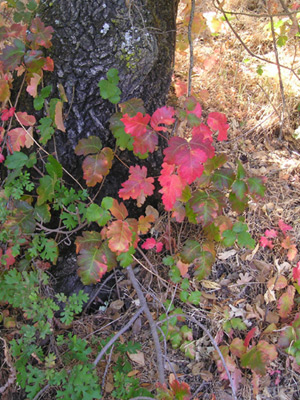
Poison Oak as Totem

A comment on my last post at No Unsacred Place brought up the itchy, urushiol-soaked leaves of poison ivy and poison oak. I am quite sensitive to all of the plants that exude this compound, and admittedly all they’ve inspired in me has been much cursing and complaint on the occasions we’ve had too close an encounter.

Elinox, the commenter who brought these plants up in the first place, mentioned the idea of a shadow totem. A “shadow totem” is a newer concept that seems to be an odd extrapolation of Jung’s Shadow archetype; a shadow totem represents or embodies something that we fear or are otherwise uneasy with. It’s not a concept I work with myself as I find it a little too much of a pigeonhole, but I agree with the general idea that sometimes we have to face some really difficult things in our paths.

So I meditated some with Poison Oak today to consider our relationship–such as it is. Like thorns and other obstacles, Poison Oak and her kin developed urushiol as a way to avoid being eaten by animals. It does mean, of course, that poison oak is not an especially cuddly plant, and the totem was correspondingly strict about personal space, though pleasant otherwise. She’s actually quite friendly; she just maintains very firm boundaries.

And that’s a very important lesson for me, especially as a woman in a culture where women are still often treated as though our boundaries don’t exist. If we object to catcalling, or sexual harassment, or any of a number of other nonphysical boundary violations, we’re told that we’re “bitchy” or “making too big a deal about it”. If we’re assaulted or raped, there are people ready to question what we did to deserve it–were we drunk, or scantily clad, or walking alone at night, or hanging out with the “wrong people”? In the same way, simply for defending her boundaries with integrity and creating a consequence for violation, Poison Oak is vilified. How much do you hear about this plant for any reason other than “this is what it looks like–DON’T TOUCH IT!”?

This goes beyond women, too. There are so many situations every day where people are expected to yield to those who are more powerful, who have no respect for their needs or integrity or safety. The abuse of power is rampant on all levels of American society and beyond. It’s no wonder, then, that so many put up fierce defenses, even against those who mean them no harm. And it can be easy, if a person doesn’t let us in as far as we want, to vilify them for not giving us what we demand.

Poison Oak also told me to examine my own boundaries. I sometimes feel a lot of guilt for maintaining the boundaries that I do. The older I’ve gotten, the more of an introvert I’ve become, and I’ve sometimes gotten criticism for that. More extroverted people don’t always understand that introverts’ quiet and solitude isn’t about them.

There will always be people who feel entitled to my personal space–strangers who don’t understand that it’s a problem if they suddenly come up to me and start flirting, or those who feel entitled to fill an entire residential block with the loud, bass-heavy thumping from their stereo system. These people tend to complain if someone challenges them, and it can be hard to stay true to my own boundaries when they’re trying to paint ME as the bad guy for standing my ground and insisting on my comfort.

And there’s only so far I should allow others to make comment on my spiritual practices. I’ve been spending a lot of time lately trying to defend myself against people who criticize me for being an American of European descent trying to put together an animistic practice, and from people who are uncomfortable with or even incensed by my work with animal parts in art and spirit. While being aware of what others are saying, and my own power and privilege, is a good practice to cultivate, there is a point past which I need to maintain my own integrity and preserve the roots I have set down to give myself more balance.

However, I also need to be mindful of the negative effects that my own “urushiol” can have; sometimes boundaries can be too tight. I sometimes have to make a real effort to get out and be social, not out of any fear of socialization, but simply because I am so comfortable in my personal space that I simply neglect to come out of it at all. Over time, others feel they simply can’t approach me, and so sometimes I need to demonstrate that yes, I can be sociable!

And in some ways I grew up with a certain level of entitlement that’s been hard to shake even at this point of my adult life. I was raised in a town where people were very prickly to each other, where being bullied taught me that everything is a personal offense, and where people always looked for someone to blame for whatever went wrong, even something as small as a delay in traffic. Poison Oak’s “passive” defense isn’t an open attack, and she doesn’t go out of her way to cause trouble. It’s something to keep in mind as I continue unraveling this unwanted part of my past conditioning.

By the end of the conversation, I saw a good deal of myself in Poison Oak, and vice versa. While I’m sure I’ll be unhappy the next time I end up with an itchy red rash from brushing up against her progeny’s leaves, I won’t blame them at all. Urushiol is only the protection that Poison Oak has developed over time, and it’s really rather effective. If I can’t touch or pick poison oak like I can clover or dandelions, it doesn’t mean the itchy plant is a bad one. It just means I need to respect that plant’s boundaries as much as my own.

The Death of the Place That Raised Me

I am in a small town in Missouri, the place that I grew up in. It’s been a trip of many revived memories, as my mom dug a whole bunch of my childhood belongings out of a storage space in my old room, and I’ve been going through the bittersweet process of sorting through everything, deciding what mementos to keep, and which to let go of as resources to send back into the cycle. So I’m already in a mindset deeply tied into my life as it was over twenty years ago.

Which meant that when I drove to the little patch of woods by my old house that I explored so much when I was still in my single digits, finding that it had been entirely leveled and replaced with a brand new building was an arrow to my heart.

I am still in shock, and so disbelieving. I feel I’ve lost a long-time friend, perhaps one that I lost touch with as I moved away, but never forgot entirely and visited when I could. And I never got to say a proper goodbye. I had no idea that the last time I visited would be the very last.

I know, I know. I get that the fact that this place stayed “undeveloped” as long as it did, in a podunk little town pretending it’s a big city, was pretty impressive. It’s actually the second place that I’ve seen destroyed. The woods behind the house we lived in next, and that I am visiting now, was almost entirely removed for a housing development. The spirit there still lives; much-diminished, and much more jaded, it still lives in the remnants of the woods that flank the artificially widened creek that sluggishly meanders through as best as it can.

And that destruction happened over fifteen years ago, when I’d only had a couple of years to connect with the spirit there. That experience, coming home on the school bus one day to find all the trees save for a few down and shattered–that was a horrible introduction to adulthood, and it really was where my childhood came to an end. Today, even those old wounds pulsed achingly.

I am still angry. I haven’t “gotten used to it” or “grown out of it”. And I feel isolated as I sit in a place where most people wouldn’t understand why I’m so deeply hurt by this loss. I’ve already been told “Oh, but the pharmacy people are so nice!” and given the attitude of “development happens, get over it”. Invalidation after invalidation. And it hurts, it just hurts so much.

That place? It taught me the joy of the outdoors, the fascination with other species, and my place as a human animal. It was my refuge when I began to experience bullying at the age of eight. It was my first minor rebellion, as technically I wasn’t supposed to be over on that side of the hill. But mostly it was a place where I could allow myself to explore, both the physical landscape, and my imagination. I wasn’t just a little girl in a pink coat wandering through the brambles and trying to avoid poison ivy. I was a wilderness seeker, living in a little cabin in the woods. I was a wolf, hunting rabbits in the tall grass. I was a snake basking on a big rock. I was so many things, each time I sneaked through the narrow pathway in the poplars and into the trails around the cedars.

I spent so much time in that place, that little maybe-half-acre of scrub woods, and now–now I can never walk there again. All I can do is hope that the few pictures I took on my last visit, two years ago, are still on my old laptop, that I can have a little more visual aid to help strengthen my memories in the wake of seeing this horrible shift.

Underneath the foundations of that building are the remnants of root systems from scraggly cedar and poplar trees that I hid among when I was young. There, too, are the nesting sites of Monarch butterflies, quite possibly relatives of the one that I watched in its chrysalis every day for two weeks until it emerged one spring day. And there lie the bones of the garter snakes and box turtles that were descendants of the ones I would catch, observe briefly, and release. There are stones that I stood on, lifted up to explore the life hiding underneath–snakes, crickets, centipedes, and more.

I won’t go back this trip. I won’t go back to try and find any last remnants of my place. I can’t bear it. I know I shouldn’t hold it against the new spirit of this place that is just being born. All places have spirits, including built-on ones. And I’m sure the pharmacy building now there will develop its own spirit over time.

But it’s not my place. The spirit of the place I knew is dead. Gone. Living only in my memories, and maybe in the remnant memories of a few other people who saw it as more than just an open lot.

All I have left is one single pine cone. I was going to go back at this trip and collect a few more mementos. I’m glad I have the one that’s left. It’s on my place altar. I hope it can stay safe there. It’s my last physical connection to the place that had so much meaning for me.

When I get home, when I can get back to that pine cone on my altar, I’ll spend some time looking for the pictures on my computer, and put together a mourning ritual to help me grieve. I’ll wait until I get back to a place where I know my anger and my sadness will be respected for what they are, instead of having them minimized and invalidated. I’ll go to where I can be safely held in my hurt, and remember the place that held me when I hurt so many years ago.

Until then, it’s not “just a place”. I’m not just “making a big deal out of nothing”. I have to remember that. I can’t let my grief be derailed by others’ expectations of how I should feel or what should be important to me. I spent too much time living up to the expectations of others, and I’ll be damned if I deny my hurt any longer for a place that formed me in ways no human being ever did.

The Core of my Spirituality

I’ve been on a HUGE artwork tear the past few days, in prep for something nifty I’m unveiling this Monday–Lupa-calia (yes, there’s a hint–it’s art-related!) While I’ve been doing so, I’ve been watching a LOT of various nature documentaries on Netflix. I find it entertaining that they call the sorts of things I like to watch “cerebral”, especially as some of what I’ve been watching has been things about the evolution of Homo sapiens. However, it’s ranged from that, to disasters that shaped the Earth and made life here possible, to what the nature of death is and how it’s ultimately defined.

The more I find out about the world, and indeed, the universe we live in, the more I fall in love with it and the more precious it becomes. On an immediate level I worry for the very near future of this planet and its inhabitants. The only people denying climate change caused by humans are the most stubborn and least willing to listen, those who desperately grope for anything to support their continued denialism.

But on a broader scale, all this research–and it is a form of research–is making my perspective continually less anthropocentric, and more awe-struck by the immense scale of time and space. We are not all-powerful beings, though our ability to manipulate our environments and ourselves is impressive. For example, if another asteroid like the one at the K-T boundary at the end of the Cretaceous hits the Earth, we would be just as dead as the dinosaurs; the animals that survived the chain reactions of natural disasters that resulted were mostly small burrowers. And yes, the Earth and the existence of life on it have survived several mass extinctions, but the scale of time it has taken to recover from these has been almost unfathomable, measured in millions of years. Being relatively large, calorie-hungry critters would definitely be a hindrance to our survival as a species if a disaster on that scale occurred–and if we keep up our actions, we may cause enough global climate change to test that hypothesis.

I am also less and less enamored of the claim that the Earth loves us, and that Nature cares about us. We are but a tiny brief blip in history; on the one-year calendar that represents all of time, we exist in the last few seconds of New Year’s Eve. We’re really not all that important, and why should we be more important than species that lasted for many more millions of years than we have? But I also don’t think “Nature” is angry with us, either. We’re talking about a planet that routinely obliterates entire ecosystems with massive volcanic eruptions and the like. While the Earth isn’t in as much of a state of upheaval as it was a couple of billion years ago, it’s still not exactly the safest it could be.

We’ve gotten complacent in the past couple of hundred years as the Industrial Revolution has caused some of us to live longer and be more insulated against illness, injury, and other such problems. For me, being more mindful of where we are in all of this has contributed a certain level of humility to my perspective. On a short-term level, sure, we’re doing some neat things, and there’s no reason not to try to make human existence as universally good as it can be as long as we’re here. And yes, the fact that we are conscious, aware, observant on a level that perhaps no other animal has ever been, is a damned impressive thing.

But we are just one of a plethora of amazing, fascinating, and uniquely skilled species that have graced this planet. Most are gone now. But as I trace the lines of my ancestors and their relatives far, far back, all the way to tiny bacteria, and before that, perhaps, chemicals that gave rise to DNA–my sense of my place in all this is that I am a much smaller, younger, and less overarching being than many humans would claim.

And I’m alright with that. They say spirituality is about feeling one with something bigger than the self. All metaphysics and otherworldly things aside, knowing that I am a part of this ever-evolving macro-eco-system Planet Earth, in an impossibly vast Universe, is enough of a spiritual core for me.

Douglas Fir as a Plant Totem

Note: This is part of the Animist Blog Carnival issue TREES, hosted by naturebum.

Most of the totemic work people do is with animal totems, and admittedly I am biased in favor of them. It’s not that I haven’t done work with others, but I just think to talk about the critters more. That, and the plants tend to be more subtle in their communications. Animals–we’re loud, and impatient, and move around a lot. (Well, most of us. Sea anemones and sloths are on the low end of that curve.) Plants, on the other hand, are more deliberate and patient. And they often whisper. Volume didn’t really have to be much of a thing until there were beings that didn’t send their roots into the great, intertwined network under the surface.

And I’ve found plant totem work to be focused on different priorities than the animals’ ideas. Animal totems seem to want to be dynamic, bringing change and motion and growth. Plant totems, from my experience, tend more toward rooting the self deeper in the now, what you have to work with right this moment, maximizing the use of immediate resources before expending the self to find more. Not that this particularly surprises me; these preferences in focus mirror the very nature of the beings and their totems themselves.

Douglas Fir is one of the most prominent plant totems in my life right now, and as I’ve been working with it I’ve been reminded that I haven’t really written about this part of my spiritual experience. In a way I’ve treated the plant totem work like a long hike in which I ooooh and aaaah at the occasional sighting of an animal, but see the trees and other plants as merely the backdrop. (Which isn’t the case when I’m actually hiking; I take lots of pictures of flora that fascinate me.) I’d like to start changing that and talking more about the plant work I’ve been doing over time. So allow me to introduce you to Douglas Fir.

I am not a native of Oregon. I was a military brat, and did much of my growing up in the Midwest, not arriving in the Pacific Northwest until early 2006. And, beyond that, I am not even a native of this continent; my family primarily emigrated here in the second half of the 1800s, and I was born on an army base in Germany–technically US territory, but not of this continent.

Occasionally this non-native status rankles a bit. I am well aware of the impact that European immigration and invasion of this continent had on the peoples who were here before (and are still here, despite attempts to erase their presence and acknowledgement). And I have heard the complaints from native Oregonians about the influx of people from out of state flooding this area in the past couple of decades as it’s become more popular a place to move (even though right now the job market here is still pretty well tanked).

Yet I am acculturated to this place. I didn’t have a choice in my upbringing, and although there is certainly something to be said for being an ex-pat, it is easiest for me to simply stay in the country where I have citizenship. And I like it here, especially Oregon. The Midwest wasn’t nearly as nice a fit culturally (though the Land liked me a good deal, and I love when I get to go back to visit family as well as places).

This mixed relationship to the place and the people may be part of why one of the first plant totems I connected to out here was Douglas Fir. Douglas Fir is a native species, but the trees’ relationship to the Land here has changed dramatically since the arrival of Europeans. As people began to clear the forests more for agriculture and farming, the opportunistic firs replaced other trees in the succession of forest regrowth. And because the firs grow so quickly, they’re a common seedling chosen for replanting logged areas to maximize profit, making their presence much more pronounced than before.

Both of these factors have homogenized much of Oregon’s forest land to one degree or another. While other native conifers such as Western hemlock or red cedar do still grow here, in many places they’re out-competed by the fir. Even some oak savannahs, highly rare any more in this state, experience firs as an increasingly invasive species.

This, of course, was not solely the doing of Douglas Fir, even with the trees’ competitiveness for resources after forest fires and other nonhuman disasters. The intervention of humans has often resulted in much more dramatic effects on ecosystems. And in the same way, I did not choose the accident of my birth, though I have decisions as to where I live and how I act as an adult, to include attempting to integrate into a different culture (even if I can never completely lose the markings of the culture I was raised and socialized in).

So Douglas Fir has been helping me to not only adjust to living in this place that I have decided to make my long-term home, but also to explore the various ramifications of that decision. There’s a certain level of responsibility that I need to keep in mind as I am here, and what it means that I have consciously made this my home. Who have I affected in this decision? How can I be a part of the community without being obnoxious and even harmful? And, more abstractly, how can I combine my work with social justice with my spiritual path?

These are just some of the things that Douglas Fir and I have worked together on. Fir is more of a presence than an active guide, providing a steady energy to tap into and a quiet reminder of connectivity, but it’s all very grounding to my little animal mind.

And so you have just one example of how my totemic work has extended beyond my fellow critters. I’ll try and talk more about it as time goes on.

(P.S. My friend Paleo has done a bit of writing on more domestic plant totems over here.)

Social Justice and the Shaman as Intermediary

Right now, I’m pissed off about a number of things. I’m angry that the death penalty is still used in the United States, and that today two men, one of whom had a lot of evidence pointing to his innocence, were killed by lethal injection. I’m angry that racism still exists in neopaganism. I’m angry that many areas of neoshamanism still seem to be largely concerned with white people flying to “exotic” far-off lands and spending money that could feed families in those lands for months. I’m angry that pagans and shamans and their ilk aren’t questioning the inherent privileges associated with even being able to consider things like wilderness and environmentalism and sustainability.

We face HUGE problems these days. It’s not just whether the crops will fail or whether the next village over will send their warriors to attack us, though these can even today be massive localized catastrophes. Instead, we have systemic racism, sexism, and other inequalities and injustices. We have a precariously balanced economy based largely on promises and virtual currencies, and which favors increasingly unequal distributions of resources. We have wars involving unbelievably lethal technology, and those who suffer most are the most disempowered. Climate change is a scientifically proven reality, and regardless of whether we caused it or not, we still face the unknown consequences of this shift, never mind the things we are responsible for like numerous species extinctions. We are much larger groups of people, and our problems have escalated in scale to match.

And yet neoshamans persist in working with templates that are based on older, smaller cultures’ shamanisms. To an extent, yes, you can learn from your predecessors, but it doesn’t do a damned bit of good if you can’t apply it to your own community’s unique situation. We face greater systemic problems than ever. It is no longer enough to only treat the symptoms of the client. The shaman’s role is not just on the person-to-person level, though this is important, and will never cease to be important. But most of the material on shamanism out there is on that level alone. We need to refocus neoshamanisms in ways that increase the shaman-to-society level of engagement, because society is the matrix in which clients and shamans alike are conditioned, and an unhealthy environment makes for unhealthy people.

I maintain that the fundamental role of a shamanic figure–at least as close to anything “universal” as you can get with varied positions in numerous cultures–is as an intermediary. Shamans bridge gaps between their society and other societies; or between humans and the rest of nature; or the physical world and the spiritual world; or between the individual and their self; or some combination thereof. In order to do this, you have to be ready and willing to engage with your community to the fullest extent possible. You have to meet your clients where they’re coming from. Our job is to be the one willing to reach out when no one else will. We have to challenge our comfort zones to a great degree, more than the average person in our communities. And we have a lot more potential discomforts to face.

This is no easy task. In many ways it is every bit as challenging and dangerous, if not more so, than traversing the riskiest realms of the Otherworld. But it is our duty as shamans to be the ones to make the first move, to reach out into the uncomfortable spaces and extend ourselves towards those in need, even at risk to ourselves. Shamanism as intermediary work requires us to bravely confront both the internal landscape where our biases live, on through potential interpersonal conflict involving other individuals, and the greater systemic problems that we as a society face regardless of background (though our unique background does affect the angle at which we face the system). Neoshamanisms, for the most part, leave their practitioners woefully underprepared to approach the systemic level of things, especially the human systems.

This is what I propose we need to do as shamanic practitioners if we are to more fully take on a role as social intermediary:

–We need to stop hiding out in other people’s cultures, and root our neoshamanisms more consciously and deeply in our own.

All cultures have things of great value, and I love how globalization has allowed a greater and more varied interplay and exchange of ideas, practices, and materials around the world (though access to that interplay is still mediated to a great degree by various factors such as socioeconomic status and access to education). But cultural elements are not plug and play. If you take something out of its original culture, to include a shamanism, it is necessarily changed by exposure to the new context. Just as a shaman needs to be able to bring things back from the places s/he travels to and utilize it in hir own community, so we need to be better at integrating what we learn from other cultures into relevant frameworks for this one. Most clients in the U.S., for example, aren’t going to want to work with someone taking ayahuasca, let alone take it themselves. But what is the ayahuasca trip supposed to do, and what’s a corresponding practice that is more appropriate to this culture? Great, take your five-figure trip to Peru and have your seminar and special training–value what you bring home, but then make it useful to home. If you’re from Brooklyn, don’t try to be a Peruvian shaman in Brooklyn. Be a Brooklyn shaman who brought some neat stuff from Peru to add to your Brooklyn toolkit. (P.S. Yes, I know ayahuasca isn’t from Peru. The examples of ayahuasca and Peruvian shamanic retreats were two common examples, but not linked together by anything other than proximity in the same paragraph.)

–We need to stop hiding in the wilderness in order to “purify” ourselves of the “taint” of humanity.

This has been weighing on my mind a lot lately, if you haven’t been paying attention to recent writings here. As an ecopsychologist, I am fully aware of and supportive of the restorative powers of nonhuman nature, from gardens to wildernesses to a single potted plant on a sunny windowsill. Walking through a downtown city park is nowhere near the same as hiking through remote old growth forest. And the latter has benefits that many people may never find in the former. The problem is in seeing ourselves as divorced from the wilderness–and whether we justify it through saying we’re superior, or through saying we’re a blight, the consequence is still the same. We widen the artificial divide that we perceive between ourselves and everything else. Worse, those of us who have learned to appreciate “nature” deny others the opportunity to do the same when we enter into the wilderness to “get away from everyone else”, as though “everyone else” has no right to be there with us. Solitude is one thing. Solitude can be healthy. But when we reluctantly re-enter human civilization as some loathsome fate, we are less likely to see fellow humans as deprived of the slaking draught of wilderness we have received. Anyone is a potential client, and those who have the most negative view toward nature may be those who are in the most need of reconnecting with it in a healthy manner. If we see our role as facilitating that connection, we have to examine our biases against humanity as “the enemy”, and instead have compassion for those who may see the wilderness as a worthless or even dangerous thing. We can’t bridge that gap if we only spend our time on the wilderness’ side of things.

–We need to stop hiding behind the spirit world as a way to keep from engaging with the physical world.

Yes, many shamanisms are largely about serving the spirits. But what good is a shaman who can only interact with spirits, and can’t complete the connection back to the physical world? If you only spend your time journeying and only serve the needs of the spirits, then you’re only doing part of the job. And it’s easy to get lost in one’s own Unverified Personal Gnosis. I have seen entirely too many shamans, spirit workers, and other such practitioners blatantly displaying all manner of dysfunction toward themselves and others while justifying it as “well, the gods/spirits/etc. told me, and it fits in with the rest of my paradigm, so it MUST be true!” Word to the wise: be a skeptic, especially when you don’t have much in the way of external validation (and especially if your outside validation consists primarily of people who think and believe like you do). If your UPG is saying you should isolate yourself from people you normally enjoy spending time with (when engaged in healthy activities), or that you’re justified in self-gratifying behaviors that wreak havoc on the relationships and lives of others, or that you should make some drastic decision in the moment without considering other alternatives, then it’s a pretty good indication that you’re getting too detached from the physical end of reality. Would you do these things in good conscience if you didn’t have spirits supposedly telling you what to do? Are you just engaging in escapism to ignore the problems of the world and your own life? All too often shamanism and other spiritualities neglect to ground themselves in the physical for fear of being “disproven”, yet the strongest shamanisms are those that can successfully navigate both the spiritual and the physical.

–We need to stop hiding behind mental illness challenges as though they are the only things that define us.

Again, I am not talking about invalidating mental health issues that are genuinely debilitating. I am talking about ceasing to even try engaging with everyday society because of challenges associated with mental health, and calling it shamanism. Some shamans face pretty damned significant mental illnesses. However, there’s a huge difference between “I am a shaman with a mental illness but I do my best to work around it and use it if/when possible” and “I have a mental illness and that makes me a shaman/mental illness is what defines shamanism/mental illness IS shamanism/wheeee, I don’t need meds or treatment because I’M A SHAMAN!!!!” If you can make your condition work for you, great–I’m all for people making the best of a situation. However, once again, part of what is required of shamans is the ability to engage with general consensus reality, because that is where most of our clients are coming from/wanting to get back to. If you’re so busy being in your own alternative headspace that you’ve given up on even trying connecting with more conventional headspaces, and especially if you justify this disconnection as your right as a shaman, then you’ve lost that crucial ability of a shaman to fully bridge two (or more) disparate worlds–in this case, losing connection with the sort of headspace that many, if not most, clients are going to want to stay in, regain a place in, etc.

–We need to stop hiding behind the idea of persecution as an excuse to avoid engaging with people about whom we are uncomfortable.

I am not, mind you, talking about directly engaging people who are real threats, those who have abused or assaulted us. I am talking about moving past dealing only with “people like us” in general. I keep coming back to the example of how most Americans wouldn’t go to a shaman because they think shamanism is immoral or crazy or otherwise discredited. Fine, then. Don’t engage with them as “a shaman”. There are plenty of other analogous roles in this culture that you may be able to draw on in addition to “shaman”, and which offer more perceived legitimacy that we can use to engage with a greater population in need. Again, it’s our job to make our way into that murky discomfort zone, to approach people that we may worry would persecute us if they knew we were “shamans”. We don’t have to use that word, though; instead, we meet them where they are and go from there. If you genuinely feel unsafe working outside of your preferred boundaries, at the very least take the time to examine why this is, and what would be the risks and benefits of challenging yourself, even if it’s only in theory. It’s preferable to assuming that anyone who is Christian, or a mental health care practitioner, or politically conservative, is automatically the enemy and therefore should never, ever be offered any sort of help because they might dislike us or discriminate against us. Owning your fear and your biases is action.

Do you see a pattern here? It can be summed up as “Helloooooooo, your clients are over here, and the best you can hope for is that they’ll meet you halfway–otherwise, plan to do more than your fair share of the walking”.

Social justice cannot be rendered by people who are not actively engaged in the society they wish to see justice in. Nor can shamans effectively shamanize if they turn their backs on the society that their clients are coming from. How one interacts with society is, to be sure, a personal set of boundaries. But how is it that so many of us will push boundaries in the spirit world, and yet won’t challenge physical-world boundaries, if not for our own sake, then for the sake of our clients?
Wilderness and Privilege

I really need to change the quote at the top of this blog. I feel less and less like there’s a strict dichotomy between human habitations and everything else. Yes, wilderness is its own thing, and to be valued for what it is, and preserved as best as possible. But I’m feeling increasingly critical of the idea that cities are uniformly bad, that anything humans do or create is unnatural, and that you have to choose sides or else you aren’t a good enough environmentalist.

All these ideas of moving out to the country, living sustainably, or just spending more time hiking, camping, etc.–all these have something in common. They all assume that a person has the means to spend quality time outdoors. And that smacks of a great deal of social and financial privilege.

For one thing, it assumes that you have enough money to be able to drive out to the wilderness if you don’t already live there. It assumes you can buy or rent a car, and also have the necessary equipment to hike, camp, etc. once you’re out there.

It also assumes that you have the time to be able to do this. If you’re working two or three jobs and spending eighty hours a week working, you probably don’t have much leisure time to put toward outdoor activities.

And it assumes that you’ve learned that the outdoors is a good place to be, that you’ve had enough exposure for it to grow on you. Believe it or not, not everyone shares these social values. “So what about urban parks? We’re trying to get more of those for people who can’t get to the woods!” Well, yes, this is a good concept. However, parks are not uniformly safe places. Many urban parks are not outdoor refuges for nature lovers, but instead are settings for drug deals and other criminal activity.

If we are going to make the environment and sustainability relevant to more than just primarily white, middle class, educated people with enough spare money to live in safe neighborhoods and buy kayaks, then we need to look outside of that bubble.

We need to understand that for many people cities are their home, and this is not a bad thing–the cities may need restructuring on numerous levels to make them safer for the people who live there (and I don’t mean the process of urban gentrification). This needs to happen at the very least in conjunction with, if not before, greening and sustainability activities can occur. If your biggest concern is paying the bills and not getting shot, robbed or assaulted, then being introduced to Window Farms may not be very effective.

And we need to look at the social biases associated with “cities bad, countryside good”. There is a core of racism and classism in there. Who lives in the worst part of cities? A lot of poor people, a large portion of whom are minorities. Not that less populous areas don’t have poverty, but it’s primarily white people with money who move to the suburbs or the country to “give the kids a safer place to grow up”. What if you can’t escape that? Are you less deserving of a safe place to live?

Additionally, as pointed out in this essay that I love, the acts of urban sustainability that are promoted as the cure for environmental ills not only again assume one has the resources to enact them, but also removes responsibility from massive corporations that promote the very same environmentally and socially unsound conditions that keep the impoverished poor. “Oh, look what I can do!” you can say proudly, all the while ignoring that there are systemic issues that don’t get as much press because they don’t feature white people with easy solutions.

So where does this leave us. Well, we don’t need to give up our camping and hiking and outdoor activities, but we need to find more ways to make environmentalism relevant outside of its “classic” context. This isn’t just supporting environmental groups and activities that focus on specific demographics of race, ethnicity, culture, etc. though these are good things.

It also means making environmentalism relevant to people who would probably not think of themselves as environmentalists per se. I don’t mean in the sense of saying “Hey! You should totally think this is important!” so much as looking at things like environmental justice. It’s looking at related issues like how people buy cheap material goods made in China from Wal-Mart because it’s what they can afford (or Wal-Mart is the only store in the area) and the manufacturing jobs are all overseas. If people can’t afford to spend greener because they don’t have money or access, then that makes jobs a green issue that can’t be solved with a compost bin.

Making it all about going into the wilderness means leaving behind the problems of the city–and abandoning the people still in it.

Why You Won’t Find Me At Burning Man

I have had a number of people recommend that I go to Burning Man over the past few years, especially now that I’m on the left side of the country. I never have gone, and I don’t intend to. Why? Because it’s not worth the environmental impact.

A significant number of Burners would probably describe themselves as environmentalists. The 2007 theme of the event was “Green Man”. And the Burning Man website has an entire section dedicated to environmental awareness. There’s also Cooling Man, which is all about carbon emissions.

And you know what? It’s all greenwashing. Carbon offsets are greenwashing. Claiming Burning Man is a “leave no footprint’ event is greenwashing. Here’s why:

–You have fifty thousand people–50,000, not 5,000–converging on one place, almost all traveling in some form that releases carbon into the air. Cars, buses, motor homes, planes, all these are releasing unnecessary amounts of greenhouse gases into the air.

–You have 50,000 people all walking, driving, biking and otherwise traveling over the same piece of playa year after year. That can’t NOT cause significant soil compaction. Soil compaction, even in a desert area, can have devastating effects on the environment. Plants find it harder to put down roots, and animals can have much more difficulty burrowing. Plus if a place does not have a lot of underground earthmovers such as earthworms, then the compaction can last for many years after the last person leaves.

–In addition to compaction, the ground is also affected by the raising of dust. This affects both air quality, and also damages topsoil (what of it is there in the desert).

–The wanton waste exhibited by certain “art” installations is appalling from a variety of levels. In addition to the carbon emissions of the Burning Man itself, you have things like a catapult hurling a flaming piano. What good does that do anyone? Air pollution? Minute particulate matter left on the playa despite “cleaning” efforts? And what of the waste of the piano itself? Surely there are low-income children with little to no access to musical instruments who could have benefited if that piano had been fixed up and donated to a needy school instead of being destroyed in the name of “art”.

–All that garbage has to go somewhere. Just because it’s no longer on the playa doesn’t mean it just disappeared. “Oh, but things get recycled!” Yes, if people remember to recycle them. And if they don’t end up in a landfill anyway. Bottled water, for example, since people have to bring water in with them. In addition to all the ethical and legal issues surrounding the privatization of water, there’s the issue of the bottles themselves.

No, I am not the perfect environmentalist. I am writing this up in Seattle, over a hundred miles away from Portland, where my partner and I have traveled for the weekend on a business trip. And no, I didn’t offset my carbon to make myself feel better with a greenwashed “solution”, because there’s no way to take back the carbon my car released, which is the main issue at hand. I vend at festivals, and I travel otherwise. I am a supporter of the concept of the green metropolis, and am a happy urban dweller.

But I don’t support the convergence of FIFTY THOUSAND PEOPLE–an entire city–to be constructed and taken apart every year at huge environmental expense. I don’t care how nifty the art installations are or how sincere the platitudes about the experience.

As far as I can tell, it’s not worth it. I don’t need to go there to verify that.

In the Bins

Recently I hit up the Bins, the big Goodwill outlet south of Portland. Why is it called the Bins? Because there are bins there–dozens of them–full of stuff. The Bins are where the rejected items end up, either the ones that didn’t sell in the retail stores, or that never made it there in the first place due to damage or other problems. Most things, other than books and furniture and a few miscellany, are sold for a dollar and change per pound. You can get clothing, appliances, kitchenware, art and art supplies, even toiletries there. You just have to not be too choosy. Some people refuse to shop in any thrift store because they feel secondhand items are “dirty” or “worn out”. They’d never set foot in the Bins.

And yet, it’s one of my favorite places. I’ve found perfectly good clothing there–maybe it needs a tiny bit of repair and a good cleaning, but it’s not shabby. Many of my dishes and other housewares were salvaged from the Bins. And I find all sorts of random art supplies–this last time I found an old weathered wooden picture frame that I have plans for, and a small real mink fur stole. Sometimes I luck out and find a leather coat I can cut up for supply. Other times it’s a bag of yarn, or feathers. And there are so many other things I’ve had to turn away because I just don’t have enough time for all the art–books that beg for alteration, clothing that could be revamped, found objects to put together into amazing amalgams of art. It’s really a creative artist’s paradise, if you know what to look for.

However, I also found it to be incredibly sad on a certain level. For every item that I or other people took away with us, there were countless ones that met the end of the line, to be thrown out at the end of the day. Here’s a picture of many, but not all, of the Bins themselves, along with a fraction of the furniture:

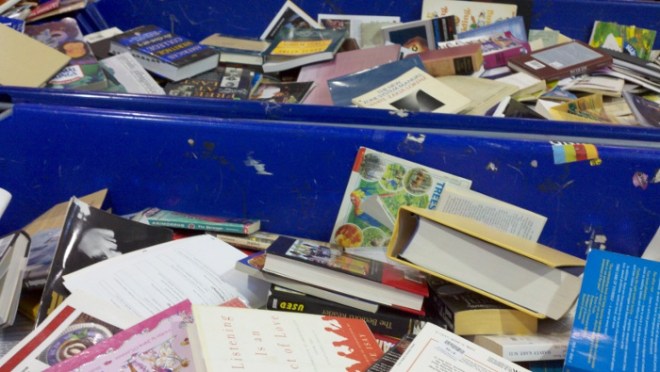
And just a tiny number of the books:

Clothing and exercise equipment:

These pictures? Show just a tiny fraction of what goes through those bins every day. Every hour they’re switched out, with leftovers taken away, and new items rolled in. What you see is some of just one hour’s worth of stuff, in one day, out of seven days a week, fifty-two weeks a year, in just one Goodwill outlet store in one city. While occasional items may end up going through multiple owners and happening to end up back here a second time, generally everything you see here is on its first–and only–trip to the Bins.

In addition to all this, imagine how much stuff gets either bought or thrown out from Portland yard sales, or from other thrift stores. Think about damaged items, including food, that Fred Meyer and WinCo and WalMart toss out, just in one metro area. Consider all the perfectly usable items people throw away in this city every day, simply because they don’t want to get up and find a donation location, or because they feel that somehow these items are no good, or that they don’t want someone else owning something that was theirs (yes, I have run into this attitude before).

And then think about this in all the cities, towns and rural areas just across the U.S. Landfills. Incinerators. Illegal dumps.

What I picture above isn’t even a drop in the bucket. It probably isn’t even a molecule. And it’s immense in the face of what I was able to take home that day.

This is what gets me going again. I am dismayed by the waste. I am angered by the gross materialism. I am disgusted by the snobbery that says “secondhand is trash, I deserve the BEST”.

So I live my ideals to the best of my ability. Maybe a dozen items in my wardrobe beyond underwear were purchased new. Almost all my books (other than some textbooks that I had to buy new) are secondhand. After my divorce last year, I restocked my kitchen in Goodwill’s aisles. And my art supplies? Sure, there are the pretty fox tails and wolf hides that are byproducts, but most of what I have comes from fur and leather coats, secondhand jewelry, random reclaimed tchotchkes, and the like. If I don’t get it from thrift stores or SCRAP, I’m buying other crafters’ leftovers. Almost everything I make has at least some secondhand component to it. Hell, sometimes I even buy supplies at the Bins to donate to SCRAP, just so someone gets to use it.

And yet, my efforts don’t even really register in the grand scheme of things, which is why I need to look at a more local, starfish story level just to keep from getting all despondent and overwhelmed by it all. But sometimes it’s good for us to get overwhelmed a little, to realize just how much there is to do and why it’s so urgent. We are wasting resources to an unprecedented degree–and it all comes down to the choices of individuals that add up cumulatively.

So: is there a trip to the Bins or their equivalent in your future?

On Dead Critters

So after my last post about strip-mined crystals and sustainability, it got me thinking more about the animal remains I use in my spirituality and artwork.

One of the things that I have always tried to do, ever since I started doing artistic and spiritual things with animal parts in the 1990s, is to try and use secondhand ones as much as possible. Early on while still in the Midwest, I haunted antique shops for old mink fur coats, and one of my best finds ever was a very old bear skin rug for $50! Since then, I’ve found more sources for old fur garments, taxidermy, even old Davy Crockett hats with real raccoon tails stitched to fabric tops. And I still generally prefer secondhand over new.

However, there are different degrees of “secondhand”. There’s secondhand as in the antique bobcat rug that I turned into a dance costume. And then there are the tails I use in my art, which mostly come from furriers, who don’t generally use the heads, tails or feet of hides, so other people like me make stuff out of them. And that’s a different sort of re-use.

See, if something is left over from food or subsistence hunting/trapping or the garment industry and never had a specific post-death use before, it’s really just a discard. Whoever had it first (other than the animal who wore it) didn’t actually do anything with it other than toss it away, or offer it to be sold to craftspeople like me. That’s using every part of the animal, but saying it’s secondhand is like saying that the bags of dried corn husks left over from food-grade corn that are used for tamales or crafts are secondhand. Yes, it’s great that the processor of the corn can sell the husks instead of tossing them, but they’re still technically a new product. In the same ways, the bundles of fox and other tails that are left over when fur coats are made are new as well. Granted, they’re not being incinerated or tossed in a landfill, but I wouldn’t call them secondhand.

So what do I consider more properly secondhand?

–Old fur and leather coats that I cut up to make into other stuff
–Taxidermy bought from a taxidermist’s private customer, not the taxidermist directly
–Animal parts that were owned by another private individual as part of a collection, or destashed from art supplies
–Other random items that were previously owned by another private individual, ranging from real-feather feather dusters to novelty armadillo purses

Why is this important? Because some people feel very strongly for spiritual and/or ethical reasons that the animal parts they work with in their spirituality should be secondhand. Leftovers from the fur industry are great to be reused, and I am happy to incorporate them in my work, but they are still new, not secondhand. And for some people, that’s not far-enough removed for their comfort, which I can certainly understand.

I feel it is important to make the distinction between discard and secondhand for honesty’s sake. I have seen sellers of animal parts at various places on the internet claiming that the heads, tails and other new discards they get from the same sources I do are “secondhand”. And, caveat emptor, there are sellers who will even claim something is not only secondhand but vintage in order to try to seem more ethical. Not all sellers do this, of course, and there are some people who do offer genuine vintage and otherwise secondhand animal parts; additionally, honest misidentification can happen. However, I feel those who are deliberately misrepresenting things with dubious stories are doing a huge disservice to the customers who trust them as well as to the spirits of the animals they misrepresent.**

And that latter part, about the animal spirits, is especially important to me. My whole reason for starting this form of artwork over a decade ago was to give the skin spirits and their remains a better afterlife than being a trophy or status symbol, and that is still one of the central goals of my work. If I deliberately sell a farmed fox tail as wild–or for that matter, as a “natural death”***–or a new one as vintage, it dishonors the spirit, the customer, and my art. It is both a spiritual and ethical issue, one that I feel needs more discussion.

**It might be enough to make some go vegan!

***A postscript on that whole “natural death” thing and related topics: I occasionally will have people contact me and ask whether I have any animal remains from animals–such as wolves–that died naturally, either in the wild or a zoo or other facility, or at the very least were accidental roadkill, or were “nuisance kills”. If an animal dies in the wild, it will almost always become food immediately; the best you can hope for is to find bones and maybe a scrap of rotted hide, for the most part. Zoos and wildlife preserves generally don’t sell the remains of their deceased inmates; they are usually either cremated or donated to science (and here’s a great article about dead zoo animals for your reading pleasure!). Roadkill often is too beat up to do more than salvage some bones, and enough states have laws against picking up roadkill that it’s a legal risk anyway. As to nuisance kills? Well, sure, there may be some use to killing a coyote as part of population control, but hunters and trappers help keep the population down, too–“population control” is just another term for “officially enacted hunting and trapping”. Ethically, it’s really not much better than regular trophy or food hunting.

****Somewhat related, and continuing the discussion on ethically-sourced art supplies, is this great bit of research on Fire Mountain Gems’ suppliers. Since a lot of people buy jewelry supplies from them, to include stone and metal beads and findings, this is good info to have!

Stripping Away the Mined Crystals

So over on Witchvox, Heather Awen has articulated something that’s bothered me for years. Go read the entire article, please, as my summary won’t do it justice, but in short she points out the hypocrisy of using crystals and other mined stones to “heal the Earth”, when those rocks come from strip-mined locations that produce pollution, employ abused workers, and are otherwise incredibly environmentally unfriendly. And I completely agree with her.

Mind you, I don’t feel that we can stop mining entirely, not unless we want civilization to come to a complete halt. We’re entirely too dependent on minerals from deep inside the Earth. However, we can at least start with taking the blinders off about where the resources we use–all of them, from rocks to food to cotton fabric–come from. To me, being environmentally friendly isn’t about making specific choices like “paper or plastic?” according to some sustainability bible, so much as it is about making informed choices, no matter what those choices are. Being more aware of what goes into our decisions and what factors affect them can help us to remember to include not only our own wants and needs, but those of others, in our ultimate answers.

Like food. Sometimes I have enough money to buy organic produce, usually in the summer when the farmer’s markets are full of direct-to-consumer sales, and the cutting out of the middlemen means that prices are competitive, if not better, than the stores–I can get a huge bundle of carrots for two bucks, for example. Other times, it’s off to WinCo where I’m after a smaller grocery bill to avoid living on ramen. Still, I keep the organics in mind even when I’m getting conventional produce and the like, and if I find a good deal on a more earth-friendly option, I go for it.

Of course, I feel the most important of the three environmental R’s is Reduce. Pagans are notorious for buying not only ritual tools, but random tchotchkes to scatter about the home. Plenty of pagans’ homes are full of statues, pictures and other images of deities, spirits and nature, along with Celtic knotwork-bedecked tapestries, candles–and, of course, strip-mined crystals. Many of these were purchased new, and a good number of them were made in China, India or other countries that aren’t so strict on slave labor. Do we really need these things? Really? Does it make us more pagan to have them? Of course not, and there are plenty of articles in print and online about how you don’t need tools to be a pagan, and how to be pagan on a budget (which includes things like using kitchen knives as athames).

The people who have these things are generally well aware that they don’t need them–but they do like them. And while I am fond of the concept of Reduce, I am not going to tell people “Environmentalism: this is why we can’t have nice things!”. But we can be more selective in the nice things we do have. For example, almost all my ritual tools were either handmade by me or another artist, or found in the woods, or secondhand. There are a few small things from early in my paganism that I bought new, but those are the exception. And even when I was in my BUY ALL THE TCHOTCHKES phase, I wasn’t going to Dollar General or Wal-mart and buying cheap-ass, poorly made statues from slave labor. I was going to thrift stores and flea markets and buying others’ discards.

Still, a secondhand strip-mined crystal was still strip-mined, and I feel it is important to remember that when we make decisions. When people want to choose greener options for working with animal parts and are not in a position to just find them in the woods, I recommend they buy secondhand and vintage–which does reduce the demand for new deaths, but it’s still the remains of an animal that may have had an awful death (hence still also advocating for both spiritual and material ways to make up for one’s purchase). Less impact does not mean no impact.

So what to do? Choose carefully. Do you need something, or do you just like it? Are you giving money directly to an artisan, or are you paying a factory who will give their workers pennies out of the price? Are you reusing the resources already in circulation, or are you creating demand for more dead teak trees? I can’t make your decisions for you, and they may be different in each case. But at least please consider this discussion food for thought.

Addendum: While this article was in half-finished mode, Heather wrote an awesome follow-up to her Witchvox post over on her own journal. There are some great tips on choosing greenly!