I Don’t Believe in Karma

I don’t believe in Karma (the New Age version, that is, which for the purposes of this discussion I’m separating from the Hindu and Buddhist versions thereof). Or the Threefold Law. Or any other attempt to stuff morality and ethics into a nice, neat proportionate package, which I’ll abbreviate as Karma/3FL. Karma/3FL states that if you do bad things, bad things will happen to you, and if you do good things then you’ll receive that good in return, sometimes in the same proportion, sometimes in some set multiple like three.

Karma/3FL is a way for people to give themselves a sense of having more more control over the external world than they actually do. Or, if they don’t have direct control, they want to be able to put themselves at the mercy of someone or something that does. Hence you have people wanting to believe that bad people get what they deserve no matter what and that some invisible force above us all makes it so.

At the other end of the supposed spectrum there’s senseless chaos. Why, if we didn’t have Karma/3FL, then bad people would just keep doing bad things without consequence, and good people would keep getting hurt for no apparent reason. To an extent that is the world we live in. There are people who die of old age having spent their lives abusing others with impunity and reaping the benefits thereof. There are wonderful people who die too young, after hard lives of unfairness. Karma/3FL is a great way to distract ourselves from that perceived imbalance and to pretend that, behind the scenes, really those bad people were suffering in private, while the good people find riches despite their suffering. (For a truly esoteric extension of this, just look at how many people comfort themselves with the idea that this person went to heaven, but that person is being punished in hell, now that they’re all dead. If they didn’t get their just desserts in this life, well, by golly, they’ll get them in the next!)

We really have no proof of this balance beyond confirmation bias, that bugaboo of thoughts that keeps us blinded to anything except that which supports our beliefs. If Nasty Individual has five good things and one bad thing happen to them, we conveniently ignore the first five and only focus on the last; supposedly that’s enough proof that they got their due. Yet people keep thinking in this regard because it comforts them more than the idea that the dastardly villain got away with it after all; that injustice is unfathomable. It’s easier to weave a fantasy around it in self-defense than to live with that stark reality.

This is the cognitive error that Karma/3FL can promote: the idea that the world is more just than it is (see “just world hypothesis”), and a justification of empathic laziness. It makes people make up stories of an ordered world to protect themselves from a world of chaos, but in doing so it also dampens compassion for those who are just “getting what they deserve”. It’s mean-spirited besides; in fact, I feel that at the heart of Karma/3FL there’s a distinct streak of Schadenfreude.

I prefer to think of being in a world of agency and acceptance. Agency means that we do have free will and ultimately our lives and the decisions we make are all on us. It can be scary the moment we come to realize that there’s no one else holding the steering wheel of our lives—that we’re it. There’s no great balancing force that “makes everything better”; there’s just us and the choices we make. And the claiming of that agency is terrifying, so much that many of us dive right into denial at the thought.

The answer to that is acceptance. Crying about the fact that there’s no one to make our decisions for us isn’t acceptance. Pretending that that mean person who hurt us is secretly wracked by three times as much pain isn’t acceptance. Passively “letting Karma/3FL do its job” isn’t acceptance. Acceptance is allowing things to be as they are, no matter how seemingly injust, and acting from there.

Acceptance also means accepting that there are many, many factors that we simply cannot control. Humans have built up our species on control; we control our environment and other species, as well as other humans, to an unprecedented degree. So we stamp our feet and throw tantrums when we reach the end of our ability to act in a particular direction. We don’t know when enough is enough. If we don’t control everything, then everything falls apart—or so we think. We want to impose order on the world, personally and globally, because it makes us feel safer from the things we actually don’t have any control over.

Yet there is already order in the world, albeit a more organic one. I take comfort in the fact that the world is made up of systems that have developed over millions upon millions of years, from the atmosphere and weather patterns to continental drift to the biological imperative to procreate. These were not created by beings that were trying to pretend they had more control than they do, but beings accepting (not necessarily consciously) that the world is a particular way in this moment, and this is how to adapt to survive it. Non-biological systems were shaped by the laws of physics—pressures and movements and speeds and resistances—all predictable and knowable at some level. Instead of screaming and ranting when these systems don’t do what I want, I can flow with them as as being who developed within them, and I find comfort in that.

Like earthquakes. I can’t stop an earthquake. If Portland got hit by The Big One tomorrow, there’s not a damned thing I could do to stop it. But I can educate myself on what to do if it hits, and what resources I need, and what to do in the aftermath. Comforting myself with the idea that the earthquake happened for some abstract reason, or that maybe some bad people lost their homes or even died in it, certainly is no replacement for preparedness. In fact, making up stories about how earthquakes happen to punish bad people (I’m looking at you, Pat Robertson) just distracts time and attention away from knowing more about plate tectonics and how that study may someday help us predict earthquakes and save lives.

In the same way as preparing for the reality of an earthquake instead of my control-freak fantasies about it, I can’t just patch over the ugliness in the world by pretending that Karma/3FL has it all covered and that it all “happens for a reason”. Instead, it’s my task and even duty to roll up my sleeves and work to make this world a better, more compassionate place, not to earn myself karma points, but because the world isn’t just, and I can do something to help those caught in the injustice. It’s something that requires me to challenge myself and my perceptions on a daily basis, to be vulnerable even when it’s terrifying, and to be courageous even when I tremble. I have to leave the comfortable realm of black and white and get messy in the gray areas in between.

And I have willingly cast off the blinders of Karma/3FL in favor of embracing my agency and my ability to act within the world, even as I learn the boundaries I have to work within. True, there’s the challenge of getting over the fear of lack of control, and acceptance of the limitations of my agency, however frustrating that may be. But isn’t it more productive to maximize the use of the control I actually have rather than engage in spiritual and mental fantasizing over control that I can’t, and will never, have? That, I think, is worth facing the fear of the loss of control and the false promises of balance that Karma/3FL claims.

Coming Out of the Crazy Closet

This is a post I’ve written and re-written a number of times. It’s probably one of the most difficult posts I’ve composed, simply because I feel so vulnerable about it. But I’m finally at a place where I feel comfortable sharing this here.

I have a mental illness, specifically Generalized Anxiety Disorder (GAD). It’s something I’ve struggled with for most of my life; I can remember its roots in being a particularly sensitive and easily-worried child still in elementary school (and it just got progressively worse from there). But I wasn’t formally diagnosed until a couple of years ago, when I was seeing my therapist for sessions during graduate school. I told her of my suspicions, as I’d read the DSM-IV cover to cover for my diagnosis class, and so we sat down with the book and looked at the criteria for a variety of conditions. GAD was the one that fit the best, and all of the criteria were very familiar to me.

So why am I telling you this here, on my blog that’s supposed to be about shamanism? For one thing, it’s the platform I use the most for writing these days, and I want to have a basic “here’s Lupa on GAD” post that I can refer to when talking about this later on. Talking is good therapy for me, writing being included in “talking”. If being more open about my anxiety helps me to get better, then that’s an additional bonus.

I am a strong supporter of mental illness awareness and advocacy, moreso after having gotten my Master’s in counseling psychology. Even though I understand and empathize with my reasons for having stayed mostly closeted on this matter in the past, I have felt for a while like a hypocrite. I encourage others to be open about their mental conditions if they deem it the right time, and I feel that more open discussion about mental health, to include careful self-disclosure, can help facilitate better resources and less prejudice.

Yet I have hidden my anxiety away like a bad habit. Even having that degree, even having worked as a counselor, even knowing and believing beyond a doubt that mental illness is nothing to be ashamed of, my own fear–and the anxiety–kept me quiet. And now I’m breaking that silence. Why?

While I have not yet “officially” used my Master’s degree, having spent the year since graduation being a fully self-employed author and artist (and recovering from the stress of grad school and corporate life before that), there’s still the possibility that some day I may need to get a job as a counselor at an agency. Even though the counseling profession is supposed to work against the stigmatization of those with mental illnesses, there is still a strong taboo against mental health professionals who are mentally ill. Even though such professionals as Marsha Linehan (the developer of Dialectical Behavior Therapy) and Kay Redfield Jamison have publicly discussed their illnesses, the stigma remains–especially if you aren’t a well-established professional yet. So even though I did well in my year-long internship counseling addicts in an inpatient setting, and was open with my supervisor there about my GAD, and we worked together to make sure it wasn’t a liability, I still worry that other supervisors, potential employers, and the like may not be so supportive.

Clients can go either way. Some clients are put off by knowing their therapist isn’t perfectly psychologically hale, especially as mental health professionals are often idealized as “perfect authorities”. But some clients feel more comfortable knowing that the person in the chair across from them might know a bit about what they themselves have been struggling with. I never told any of my clients in my internship about my anxiety, but having GAD did help me to empathize more with them. It also made me more aware of my own boundaries, and where the GAD could weaken my ability to deal with sometimes very challenging clients.

Then there’s the more general stigma. Many people still equate mental illness with everything from homelessness to senseless shootings as in Aurora, CO. Mental illnesses are seen as ticking time bombs. Or they’re dismissed; we are told to “just get over it”. We who have these illnesses are marginalized and stigmatized. It’s easier to ignore us or make fun of us than to help us and try to understand the complexity of our different way of viewing the world. Some people still even conflate alternative spiritual views as a whole with mental illness, and there’s the chance that me being out of the crazy closet will just fuel their misconceptions.

Continuing to hide my anxiety disorder just perpetuates stigmatization. One of the most effective methods of teaching is modeling. If I model the idea that it’s okay to be mentally ill and open about it, if I can just talk about it like an everyday (albeit unwanted) part of my life, then hopefully I can help others to do the same, whether they’re mentally ill or not. I’ve gotten so many emails from people who have told me that my writing here, and in my books and other places, has been a huge help and inspiration to them. By coming out as having GAD, my hope is that I can continue to provide inspiration to others fighting their own battles with mental illnesses.

There’s one other reason I’m bringing my anxiety up here, and that’s shamanism itself (see? It IS relevant here!) There is a misconception that because some indigenous shamans have had mental illnesses as part of their initiations/shamanisms, that this means that you have to have a mental illness to be a shaman, or even that mental illnesses ARE shamanism. I find these to be inaccurate and dangerous conflations.

First, it’s demeaning to indigenous cultures to assume they don’t know the difference between someone with a mental illness, and a shamanic practitioner. While there is some crossover in some cultures between SOME mental illnesses and SOME shamanic and spiritual traditions, it’s specific in degree and nature in each culture and even each community, and to say that they all see them as one and the same is short-sighted and inaccurate.

Second, here in the dominant culture in the United States, it is downright dangerous to equate mental illness with shamanism. “Mental illness” is a broad, broad concept. If we include the various entries in the DSM-IV (some of which are developmental disorders rather than “sicknesses”), we’re talking everything from autism to depression and anxiety disorders to Cluster B personality disorders such as Antisocial and Borderline. If shamanism helps you deal with your mental illness better, whether as a client or a practitioner, great! But there is no cure-all or universal treatment for mental illnesses in general, and I oppose the broad-brush assumption that shamanism is the magic bullet.

And there is one more reason I am talking about my anxiety disorder here on my shamanism blog: I want to emphasize that for me, GAD is NOT a facilitator of my shamanism. I know some shamanic practitioners of varying traditions for whom their mental illnesses are assets, or at least tools. And some of them do help manage their illnesses with their shamanic practices.

But I know for a fact that I am not the only shaman who would give up their mental illness in a heartbeat if they had the chance. Reducing the stigma against mental illness doesn’t mean automatically stopping treatment and accepting things as they are forever more. I’m still trying to get rid of my anxiety disorder. GAD does not make me a stronger person. GAD is my weakness, my Achilles’ Heel. If I did not have my anxiety, if I could shuck it off of me like an overworn, stinking old coat, I would be so much the better for it. I could function better as a person, as a shaman, as a professional of several fields. GAD cripples me at times. It is not my friend.

Do you know what GAD is like for me? It’s daily, almost constant, worrying over things that I know I shouldn’t worry about, but that my limbic system tells me to be on guard against anyway. I’m not talking about being aware of spirits. I’m talking about nights of insomnia fueled by the fear that I’ll get up the next day and all my money will be gone, or that my partner will suddenly leave me for someone else, or that I’ll die of cancer before I ever get the chance to own my own home. It’s overreacting to small setbacks because my brain automatically catastrophizes and focuses on the very-worst-case scenario in perceived self-defense. It’s being irritable and short-tempered because everything just hurts, where emotionally and psychologically I feel like I’ve been flayed and every single stimulus is agony.

It’s being so exhausted from trying to keep my emotions on an even enough keel to be able to function on a day to day basis that I sometimes have to take a mental health day to recover from the fatigue of that daily battle. It’s the constant ache in my trapezius muscles because I carry all that tension and worry in my shoulders. It’s knowing that the chronic acid reflux the anxiety caused could kill me early with esophageal cancer. It’s knowing that I am at a greater risk of heart disease because my anxiety puts such constant heightened stress on my body, to include abnormal levels of adrenaline and other such chemicals.

None of these things make me a better shaman. Okay, yes, you can argue that my experiences have been “character building” and I’m a better shaman and person for having “resiliency” and “empathy” built from dealing with anxiety for decades. But some day I want to be able to say “I used to have GAD, but I finally overcame it, and I’m better for it”. I refuse to let go of that goal to settle for the consolation prize of “might as well just be a shaman since I’m nutty as a fruitbat anyway”. Part of being a shaman is healing others, but part of it is also healing the self, and even if I never do get completely better, I’m not going to stop trying to find my cure, and my path to a life without abnormal levels of anxiety.

So there you have it. I’m out of the crazy closet. And I want to note that I use the term “crazy” not in its derogatory manner, but tongue in cheek, and with a bit of cynical humor. When the anxiety really gets going, I really do feel crazy in that out of control, my-brain’s-been-hijacked way. But I’m so used to talking about “anxiety” in serious, overwrought tones that talking about “the crazy” or “I had too much crazysauce today” or asking my partner “You still love me even though I’m a crazy girl, right?” allows me to acknowledge it with some contextual silliness. Those I use it with know I’m not crazy in the stereotypical sense, but it’s a convenient code for the illness that pervades my life.

So hi, I’m Lupa, and I’m crazy. But I’m working on getting less crazy.

(As with all my posts, comments are screened until I decide they can come out to play. I know most, if not all, of you will be perfectly cool and supportive about all this. On the off chance someone decide to be an asshat, know that your comment will be BALEETED before it has a chance to gasp for its first breath of air.)

Some Observations on Plant Totems vs. Animal Totems

If you’re at all familiar with my writing, you’ll know I’ve been writing about animal totems for years. Animal totemism has been a foundation of my practice pretty much from the beginning, way back in the 90’s. I’ve always had some connection to plant totems as well, but they’ve had more of a background presence in my life. A lot of that is due in part, no doubt, to the fact that I am an animal, and therefore I resonate more easily with other species of animal. So it’s been harder for the plants to get through to me; sadly I’ve seen them more as scenery in my journeys and other works than as active participants.

White trillium near Triple Falls, Oregon. Photo by Lupa, 2012.

Over the past few years, though, and especially as I’ve been spending more time in deeper wilderness, I’ve been more aware of the bioregional nature of the spirit realm. Animal totems don’t just exist as disembodied spirits in a void somewhere, but in spiritual ecosystems with the totems of plants, fungi, stones, and various other spiritual beings. What I’ve become aware of is that there were deep connections with plant totems all along, and I just wasn’t appreciating them for what they were. For a while now I’ve been spending more time meditating on those relationships and really getting a feel for them, and now I feel ready to share my thoughts.*

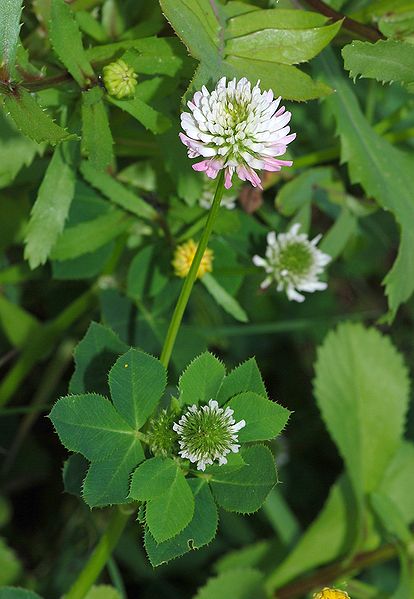
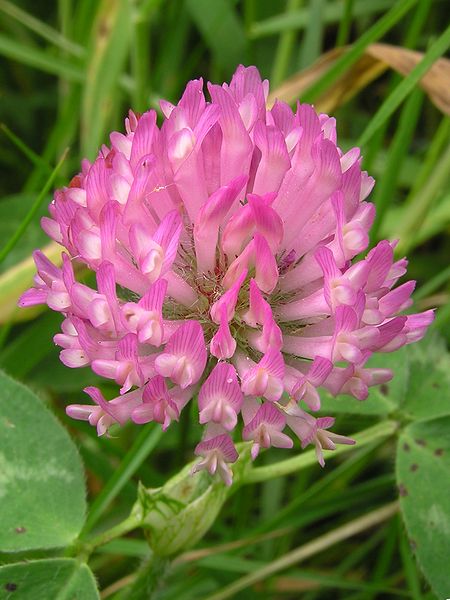
Some of this is due to the way in which the plant totems have tended to relate to me. Animal totems are very active and pro-active. Like their physical counterparts, they’re frequently on the move, going from place to place, and they’re used to making the first contact with a person. They view the world often as a series of tasks, challenges, and things to do. And we humans follow suit. Plant totems, on the other hand, have a much different perspective. They are often acted upon (though certainly there are examples of plants acting on animals, and definitely on other plants). While a plant totem can make itself known to me, it’s usually after I’ve made the first contact. In my last post here I talked about how White and Red Clovers came to me and talked to me about some of our early experiences together, but it was only after I thought about them and gave them that opening.

So we often take for granted that a totem being will come to us if there’s something important to know. I wonder, though, how many plant totems have messages and conversations ready for us that go unheard because we don’t pay attention? And what sort of attention should we pay, anyway? Most of the things I have learned from plants and their totems have been through a sort of experiential osmosis–absorbed in my senses and pores without consciously realizing them, inhaled and digested as a matter of daily goings-on, rather than being actively sought and observed with animals. Yet these can be incredibly powerful and moving lessons, and I am amazed at just how much I didn’t realize I have gained from plant totems over the years.

Another consideration is that a plant is rooted in one place, something that is alien to most animals (especially terrestrial ones). Other than a few house plants that get repotted, plants generally stay in the same place their entire lives. Even widespread plant colonies that expand their boundaries through growth still have limited “travel” by our standards; most of us couldn’t think of living our entire lives on a single acre, never mind being rooted in the same place for life. Not that plants know nothing of the world; part of my unverified personal gnosis is that plants (or, at least, their spirits) communicate through their intricate root systems. Plants do move. They grow, they shed, they expand, they move with the wind. A plant is not a still being. We can’t see it with the naked eye, but plants breathe, and they convert sunlight to food. Like the depth of understanding, plants know how to make the most of the spot they’ve taken root. Forests, for example, are a living race upward, each plant jockeying for the best spots to get sunlight.

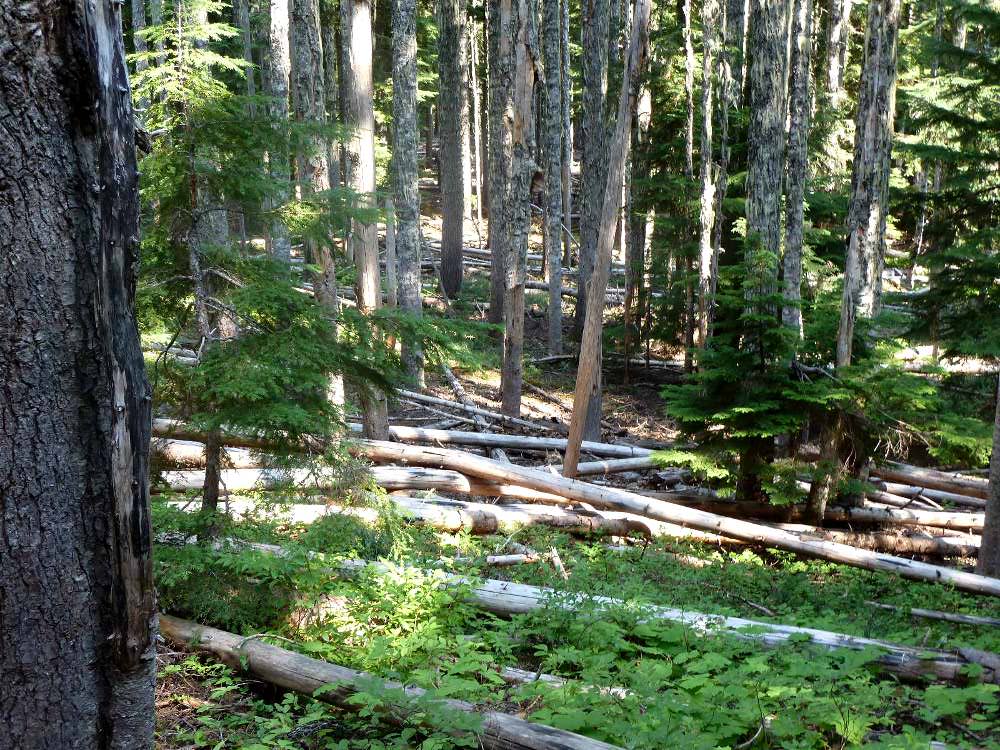
Photo of Douglas fir forest on Mt. Hood near Barlow Pass, Oregon. Photo by Lupa, 2011.

And the plant totems, being connected to every individual of their species, can often have a very deep understanding of many places and what goes on there. Tree totems in particular can be very significant wells of knowledge of places. That’s another thing that can throw us humans off about plant totems. Animals have comparative breadth of knowledge about a place; they can know their territory intimately, but it’s still limited primarily to the surface (or water, or tunnels, or whatever their primary habitat is), and they can be easily removed from their territory by rivals, by a lack of food, by humans, and so forth. Plants, on the other hand, know one place very deeply, investing an entire lifetime in one spot, one view. A plant can be uprooted and moved if young enough, of course, but left to its own devices it will concentrate on the one place it’s rooted until it dies. And so we don’t always understand the “depth” observation that plants take versus our “breadth” animal understanding.

When the Clovers were talking to me about how I still carry the lessons I learned early on, even though one of the places I learned them has been destroyed and others are off-limits, that was a testament to the plant totems’ patient, long-distance way of perceiving. Like a tree rooted in a forest, some of the features and beings around me and my life would change, but I remained. (And, likewise, I may someday be one of those features in someone else’s life that goes away, while they themselves remain.) I really had to stop and think about what they were seeing in me, and more importantly how they were seeing me. Where I was caught up in a piece of my lateral landscape that had changed forever, they were taking a longitudinal assessment of me as a constant factor.

There’s a lot of value in the alternative style of perception and understanding that plant totems have. It can be difficult to engage sometimes because I’m not used to it. But the more I consciously engage with what the plant totems have been sharing with me without me realizing it, the more grateful I am to them for it, and for the patient, ongoing contributions of their physical counterparts.

* Incidentally, I’m also working on exploring my experiences with fungi totems, stone totems, spirits of places, and other not-animal, not-plant beings as a greater exploration of the spiritual ecosystem, and I intend for my writing to unfold and reveal these explorations over time, traveling deeper into the foundations of the ecosystem. But for now–you gt my thoughts on plants, because I’m just linear that way. Plus it’s a lot easier for many people to start wit what’s familiar and progressively move outward, and I figure it’ll be better for everyone if I take this progression from “more like me” to “less like me”.

White and Red Clover as Totems

I’ve been thinking again about my now-deceased little patch of woods from my hometown. I can’t have that place back ever again; even if the pharmacy that’s there now were to be torn down, the plants that would regrow wouldn’t be the same, and the geography’s been changed, flattened out. And so I mourn that loss. (As an aside, I’ve written even more about it recently at No Unsacred Place.)

In the process of mourning, White Clover and Red Clover came to me. These low-lying legumes were a big part of my childhood explorations; I spent many hours outdoors lying in patches of three-lobed leaves and fragrant white flowers, and eating the pink petals of the larger red species. Spring was always marked by the arrival of the first clover buds, and throughout the summer I would silently cheer any time the flowers got high enough to be made into necklaces before the lawn would get mowed again. My favorite hiding places were where the clover and other plants were allowed to grow high and thick, instead of being cultivated into submission as with most of the neighborhood.

As I grew older, and eventually moved to several places around the country, I always found clover–white more often than red, but both of them still made strong showings. And they were persistent. Even when I lived in paved-over old industrial areas of Pittsburgh where bricks and old run-down buildings were common, clover stubbornly populated open lots and little scrubby patches by the sidewalks. Here in Portland I see a lot of white clover, to include places where organic urban gardeners plant it as a cover crop. Red is more rare, but I’ve seen it on occasion, often on the edges of parking lots and other hardscrabble places.

And as I have mourned my loss, White and Red Clover reminded me of all the times I’ve seen them over the years and how that’s helped me to maintain the connection to my childhood wonder at the world. I realized that although I’ve lost a specific place dear to me, I never lost the connections that were formed there. I’ve taken these connections much further, too, out of suburban lawns and into empty lots in cities, and the wide open territory of the Columbia River Gorge. I’ve gone from a tiny little creek trickling through my second patch of woods, to the rivers the bridges in Portland cross over–and to the Pacific Ocean itself.

I am not lost. I am still here. Wherever there is clover, there is also the connection I grew up with. I do not need to feel connected only to the patches of clover in a yard I no longer have permission to enter, or in a field that no longer exists. I also have the clover in the neighbor’s yard that I walk by several times a week, and odd patches here and there throughout Portland. And just as I carry the lessons taught by family members many years deceased, so do I carry what I learned from White and Red Clover, and Periwinkle, and Black Poplar, and Eastern Red Cedar, and White Oak, and so many others through their physical counterparts as I went from a seedling to a sapling to a fine young tree myself. These still stand out to me, so many years later, as a collective of plants and their totems who were so incredibly influential. Some of their children are now dead, victims of the destruction of one place. But thankfully the species and the totems live on, and no one can take that from me.

And given that neither White nor Red Clover are native to the United States, their ubiquitous presence helps me to feel at home where I might otherwise feel rootless. Similarly to Douglas Fir, the Clovers have helped me to be as flexible and adaptable as they are in a new place, particularly as I was not even born on this soil. Part of that grounding does come from reminding me of my roots, and teaching me to set them down wherever I go. If they can bloom where they’re planted, so can I.

I find all this comforting. I have lost, but I am far from alone–or rootless. White and Red Clover showed me that.

Poison Oak as Totem

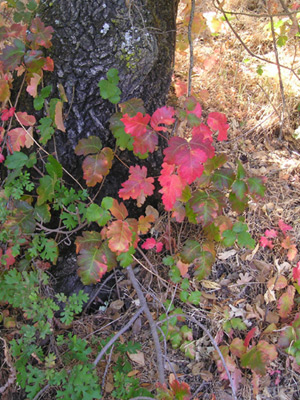
A comment on my last post at No Unsacred Place brought up the itchy, urushiol-soaked leaves of poison ivy and poison oak. I am quite sensitive to all of the plants that exude this compound, and admittedly all they’ve inspired in me has been much cursing and complaint on the occasions we’ve had too close an encounter.

Elinox, the commenter who brought these plants up in the first place, mentioned the idea of a shadow totem. A “shadow totem” is a newer concept that seems to be an odd extrapolation of Jung’s Shadow archetype; a shadow totem represents or embodies something that we fear or are otherwise uneasy with. It’s not a concept I work with myself as I find it a little too much of a pigeonhole, but I agree with the general idea that sometimes we have to face some really difficult things in our paths.

So I meditated some with Poison Oak today to consider our relationship–such as it is. Like thorns and other obstacles, Poison Oak and her kin developed urushiol as a way to avoid being eaten by animals. It does mean, of course, that poison oak is not an especially cuddly plant, and the totem was correspondingly strict about personal space, though pleasant otherwise. She’s actually quite friendly; she just maintains very firm boundaries.

And that’s a very important lesson for me, especially as a woman in a culture where women are still often treated as though our boundaries don’t exist. If we object to catcalling, or sexual harassment, or any of a number of other nonphysical boundary violations, we’re told that we’re “bitchy” or “making too big a deal about it”. If we’re assaulted or raped, there are people ready to question what we did to deserve it–were we drunk, or scantily clad, or walking alone at night, or hanging out with the “wrong people”? In the same way, simply for defending her boundaries with integrity and creating a consequence for violation, Poison Oak is vilified. How much do you hear about this plant for any reason other than “this is what it looks like–DON’T TOUCH IT!”?

This goes beyond women, too. There are so many situations every day where people are expected to yield to those who are more powerful, who have no respect for their needs or integrity or safety. The abuse of power is rampant on all levels of American society and beyond. It’s no wonder, then, that so many put up fierce defenses, even against those who mean them no harm. And it can be easy, if a person doesn’t let us in as far as we want, to vilify them for not giving us what we demand.

Poison Oak also told me to examine my own boundaries. I sometimes feel a lot of guilt for maintaining the boundaries that I do. The older I’ve gotten, the more of an introvert I’ve become, and I’ve sometimes gotten criticism for that. More extroverted people don’t always understand that introverts’ quiet and solitude isn’t about them.

There will always be people who feel entitled to my personal space–strangers who don’t understand that it’s a problem if they suddenly come up to me and start flirting, or those who feel entitled to fill an entire residential block with the loud, bass-heavy thumping from their stereo system. These people tend to complain if someone challenges them, and it can be hard to stay true to my own boundaries when they’re trying to paint ME as the bad guy for standing my ground and insisting on my comfort.

And there’s only so far I should allow others to make comment on my spiritual practices. I’ve been spending a lot of time lately trying to defend myself against people who criticize me for being an American of European descent trying to put together an animistic practice, and from people who are uncomfortable with or even incensed by my work with animal parts in art and spirit. While being aware of what others are saying, and my own power and privilege, is a good practice to cultivate, there is a point past which I need to maintain my own integrity and preserve the roots I have set down to give myself more balance.

However, I also need to be mindful of the negative effects that my own “urushiol” can have; sometimes boundaries can be too tight. I sometimes have to make a real effort to get out and be social, not out of any fear of socialization, but simply because I am so comfortable in my personal space that I simply neglect to come out of it at all. Over time, others feel they simply can’t approach me, and so sometimes I need to demonstrate that yes, I can be sociable!

And in some ways I grew up with a certain level of entitlement that’s been hard to shake even at this point of my adult life. I was raised in a town where people were very prickly to each other, where being bullied taught me that everything is a personal offense, and where people always looked for someone to blame for whatever went wrong, even something as small as a delay in traffic. Poison Oak’s “passive” defense isn’t an open attack, and she doesn’t go out of her way to cause trouble. It’s something to keep in mind as I continue unraveling this unwanted part of my past conditioning.

By the end of the conversation, I saw a good deal of myself in Poison Oak, and vice versa. While I’m sure I’ll be unhappy the next time I end up with an itchy red rash from brushing up against her progeny’s leaves, I won’t blame them at all. Urushiol is only the protection that Poison Oak has developed over time, and it’s really rather effective. If I can’t touch or pick poison oak like I can clover or dandelions, it doesn’t mean the itchy plant is a bad one. It just means I need to respect that plant’s boundaries as much as my own.

This is What Frustration Looks Like

Okay. This is going to be more of a disjointed rant than a highly polished essay, so bear with me.

I try really, really, really, really, really, really hard to be aware of issues of cultural appropriation when it comes to shamanism, and paganism in general. I do my best to address them both in theory and practice. And yet I still feel like no matter what I do, it’s still treading on someone’s toes somewhere. Not that I need to please everyone, but as a member of the dominant culture drawn to work with certain spirits in a particular neoshamanic paradigm, I like to at least think I’m putting forth effort to address the issues of racism, appropriation, and oppression in non-indigenous shamanic practices. And I’m open to more suggestions on how I can do better. I do my best to listen.

But sometimes even I get confused as to what’s supposed to be the best practice. Here are all the messages I’ve gotten from different people on what we should be doing to “do it right”:

–That’s not what shamans do! You actually need to know what indigenous shamans do, so find out more about them.
–Actually, don’t find out about indigenous non-European traditions if you’re not part of them because they’re not yours to use. Look to your European ancestors’ traditions instead.
–Don’t look to your European ancestors’ traditions because you’re an American, not German/Celtic/Slavic/etc. in culture. Create your own traditions.
–Wait! Stop creating your own shamanic tradition from your own cultural perspective! You’re appropriating by looking at general concepts from other cultures and you can’t do that! Go make something of your own without any inspiration from any other culture.
–You’re creating a tradition from scratch? How n00bish. Quit pretending and go find out what real shamans do.
–Don’t call yourself a shaman. Call yourself a witch. Except that’s not really what witches do.
–Actually, call yourself a druid. Druids are European, right? And they like trees, too!
–Or here, how about this other non-shaman term whose commonly understood connotation really doesn’t quite fit what you do and may still piss someone off?

And so forth. Do you see how this can get frustrating? Yes, these are all coming from different people; the critics of neoshamanism are not a monolithic group. And I am exaggerating and generalizing those statements above somewhat, but I’m also trying to make the point that in all the criticism of non-indigenous shamanisms, there’s never really been one good, solid answer on how to address the known issues, to include from the critics both within and outside of neoshamanic practice.

I guess I just don’t want to see non-indigenous shamanic practitioners get so frustrated with being constantly told what they’re doing wrong that they end up ignoring all the criticisms entirely, and go their own way without even considering the potential negative effects they could have. Let me say this, to be clear–I am in complete agreement that there’s plenty of fucked-uped-ness in neoshamanism. There are still a lot of people who are utterly racist and may not even know it, who romanticize indigenous cultures, and even those who knowingly misrepresent themselves for profit. I think there are good reasons for the criticism. Where my frustration is isn’t even that we’re not getting special acknowledgement cookies for trying harder to not be racist and appropriative. And while the experience of Minority A is not the same as the experience of Minority B, I’ve tried thinking about my own experiences as a woman trying to explain misogyny to people and how frustrating that can be, and wonder if indigenous people get the same sort of frustration trying to explain appropriation to others. So this isn’t just “It’s all YOUR fault for not telling me what to do!” I know the answer is to listen to the people who are oppressed, and I’m trying my very best to have my ears open to what they’re saying, to voices that have too often been silenced.

But I’m also at my wit’s end today, having watched yet another attempt to create a conceptual shamanism for a culture that never had it get torn down as racist and appropriative. There has to be some answer in between “Just ignore the critics because they don’t have anything useful to say” and “if you don’t already have a shamanic tradition in your culture then you don’t get to practice shamanism ever”. I just don’t know where that is right this moment, beyond my own personal solution that I’ve been sharing here for years.

So. What do you all think?

The Death of the Place That Raised Me

I am in a small town in Missouri, the place that I grew up in. It’s been a trip of many revived memories, as my mom dug a whole bunch of my childhood belongings out of a storage space in my old room, and I’ve been going through the bittersweet process of sorting through everything, deciding what mementos to keep, and which to let go of as resources to send back into the cycle. So I’m already in a mindset deeply tied into my life as it was over twenty years ago.

Which meant that when I drove to the little patch of woods by my old house that I explored so much when I was still in my single digits, finding that it had been entirely leveled and replaced with a brand new building was an arrow to my heart.

I am still in shock, and so disbelieving. I feel I’ve lost a long-time friend, perhaps one that I lost touch with as I moved away, but never forgot entirely and visited when I could. And I never got to say a proper goodbye. I had no idea that the last time I visited would be the very last.

I know, I know. I get that the fact that this place stayed “undeveloped” as long as it did, in a podunk little town pretending it’s a big city, was pretty impressive. It’s actually the second place that I’ve seen destroyed. The woods behind the house we lived in next, and that I am visiting now, was almost entirely removed for a housing development. The spirit there still lives; much-diminished, and much more jaded, it still lives in the remnants of the woods that flank the artificially widened creek that sluggishly meanders through as best as it can.

And that destruction happened over fifteen years ago, when I’d only had a couple of years to connect with the spirit there. That experience, coming home on the school bus one day to find all the trees save for a few down and shattered–that was a horrible introduction to adulthood, and it really was where my childhood came to an end. Today, even those old wounds pulsed achingly.

I am still angry. I haven’t “gotten used to it” or “grown out of it”. And I feel isolated as I sit in a place where most people wouldn’t understand why I’m so deeply hurt by this loss. I’ve already been told “Oh, but the pharmacy people are so nice!” and given the attitude of “development happens, get over it”. Invalidation after invalidation. And it hurts, it just hurts so much.

That place? It taught me the joy of the outdoors, the fascination with other species, and my place as a human animal. It was my refuge when I began to experience bullying at the age of eight. It was my first minor rebellion, as technically I wasn’t supposed to be over on that side of the hill. But mostly it was a place where I could allow myself to explore, both the physical landscape, and my imagination. I wasn’t just a little girl in a pink coat wandering through the brambles and trying to avoid poison ivy. I was a wilderness seeker, living in a little cabin in the woods. I was a wolf, hunting rabbits in the tall grass. I was a snake basking on a big rock. I was so many things, each time I sneaked through the narrow pathway in the poplars and into the trails around the cedars.

I spent so much time in that place, that little maybe-half-acre of scrub woods, and now–now I can never walk there again. All I can do is hope that the few pictures I took on my last visit, two years ago, are still on my old laptop, that I can have a little more visual aid to help strengthen my memories in the wake of seeing this horrible shift.

Underneath the foundations of that building are the remnants of root systems from scraggly cedar and poplar trees that I hid among when I was young. There, too, are the nesting sites of Monarch butterflies, quite possibly relatives of the one that I watched in its chrysalis every day for two weeks until it emerged one spring day. And there lie the bones of the garter snakes and box turtles that were descendants of the ones I would catch, observe briefly, and release. There are stones that I stood on, lifted up to explore the life hiding underneath–snakes, crickets, centipedes, and more.

I won’t go back this trip. I won’t go back to try and find any last remnants of my place. I can’t bear it. I know I shouldn’t hold it against the new spirit of this place that is just being born. All places have spirits, including built-on ones. And I’m sure the pharmacy building now there will develop its own spirit over time.

But it’s not my place. The spirit of the place I knew is dead. Gone. Living only in my memories, and maybe in the remnant memories of a few other people who saw it as more than just an open lot.

All I have left is one single pine cone. I was going to go back at this trip and collect a few more mementos. I’m glad I have the one that’s left. It’s on my place altar. I hope it can stay safe there. It’s my last physical connection to the place that had so much meaning for me.

When I get home, when I can get back to that pine cone on my altar, I’ll spend some time looking for the pictures on my computer, and put together a mourning ritual to help me grieve. I’ll wait until I get back to a place where I know my anger and my sadness will be respected for what they are, instead of having them minimized and invalidated. I’ll go to where I can be safely held in my hurt, and remember the place that held me when I hurt so many years ago.

Until then, it’s not “just a place”. I’m not just “making a big deal out of nothing”. I have to remember that. I can’t let my grief be derailed by others’ expectations of how I should feel or what should be important to me. I spent too much time living up to the expectations of others, and I’ll be damned if I deny my hurt any longer for a place that formed me in ways no human being ever did.

Art, storytelling, and shamanism my path

I have some half-formed thoughts about the recent integration of storytelling with my artwork, as well as the very deep, significant spiritual elements of the acts of creation. Yes, the coyote and wolverine are the most recent and obvious syntheses, given that each has a “new” myth to talk about its origin. But Anput was also a spiritual story, albeit one in which I featured as a main character, and which was not just a story that I created in my mind, but something that happened to me in working with that Goddess. Even Lady Red Riding Hood was story, rewriting the tale to better fit modern parameters, though maintaining its “once upon a time” feel.

I’ve long been a spirit-worker, evoking and invoking totems, animal spirits, deities and others. And the spirits have often spoken through my art, and not just the skin spirits that are in the remains themselves. I’ve even created numerous ritual tools and costumery over the years that could mesh with certain beings or energies in ritual.

However, this feels bigger. I feel like I’m adding to mythology, if that makes sense. The process of creation is simply the vehicle thereof. Perhaps it’s hubristic to say so, but it feels as though I am *adding to* these beings, with their consent and even invitation. Along with transforming the animal remains and their spirits, I feel I am also making a bigger transformation than before to the bigger beings, the totems and deities. If a totem, for example, is “made of” the natural history of the physical animal, its relationships with all other species, and the human observations as translated into legend, lore, and mythology, then I feel like I am making a bigger contribution to the ongoing, ever-developing mythology.

Like when I make a small pouch out of recycled rabbit fur, I am transforming the fur into something new, and I am rejuvenating the spirit with a new purpose–or releasing it from its container if it so wishes. But Domestic Rabbit stays largely the same; the pouch may be used to connect to Rabbit, but the change is only on this end. However, I look at my experiences creating the Anput headdress, and it definitely feels *bigger*. If you give me the generous allowance that my UPG is more than just something in my head, then I have been shown an element of this Goddess that may have been previously unknown, perhaps by even the ancient Egyptians. I don’t feel I’ve so much added something that wasn’t a part of her before, so much as I helped to shed light on it.

I’m not the only person to do this sort of thing; Ravenari has long been creating these inspired works. Her As Totems series largely comes from the individual totems pressing her into making portraits for them, or asking others to commission her (as with me and Steller’s Jay). She also learns more about the totems in the process of creating these works, hence her creating about the only totem animal dictionary I give any credence to. I give it more weight because I am aware of her process as well as her general familiarity with the animals and her shamanic skills, and I know how much effort goes into the contact with each. Whether she changes the totems, adds to them, or simply enhances the focus on certain parts, I can’t say. But it is very impressive to watch.

And it’s incredibly fascinating to be going through this process; the exchange of energy and ideas that I’m sharing with the deities and totems and spirits in this is beyond what I’ve done before. Whether you see me as connecting with independent beings, or being able to better access these archetypes and channel them through my work, I would appreciate your constructive feedback on what I’m trying to describe here. Anyone else been here?

The Goddess Anput

While I’ve been creating ritual costumery and other tools out of hides, bones and the like for over a decade, more recently I’ve been getting into more elaborate projects. One of my most recent endeavors was a ritual costume in which I had a surprise spiritual experience–well, unexpected, but not entirely surprising. Here’s what I wrote about the experience at the time, just about a month ago:

Tonight, a Goddess found me.

For many years, I have acknowledged Anubis–Anpu–Yinepu–as the God of dead things, related to my art with the remains of animals. And he has watched over my work in the background, quietly, only occasionally coming forth to speak if he feels the need to add a bit of guidance. But still…so distant.

Then the day came when the hide of a black coyote came into my possession. Even having lived and died a half a world away and thousands of years past the jackals of Egypt that gave their form to the God, this coyote carried that energy, inexplicably and completely.

Almost.

Except this coyote was female, and held onto that beyond death almost defiantly. And through that skin spirit, Anput made Herself known to me. Where Anpu had been distant, though not uncaring, Anput settled Herself down in front of me, and in the same way Artemis had done so long ago when I was younger, She looked at me and said “Doesn’t something look familiar?”

Familiar? How could I even know what to look for, when I knew not Whom I beheld? I knew scant little of her, as did anyone today–the feminine aspect–some said wife–of the better-known Anpu, had had little surviving lore and few adherents today. “Goddess of the 17th nome of Egypt, with the standard of the jackal” told me little.

And so I returned to Her, perplexed. And before I could say a word, She saw my confusion, and She spoke. “I am the Goddess of funerary arts. When the stones were carved into the faces of pharaohs long-dead, My hand guided the chisel. When each set of canopic jars was formed, I shaped each detail and applied every stroke of the brush. And now, when you weave hide and bone into sacred art, My hands wrap around yours, and I see the work through your eyes”.

The black coyote then wrapped around my shoulders, wishing that I would prepare her to move on to the next person in her afterlife, for, as for so many, I am only a threshold, a transitional point. And so we enmeshed ourselves, for three days and nights, in the sacred preparation and creation of what would carry a piece of each of us.

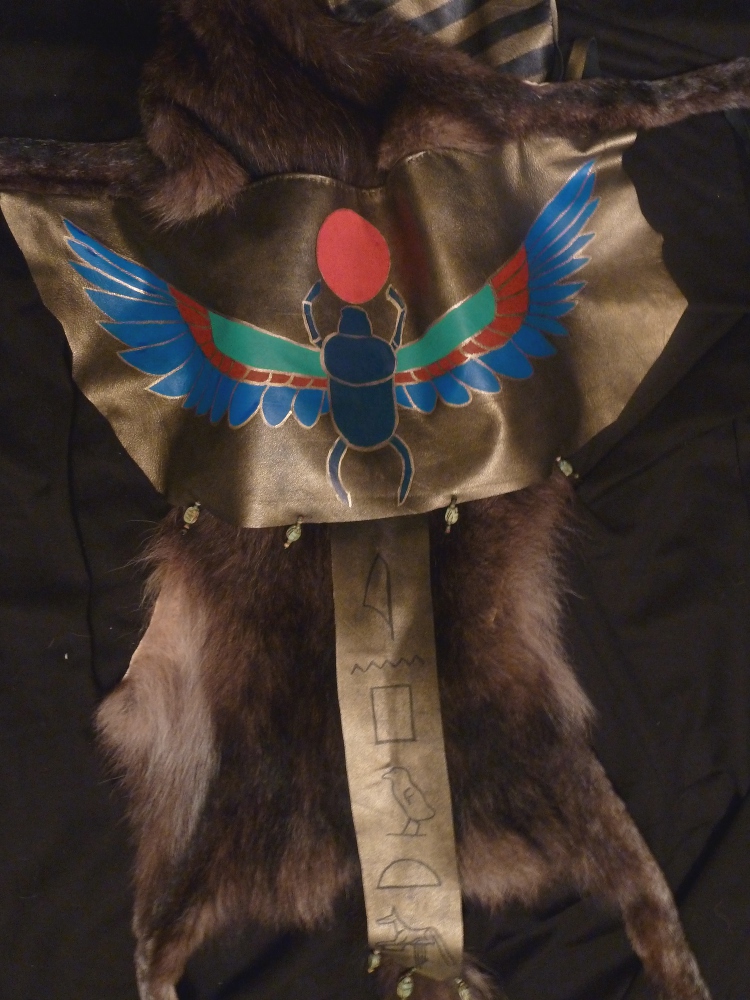
And at the end of the three days and three nights, I wore a cloak upon my shoulders, with the sacred mantle and hood as the Goddess directed me and as the black coyote concurred and as I created. Khepri stretched his wings wide, and the name and standard of Anpu—Input—cascaded in hieroglyphs.

This, then, was our inauguration, the Goddess and I. The black coyote would go forth as Her emissary while I would remain here and continue the sacred work as I always had, only with the consciousness of She who guided me.

***************

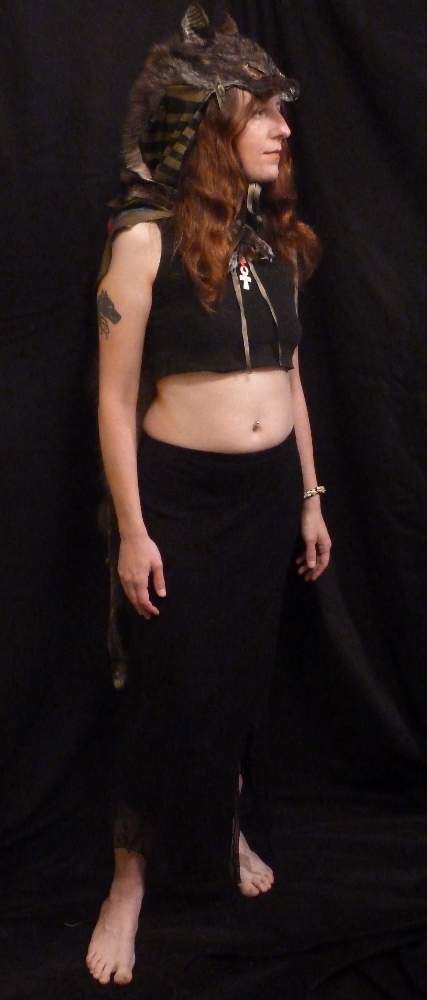
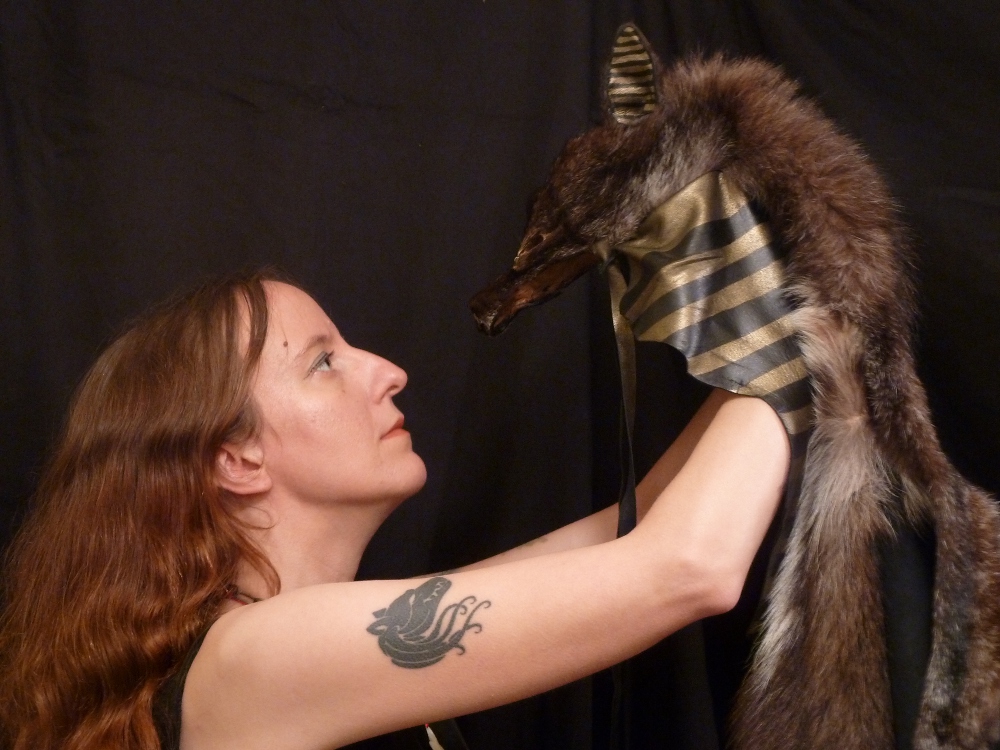
This headdress is dedicated to Anput, the female counterpart to Anubis. It is in no way meant to be an authentic replication of any traditional Egyptian creations, but is instead a hybrid of my own style mixed with elements inspired by a very general Egyptian aesthetic, guided by sacred inspiration (and many pictures of old statues and paintings from various dynasties!).

This headdress is based around a black (melanistic) coyote hide; this is a rare, but naturally occurring mutation in this species. This particular hide came from a small female, black with a white blaze on her chest. She is complete with all four paws and claws; the only piece missing is her lower jaw, which was removed for the purpose of this project. Her ears and face have been reshaped to a more natural appearance; they were originally rather flat and misshapen, as many hides are after tanning. Her face has been given painted details, to include hold around the eyes, and gold accents on her nose. I inserted gold and black leather in her ears to mimic the striping often found in the ears of depictions of Anubis.

The leather is one whole tanned lambskin hide, dyed black, and then with an overlay of gold on one side. It forms the side panels of the hood, again striped, as homage to the Nemes headdress that Anubis and other deities were commonly depicted wearing; there are very few images of Anput Herself that remain, and as I was working on this inspired piece this is what She indicated She wanted.

The mantle over the shoulders was the most difficult portion of this. I drew out the scarab and wings with a black fine tipped paint pen, and then colored it in with acrylic and oil paint pens in two shades of blue, green, and red, and detailed in gold. I tested all these on a scrap of the same leather to be sure of the colorfastness. The hieroglyphs descending from the mantle read “Input”, an alternate of Anput’s name, and below that is the standard of 17th nome (district) of Egypt, over which She reigned.

The beaded accents on these leather pieces are a combination of new (reproduction) faience scarabs, and genuine old Egyptian faience beads (exact dynasty unknown). Each one of these dangles is about 1 1/8” long.

The headdress ties on with straps under the chin, and the forelegs also are tied together with more leather strappage. It is one size fits most; for scale, I am 5’4” and 115 pounds.

This project did take me the better part of three days and nights with only small breaks. It is by far one of the most ambitious pieces I have done, and represents a shift to more elaborate and involved crafted artwork.

***************************

In the weeks since I created this headdress, Anput has been a quiet but strong presence in my workspace, and she has actually brought Anpu Himself forward more as well, not that I should be surprised. The feeling I get is that they are aspects of each other, rather than spouses, though perhaps the distinction isn’t so strict. Sometimes I work with them both, sometimes Her alone.

And as I work with the Divine in my art, I am beginning to feel the inklings of others who wish to have creations in their honor. I have long done this work with totems; every piece I create has been a tribute to the species’ totem as well as the individual animal spirit, whether a full dance costume, or a simple leather pouch. But there are other beings stepping forward now, adding yet another layer to what I am creating.

And I’m very much looking forward to seeing where this will take us all.

******************

Just as a side note, the Anput headdress is not meant to stay with me, nor are the rest of the creations I will be making. The Anput headdress may be found here on Etsy. If you are interested in giving this work a home, or in commissioning your own art, please feel free to contact me.

Douglas Fir as a Plant Totem

Note: This is part of the Animist Blog Carnival issue TREES, hosted by naturebum.

Most of the totemic work people do is with animal totems, and admittedly I am biased in favor of them. It’s not that I haven’t done work with others, but I just think to talk about the critters more. That, and the plants tend to be more subtle in their communications. Animals–we’re loud, and impatient, and move around a lot. (Well, most of us. Sea anemones and sloths are on the low end of that curve.) Plants, on the other hand, are more deliberate and patient. And they often whisper. Volume didn’t really have to be much of a thing until there were beings that didn’t send their roots into the great, intertwined network under the surface.

And I’ve found plant totem work to be focused on different priorities than the animals’ ideas. Animal totems seem to want to be dynamic, bringing change and motion and growth. Plant totems, from my experience, tend more toward rooting the self deeper in the now, what you have to work with right this moment, maximizing the use of immediate resources before expending the self to find more. Not that this particularly surprises me; these preferences in focus mirror the very nature of the beings and their totems themselves.

Douglas Fir is one of the most prominent plant totems in my life right now, and as I’ve been working with it I’ve been reminded that I haven’t really written about this part of my spiritual experience. In a way I’ve treated the plant totem work like a long hike in which I ooooh and aaaah at the occasional sighting of an animal, but see the trees and other plants as merely the backdrop. (Which isn’t the case when I’m actually hiking; I take lots of pictures of flora that fascinate me.) I’d like to start changing that and talking more about the plant work I’ve been doing over time. So allow me to introduce you to Douglas Fir.

I am not a native of Oregon. I was a military brat, and did much of my growing up in the Midwest, not arriving in the Pacific Northwest until early 2006. And, beyond that, I am not even a native of this continent; my family primarily emigrated here in the second half of the 1800s, and I was born on an army base in Germany–technically US territory, but not of this continent.

Occasionally this non-native status rankles a bit. I am well aware of the impact that European immigration and invasion of this continent had on the peoples who were here before (and are still here, despite attempts to erase their presence and acknowledgement). And I have heard the complaints from native Oregonians about the influx of people from out of state flooding this area in the past couple of decades as it’s become more popular a place to move (even though right now the job market here is still pretty well tanked).

Yet I am acculturated to this place. I didn’t have a choice in my upbringing, and although there is certainly something to be said for being an ex-pat, it is easiest for me to simply stay in the country where I have citizenship. And I like it here, especially Oregon. The Midwest wasn’t nearly as nice a fit culturally (though the Land liked me a good deal, and I love when I get to go back to visit family as well as places).

This mixed relationship to the place and the people may be part of why one of the first plant totems I connected to out here was Douglas Fir. Douglas Fir is a native species, but the trees’ relationship to the Land here has changed dramatically since the arrival of Europeans. As people began to clear the forests more for agriculture and farming, the opportunistic firs replaced other trees in the succession of forest regrowth. And because the firs grow so quickly, they’re a common seedling chosen for replanting logged areas to maximize profit, making their presence much more pronounced than before.

Both of these factors have homogenized much of Oregon’s forest land to one degree or another. While other native conifers such as Western hemlock or red cedar do still grow here, in many places they’re out-competed by the fir. Even some oak savannahs, highly rare any more in this state, experience firs as an increasingly invasive species.

This, of course, was not solely the doing of Douglas Fir, even with the trees’ competitiveness for resources after forest fires and other nonhuman disasters. The intervention of humans has often resulted in much more dramatic effects on ecosystems. And in the same way, I did not choose the accident of my birth, though I have decisions as to where I live and how I act as an adult, to include attempting to integrate into a different culture (even if I can never completely lose the markings of the culture I was raised and socialized in).

So Douglas Fir has been helping me to not only adjust to living in this place that I have decided to make my long-term home, but also to explore the various ramifications of that decision. There’s a certain level of responsibility that I need to keep in mind as I am here, and what it means that I have consciously made this my home. Who have I affected in this decision? How can I be a part of the community without being obnoxious and even harmful? And, more abstractly, how can I combine my work with social justice with my spiritual path?

These are just some of the things that Douglas Fir and I have worked together on. Fir is more of a presence than an active guide, providing a steady energy to tap into and a quiet reminder of connectivity, but it’s all very grounding to my little animal mind.

And so you have just one example of how my totemic work has extended beyond my fellow critters. I’ll try and talk more about it as time goes on.

(P.S. My friend Paleo has done a bit of writing on more domestic plant totems over here.)