A Brief Response to a Few Replies…

…on my previous post. I’ll have more specific replies later, but here’s a thought.

I had to think about it a bit, the whole “softening up” thing. It’s not that I’m going to entirely stop criticizing anything I see as potentially off. I’m definitely still going to call out people who claim their practices are what they aren’t. And I’m still going to be clear about why I, personally, will not adopt certain things, such as the bulk of core shamanism, or the more severe practices at the other end of the spectrum that simply don’t fit my worldview, and suggest to others that they take these things into consideration for their own opinions.

However, I’m not going to go so far as to invalidate all the experiences of anyone whose practices significantly differ from mine. I can’t say for sure that if someone encounters relatively safe journeying conditions that their experiences are less valid; nor will I invalidate my own experiences simply because they aren’t as harsh as others’ (or, for that matter, assume that those other folks are “going too far”). I’ve been more critical of core shamanism than others, but I’ve had my personal misgivings with conceptions of deities and spirits that in essence say that we must give in to their every demand as a way to placate them because that’s the way it’s supposedly done genuinely. Either way, softer or harder than what I do, I’m looking at things from a more practical viewpoint, and less automatically critical.

So that’s a bit of a clarification. I’m not accepting things without consideration, but I am going to say that beyond a certain point my authority to criticize only goes so far because of subjectivity and the inability to climb into someone else’s head. I think a better criterion would be “Does it work?”. There’s also the argument over semantics and who’s a “real shaman”, but for the practices themselves, I’m going to be less liable to dismiss something because it involves things I personally disagree with.

Shamanism and Subjectivity

I think I’m just going to give up on trying in any way to prove that my spirituality/belief system/etc. has any direct validity for anyone besides me, and anyone who agrees to take part in my subjective spiritual reality. The seeds for this post took root while I was detangling the thoughts for the last one. I started thinking about the subjectivity of nonindigenous shamanic experience. On the one hand, you have core shamans and their ilk who experience shamanism as a relatively safe, defanged thing compared to traditional shamanisms. On the other, you have people who are doing their best to emulate traditional shamanisms, particularly the most dangerous parts thereof. And then I thought about my own experiences, which are somewhere in the middle.

I look at where my path diverges significantly from these two ends of the spectrum. I do experience journeying as being riskier than what a lot of core shamans describe. However, I don’t do the complete submission to the spirits that I’ve seen on the other end. I do my best to not take the spirits for granted, but I also maintain autonomy–as in D/s, I have hard limits to my vulnerability, and ways to enforce them. And that is what has worked well for me, even before I began working with shamanism. I haven’t had experiences that have deviated significantly from that balance. And the thing is, the people at each end of the spectrum could probably say the same thing for themselves, that their experiences fit within a particular style of shamanism. Additionally, they could probably all find other people and sources that corroborate with their own experiences.

Really, how can I prove any of them are wrong, that they haven’t had the very experiences they claim to have had? How can I necessarily say that my experiences with shamanism are more objectively valid when in the end I really don’t have more proof of being right than anyone else? Sure, there’s looking at the shamanisms of other cultures–but that’s other cultures. To an extent, cultural context is crucial. And if a large portion of shamanic practitioners in this culture are reporting a certain way of doing things, then I should not dismiss that simply because it doesn’t corroborate entirely with the ways other cultures have described their practices. There’s something going on there, and beyond a certain point I cannot judge the veracity of what’s happening. Maybe someone really is working with harmless spirits, and another with savage ones.

But what’s the point of trying to judge the objective reality of the experiences themselves? Sure, I can discuss the conflation of neoshamanisms with indigenous shamanisms, and explain that certain practices found in the former are in no way, shape or form a part of any of the latter. But how can I judge whether someone else’s journey was valid for them or not? And, more importantly, does it really matter whether it’s valid for me if it’s not my experience (and I’m not the client or otherwise involved)?

All I can really say for sure is that my subjective reality is real to me, and that it is necessarily filtered through my subjective perceptions. I would wager that a good part of the reason that other practitioners experience things so differently in a lot of ways is because their perceptions–if not their experiences in their entirety–are also subjective. I would also add that it’s very likely that as my expectations about the world, conscious and otherwise, shape my experiences, that it’s also likely that others’ experiences are shaped by their own conscious and unconscious expectations. If you expect that shamanism is like in anthropological accounts where it’s a highly violent, dangerous thing, then that raises the chances that your shamanic experiences are going to be violent and dangerous. Likewise, if you expect that journeying is safer than dreaming, then you’re more likely to have safer experiences.

I can clearly see where my own expectations about reality, and spirituality, and related concepts, resemble my experiences as a shaman. And I can see where my perceptions also shape these experiences. Therefore, at this point I’m going to maintain that while it’s not impossible that there’s an objective spiritual reality, I strongly believe that spirituality is heavily subjective regardless of the existence (or not) of objectivity. I can see the physical world around me, the trees, the stones, the animals, and can agree on that objective reality for the most part with other people–but the animistic
end of things, that’s another story entirely.

And I’m okay with that. I’m tired of the endless wrangling over who’s right, regardless of what spiritual reality is being argued over. I’d rather focus on developing my subjective spiritual reality, which I know is real for me, and which is effective for me. I’m not sure I really care how real it is for anyone beyond those who have agreed to take part in it, whether to learn more about it, or even adapt it to their own practices. Beyond those functions and practicalities, is it really all that important that I try to prove that the journeys and so forth that I describe here actually happened beyond the scope of my own perception? And is it important for me to measure my shamanic practice up against those of others for experiential (rather than historical or other factual) veracity? If I didn’t have the exact same sickness, or have the spirits treat me the same way, does it really matter?

I look at all the time people spend trying to get external validation. And I’m really thinking it’s a waste of time, at least for me. The need to prove an objective spiritual reality has been a weight I’ve been carrying too long. So–at this point, my running theory is that spiritual realities are largely subjective, and any objectivity is hidden to some extent by subjective perceptions. The quest for objectivity, in addition, is overrated. (YMMV, of course.)

Environmentalism as a Spiritual Practice

Recently I was at Fred Meyer (your usual grocery/department/everything else store, only unionized and with more sustainable choices). While picking up some socks for my husband, I happened to walk by a sale rack that was full of knee-high white socks with various environmental slogans on them (25% off, even!). “Oh, those are cute!” was my first thought. I almost thought about picking up a pair, but then read one of the slogans a little more closely: “Protect the Earth”, it said. That made me stop and think about the potential purchase. Just what was I about to buy? Socks made in China, out of cotton (which is one of the least sustainable fabrics due to the amount of resources used in processing it)–and since I mainly see socks as a necessary liner for shoes and boots in cold weather, I didn’t exactly need “cute” socks.

So I decided, “Okay, I’ll protect the Earth–by not buying a pair of probably-sweatshop-made, not-even-organic cotton socks that I don’t really need right now”. And walked away. I felt better about myself for having done that, not just because it’s better for the budget right now, as well as my attempt to lower my impulse spending, but because I did feel I made the more ethical choice in that case.

But it also made me feel more in line with my spiritual path. I claim to practice a nature-based path; multifaceted, but still focused primarily on the sanctity of nature. Environmentalism is one of the most physical manifestations of what it is I believe about reality. I do the things I do not only because of the physical realities (reducing waste means less in the landfill, etc.) but what I perceive as spiritual realities in my path (everything has a spirit, and one honors the Earth-as-a-being by reducing and even reversing the negative impact on it).

So I decided to assess my approach to environmentalism as a religion in and of itself, focusing on a few particular areas:

The Divine: I am unapologetically pantheistic. The Divine–whatever its nature may be–manifests itself in all things. “God” is not a presence up in heaven, with an antithesis in hell. “God” is right here, in every being, in every thing; just as each of our cells is a part of us, so are we all a part of the Divine. Now, is the Divine a personal deity who cares about every single one of us? Or is “the Divine” a catch-all metaphor for the sum total of Everything That Is, perhaps with collective awareness (or some other cohesive connection that we may or may not be able to comprehend)?

For me, I find my connection to the Divine/God/whatever label you wish to use in the intricate ecosystems that wrap around the Earth. This includes human beings; we may pretend we aren’t a part of Nature any more, but any time a person catches a disease, or eats, or breathes, they are participating in the local ecosystem. That ecosystem may be largely dominated and shaped by humanity, but humans cannot live separate from all other beings in total. Nor can we subsist without “non-living” natural resources.

Maybe the only hell is the physical and psychological illnesses that often result from attempting to isolate the self from everything else. My attraction to ecopsychology is largely due to the perception that I and others have had that A) disconnection from the natural environment (and other ecosystems) very often has a damaging effect on people, individually and culturally. and B) many people respond favorably to exposure to natural ecosystems to whatever degree they are comfortable (factoring in things like agoraphobia, associations between wilderness and trauma, etc.). I want to help facilitate people’s reconnection to ecosystems, natural and otherwise, because as a general culture most Americans are suffering from one degree of disconnection or another–I know I have my own issues to work through in that regard, and I’ve seen it countless times in others. Rugged individualism is not good for the soul (literal or metaphorical).

Everyday environmental actions help me with this reconnection to the Divine/Everything That Is. Whether I’m in the garden growing the most locally available food there is, or making decisions in purchases based on sustainability, or repurposing an item that may be too worn for its original role, these things remind me of my connection, that I’m not just acting for myself.

Dogma: Because our understanding of the environment is constantly changing, both due to the tools at our disposal, and the changes in the environment itself, there’s no room for unchanging dogma, beyond “Do what is best for the environment without destroying yourself” (though there are a few extremists who believe the best thing would be for the entire human species to commit self-extinction). And I like that lack of overall dogma. It can be easy to fall into dogmatic, repetitive patterns, however, particularly where other people are concerned. It’s tempting to point out another’s flaws, to say “Hey–you didn’t recycle that piece of paper! For shame!” And we do need to speak up to others about the issues at hand, and what people can realistically do to help (as well as holding corporations, some of the worst offenders, accountable for their part in all this mess).

But few people like being forcibly converted to any belief system, whether it’s a recognized religion, a philosophy, or so forth. And the thing that I’ve learned as an environmentalist is that that whole adage about flies and honey is true. Just by blogging about my garden on my Livejournal, I’ve convinced several people to try their own hands at gardening. That’s a more concrete result than the times I’ve gotten up on my soapbox to preach the Good Green Word–I’ve mainly just gotten agreement from those who were already on board, and occasionally some disagreement from others. The constructive approach does indeed work better.

If someone doesn’t do things my way, I have to accept that that’s the reality. Trying harder to get through to that person isn’t going to help; if anything it’s going to alienate them. And my job is not to change people’s minds; my job is to offer information and set an example–and if someone chooses to emulate that example out of their own free will, to do what I can to help. People can convert themselves just fine without my help.

Mythos: A mythos isn’t necessary to environmentalism in general (and in fact some environmentalists distance themselves even from things like the Gaia Hypothesis, for fear of getting accused of idolatry by their own faith communities). For me, personally, though, the mythos grew alongside with my environmental action.

I have a whole other post brewing about subjectivity and belief, but for the moment here’s what I’ll say to this: The mythos of therioshamanism and my paganism in general provides me with additional meaning to the everyday actions I take, both with regards to environmentalism and with other aspects of my life. I don’t believe my actions are dictated by other beings, spirits and deities and such. But the purpose of the mythos, and the rituals and other practices surrounding it, is to find and define meaning apart from the actual physical activities and chains of events themselves.

Why? Why do we create art? Or music? Why do we indulge in this thing called “love”, instead of only thinking of it as a mess of hormones meant to bind people for survival reasons? Not that love doesn’t contain the hormones and messiness, but we don’t have to romanticize it in order to survive. Neither do I have to work with the mythos and spiritual beliefs that mesh with my physical everyday life. But I have the mythos, and I believe in love, because I want to, and I like to, and these things make me happy. And, as mentioned, they add meaning, and additional structure, which are also valuable.

The Afterlife: I’m really not sure, honestly, what I think about the afterlife. I know that my body, which is made of all sorts of molecules that have been all kinds of things, will decompose and go on to become other things. Beyond that? Who knows for sure? I’ve mostly decided that I’m just going to wait until I die, and then I’ll know for sure. Yes, I have my experiences with spirits, which some think should prove to me that there is a spirit world. But I have no way of knowing that those spirits are real for anyone besides me. That’s not enough of a basis to form an afterlife on.

People have a hard time with impermanence. Even I have moments where I’m utterly terrified that there’s nothing beyond this life. But I try hard to avoid compromising the lives of others out of my fear of impermanence. If I want to convince someone that a particular practice is better for the Earth, I’m not doing it for the purpose of racking up bonus points with the Divine. I’m doing it because it’s something I feel will benefit those of us right here, right now–and future generations to come. I’d rather focus on this world while I’m in it, rather than looking forward to another world that may not even exist. I’d rather plant a garden than buy an indulgence.

Sin: I dislike the concept of sin. It’s such a dualistic concept. In my view, we make mistakes, we (hopefully) learn from them, we move on. I would say that deliberate destruction and greed are definitely bad things–but I hate the concept of “sin”, like something is automatically and completely antithetical to “the RIGHT way to do things”. Some things are most certainly bad for the environment, but referring to any action that’s supposedly anti-environmental as “a sin” seems too simplistic. Sometimes people make honest mistakes. Others don’t have the resources to be as green as they’d like. And since our understanding of what is environmentally friendly is constantly changing, what may be “bad” at one point may actually turn out to be better, or vice versa.

This could be a lot more complete, to be sure. I’m no expert theologian. But I wanted to get these thoughts out in their raw form; there may very well be more polished versions in the future. Constructive feedback is always appreciated.
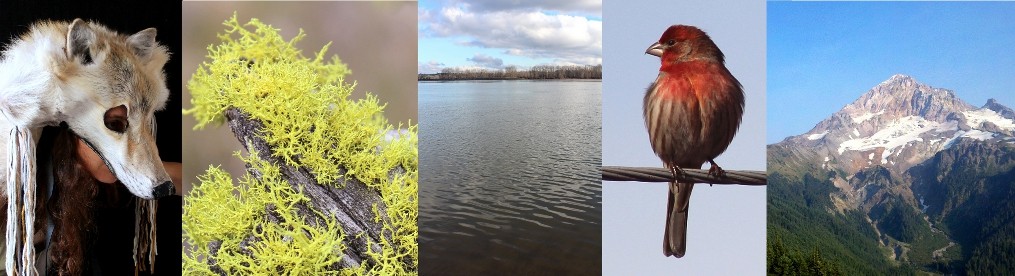
Coming Up For Air

I haven’t journeyed since late January (in my defense, February is a short month!). But I did manage it anyway, despite the crazy schedule (more on that in a bit). When I arrived at my starting point, Bear (I primarily work with Alaskan Brown Bear, to be specific) was waiting for me intently. As soon as I arrived and we exchanged greetings, s/he led me off down the mountainside. S/he had me stop at a particular tree to rest, and told me to wait. Then she introduced me to (Sockeye) Salmon, who could show me the way to the Lower World, and how to get there when I needed to. I was surprised to find myself there, especially because there hadn’t been much in the way of a draw towards there, but I found myself suddenly plunged into the belly of the River Dragon of the Columbia, as it were, with Salmon taking me to the opening to the Lower World. I had to make myself tiny to get in–I could see the parasitic worms on Salmon’s side–but I made it through.

When I got there, (Grey) Wolf was waiting, just as anxiously as Bear had been. S/he took me to a place s/he had prepared, up on a ledge. There were blankets there on the rock. Looking around, I saw that the Lower World (what I could see of it) looked very similar to this one, though Wolf said that part of that was because I was on the boundary between the two, and it got weirder the deeper in you go.

We talked a good bit about my current state, how I’ve been run ragged by school and other things, and how since the move to the new place back in December I’ve been feeling disconnected from the Land. I haven’t really made the time to connect beyond the streets here, even though there’s a wetland a block over. Things keep seeming to come up. It hasn’t helped, either, that it’s been too cold to go out hiking; many of my favorite places are inaccessible this time of year. And it being winter, I simply don’t go outside as much as I do in warmer months.

I’ll talk more about the specifics of the previous paragraph in a moment; needless to say, Wolf’s advice to me was to spend time reconnecting to the Land, and engaging in my spirituality more. It’s good advice–the disconnection hasn’t been helping the situation. I also received offers for help from a couple of other totems regarding specific areas where I need some help, including one totem I’ve never been approached by before.

So–the problems at hand. There are a number of ways in which grad school has changed my life. One of the more obvious is the manner in which it manages to consume my time like the personification of Famine. While the commitments tend to ebb and flow over the course of the semester, there are weeks where all my free time belongs to assignments and readings and essays. This is mainly fixed by careful time management, and sometimes giving up fun things temporarily, but I also need to deal with my own stress when perceiving myself as more crunched for time than I actually am.

However, another effect of graduate school is that it’s caused me to become much more deeply immersed in my psyche. I’ve always been very self-aware; I’ve spent many years digging through my own wiring and conditioning, trying to figure out what makes me tick, and doing my best to replace bad conditioning with better. In fact, a lot of the magical and spiritual practices I’ve done have been aimed at personal metamorphosis through ritual psychodrama. This has generally worked well–not perfectly every single time, but I’ve made a good deal of progress.

It’s very common for psych students to do a lot of introspection, and I’ve been finding all sorts of new tools to mess around in my own head with (as well as potentially help others with down the line). The program I am in is particularly focused on self-awareness to the ends of self-care and being a better therapist, and so a lot of the classes deliberately challenge us to know ourselves better and more fully. Combining this with the fact that I’ve already done a lot of internal work, the result is that I’ve been spending a lot more time than usual processing things, and digging deeper into my own head. As I’ve already gotten rid of a good deal of the surface issues, I’ve been frequently hitting a lot of deeper, root issues, things that are a lot more painful–and a lot more firmly entrenched.

No, this hasn’t been easy. I’m pretty independent, and I’ve done my best to self-regulate, but I’m taking the opportunity to avail myself of the university’s free counseling services–at least once they have an opening for me. Until that point I’ve been utilizing a lot of self-care techniques, and relying on a few friends who are willing to help me work through some of the tougher moments. All of this is coming to a good result, but it’s been a challenge.

This all makes me think about the motif of the shaman’s sickness in conjunction with the cultural context I’m coming from. I’ve had a lot of cause to think about my cultural context–my social location, as it were–as I’ve been taking my Counseling Diverse Populations class, which has a very strongly emic perspective on working with clients from cultures and perspectives other than your own. For the first time, for example, I’ve been called on to actually think about what it means to be white, something I’ve had the privilege of not having had to think about before. It’s definitely made me think more about the concept of mainstream/dominant American culture, and how there are even more alternatives to it than I had originally conceived of. And I’ve been thinking more about shamanism within that cultural context.

I still maintain that “psychologist” is one of the roles that most closely mirrors that of the shaman in my culture, even though my understanding of my culture has changed. And I look at the sometimes agonizing experience of digging deeper and deeper into my psyche, into the Places That Hurt, and I wonder if that is a parallel to the shaman’s sickness found in some shamanisms (again, with the reminder that “shaman” in this instance is the borrowed-by-anthropologists version, not only the original Evenk usage of the term). I don’t have any major, disabling physical diseases; the few relatively minor chronic issues I have are easy to maintain. However, I can see where it took me years to overcome depression. And while I’m not sure a therapist would classify me as anything more than “stressed–please refer to graduate school for causes” at this point, some of the hardest moments in my life have been in the duration of working through the issues I’ve been dredging up as of late. Does it count as a sickness if it isn’t a long-term or permanent thing?

Of course, that also makes me wonder if, in a culture where physical illnesses are generally easily treatable (though a lot depends on insurance, etc.–that’s a whole political rant there), the shaman’s sickness isn’t necessarily a physical thing. And many cases of sickness were temporary, though severe. We know a lot less about the treatment of the psyche, in a lot of ways, than we do about the treatment of the body–especially if we’re trying to not just rely on pharmaceuticals to “maintain” an illness. So the psyche is more of a cultural vulnerable spot than the body in a lot of ways. Would it make sense for the challenges to come at that level more frequently in this culture, then?

I do know that what I’m going through is most certainly making me better prepared for my roles both as a therapist and as a shaman. In some indigenous cultures, if a shaman suffered from (and survived) a particular illness, s/he was seen as an expert in curing that illness. Does the same thing hold true for having survived repeated excursions into the depths of the self, with the result being a stronger, healthier person overall?

I won’t play the dogma card and try to say that this absolutely must be the experience of a “true shaman” in this culture. But I believe that shamanisms adhere to the contours of the cultures they are a part of; the general themes and purposes may be the same, but I’m not sure I believe that a practitioner in the urban United States has to have the exact same experiences as a genuine Evenk shaman. My thought is that it’s up to us to create our own relationships with the spirits (albeit with a more realistic perspective on what nature and spirits are); looking to other cultures helps to an extent, but beyond that we need to remember where we are, and who we are working with.

I’ve said this before, but it bears repeating. I am not an indigenous anything. I may be of European genetic makeup (as far as I know, anyway), but I am not European culturally. I am a white American, generally middle class of some sort, university-educated, geeky, neopagan, an urban dweller, and so forth. Ultimately, that is the cultural context I am coming from, and that is what needs to most inform my practice; even if my clients as both a therapist and a shaman end up being from different social locations, I need to have a firm understanding of where I am, so I can better orient myself to them. And the same thing goes for the spirits; the relationships that I have with them are largely informed by the people I come from, and solving the problems that result from a culture largely detached from nature.

You Mean I Have To Give a Reason?

I’ve started journeying again since the year turned over. Only once, but it was an important one.

I showed up at my starting place, in the form of a wolf per usual, and was met by the Animal Father. He carried me inside himself up the mountain to his home (no, it wasn’t squishy and I wasn’t making elbow room amid spiritual internal organs or whatnot–more like floating/flying up the trail, but feeling surrounding by the energy I associate with him). Then he set me down on the ground, and we began to talk about why I hadn’t journeyed in four months–or, rather, he began snarling at me about it. In fact, he ended up turning into a significantly larger wolf, bared fangs and all. This served primarily to put me on the defensive, rather than listening to what he had to say.

So he ended up turning into a mouse instead, which relaxed me quite a bit. We discussed the need for me to be journeying much more often–short version is, no more four month absences. This being the first week of school, I didn’t do the best job of increasing the amount of journeying I do, but now that I have a better idea of what my time commitments and schedule will be like, I have a better idea of where I can fit it in.

After this, he asked me how my progress on getting to the Upper world was, since I’d been trying to figure out that conundrum. I told him I was still stuck, and he suggested talking to the resident Owl, one of the totems specific to the area I start my journeys in. So he called hir to show up, and we were joined by Great Grey Owl (totems, for me, are species-specific). S/he and I had a conversation about the Upper world, and why I was having trouble accessing it.

The main thing s/he asked me, and which I puzzled over afterwards, was “Why do you need to get up there, anyway?” And I honestly couldn’t give hir a good answer beyond “To find information”. Owl told me to come back when I had a better answer for hir, and flew away. For my part, I ran back down the mountain with this question burning in my mind. Scrub Jay (the totem this time, not just a scrub jay spirit) and Red Fox both showed up. They offered their help in navigating this world, and Scrub Jay additionally told me s/he could help with the Upper World when the time came. I noted this, thanked them for the offer, and ended up needing to head back home.

For a few days, I couldn’t really come up with a decent answer for Owl’s question. Then one day, as I was on a walk, it hit me–why did I need to get to the Upper World, anyway? I didn’t have a specific reason, a particular piece of information to seek out. The only reason I could think of was “Because it’s part of what shamans are supposed to do–right?” Same thing with the Lower World. And here we get to one of the downsides to not being a part of an established shamanic paradigm–there’s no one to explain why, specifically, I might need to go to one or the other, or neither for that matter. I could read books, but even there the material is limited. I can talk to other practitioners, but how much of what they experience will be relevant to me?

To be sure, journeying is intensely personal, and I think there’s more subjectivity to it than a lot of practitioners want to admit. This means I can potentially look at the different worlds in the shamanisms of other cultures. But would these motifs and experiences be relevant to me, in my cultural context? And how much standardization is there, really? After all, there are other things that are “supposed” to happen in shamanism that haven’t quite matched my experiences. For example, according to most texts on neoshamanism, you’re “supposed” to climb up and down a tree to travel to the various worlds. I climb a mountain instead, one that I’ve visited frequently in waking time. And what I am practicing isn’t necessarily what other people are practicing; I am developing my relationships with the spirits from scratch, not following someone else’s template of expectations. In fact, most of the examples of neoshamanism I’ve seen have a lot of fundamental differences compared to what I’m doing.

This still left me with the problem: if I don’t know what’s in the Upper World or what to expect there, how do I know why I would want to go there? And then it hit me, as I was walking–right after I was presented with that problem, Scrub Jay and Red Fox offered me a solution: Don’t worry about the Upper World right now. Look for answers and explorations in this world first. It’s the closest, and the one I’m most familiar with. Where better to get more practice with journeying than the layer of reality that I’m most accustomed to? Not that everything will be a cakewalk, of course. But it makes a lot of sense.

I’m willing to bet that I’m not the first novice (neo)shaman to get caught up in the “Oooooh, I get to explore the Other worlds!” thing, to the point of neglecting this world. Now, I do tend to be a fairly pragmatic person. I’m the kind who will take mundane solutions before leaping into magical practice. So it’s not surprising to me, this concept of checking around the spiritual portions of this world first, before travelling further afield. I think I just got caught up in that whole “Shamans travel to the Upper and Lower worlds” concept a little too much.

Some of the Middle world stuff will no doubt be “mundane” things–like my venturing into psychology as a profession, for example, or finding other “everyday” solutions. However, I would imagine that journeying, as with various forms of divination, will help expand my perception of possible solutions (altered states of consciousness are good for that). I won’t make too many assumptions, but I think for now my journeys are going to be focusing on what Jay and Fox have to show me. They’ve offered, and I’ll follow. I should probably go to Owl and let hir know my current answer (“I actually don’t have a need to go there yet”) as well.

Totemic Therianthropy

A little over a year ago, I posted A Totemic Perspective on Spiritual Therianthropy, and a bit before that, A Mythological Perspective on Therianthropy. A few months later, I kicked around some ideas on therianthropy, Otherkin, identity, and hermeticism, among other things. These were some of the first written manifestations of thoughts and understandings I’ve been testing out to one degree or another for the past few years.

So I’ve finally come to a conclusion from all this testing of ideas. My therianthropy–the structure on which I examine why it is that I feel that on some (nonphysical) level I am wolf in nature–is directly related to and caused by totemism. It’s something that was given to me by Wolf, my primary totem, who has been with me my entire life. It is still something that permeates my being at all times, not something I can simply take off and put back on at will, and not something that is separate from me. I am wolf on some level, as I am also human on other levels (the physical included).

This isn’t something that’s easy to say. There are a lot of kneejerk reactions to mentioning therianthropy and totemism in the same sentence. There’s been a good deal of effort put towards making the differences between therianthropy and totemism very clear, particularly because there has been a lot of confusion (especially among newbies to the concept of therianthropy). What commonly happens is you’ll get someone who has recently (or not) discovered hir totem, whether s/he knows what it is or not, and because s/he feels a strong draw towards this animal, s/he assumes s/he IS the animal. Additionally, while most of the furries I know know the difference, there also seems to be some confusion among totemism, therianthropy, and the fursona. Often newbies will leap to conclusions without having done much research or self-searching and introspection, and try to speak as authoritatively as someone who’s actually done the work over time. Granted, this happens with newbies in any group–but I digress.

This results in a tendency to try to keep the lines between totemism and therianthropy as sharply delineated as possible. Unfortunately, this can occasionally mean situations in which the combination of the two in any way is discouraged, particularly if the nice, safe lines get blurred. I’ll freely admit that I avoided exploring this possibility for a while specifically because I’d seen so much negative press about it, and wanted to make sure I was “doing things right”. However, as my need for external validation diminished, and my ability to validate my own beliefs and experiences became stronger, I said “Fuck that noise” and decided to explore it anyway. I’m glad that it did, because it’s been the most fertile exploration related to my therianthropy I’ve ever had.

However, I didn’t come to this conclusion quickly or lightly. As I mentioned, I’ve been working with these ideas for the past few years, and have been working them out in writing (one of my best forms of processing) for over a year. Some of the material on personal mythology in A Field Guide to Otherkin, which came out in 2007, was a precursor to some of the ideas woven in to my current theory. But it wasn’t until I started developing my therioshamanic practice that I really reached a greater understanding.

While I’ve been an actively practicing totemist since the mid-1990s, and have had Wolf as a presence for my entire life (and became aware of it at a very young age), my relationships with the totems deepened significantly after I started practicing shamanism. Shamanism, by necessity, is built on relationships with the spirits. It isn’t about techniques, or shiny objects. First and foremost, it is communication with spirits and travelling to their realms (or in a few cultures, mediumship). The techniques and trappings stem from and support that communication and those relationships.

As I got to know Wolf better, s/he began telling me more about myself-as-wolf, as s/he felt I was ready for it. S/he told me the significance of our first meeting, when I first remembered realizing there was something wolfish in me–and that it never stopped being there, ever, no matter how much I sometimes tried to get rid of it. Most of the details are private, but I can definitely say that that which is wolf in me, was a direct gift from hir, and is part of the ongoing relationship that’s developed over this lifetime. It’s something that I did question a number of times, just to be sure I wasn’t making it up. S/he confirmed each time.

So, what of my personal experience is therianthropy, and what is totemism?

Therianthropy: I am wolf on some (nonphysical) level. This is not a wolf spirit carried within me, or any other being independent of me. It is not me carrying Wolf hirself in me, though I see what is wolf in me as having originated with hir. This is me. I don’t believe reincarnation factors in. The part of me that is wolf is something that, as far as I understand, is part of this life.

Totemism: Wolf is a totem, an archetypal being who embodies all that is to be known about wolves. Specifically I work with Timber (Gray) Wolf, who protects all the subspecies of that species. Wolf is an external being who gave me a piece of hirself that was integrated into who I am from the beginning. Just having a totem does not make me a therianthrope; it is the specific part of myself that Wolf gave me that is important. None of my other totems have given me something like that, and therefore I am not, for example, a fox therian, or a badger therian.

So, yes, I can definitely say that at this point the best way to explain my own therianthropy, myself-as-wolf, is through my relationship with Wolf the totem. I am wolf in and of myself, but it is something that was given to me by Wolf. I’m still going to continue exploring and working to better understand myself in parts and in whole, but this is the closest I’ve come to an explanation of myself-as-wolf.

Shamanically speaking, this gives me even more understanding as to how my therianthropy can be incorporated into my shamanic practice. It explains more of why Wolf has been around the whole time, and it also offers up some intriguing possibilities for forging stronger, potentially permanent connections with other totems. I’ve often wondered if, assuming they were willing, other totems could give me (or other people) similar pieces of themselves. Though it also may be something that is not easily given, or given at all. We shall see.

One final thing I want to make absolutely clear–this is something that is unique to my experience. While I know a very small number of people (count on one hand) with similar experiences, the vast majority of therianthropes who also practice totemism don’t (to my knowledge, anyway) have the same relationship with their totems that I do with Wolf, in that their therianthropy isn’t directly related. I do think it’s possible that this happens more often than I realize, but the thing I want to emphasize is that I came to this conclusion after nearly three decades of being aware, on some level, that there was something about me wolfish, after over a decade of active totemic work, and after a few years specifically spent on exploring the connection between my personal therianthropy, and my personal rel,ationships with my totems, including the intensity of shamanic practice. While I don’t want to discourage people from considering a similar possibility for themselves, I also want to make sure it’s understood that it’s not to be considered lightly–but then again, when is any of this to be decided through hasty processes?

Wolves and Dogs and Therianthropy

Part of my personal mythology involves identifying myself as a wolf therian–basically, I believe that on some nonphysical level of myself, I am more wolf than human. This is something that goes wayyyyyy back to a very young age; therianthropy is just the general framework that I’ve been using to explore and explain it in the past several years. I’ve been evolving into more a personal mythology framework the past couple of years–but not completely disavowing “therianthropy” as a concept. I’m currently explaining it (in my case) as a part of the metaphorical story (that is also true–more on that in a minute) I tell about myself, rather than trying to take the (relatively) literalist perspective of “There’s something wrong with my neurobiology, and that of every other therian, that causes a fundamental miswiring related to identity/senses/etc.”, or the other popular opinion, “I was a wolf in a past life/my soul is that of a wolf”.

Let me make something very clear: I believe that metaphor and mythology are not “just made up”. They come from a complex interplay of the mind and the environment, to include what I believe to be autonomous beings. The modern Western conception of myth/metaphor is that it’s “all in the head’, with no bearing on the real world. I believe these are as much a part of the fabric of reality as physics, and other more materialistic things. I choose to believe that metaphor/myth have autonomous existences independent of the human mind, but that there is interdependence as well. This is a case of both/and instead of either/or. I make this choice A) because I have experienced things that prove to me as an individual that this is true in my subjective reality, and B) because my spiritual path functions much better when I believe this is true.

So. Back to the topic at hand.

As I said, myself-as-wolf is a significant part of my personal mythology. It explains to me a number of traits that “human” doesn’t quite fit–or, at least, that “wolf” fits better. Taylor brought up to me a few weeks ago the concept of myself-as-dog, however. I have a lot more experience working with dogs than I do with wolves, and being a somewhat domesticated critter myself, “dog” may be something to explore in more depth.

What is a dog? One way of looking at it is essentially a domesticated wolf. That’s a very simplistic explanation, but it’s a starting point. A dog is what happens when wolves interact over a long period of time with humans, becoming interdependent. If I am a wolf in human form, interacting within a human paradigm for a lifetime, wouldn’t that create some kind of change in the self-as-wolf? After all, I can’t say that I am only wolf, and while I can guess at how close I am to the experience of being wolf, it’s all conjecture in the end. No on can prove that my experiences when I am in a more wolfish mindset are anything more than my mind’s approximation of what I might assume to be “wolf” things.

Dogs, though, are more of a known quantity. Again, I can’t get inside the head of a dog, but I can observe doggish behavior more often and have a better idea of what a dog is. And from a purely analytical viewpoint, I can compare the outsider’s perspective on wolves and dogs to see where the similarities and differences are.

So working with Dog energy may be an interesting way to get a better handle on myself-as-wolf, filtered through myself-as-human. It’s not a complete parallel, since that part of myself still identifies as wolf rather than dog. However, dogs are the closest things to wolves I have access to on a regular basis. It can’t hurt to at least explore the connections.

Totemically, I may also try working with the totems of different breeds of domestic dog. I’ve always had a particular fondness for more primitive, wolfish breeds–I had German shepherds growing up, and also like malemutes, huskies, and other such breeds. I’m still undecided about what I think about wolf hybrids; I haven’t had much experience with them, and I’ve heard lots of both good and bad testimonies to their temperaments and safety. Still, I’d much rather be around a German shepherd than a Bichon Frise.

I don’t think that I’ll ever give up embracing “wolf” as the primary theme in my life, though the work with “dog” may bring some interesting perspectives. “Wolf” is too deeply ingrained in my fundamental self, and there are certain things that I know will always fit “wolf” better than “dog”. However, I’ve also been embracing the concept of feralness again, the idea of a once-wild being (or lineage of beings) that has been brought into captivity, and then released to the wild again. Your average dog is not feral, but has the capacity to be. It may be that I can find some parallel patterns in my own life as I find once again the part of myself that was born wild, was made captive, and is only now finding itself free again. Given that this part of me is very closely tied to myself-as-wolf, this work with wolf and dog and related concepts may be valuable indeed.

The Journeying Continues…

Tonight I tried my first journey with a purpose beyond exploration. I had a favor to ask of Badger, and so I went to see hir. I had an offering in mind, something I could give hir now, and something later, if s/he would help me.

I asked Small Horse and Small Deer (the drum and beater) for their aid, warmed up the drum, then I played Small Badger’s song to ask him to help me to negotiate with Badger. He was quite pleased that I played the song for him and asked him for his help, though I may make it a habit to make a small offering besides that for the skin spirits and other helpers.

So we all went to go see Badger. I drummed for a bit to let Small Horse and Small Deer take me to the starting point. When I arrived, I sang Badger’s song as loudly as I could, just to let hir know I was there. In retrospect, I could have gone looking for hir, too, but s/he didn’t seem miffed about coming to me instead. This is probably at least in part because s/he was expecting me; we’ve already talked a bit about the situation, and this time I came armed with offerings.

Badger made hirself look very large and impressive, and s/he towered over me, even for being a normally close to the Earth animal. I was sufficiently awed, and s/he and I got down to business. I told hir what I wanted hir help with, and also what offerings I would make. S/he was surprised, though not unpleasantly so, that I was offering something now and something later. S/he knew how important this situation is, and also that it would take some time to complete. So s/he accepted, and I was happy. I sang Badger’s song for hir again, to boast about how wonderful s/he is, which tickled hir even more.

Then I came back, and sang songs for Small Badger and Small Deer, and played Small Horse’s drumbeat, though I don’t have a song for hir yet. I warmed the drum down, and set out to start making things happen on my end.

I am quite pleased to note that my ritual structure is coming together nicely. When I started all this stuff out last year, I was doing things in a much more generically neopagan manner. I did a circle casting with an athame still, and swept the place with a broom beforehand for purification. I won’t say that my ritual structure now is the exact same as such-and-such culture’s shamans do it, because it isn’t. However, the structure has changed quite a bit.

Part of this is due to my beliefs. I no longer feel that I need to create a “world between worlds” to practice in, and I see all space as sacred, even if the Land in one place is tougher for me to connect with than in another place. While I greet the totems at the directions, I don’t do this as part of circumscribing a circle to divide me from the rest of the world. I don’t see myself as calling them, either–they’re already there; I need only remember that.

As I’m also focusing more on journeying, the ritual structure has evolved to support that as a central practice in many of the rituals, preparing me to go in, and helping me to come back out, as well as interact with the spirits at all points throughout. And the drumming has become much more prevalent, essentially having replaced the athame in greeting the directional totems and others.

Obviously, there are things that are in common between the previous structure and what I use now. But these are the most significant changes I’ve ever made, taking whole sections and tools and things out, and adding others in because they work better. It’s made things a lot more effective, even in this relatively short period of time.

So we’ll see how things progress, and what Badger ends up bringing about. While at an earlier point in my life, particularly when I was heavily into Chaos magic, I was very focused on the end results of my magic to determine my success. While that’s still important, what constitutes a good result may vary more than “I asked for X and got X”. It may be something as simple as “I asked for X, but Badger decided that Y would actually be better–and s/he was right”. Or it may end up being something much more complex, something that can’t be quantified in a linear, cause and effect fashion. “Success” is a very subjective notion, and a ritual that didn’t result in the intended way may still end up being more success than failure.

Not that I’d mind getting what I asked for, of course 😉

State of the Lupa

I updated the therioshamanism FAQ, since it hadn’t been done since last April, and a lot has changed since then.

It amazes me just how quickly things are changing. I’m used to things developing with some advancing through leaps and bounds, sudden shifts upward that carry me along. However, in the past year, and especially the past half year, the process has been accelerated. A lot of this, I think, is because I’m applying myself more than I ever have before I started this whole therioshamanism thing. I’ve been doing a lot, including things I don’t blog about but that are important anyway. It’s become a day-to-day practice, even if every day doesn’t always include journeying or rituals. It’s been a very intense time.

It almost feels, in a way, like I’ve reached a new level of actualizing, of tapping into potential I hadn’t been in contact with before. I knew that formalizing my spiritual path would create some changes for the better, but I wasn’t expecting the kind of experiential growth I’ve been through. I’ve made progress in the past, but there’s more fluidity, continuity, and meaning in it this time through.

Take the teaching aspect, for example–the fact that I’ll be teaching therioshamanism to others is part of what prompted me to change the FAQ, since a lot of it was based from a solitary perspective. I’ve taught via workshops and books for several years now, and I think I’ve done pretty well with it. However, when I started all this I hadn’t intended it as anything except a path for myself.

Back in November was when the spirits first started urging me to pass what I’ve been learning on to others. At the time, I told them I wanted my six months’ initial training to be done before I even considered it seriously. Even then, it took another six months after that.

I wouldn’t have agreed to it if I didn’t feel comfortable where I am now. Anyway, I won’t be teaching everything there is to teach. Instead, I’ll be guiding students through the six months’ training, which is really the only structured part of this whole path. And that’s mainly to give them the context and parameters that I’ve developed for therioshamanism. After that initial training is done, we’ll all practice as individuals, and come together once a month to trade notes and troubleshoot. There won’t be any degree system, and rites of passage will be organic and personal. I want to maintain enough control to be able to decide what therioshamanism is and isn’t, but I want those I teach to feel comfortable with experimenting within those parameters.

I feel like the personal part of my practice is accelerating as well. I can’t get into details right now, but I am very quickly coming to better understand and develop a formal ritual structure that will facilitate journeying and other practices. The spirits and I have been bouncing a lot of information and ideas off each other, thoughts and aesthetics and considerations. Things that have been vague forms in my head for literally years are coming into sudden, sharp focus. I think the roots of therioshamanism go deeper than I thought, and I only recently became conscious of what was growing there.

Things are coming together nicely, and I’ll be curious to see where I am next September.

So It’s Been About a Year…

This week marks a year since I started developing therioshamanism. I made the first posts here on September 20, but the idea was percolating for a few days beforehand, along with a few experiences that pushed me in this direction. I look back at those first posts, and holy cripes–there’s been a lot of change in the past year on many levels. For one thing, my practice is a lot less neopagan-y, and while I still value the input of books, I’m much more aware of just how important practice is in comparison. Books can give ideas, but unless I put those ideas to work, what am I really doing at all?

My first six months saw a lot of restructuring and cosmology-building, as well as figuring out what from my past practices was really useful, and what I could leave behind. After that things got a lot less linearly organized, and as I’ve evolved into actual practice beyond meditation, with activities ranging from writing songs for my guides to taking some exploratory journeys, I’ve come to realize that this isn’t about “Your first year should mean the accomplishment of this, and then the second year will bring that”. There aren’t degrees, and I’ve evolved at the rate I needed to. I think the structure of the first six months was exceptionally helpful in getting me started, but it fell away afterwards, and I think things went better for that.

I look back, and I see a lot of time spent working on figuring things out for myself. I see a lot of useful comments that helped me when I was trying to bounce ideas off others for feedback, and I see times when the spirits I work with nudged things into place just at the right time. I see some times of frustration, of doubt, and of insecurity, but I also see times of learning and victory and states of flow. I see where I fell flat on my face (usually due to my own actions), and I see where my spirituality contributed to my going back to graduate school. I’ve been to numerous places, physically and otherwise, and I’ve learned so much–not the least of which being the knowledge that I still have so much left to learn.

It’s been a good year overall. There’s so much potential before me, and while I’m not under the misapprehension that everything will be a cakewalk, there’s a lot of potential to create good things out of this.

So how did I celebrate? By hiking, of course. This was something more instigated by me and my need to mark the occasion, than by the spirits, who are working more along a “Okay, the time is right for this” “schedule”. I wanted to do a bit of a dedication ceremony for my new drum, and also wanted to make offerings to a few particular local guides associated with my sacred place in the Gorge (which is mirrored as my starting place when I journey in the spirit world).

So, having prepared the offerings, basic hiking supplies, and also having strapped my drum to the back of my pack, I hiked on up the mountain. I had just gone hiking with Taylor a few days before, so I was still a bit tired, and the temperature was in the nineties. I ended up taking a lot of short breaks on the way up. But I made it with no major complications.

A couple of auspicious occurrences happened on the way up. First, I found a deer leg bone. This is unprecedented, as I have never found anything more than a few stray feathers at this place, let alone bones. However, there was a slightly dirty but intact deer bone right in the middle of the trail in front of me. “Pick me up!” its spirit said. I did, and got an instant mental image of the bone as the handle for a drum beater. Now, the beater that I got with my new drum was well-made, but the stick that was the handle just didn’t really connect with me. So I resolved that once I got to the top of the mountain and to my place that I’d do a quick replacement.

The other occurrence traces back to some of my recent journeying. There’s a particular place I haven’t been able to get past due to certain spirits blocking it. I know I need to get up there, and I never have a problem getting up there in the physical world. As I sat resting near this place, Stellar’s Jay came swooping across, shrieking loudly as if to say “Clear the way!” I decided that next time I journeying I’d ask for Stellar’s Jay to help me get past these spirits.

Once at my sacred place, specifically the location that is the home of the Animal Father, I rested and refreshed myself. I then went around and placed the offerings in their proper places; these were not food, but rather small shiny objects that I made over the weekend. One was for the Land itself, and contained some of my hair. The others were for local guides: Stellar’s Jay, whose presence in the wilderness resembles (but isn’t identical to) Scrub Jay in the city; Northern Harrier Hawk, who is the raptor closest to me in this area, replacing Redtail back east; Great Horned Owl, who is a particular guardian of this place, and for whom the offering was less about me and more about the place; Raven, whose quorks have often accompanied me here; Douglas Squirrel, bold and brash, but with caution when it’s necessary; and Red Fox, who is rarely ever seen, but is a silent shadow here, and wanted to make hir presence known to me.

After the offerings were made, I redid the drum beater with the deer leg. Then I did my first journey with the new drum. I warmed the drum up with my hand, raising the energy of it and waking it up. Then I drummed slowly, gradually speeding up in a pattern that I’ve found to be effective for me. I saw the horse spirit in the drum, and learned her name (though I’ll refer to her from here on out as Small Horse, as with other skin spirits I work with). Then I began the formal journey.

Every time I’ve journeyed so far, I’ve found myself in the form of a white wolf, and this time was no exception. The Animal Father approached, as numerous spirits of the Land surrounded us. He led me down a trail, then into the woods. He showed me an opening in the trees that he told me was the entrance to the Upper World. While he could go there, he couldn’t take me with him, and told me I’d have to find a guide to help me with that.

Next he took me to a small trickling stream across the path I had walked. He told me to start following the River Dragon down the mountain, starting at that stream. I bounded down along the stream as it joined others and got larger, until the River Dragon finally arrived at a specific point where s/he could go to the Lower World, but I couldn’t, same as with the Upper World. S/he suggested that I try talking to some of the fish about getting help.

Before I could do more, though, I heard a Douglas squirrel making an alarm call in the physical world, and was told I needed to go. The Animal Father told me as I began to head back that Douglas Squirrel would always tell me if I needed to go back, or if there was a threat. In this case it was good that I left when I did. While the place I was at is pretty secluded, and populated only by more serious hikers, there was relatively heavy traffic today. I managed to not be bothered during the journey, but after packing up and heading out, I ran into a pair of women not 100 yards away from where I’d been.

All in all, it was a good day. And it’s been a good year, too. I have accomplished more, spiritually and magically, this year than any other. It’s been intense, but overall positive. I’m grateful for the opportunities I’ve had.