No Unsacred Place posts

Here’s a roundup of more posts I’ve done over at No Unsacred Place:

A Few Thoughts on Plant Totems

I Greet the Land with Love

We Do Not Return to Nature. We Are Already There. and Further Thoughts on Nature, Wilderness, and Urban Sustainability, two essays in which I explore what “nature” really is and how we, even in the deepest parts of cities, are still a part of nature.

I Am Not There; I Do Not Sleep.

One of my very favorite poems has been making the rounds over on Tumblr. While often attributed to “anonymous”, with several versions floating around the internet and elsewhere, the creator Mary Elizabeth Frye’s definitive version of “Do Not Stand At My Grave and Weep” is as follows:

Do not stand at my grave and weep,

I am not there; I do not sleep.

I am a thousand winds that blow,

I am the diamond glints on snow,

I am the sun on ripened grain,

I am the gentle autumn rain.

When you awaken in the morning’s hush

I am the swift uplifting rush

Of quiet birds in circling flight.

I am the soft star-shine at night.

Do not stand at my grave and cry,

I am not there; I did not die.

This reminded me of Cat Chapin-Bishop’s No Unsacred Place post from a few weeks ago about green burial as well. I especially thought of the line “I would like you to find me in fresh strawberries, blood-red beets, tenacious bitter dandelions, and the shape of a robin’s breakfast”.

I also thought of Aaron Freeman’s essay, You Want a Physicist to Speak At Your Funeral. It may seem a little odd and out of place in a discussion about spirituality and the afterlife, but here’s a choice line from this beautiful piece of writing: “And at one point you’d hope that the physicist would step down from the pulpit and walk to your brokenhearted spouse there in the pew and tell him that all the photons that ever bounced off your face, all the particles whose paths were interrupted by your smile, by the touch of your hair, hundreds of trillions of particles, have raced off like children, their ways forever changed by you.” Yes. This fits as well.

I cling to these poetic-prose statements because they’re so rare. Most of the time when people speak of what happens after death, at least in sentimental terms, they talk about heavens or paradises, places where you’ll get to see your loved ones who have gone before you, even your deceased pets. Near-death testimonies aside, we don’t have any hard evidence that these post-mortem places exist, or even that there is anything once our brains go dark for the last time.

Why do we tell the bereaved to remember these places, then? Because when someone we care for dies, we miss them terribly, and we wish they were there with us. But since we can’t see them any more, or touch them, or speak with them, at least not in the way we used to, we hold onto a hope that once we die we’ll be reunited. In fact, the afterlife is sort of the big reset button that so many religions and spiritualities promise us. All the crappy things that happen in life are supposed to be left behind once we shuffle off the mortal coil (assuming you’re not of the belief that you’ll get punished for any wrongdoing, no matter how small, from this life). Regardless, the afterlife is seen as some degree of escape from the realities and challenges of this world, and most afterlife discussions almost exclusively focus on incorporeal things.

Yet it is the raw physicality of another sort of life after death that comforts me when I think about my mortality and that of those I care for. I can guarantee that the temporary collective of molecules that has made up my body—and perhaps my entire being—will fall apart over time after my death. All these bits and pieces, nutrients and atoms, that have been in countless beings and places and things for billions of years, will continue their journeys into new conglomerates. There is, of course, no way to track where individual molecules go, just as right now I can’t trace the ones that leave me through elimination or exhalation or shedding of dry, dead skin cells.

But the general process is what’s important. This body, this form that people have held and touched and loved and interacted with, will disseminate back into the wider cycles of the universe. I will feed other living beings. I will become the building blocks of mountains, or perhaps coral reefs. I will join rivers and the ocean. And who knows where I’ll be? I like to think that my loved ones will remember me not in a specific raindrop, but whenever the sun-parched land is soaked with the autumn’s first showers.

You see? I will still be here. There’s no need to wait til your own death for me to be around. My imprint is saved in the “constellations of electromagnetically charged neurons whose energy will go on forever”, as Freeman said.

And why waste that opportunity waiting for something else that may or may not ever happen? We don’t know for sure if there’s an afterlife, and we won’t know until we each reach that threshold. But we do know that all of us, alive or dead, are a part of that ongoing series of cycles of creation and destruction, matter and energy, that has been occurring since the Big Bang.

I hope that when I have my own green burial, that my loved ones will stand over that piece of land, touch the grass, and know that I am there—and that I’ll be forever expanding my influence from that place onward. Who knows where the molecules that were me for a while may end up next? When I am gone, look to the birds and the snow and the wind to see me again, and remember what I once was.
The Death of the Place That Raised Me

I am in a small town in Missouri, the place that I grew up in. It’s been a trip of many revived memories, as my mom dug a whole bunch of my childhood belongings out of a storage space in my old room, and I’ve been going through the bittersweet process of sorting through everything, deciding what mementos to keep, and which to let go of as resources to send back into the cycle. So I’m already in a mindset deeply tied into my life as it was over twenty years ago.

Which meant that when I drove to the little patch of woods by my old house that I explored so much when I was still in my single digits, finding that it had been entirely leveled and replaced with a brand new building was an arrow to my heart.

I am still in shock, and so disbelieving. I feel I’ve lost a long-time friend, perhaps one that I lost touch with as I moved away, but never forgot entirely and visited when I could. And I never got to say a proper goodbye. I had no idea that the last time I visited would be the very last.

I know, I know. I get that the fact that this place stayed “undeveloped” as long as it did, in a podunk little town pretending it’s a big city, was pretty impressive. It’s actually the second place that I’ve seen destroyed. The woods behind the house we lived in next, and that I am visiting now, was almost entirely removed for a housing development. The spirit there still lives; much-diminished, and much more jaded, it still lives in the remnants of the woods that flank the artificially widened creek that sluggishly meanders through as best as it can.

And that destruction happened over fifteen years ago, when I’d only had a couple of years to connect with the spirit there. That experience, coming home on the school bus one day to find all the trees save for a few down and shattered–that was a horrible introduction to adulthood, and it really was where my childhood came to an end. Today, even those old wounds pulsed achingly.

I am still angry. I haven’t “gotten used to it” or “grown out of it”. And I feel isolated as I sit in a place where most people wouldn’t understand why I’m so deeply hurt by this loss. I’ve already been told “Oh, but the pharmacy people are so nice!” and given the attitude of “development happens, get over it”. Invalidation after invalidation. And it hurts, it just hurts so much.

That place? It taught me the joy of the outdoors, the fascination with other species, and my place as a human animal. It was my refuge when I began to experience bullying at the age of eight. It was my first minor rebellion, as technically I wasn’t supposed to be over on that side of the hill. But mostly it was a place where I could allow myself to explore, both the physical landscape, and my imagination. I wasn’t just a little girl in a pink coat wandering through the brambles and trying to avoid poison ivy. I was a wilderness seeker, living in a little cabin in the woods. I was a wolf, hunting rabbits in the tall grass. I was a snake basking on a big rock. I was so many things, each time I sneaked through the narrow pathway in the poplars and into the trails around the cedars.

I spent so much time in that place, that little maybe-half-acre of scrub woods, and now–now I can never walk there again. All I can do is hope that the few pictures I took on my last visit, two years ago, are still on my old laptop, that I can have a little more visual aid to help strengthen my memories in the wake of seeing this horrible shift.

Underneath the foundations of that building are the remnants of root systems from scraggly cedar and poplar trees that I hid among when I was young. There, too, are the nesting sites of Monarch butterflies, quite possibly relatives of the one that I watched in its chrysalis every day for two weeks until it emerged one spring day. And there lie the bones of the garter snakes and box turtles that were descendants of the ones I would catch, observe briefly, and release. There are stones that I stood on, lifted up to explore the life hiding underneath–snakes, crickets, centipedes, and more.

I won’t go back this trip. I won’t go back to try and find any last remnants of my place. I can’t bear it. I know I shouldn’t hold it against the new spirit of this place that is just being born. All places have spirits, including built-on ones. And I’m sure the pharmacy building now there will develop its own spirit over time.

But it’s not my place. The spirit of the place I knew is dead. Gone. Living only in my memories, and maybe in the remnant memories of a few other people who saw it as more than just an open lot.

All I have left is one single pine cone. I was going to go back at this trip and collect a few more mementos. I’m glad I have the one that’s left. It’s on my place altar. I hope it can stay safe there. It’s my last physical connection to the place that had so much meaning for me.

When I get home, when I can get back to that pine cone on my altar, I’ll spend some time looking for the pictures on my computer, and put together a mourning ritual to help me grieve. I’ll wait until I get back to a place where I know my anger and my sadness will be respected for what they are, instead of having them minimized and invalidated. I’ll go to where I can be safely held in my hurt, and remember the place that held me when I hurt so many years ago.

Until then, it’s not “just a place”. I’m not just “making a big deal out of nothing”. I have to remember that. I can’t let my grief be derailed by others’ expectations of how I should feel or what should be important to me. I spent too much time living up to the expectations of others, and I’ll be damned if I deny my hurt any longer for a place that formed me in ways no human being ever did.

Souvenir

So in case you missed it, last week I got home from a road trip involving heading down to San Jose for PantheaCon, then heading back up the Pacific coast by way of highways 1 and 101. My partner and I ended up doing some inexpensive (read: free) touristy things. We also spent a good deal of time poking around antique shops and flea markets for inexpensive art supplies and other goodies. I didn’t have a huge budget, but I did find a few really nice things, particularly in the realm of beads.

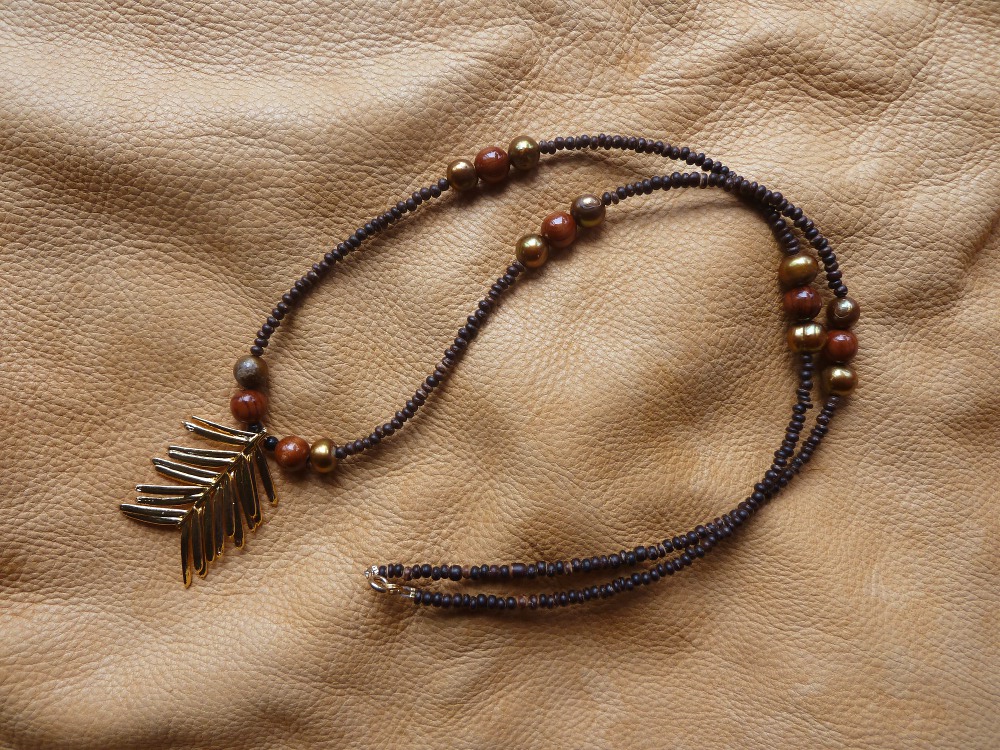
So last night I made some time to just sit and make jewelry, since I’ve been itching to play with the new beads I got since we got home. The first necklace I made was one that I had been planning in my head as I was collecting beads and findings from here and there, and as it came together its spirit wrapped around me, cuddled up close, and refused to let go. Each bead I put on the wire told a bit more of the story of our trip, and when I was done, I had the perfect souvenir of our adventures together.

See, we started down in San Jose itself, once the convention was over. And when we escaped the urban areas and got into the wilderness, we were greeted by the beauty of redwoods, one of several new experiences for me. The same day I left PantheaCon as it closed was the first day I got to see redwood groves in Muir Woods. Later in the week we drove down the Avenue of the Gods, further north along the coastline once we had reached 1/101. And it was there that we stopped at a little independently-owned gift shop. Most of what they had were either out of my price range ($80 bowls made from redwood burls, totally worth the price for their craft) or not particularly useful to me (yet ANOTHER sweatshirt?) But I found a string of polished beads made from redwood scrap, and three little clusters of redwood needles coated in 24K gold, sitting forlornly on the clearance rack.

So those carried the energy of new experiences–the redwoods, the California coastline, my first coastal storm, and the seemingly endless road trip.

Later that day, we traveled along to Ferndale, a small town a little outside of Eureka. My partner wanted to check out all the restored Victorian homes and business buildings, and was not disappointed. There were gingerbread manses galore, and the downtown district was full to overbrimming with historic locations and 19th century construction that had survived storms and fires and neglect. We visited an artist who had made the town his home for many decades, who opened a studio not to sell his art, but to share it for free, and to teach people his crafts. We took pictures of lovingly cared-for houses and churches. And we explored a little general store of nouveau-vintage items, knickknacks, and an extensive display of period antiques for all to see. At this place I found several strands of glass beads, as well as some dyed freshwater pearls.

A few of these pearls, dyed green-gold, flank the redwood beads. The pearls represent the best of human contributions–creativity, conservation, and art–which were evident not only in Ferndale, but in various communities throughout our trip.

Across the Oregon border, not too far from home, we ended up in Waldport, one of a string of little coastal towns. While my partner chatted up the owner of a local knife and sword shop, I wandered over to a flea market across the street. I poked through various antiques and tchotchkes, and came across a veritable treasure trove of little wood beads of the sort that I use frequently in my jewelry. The seller wanted naught but a song for them, and I knew they’d get used, so they went home with me as well. And as I stepped back out onto the street with my little purchase, looked at the little rows of shops that characterize so many Oregon coast towns along 101, and breathed the salt-tinged air, I knew I was back home.

And these little brown beads–those ground the necklace. They’re not the most flashy ones, but they connect the islands of shiny redwood and pearl together.

And in the same way, home is what makes the moments of exploration and adventure stand out even more. It’s not that home is a bad thing; quite the contrary. My partner and I have created a cozy living situation together, and Portland is a good place to be right now. Home is a safe place to return to when the adventures are through for the time being. And the adventures are all the better when I know I have that anchor if I need it, if I start feeling overwhelmed by all the new things, or tired from driving. The shine and sparkle of new places helps me appreciate home more, and without my good home I couldn’t enjoy travel nearly so often on the occasions it happens.

The necklace I’ve created, then, isn’t just some shiny thing–indeed, I very rarely wear jewelry other than my usual wolf chain. So for me to keep something like this that I would normally release into the wild, as it were, is an occasion to be noted. Right now, as I am easing back into the routines and challenges of everyday life, I am wearing this necklace to remind me of those beautiful adventures and the healing they gave me. I carry with me the redwoods, and the gingerbread, and the crashing waves on bluffs. And I smile, and continue on with my day here at home.

Quick note – No Unsacred Place links

Hey, all, just wanted to crosspost a few quick links to my latest essays from No Unsacred Place.

I completed the “Deep Ancestral Totemism” series of posts, meditating on our evolutionary history and the structures of our brains to be more in touch with ourselves as animals; you can read them here:

Part One

Part Two

Part Three

And my latest post, We Do Not Return to Nature. We Are Already There. solidifies some thoughts I’ve had about the nature of “nature” for a while now, particularly in light of us being an increasingly urban species. This isn’t just about finding little bits and pieces of “nature” in a city, but rather a city being, in its entirety, a part of nature, as much as any wilderness place, and the ramifications that that view can have for our efforts toward sustainability.

The Core of my Spirituality

I’ve been on a HUGE artwork tear the past few days, in prep for something nifty I’m unveiling this Monday–Lupa-calia (yes, there’s a hint–it’s art-related!) While I’ve been doing so, I’ve been watching a LOT of various nature documentaries on Netflix. I find it entertaining that they call the sorts of things I like to watch “cerebral”, especially as some of what I’ve been watching has been things about the evolution of Homo sapiens. However, it’s ranged from that, to disasters that shaped the Earth and made life here possible, to what the nature of death is and how it’s ultimately defined.

The more I find out about the world, and indeed, the universe we live in, the more I fall in love with it and the more precious it becomes. On an immediate level I worry for the very near future of this planet and its inhabitants. The only people denying climate change caused by humans are the most stubborn and least willing to listen, those who desperately grope for anything to support their continued denialism.

But on a broader scale, all this research–and it is a form of research–is making my perspective continually less anthropocentric, and more awe-struck by the immense scale of time and space. We are not all-powerful beings, though our ability to manipulate our environments and ourselves is impressive. For example, if another asteroid like the one at the K-T boundary at the end of the Cretaceous hits the Earth, we would be just as dead as the dinosaurs; the animals that survived the chain reactions of natural disasters that resulted were mostly small burrowers. And yes, the Earth and the existence of life on it have survived several mass extinctions, but the scale of time it has taken to recover from these has been almost unfathomable, measured in millions of years. Being relatively large, calorie-hungry critters would definitely be a hindrance to our survival as a species if a disaster on that scale occurred–and if we keep up our actions, we may cause enough global climate change to test that hypothesis.

I am also less and less enamored of the claim that the Earth loves us, and that Nature cares about us. We are but a tiny brief blip in history; on the one-year calendar that represents all of time, we exist in the last few seconds of New Year’s Eve. We’re really not all that important, and why should we be more important than species that lasted for many more millions of years than we have? But I also don’t think “Nature” is angry with us, either. We’re talking about a planet that routinely obliterates entire ecosystems with massive volcanic eruptions and the like. While the Earth isn’t in as much of a state of upheaval as it was a couple of billion years ago, it’s still not exactly the safest it could be.

We’ve gotten complacent in the past couple of hundred years as the Industrial Revolution has caused some of us to live longer and be more insulated against illness, injury, and other such problems. For me, being more mindful of where we are in all of this has contributed a certain level of humility to my perspective. On a short-term level, sure, we’re doing some neat things, and there’s no reason not to try to make human existence as universally good as it can be as long as we’re here. And yes, the fact that we are conscious, aware, observant on a level that perhaps no other animal has ever been, is a damned impressive thing.

But we are just one of a plethora of amazing, fascinating, and uniquely skilled species that have graced this planet. Most are gone now. But as I trace the lines of my ancestors and their relatives far, far back, all the way to tiny bacteria, and before that, perhaps, chemicals that gave rise to DNA–my sense of my place in all this is that I am a much smaller, younger, and less overarching being than many humans would claim.

And I’m alright with that. They say spirituality is about feeling one with something bigger than the self. All metaphysics and otherworldly things aside, knowing that I am a part of this ever-evolving macro-eco-system Planet Earth, in an impossibly vast Universe, is enough of a spiritual core for me.

First Hike of 2012

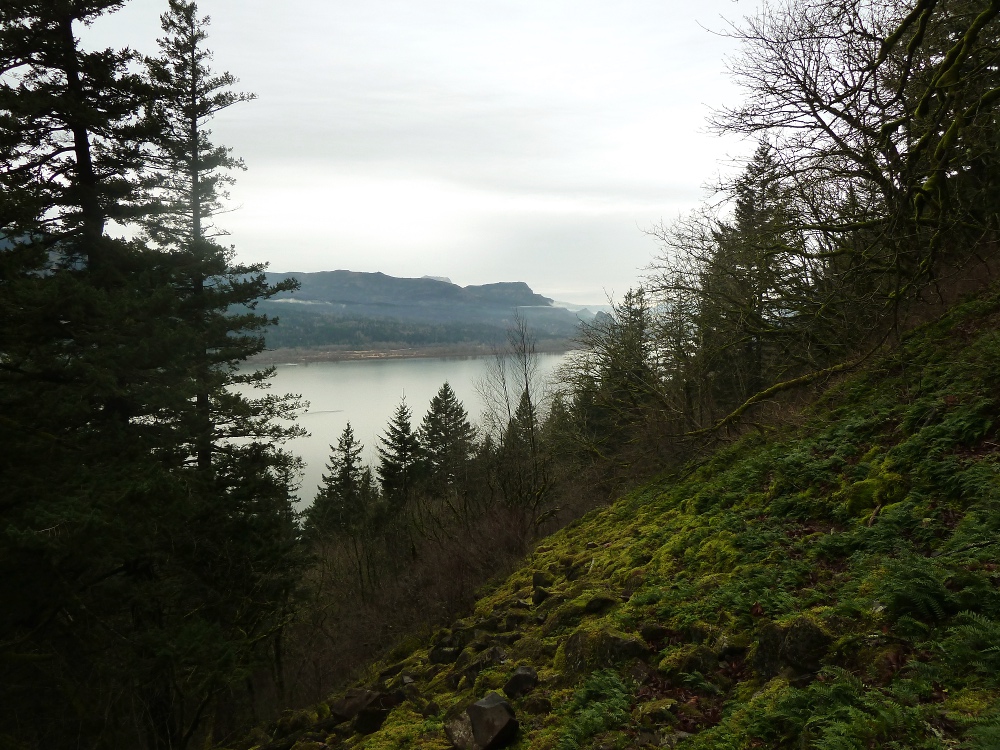
I have been stuck indoors too much as of late, between book revisions and artwork frenzies. So today we had a warm enough day (in the low 50s) that I decided to venture out to the Gorge for a hike. I had originally intended to do something relatively low-altitude like Triple Falls, since I wasn’t sure how far down the snowline would be out in the Gorge area. However, as I drove further out I didn’t see snow on the lower peaks, and so I decided my first hike of the year should be one of my very favorites–the Multnomah-Wahkeena Loop.

Now, I’ve rather out of condition. Up until this past September, I was running 5k three times a week. However, once I graduated with my M.A., I hit the ground running on some creative projects, and unfortunately let the running lapse (though I have been on some hikes in the meantime). So it’s only been in the past couple of weeks that I’ve started to run again, and I’m nowhere near the condition I was before. I was prepared to turn around and go back if necessary. Happily, not only did I make it around the entire loop in three hours, but a lot of my slow-down was due to adjusting my hip pack, taking entirely too many pictures, food/water breaks, etc. I actually did less resting than I normally do, probably due in part to the cooler air, as well as having been cooped up inside too long!

I’ve never done this hike later than late November, when it was still a bit fall-like, and if I recall correctly, sunny and warm. (Autumn likes to stay warm here for a while.) So it was a real treat getting to see what this place is like in full dormancy. The only (not-human and not-dog) animal I saw the entire time was a single female dark-eyed junco in some brush near the end. However, the plant life was incredible! The firs and other conifers were still spreading their branches for sun and mist, and the ferns had nothing left green except their newest fronds, so they were these spectacularly bright green arrays against the dark brown of dead leaves and soil.

One new development was that as I was hiking, and observing everything around me, my mind kept accessing information that I’ve been picking up from science-based TED Talks, Carl Sagan’s Cosmos, and other videos on YouTube from various scientists. I listen to these and watch what I can while I’m making artwork. Having enriched my store of knowledge about everything from geology to biology to physics and then some, I felt as I hiked that I had more of the backstory to this place I was a part of for that time. It wasn’t distraction, though. Rather, knowing things like just how long the processes of evolution have taken to get to this point only served to make me appreciate my fellow beings more. I could look at the canyons I hiked through and imagine how the rivers and streams had slowly cut down the earth over time, wearing these enormous grooves over thousands and even, in some cases, millions of years. I consciously shared breath with the trees, ferns, moss and other plants in this well of oxygen. I observed the formation of rain clouds in the sky. I knew the fleeting, short lifespan of the little songbird who greeted me so briefly before flitting away and was blessed even more by her presence.

The knowledge of this world is sometimes downplayed for sake of more ethereally “spiritual” interests. One of the points I made in Deep Ancestral Totemism, Part One over at No Unsacred Place is that so much of religion and spirituality is aimed at transcending or otherwise escaping this world, as though it has nothing to offer. The idea is that this world is so flawed that we are encouraged to look to a “perfect” world that comes next. Or, alternately, while we are here we are supposed to transcend and avoid anything of our more animal nature, trying to be “spiritual beings having a physical experience”. And, of course, there’s the very mundane practice of escaping “nature” for the comforts of human technology, which often distracts us from the needs of our bodies, or negates those needs temporarily.

The problem is that so many people are trying to escape the physical realm for various other places that our detachment causes us to take what is physical for granted. Because we can conveniently ignore the world around us, we lose that sense of connectivity. The idea of a polluted river or strip-mined mountain is so distant because most of us in the US don’t have to think about them. And so these actions are allowed to continue unabated because we’re more interested in our selves and our needs and the things that let us continue ignoring, transcending, ignoring, transcending, etc. The more we focus on the mind, too, and virtual reality, and spiritual reality, the more this reality suffers.

So it was a great relief to me to find that the knowledge I had absorbed through modern media had only deepened my connection to the physical Land. I had felt yearnings and appreciations even when I was holed up in my apartment listening to these things, but being out in the wilderness today really confirmed that knowing more = appreciating more.

Anyway–like any good trail, this essay rambles.

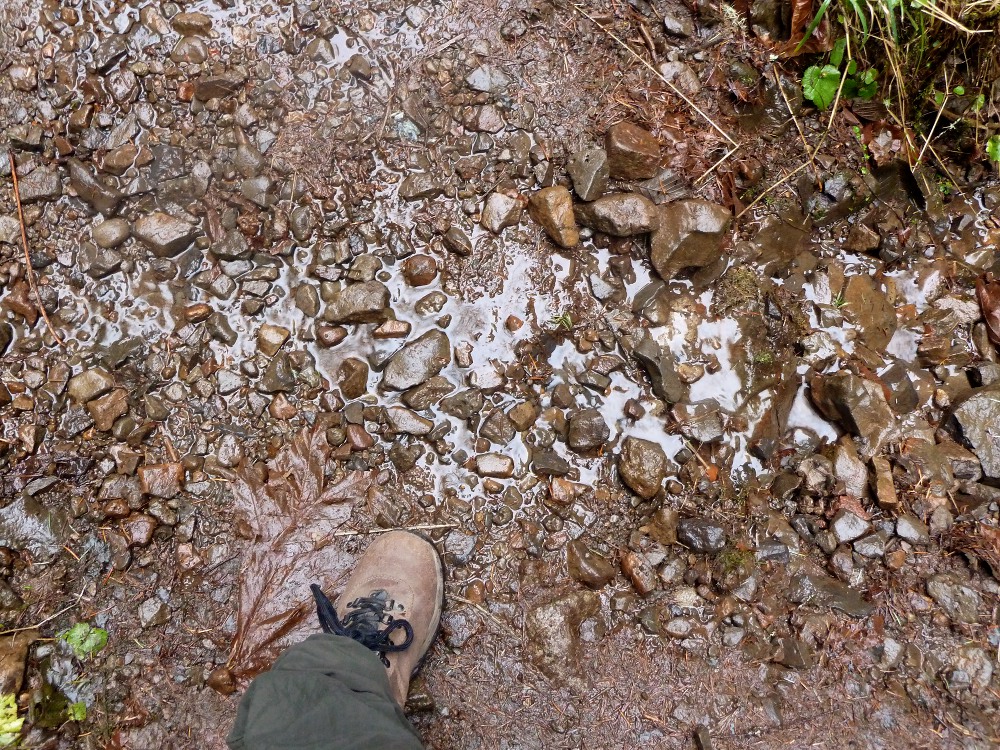
My favorite part of the hike was actually the last two miles, coming down the mountain alongside Wahkeena Stream. Why? Because it was raining! I love hiking in the rain, provided it’s not close to freezing. I admit that, selfishly, I like having the trail to myself when possible. But more than that, it reminds me that this area is a rain forest, and to only visit here when it’s clear is to miss out on what truly gives life to this place.

And so that was what grew within me as I hiked, and this is what it became:

Sometimes I think the Northwest is best
When it is being the Pacific Northwet.
The rain soaks into the sun-parched pigments of the soil,
And glazes the fern leaves in a hydrous kiln,
Until all the colors remember themselves more fully.
Even the sky cordially removes his blue cloak,
And gently wraps the sun in a sheet of gray
So that it is the rain forest who shines the most.

You can see more pictures from the hike here.

Douglas Fir as a Plant Totem

Note: This is part of the Animist Blog Carnival issue TREES, hosted by naturebum.

Most of the totemic work people do is with animal totems, and admittedly I am biased in favor of them. It’s not that I haven’t done work with others, but I just think to talk about the critters more. That, and the plants tend to be more subtle in their communications. Animals–we’re loud, and impatient, and move around a lot. (Well, most of us. Sea anemones and sloths are on the low end of that curve.) Plants, on the other hand, are more deliberate and patient. And they often whisper. Volume didn’t really have to be much of a thing until there were beings that didn’t send their roots into the great, intertwined network under the surface.

And I’ve found plant totem work to be focused on different priorities than the animals’ ideas. Animal totems seem to want to be dynamic, bringing change and motion and growth. Plant totems, from my experience, tend more toward rooting the self deeper in the now, what you have to work with right this moment, maximizing the use of immediate resources before expending the self to find more. Not that this particularly surprises me; these preferences in focus mirror the very nature of the beings and their totems themselves.

Douglas Fir is one of the most prominent plant totems in my life right now, and as I’ve been working with it I’ve been reminded that I haven’t really written about this part of my spiritual experience. In a way I’ve treated the plant totem work like a long hike in which I ooooh and aaaah at the occasional sighting of an animal, but see the trees and other plants as merely the backdrop. (Which isn’t the case when I’m actually hiking; I take lots of pictures of flora that fascinate me.) I’d like to start changing that and talking more about the plant work I’ve been doing over time. So allow me to introduce you to Douglas Fir.

I am not a native of Oregon. I was a military brat, and did much of my growing up in the Midwest, not arriving in the Pacific Northwest until early 2006. And, beyond that, I am not even a native of this continent; my family primarily emigrated here in the second half of the 1800s, and I was born on an army base in Germany–technically US territory, but not of this continent.

Occasionally this non-native status rankles a bit. I am well aware of the impact that European immigration and invasion of this continent had on the peoples who were here before (and are still here, despite attempts to erase their presence and acknowledgement). And I have heard the complaints from native Oregonians about the influx of people from out of state flooding this area in the past couple of decades as it’s become more popular a place to move (even though right now the job market here is still pretty well tanked).

Yet I am acculturated to this place. I didn’t have a choice in my upbringing, and although there is certainly something to be said for being an ex-pat, it is easiest for me to simply stay in the country where I have citizenship. And I like it here, especially Oregon. The Midwest wasn’t nearly as nice a fit culturally (though the Land liked me a good deal, and I love when I get to go back to visit family as well as places).

This mixed relationship to the place and the people may be part of why one of the first plant totems I connected to out here was Douglas Fir. Douglas Fir is a native species, but the trees’ relationship to the Land here has changed dramatically since the arrival of Europeans. As people began to clear the forests more for agriculture and farming, the opportunistic firs replaced other trees in the succession of forest regrowth. And because the firs grow so quickly, they’re a common seedling chosen for replanting logged areas to maximize profit, making their presence much more pronounced than before.

Both of these factors have homogenized much of Oregon’s forest land to one degree or another. While other native conifers such as Western hemlock or red cedar do still grow here, in many places they’re out-competed by the fir. Even some oak savannahs, highly rare any more in this state, experience firs as an increasingly invasive species.

This, of course, was not solely the doing of Douglas Fir, even with the trees’ competitiveness for resources after forest fires and other nonhuman disasters. The intervention of humans has often resulted in much more dramatic effects on ecosystems. And in the same way, I did not choose the accident of my birth, though I have decisions as to where I live and how I act as an adult, to include attempting to integrate into a different culture (even if I can never completely lose the markings of the culture I was raised and socialized in).

So Douglas Fir has been helping me to not only adjust to living in this place that I have decided to make my long-term home, but also to explore the various ramifications of that decision. There’s a certain level of responsibility that I need to keep in mind as I am here, and what it means that I have consciously made this my home. Who have I affected in this decision? How can I be a part of the community without being obnoxious and even harmful? And, more abstractly, how can I combine my work with social justice with my spiritual path?

These are just some of the things that Douglas Fir and I have worked together on. Fir is more of a presence than an active guide, providing a steady energy to tap into and a quiet reminder of connectivity, but it’s all very grounding to my little animal mind.

And so you have just one example of how my totemic work has extended beyond my fellow critters. I’ll try and talk more about it as time goes on.

(P.S. My friend Paleo has done a bit of writing on more domestic plant totems over here.)

Thunderstorms and Wildflowers

(Apologies to those with feeds for the number of pictures lengthening this post.)

Earlier this week, I decreed Wednesday to be “Take a Fucking Hike Already!” day. I haven’t been out as much as I would like as of late, and so in an effort to get more outdoor time as well as make myself some schedule self-care time, I decided to take one afternoon every week for extensive hiking or similar outdoor endeavors. I headed out to Washington to Catherine Creek, which I had heard has absolutely beautiful wildflowers this time of year (or so said the author of the Portland edition of 60 Hikes Within 60 Miles). I also recently replaced my old, dying camera with a refurbished Lumix care of Woot.com, and though it’s proven its worth in photographing my artwork, I wanted to see how it did with nature photography.

So I jumped in my car Wednesday morning and headed out into the Gorge. Even in the middle of the week, the parking lot at the trailhead was almost entirely full, though it has capacity for about fifteen cars before you start parking on the grass. The day was absolutely brilliant–sunny, upper 60’s, some breeze from the west. I got my gear (such as it was) situated, and headed on up the trail.

Now, I had had the intention of hiking the entire 4.1 mile loop. However, my progress ended up being significantly slower than I had intended because I kept finding really pretty things to take pictures of. Before I even got to the trailhead, in fact, I had already pulled over to the side of the road to take pictures of some poppies:

And then there were mossy carpets spiked with bitterroot:

Plus some verdant young oak leaves:

And pine trees, both live…

…and long dead…

Never mind the tadpoles.

And the turkey vultures.

As I proceeded up the ridge, I had a great vantage point to see a massive array of dark clouds coming up over the mountains to the southeast. At first I figured they would most likely pass by to the north and east of where I was. However, the wind shifted, and I began to worry as they started my way.

It wasn’t until I heard thunder, though, that I decided that being up on an exposed ridge was a great way to become a headline; “Hiker killed by lightning strike”, while it sounds less dramatic than it probably would be, is not what I’d like my last word in this world to be.

So I made my retreat back down the trail, only having made it a little over a mile up in the first place. The rain started to fall just as I got to my car, and so I headed back west toward Portland and sunnier skies.

This hike really exemplified postindustrial humanity’s relationship with nature in a very basic nutshell. Human being goes out with shiny technology to take a particular slice of nature back with her. Bigger, scarier and much more uncontrollable slice of nature thwarts nicely planned activities. Retreat ensues. Unlike many people, though, I didn’t see it as a waste of time or a reason to curse the storm. I was grateful for the time I got out on the ridge, and was rather philosophical about not having any control whatsoever about the storm coming in and changing anything. If anything, I felt fortunate that I had enough time to get off the ridge and to my car safely, and that I got to see a phenomenon that’s pretty rare on my side of the Cascades (I can count on one hand the number of times I’ve heard thunder in Portland, which is entirely different from my experiences growing up in the Midwest!).

And I did get a poem out of it, too:

Catherine Creek, 5/18/2011 – by Lupa

Stem-threads bow their heads;
The ladies hold their hats against the wind.
The sun yields to massive paws
Of a bear rumbling across the ridge.
Only the birds are defiant:
Ravens pick at wet, grey fur;
Vultures ride the warm breath;
Swallows look no further than their brush.