White and Red Clover as Totems

I’ve been thinking again about my now-deceased little patch of woods from my hometown. I can’t have that place back ever again; even if the pharmacy that’s there now were to be torn down, the plants that would regrow wouldn’t be the same, and the geography’s been changed, flattened out. And so I mourn that loss. (As an aside, I’ve written even more about it recently at No Unsacred Place.)

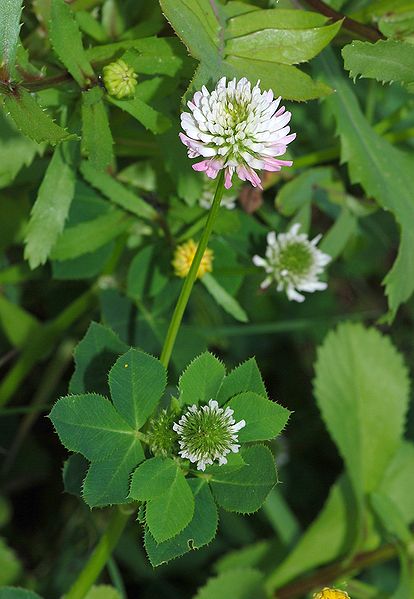
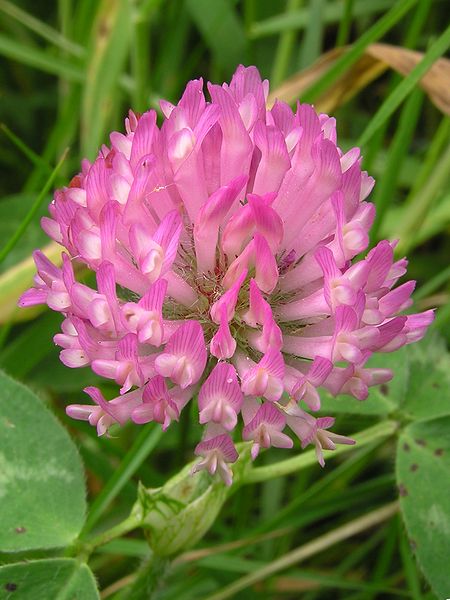
In the process of mourning, White Clover and Red Clover came to me. These low-lying legumes were a big part of my childhood explorations; I spent many hours outdoors lying in patches of three-lobed leaves and fragrant white flowers, and eating the pink petals of the larger red species. Spring was always marked by the arrival of the first clover buds, and throughout the summer I would silently cheer any time the flowers got high enough to be made into necklaces before the lawn would get mowed again. My favorite hiding places were where the clover and other plants were allowed to grow high and thick, instead of being cultivated into submission as with most of the neighborhood.

As I grew older, and eventually moved to several places around the country, I always found clover–white more often than red, but both of them still made strong showings. And they were persistent. Even when I lived in paved-over old industrial areas of Pittsburgh where bricks and old run-down buildings were common, clover stubbornly populated open lots and little scrubby patches by the sidewalks. Here in Portland I see a lot of white clover, to include places where organic urban gardeners plant it as a cover crop. Red is more rare, but I’ve seen it on occasion, often on the edges of parking lots and other hardscrabble places.

And as I have mourned my loss, White and Red Clover reminded me of all the times I’ve seen them over the years and how that’s helped me to maintain the connection to my childhood wonder at the world. I realized that although I’ve lost a specific place dear to me, I never lost the connections that were formed there. I’ve taken these connections much further, too, out of suburban lawns and into empty lots in cities, and the wide open territory of the Columbia River Gorge. I’ve gone from a tiny little creek trickling through my second patch of woods, to the rivers the bridges in Portland cross over–and to the Pacific Ocean itself.

I am not lost. I am still here. Wherever there is clover, there is also the connection I grew up with. I do not need to feel connected only to the patches of clover in a yard I no longer have permission to enter, or in a field that no longer exists. I also have the clover in the neighbor’s yard that I walk by several times a week, and odd patches here and there throughout Portland. And just as I carry the lessons taught by family members many years deceased, so do I carry what I learned from White and Red Clover, and Periwinkle, and Black Poplar, and Eastern Red Cedar, and White Oak, and so many others through their physical counterparts as I went from a seedling to a sapling to a fine young tree myself. These still stand out to me, so many years later, as a collective of plants and their totems who were so incredibly influential. Some of their children are now dead, victims of the destruction of one place. But thankfully the species and the totems live on, and no one can take that from me.

And given that neither White nor Red Clover are native to the United States, their ubiquitous presence helps me to feel at home where I might otherwise feel rootless. Similarly to Douglas Fir, the Clovers have helped me to be as flexible and adaptable as they are in a new place, particularly as I was not even born on this soil. Part of that grounding does come from reminding me of my roots, and teaching me to set them down wherever I go. If they can bloom where they’re planted, so can I.

I find all this comforting. I have lost, but I am far from alone–or rootless. White and Red Clover showed me that.

Poison Oak as Totem

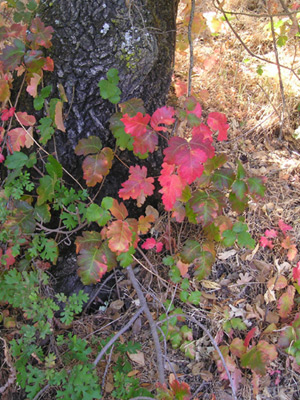
A comment on my last post at No Unsacred Place brought up the itchy, urushiol-soaked leaves of poison ivy and poison oak. I am quite sensitive to all of the plants that exude this compound, and admittedly all they’ve inspired in me has been much cursing and complaint on the occasions we’ve had too close an encounter.

Elinox, the commenter who brought these plants up in the first place, mentioned the idea of a shadow totem. A “shadow totem” is a newer concept that seems to be an odd extrapolation of Jung’s Shadow archetype; a shadow totem represents or embodies something that we fear or are otherwise uneasy with. It’s not a concept I work with myself as I find it a little too much of a pigeonhole, but I agree with the general idea that sometimes we have to face some really difficult things in our paths.

So I meditated some with Poison Oak today to consider our relationship–such as it is. Like thorns and other obstacles, Poison Oak and her kin developed urushiol as a way to avoid being eaten by animals. It does mean, of course, that poison oak is not an especially cuddly plant, and the totem was correspondingly strict about personal space, though pleasant otherwise. She’s actually quite friendly; she just maintains very firm boundaries.

And that’s a very important lesson for me, especially as a woman in a culture where women are still often treated as though our boundaries don’t exist. If we object to catcalling, or sexual harassment, or any of a number of other nonphysical boundary violations, we’re told that we’re “bitchy” or “making too big a deal about it”. If we’re assaulted or raped, there are people ready to question what we did to deserve it–were we drunk, or scantily clad, or walking alone at night, or hanging out with the “wrong people”? In the same way, simply for defending her boundaries with integrity and creating a consequence for violation, Poison Oak is vilified. How much do you hear about this plant for any reason other than “this is what it looks like–DON’T TOUCH IT!”?

This goes beyond women, too. There are so many situations every day where people are expected to yield to those who are more powerful, who have no respect for their needs or integrity or safety. The abuse of power is rampant on all levels of American society and beyond. It’s no wonder, then, that so many put up fierce defenses, even against those who mean them no harm. And it can be easy, if a person doesn’t let us in as far as we want, to vilify them for not giving us what we demand.

Poison Oak also told me to examine my own boundaries. I sometimes feel a lot of guilt for maintaining the boundaries that I do. The older I’ve gotten, the more of an introvert I’ve become, and I’ve sometimes gotten criticism for that. More extroverted people don’t always understand that introverts’ quiet and solitude isn’t about them.

There will always be people who feel entitled to my personal space–strangers who don’t understand that it’s a problem if they suddenly come up to me and start flirting, or those who feel entitled to fill an entire residential block with the loud, bass-heavy thumping from their stereo system. These people tend to complain if someone challenges them, and it can be hard to stay true to my own boundaries when they’re trying to paint ME as the bad guy for standing my ground and insisting on my comfort.

And there’s only so far I should allow others to make comment on my spiritual practices. I’ve been spending a lot of time lately trying to defend myself against people who criticize me for being an American of European descent trying to put together an animistic practice, and from people who are uncomfortable with or even incensed by my work with animal parts in art and spirit. While being aware of what others are saying, and my own power and privilege, is a good practice to cultivate, there is a point past which I need to maintain my own integrity and preserve the roots I have set down to give myself more balance.

However, I also need to be mindful of the negative effects that my own “urushiol” can have; sometimes boundaries can be too tight. I sometimes have to make a real effort to get out and be social, not out of any fear of socialization, but simply because I am so comfortable in my personal space that I simply neglect to come out of it at all. Over time, others feel they simply can’t approach me, and so sometimes I need to demonstrate that yes, I can be sociable!

And in some ways I grew up with a certain level of entitlement that’s been hard to shake even at this point of my adult life. I was raised in a town where people were very prickly to each other, where being bullied taught me that everything is a personal offense, and where people always looked for someone to blame for whatever went wrong, even something as small as a delay in traffic. Poison Oak’s “passive” defense isn’t an open attack, and she doesn’t go out of her way to cause trouble. It’s something to keep in mind as I continue unraveling this unwanted part of my past conditioning.

By the end of the conversation, I saw a good deal of myself in Poison Oak, and vice versa. While I’m sure I’ll be unhappy the next time I end up with an itchy red rash from brushing up against her progeny’s leaves, I won’t blame them at all. Urushiol is only the protection that Poison Oak has developed over time, and it’s really rather effective. If I can’t touch or pick poison oak like I can clover or dandelions, it doesn’t mean the itchy plant is a bad one. It just means I need to respect that plant’s boundaries as much as my own.

Silent Totems

Recently I was given a very old jaguar hide as a gift. I was rather stunned, as I had been told by the person who gave it to me that it was a “spotted cat hide”, but not specifying which sort. So when I opened the package and saw the distinctive rosettes, my heart skipped a beat.

See, Jaguar is what I call a Silent Totem. Silent totems are totems who are not necessarily active participants in my life. They don’t come to me in dreams, and I don’t call on them in rituals. But their influence is still there in the background, and the distance doesn’t always mean a weak “signal”, either. Sometimes a silent totem need not do anything but be present and observe in order to make a great impact.

Take Jaguar, for instance. Jaguar is connected to my shamanic practice, not as an active guide, but as one who represents the gravity of the work that I do. I am reminded that the foundational practices of shamanism were forged in much more dangerous times and settings, in places where being attacked and eaten by large wild animals was (and is) a real threat, where the shaman was the main line of defense against illnesses where there were no refined antibiotics and other high-tech medicines, where the life expectancy was much lower than it is for me. Jaguar is also the reminder that the spirit world is not a safe place to be, and that although I have good companions on my journeys, none of them are a complete proof against threats by malign beings.

And all it takes is a glimpse, in the back of my head where the wild things are, of black spots on yellow fur sliding through dappled underbrush–for just a moment–to make that reminder clear. There are other silent totems as well. Anna’s Hummingbird can be felt in periods of high energy, where I’m dashing from one task to the next as quickly as I can, drawing on my reserves to meet the demands at hand. Common Octopus carries the ephemeral nature of mortality, to not take for granted what is here before it’s gone, and to not underestimate something short-lived–in other words, to seize the day and make the most of it.

None of these or other silent totems normally come out of their places in the shadows of my mind, but they are there nonetheless. I will be interested to see whether Jaguar decides to come forth; there was a decided “spark” when I first touched the jaguar hide, and I felt an almost overwhelming energy for just a moment. If I do start more work with Jaguar, it promises to be intense.

Quick note – No Unsacred Place links

Hey, all, just wanted to crosspost a few quick links to my latest essays from No Unsacred Place.

I completed the “Deep Ancestral Totemism” series of posts, meditating on our evolutionary history and the structures of our brains to be more in touch with ourselves as animals; you can read them here:

Part One

Part Two

Part Three

And my latest post, We Do Not Return to Nature. We Are Already There. solidifies some thoughts I’ve had about the nature of “nature” for a while now, particularly in light of us being an increasingly urban species. This isn’t just about finding little bits and pieces of “nature” in a city, but rather a city being, in its entirety, a part of nature, as much as any wilderness place, and the ramifications that that view can have for our efforts toward sustainability.

How Wolf Fed the Scavengers

Once, when this place was still new, a great famine struck the land. The sun broiled the earth, and the plants were so thirsty in the drought that they could barely keep their stems and trunks straight, never mind grow enough fruits and leaves for everyone to eat. The plant-eaters were always hungry and they grew thin, and the meat-eaters could barely find anything other than bones to gnaw on, their prey was so wasted away. All the animals grew desperate, and fell to fighting each other more than they ever had before.

So it was decided that the animals needed a king. This king would decide who got how much to eat. The plant eaters argued that because they were the closest to the plants, that they knew them better and should get to have control over who got what. The meat eaters opposed them, saying that as they were at the top of the food chain, they had a better view of the situation. Those who ate both plants and meat were split right down the middle, some siding with the plant eaters, and some with the meat eaters.

Bone stag wall hanging by Lupa, 2010

The arguing lasted for three days and three nights, until at the end Whitetail Deer was made the king. All the animals brought forth all the plants that were ready to eat. “Since I am king,” he said, “I will take the first portion since I need my wits about me to keep an eye on our food supply. Then the rest will be divided up among the plant eaters according to size. But the meat eaters may only eat those animals who die of starvation and disease; from now on, hunting will be banned.” This caused much dismay among the meat-eaters, but what could they do? He was their king, too, and he said these words while shaking his mighty antlers with their sharp points.

So the plant eaters were able to leave the meeting with as much food as they were able to get, and all the animals were to collect more plants as they were ready to harvest, even the smallest berry or seed. Each day the food would be brought to Deer’s home, where he would divide it up, and send the plant eaters home with food while the meat eaters only had a scant few bony carcasses to squabble over.

Then it was decided that the meat eaters were not even allowed to be at the food collection except to bring what they had gathered and pick at the bones of the starved, and the plant eaters began to venture out of Deer’s home only to bring the collected food in, protected by their king’s antlers. The only ones who stayed out were the dead, who were left on the edge of Deer’s home, and over time there were fewer and fewer carcasses left out each day.

Wolf totem headdress by Lupa, 2012

Soon the meat eaters began to hoard what food they could. The bigger ones, by bullying and stealing food from others, ended up with the most and stayed strongest, while the little scavengers grew more and more hungry over time. Only Timber Wolf did not participate in this; she only took enough to feed herself, her mate, and her pups, and often ate the least of all her family. She grew sadder as she saw how the animals fought each other over so little.

The little scavengers noticed that of all the big meat eaters, she was the only one to let them have their own food. So they sent Raven, who was the bravest of them, to go speak with Wolf and ask her for help, since she was a great hunter, swifter than all the other meat eaters, and perhaps she would know what to do. She was given the last of the scraps to take to Wolf as an offering.

Raven flew to Wolf’s home as quickly as her weakened wings would carry her. She landed at the front of Wolf’s den, and croaked to her, “Lady Wolf, great huntress, brave warrioress, I am here on behalf of all the little scavengers, those of us who are too small to hunt big game. We are hungry, and we are too weak to steal our food back from the other big meat-eaters. You have the greatest hunting skills, and you are powerful. Will you help us to get food so that we may not starve to death and all become food ourselves? Soon none of us will be left!”

Wolf, curled with her mate and pups in her den, heard Raven’s pleas, and it was enough for her. She was tired of seeing the little scavengers creeping around and crying. Her hackles raised, she stalked out of the den, and met Raven there.

“Yes, I will help you. Let us go to our king, and ask him why we are unable to hunt. Let us ask him why we are not allowed to be at the food collection any more, other than to bring what we spend our days collecting in the hopes that we will be given bones to gnaw. My young cry for food, and your young barely live. It is too much.”

So they shared the scraps so Raven could recoup her strength from her flight, and Wolf could be ready for the trip. Raven perched on Wolf’s back, and they went to Deer’s home. When they got there, all the plant-eaters were inside, and no one was guarding the door since all the meat eaters were so weak that no one thought they could get in.

But Wolf got in, and Raven with her, and before anyone could speak or stop them, Wolf strode straight to where Deer sat, one antler shed and lying on the ground, the other shaking on top of his head. He was surrounded by all manner of food. The stores were piled from the floor to the ceiling; there were enough plant eaters that had died that even the small amount the famine-stricken plants could produce was more than what they could all eat. She looked at Deer, and all the plant eaters around him, and noticed how fat all of them were. And she grew enraged.

“How dare you?” she cried. “How dare you leave us out here to starve? You threw out all of those who nibbled at the edges of your leavings, and you only gave us your dead. Now that so many of you have died and you have more than enough food for all who remain, you keep it locked away here! You are no fit king!” And with this she fell upon them all, with bared teeth and fiery eyes.

She slew a tenth of the rabbits, and a tenth of the wild sheep, and a tenth of the elk. She hunted and killed a tenth of all the plant eaters, and the smell of the blood brought all the meat eaters together to feed. Then Deer himself, huge and fat and no longer so fierce without his antlers, got up and ran away, and Wolf chased him, with the little scavengers in their wake.

She chased him through the forest, and she tore away his toe, and the weasels fed upon it. Then she chased him through the mountains, and in a clearing she tore away his tail, and all the ravens came to take a piece of it. Then she chased him through the desert, and she tore away his remaining antler, and all the mice came and chewed at it.

Detail from wolf totem headdress by Lupa, 2012

And finally they circled back around to the mountains, where Wolf chased Deer all the way to the top of the highest peak, and there she overtook him and slew him. And his coppery blood rushed down the mountain in all directions, and he had grown so big that there were great, gushing rivers of it. The blood flooded all the land, from the mountains to the desert to the forest, and such was its power that it brought an end to the famine, and the plants thrived again.

And when Wolf came down from the mountain she brought Deer with her. She fed her young and her mate and herself and she tore what was left of Deer to pieces and gave all the little scavengers enough to feed themselves and their families.

Then she addressed all the animals, “I have killed our king, which makes me queen. I have only one decree—that we all go back to the way things were before the famine so that plant-eaters eat only what plants they gather, and meat-eaters eat only what meat they hunt or find.” And so it was.

But all the little scavengers followed Wolf around from that day on, for whenever she made a kill, she remembered their plight and how their food had been stolen from them, and always left them something to eat. And for her part in bringing back balance, Raven and her children were allowed to eat with Wolf and her kin for the rest of time.

The Foxes of the Four Seasons

A long time ago, the world was a lot different than it is now. There were no seasons, no changes in the weather. If you wanted snow, you had to go to one part of the world. If you wanted sun, you had to go to another. And everybody had to bring back rain from the only place in the world that had it, though it got enough for everybody. Since the animals couldn’t only have rain or only sun, there was a lot of moving around, and you didn’t have so many animals who stayed in one place. Some animals hardly ever saw another of their kind, but others would organize reunions every so often so as to not get lonely.

So it was that every seven years, all the foxes of the world would come together in one place for one great conclave. Long-separated friends caught up with each other, families introduced their youngest kits, disputes were addressed and resolved, and at night there was much celebration to be had. It was all rather a busy affair, as one might imagine would happen with that many foxes in one place.

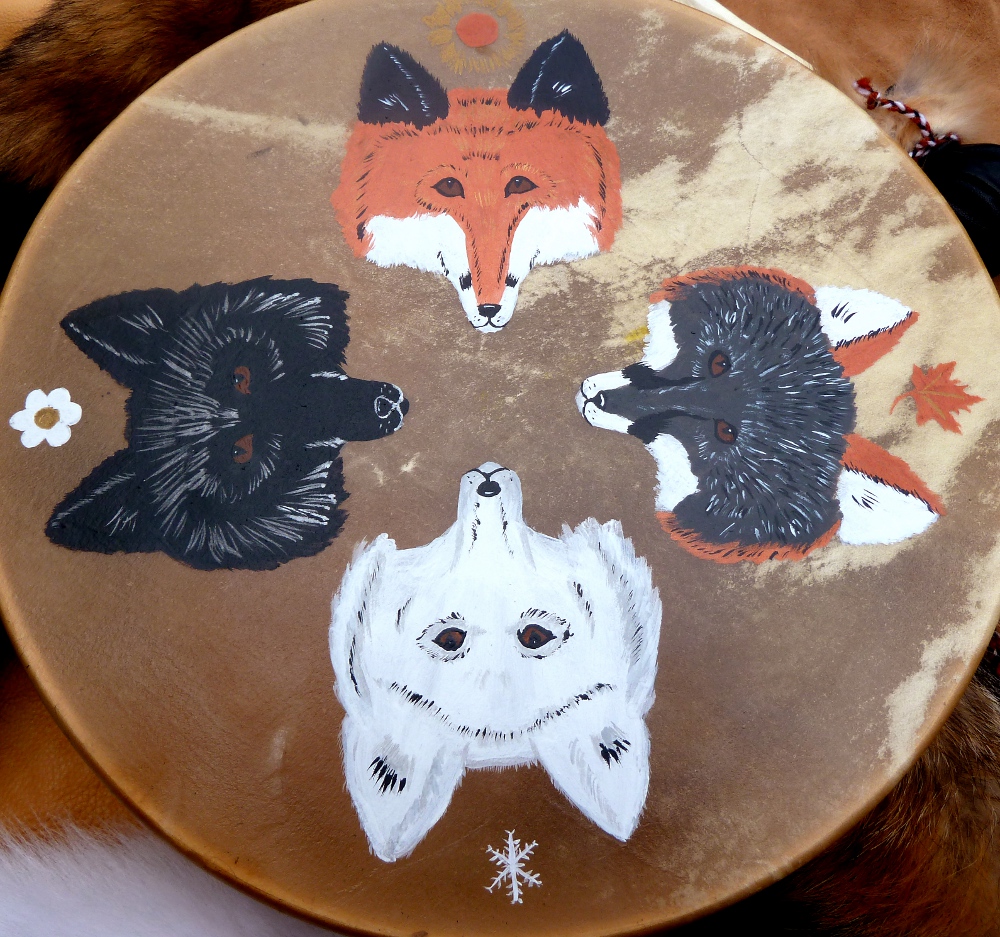
It just so happened that one year, there was a contest over which fox was most beloved by the Earth, who gave the foxes’ paws somewhere to go. Finally, it came down to White Fox from the North, Black Fox from the East, Red Fox from the South, and Gray Fox from the West. Everyone agreed that these were the very best, cleverest, swiftest and strongest foxes of them all. They spent an entire day debating who was going to be elected the best fox when the Earth would make her presence known that night. They had heard that the very best fox would receive a special gift from the Earth, and they each wanted to prove they deserved it.

“She’ll choose me,” White Fox said, “because I am the only one who holds the cold snow and ice with my tall, proud mountains!” And everyone agreed that his mountains were indeed quite impressive.

“Nobody likes being cold, silly thing,” said Black Fox. “She’ll choose me, because I carry the soft, warm winds that help new seedlings to grow.” And all the foxes assembled thought she made a very good point.

“Ha! Just a little warmth? I’ll give you all the warmth you need with all the sunshine you could ever want!” declared Red Fox. “That’s why I’ll be chosen!” There was a good deal of agreement with that, as basking in the sun was a favorite activity of foxes all over.

“Surely we cannot have any snow or plants or cooling off from the sun without rain,” said Gray Fox. “I have the most water, which means that I’m sure to be the one the Earth will choose.” And the other foxes licked their chops at the thought of cool, refreshing rain water to drink.

But who would be chosen? The four foxes fell to arguing amongst each other, and had almost come to blows when there was a great trembling beneath their paws, and the Earth made her spirit present as a great, glowing golden Fox. “Dear children, what are you doing?” she asked.

“We were trying to figure out who you were going to choose as your favorite fox, and we can’t all be your favorite!” the four foxes said.

The Earth thought a moment and looked at each of the little foxes at her feet, each one so strong and talented in her or his own way. Then she smiled.

“Of course you can all be my favorites. Why choose one among you when all four of you have so much to offer?

My lovely Black Fox, you are the deep, rich soil which allows all the plants to grow healthy and strong. You take what has died and rebirth it as new living things. Your warm winds help to bring life to the land. Therefore, I will give you the first part of the year, when my friend the Sun is on his journey back here.

And you, bright Red Fox, you give the Sun a place to show us his strength the best. You allow him a place to set down the burden of rays on his back, and unwrap them so that all of us may see them and enjoy their warmth. To you, I give the second part of the year so the Sun may share with us every year.

Dear Gray Fox, your rains are invaluable to us all; without water we would be parched. I give you the third part of the year, where your rains may be the tears that bid farewell to the Sun as he leaves again, and your bright colors will be reflected in the leaves of the trees as they wear their finery to see him off.

Oh, beautiful White Fox, I haven’t forgotten you! Your cold climate cries out to the Sun for what warmth he will give, and your snows reflect his rays so that he can see this land no matter where he goes. To you, I give the final part of the year, to remind the Sun of us when he is at the farthest part of his travels, while we await his return here.”

And so it was that every year after that, all the places of the world received the gifts of the four foxes, each one in turn. Of course, each Fox had her or his own favorite places where they might tarry a little longer. But the animals no longer had to travel so far just to get sunshine or rain, or to get out of the cold or the heat. And so all but the most adventurous were able to settle down and create nests and dens, and allow the seasons to come to them.

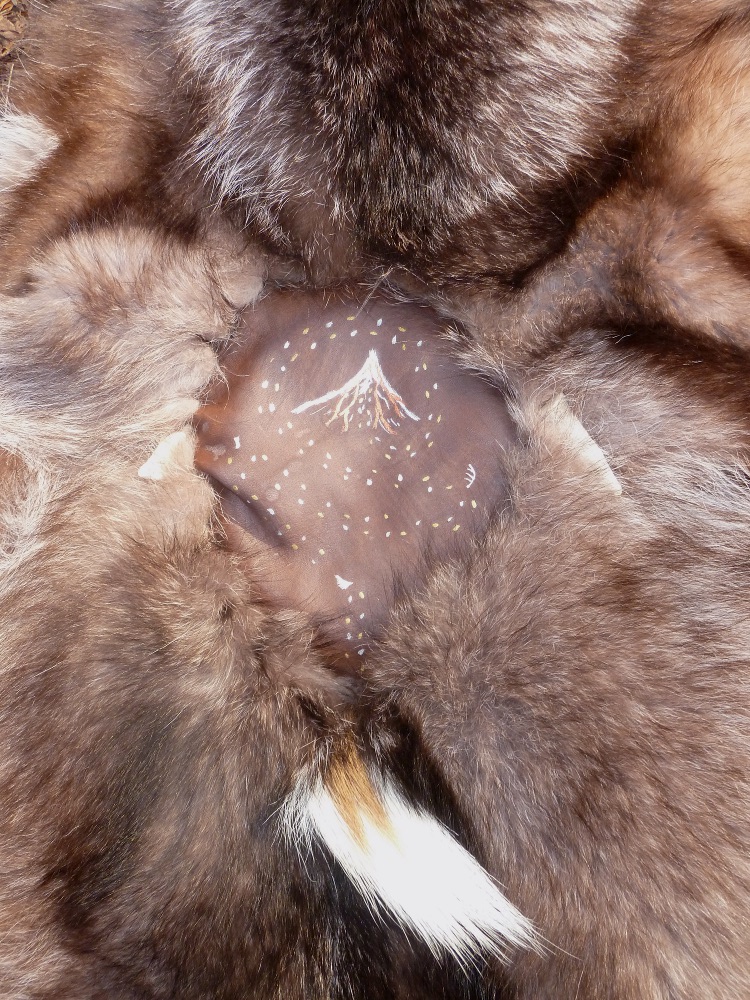
Fox drum, acrylic on deerskin with fox tails, by Lupa, 2011

Art, storytelling, and shamanism my path

I have some half-formed thoughts about the recent integration of storytelling with my artwork, as well as the very deep, significant spiritual elements of the acts of creation. Yes, the coyote and wolverine are the most recent and obvious syntheses, given that each has a “new” myth to talk about its origin. But Anput was also a spiritual story, albeit one in which I featured as a main character, and which was not just a story that I created in my mind, but something that happened to me in working with that Goddess. Even Lady Red Riding Hood was story, rewriting the tale to better fit modern parameters, though maintaining its “once upon a time” feel.

I’ve long been a spirit-worker, evoking and invoking totems, animal spirits, deities and others. And the spirits have often spoken through my art, and not just the skin spirits that are in the remains themselves. I’ve even created numerous ritual tools and costumery over the years that could mesh with certain beings or energies in ritual.

However, this feels bigger. I feel like I’m adding to mythology, if that makes sense. The process of creation is simply the vehicle thereof. Perhaps it’s hubristic to say so, but it feels as though I am *adding to* these beings, with their consent and even invitation. Along with transforming the animal remains and their spirits, I feel I am also making a bigger transformation than before to the bigger beings, the totems and deities. If a totem, for example, is “made of” the natural history of the physical animal, its relationships with all other species, and the human observations as translated into legend, lore, and mythology, then I feel like I am making a bigger contribution to the ongoing, ever-developing mythology.

Like when I make a small pouch out of recycled rabbit fur, I am transforming the fur into something new, and I am rejuvenating the spirit with a new purpose–or releasing it from its container if it so wishes. But Domestic Rabbit stays largely the same; the pouch may be used to connect to Rabbit, but the change is only on this end. However, I look at my experiences creating the Anput headdress, and it definitely feels *bigger*. If you give me the generous allowance that my UPG is more than just something in my head, then I have been shown an element of this Goddess that may have been previously unknown, perhaps by even the ancient Egyptians. I don’t feel I’ve so much added something that wasn’t a part of her before, so much as I helped to shed light on it.

I’m not the only person to do this sort of thing; Ravenari has long been creating these inspired works. Her As Totems series largely comes from the individual totems pressing her into making portraits for them, or asking others to commission her (as with me and Steller’s Jay). She also learns more about the totems in the process of creating these works, hence her creating about the only totem animal dictionary I give any credence to. I give it more weight because I am aware of her process as well as her general familiarity with the animals and her shamanic skills, and I know how much effort goes into the contact with each. Whether she changes the totems, adds to them, or simply enhances the focus on certain parts, I can’t say. But it is very impressive to watch.

And it’s incredibly fascinating to be going through this process; the exchange of energy and ideas that I’m sharing with the deities and totems and spirits in this is beyond what I’ve done before. Whether you see me as connecting with independent beings, or being able to better access these archetypes and channel them through my work, I would appreciate your constructive feedback on what I’m trying to describe here. Anyone else been here?

How Wolverine Devoured the Sun

Wolverine was the fiercest animal in the forest. Even great Grizzly Bear ran away when Wolverine was angry. Wolverine was also the hungriest animal in the forest. He ate everything he could find that wouldn’t bite him back, and even most of the ones that would. All the animals of the forest told their young to stay away from Wolverine, lest he gobble them up for breakfast.

After a while, everyone learned to stay far away, and he found it harder and harder to find food to eat. One day, there was an enormous rumbling in his stomach, and he knew that if he did not eat soon his stomach might just try to eat him! So he left his den to go out and see whether some animal or another might be close enough for at least a snack.

Yet the snow covered the land so thickly that not even the tiny field mice with their enormous families could be found. And because all the animals had hidden away while it snowed, there were no tracks to be found anywhere.

Wolverine looked all around him. There was only snow, that melted in his stomach and did no good. And there were trees and rocks, but even his formidable stomach would reject them. Finally he looked up, and saw the Sun in the sky.

And he thought to himself, “All life comes from the Sun. She feeds the plants, who feed the animals, who feed me. So if I eat the Sun, then I’ll never be hungry again!”

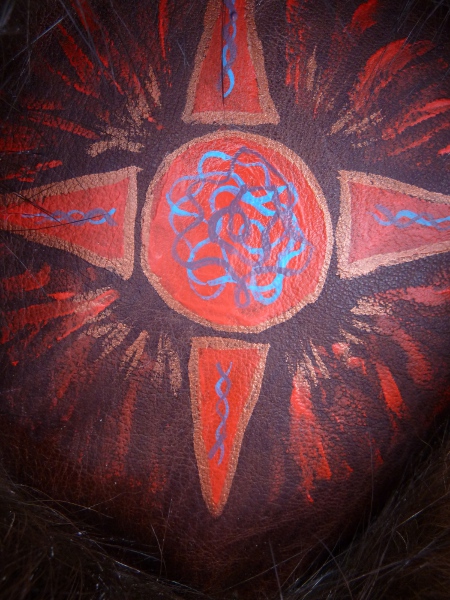
Sunburst, Lupa, 2011

Just then, the Sun was approaching the top of the highest mountain peak. So Wolverine ran as fast as he could, climbing the mountain with his sharp claws gouging gashes in the rocks, and shredding the boulders into rock slides. He destroyed the mountainside homes of the pikas, who to this day will still complain loudly and shrilly about it to anyone who comes near.

Right when the Sun was crossing over the tip of the mountain, Wolverine reached the summit. With a running leap, he opened his jaws just as wide as they would go—and he swallowed the Sun! The world was thrown into complete darkness, since the Moon was still slumbering on the other side of the world, and the Stars were too surprised to shine.

Down in the forest, the startled animals panicked, shoving their way through the cold and snow to see if their neighbors, too, had experienced this sudden nightfall. Some were lost in snowdrifts; others tripped over rocks or fell off cliffs or stumbled into rivers. The trees and other plants shook and wailed as their only source of food had disappeared. “We are lost!” they exclaimed.

Meanwhile, Wolverine attempted to pick his way down the mountain with a very round, very full, and very uncomfortable stomach. He was so busy trying to not roll down the mountain that he didn’t even stop to consider whether he was even hungry any more. And he certainly didn’t notice that he had, in his haste, swallowed the Sun quite alive.

For her part, the Sun had shaken off the indignity and inconvenience of having been eaten whole, and she began to look for a way out. First she looked up Wolverine’s throat, but she only saw his sharp teeth, and having avoided them once she did not wish to try her luck again. She then looked toward his tail, but she only saw his long, long tangle of intestines, and she did not wish to find herself lost in that maze. She even tapped at his ribs, but found the bones to make all too effective a cage.

Wolverine totem headdress, Lupa, 2011

So finally she decided she would stay right where she was and look for any possible way out. She began to roll around, testing every surface she touched for any sign of an opening. As the Sun pressed up against Wolverine’s insides, she burned him terribly. Wolverine, even so strong and stoic as he was, could not help but cry, and the pain was so great that he began to shed tears of blood that flowed down his body.

Finally, the Sun found a weak spot at the back of his belly. And she pushed, and she pushed, and Wolverine clawed the ground trying to keep her in, and his howls of fury and pain were so great that all the other creatures ran far away.

And then with a great tearing and rending, the Sun burst through Wolverine’s back. She scorched his fur as she escaped, and left an impression of her beams radiating out from the hole she created. She flew back up into the sky and brought the day to the land again.

As she looked down upon Wolverine, who lay dead upon the ground, she took pity on him. And lifting him up into the sky, she breathed life back into him, and knit together his torn form. And Wolverine stood up, as healthy—and hungry—as ever. But as he looked back to see whether the hole still remained in his back, he saw a ring of pale sunbeams on his fur.

“These are to remind you of the consequences of your gluttony,” the Sun said. “You were only so very hungry, my fearsome child, but you are a creature of the earth, not the sky, and there are many things for you to eat where you came from.” And so she placed him back down right by his den.

And from that day forward, no matter how hungry Wolverine was, and no matter how far he had to travel to find food even in the middle of Winter, he had only to look at the Sun’s touch upon his back to remind him of the folly of his past.

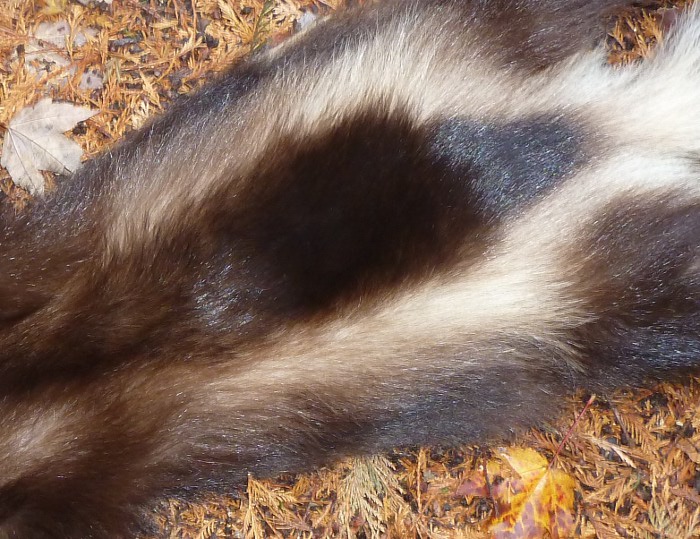
Wolverine Fur, Lupa, 2011

How Coyote Lost His Hearing

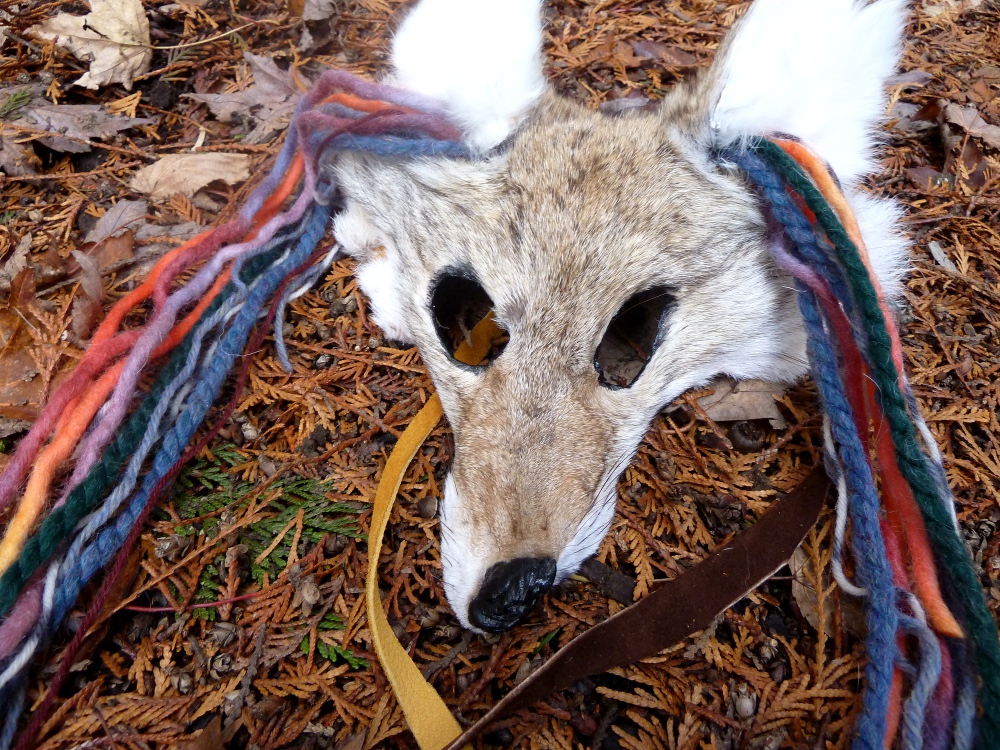
Coyote Fool Mask by Lupa, 2011

Now Coyote was a fine young man, if a little rough around the edges. And there came a day when he decided he was going to go courting, because no one had married him yet, and that was a rather sad state of affairs if he said so himself! So he went on down to the river, jumped in and swam around a while, came back out and shook himself dry in the sunshine. Then he put on his finest clothes, which were rather threadbare and shabby and a bit out of style, puffed his chest out, and went to go find someone to court.

Soon he ran into Rabbit, who was grazing in some clover at the edge of a buffalo wallow. “Look, there’s Rabbit! She’s not married, but she has a lot of children. I bet she’ll want to marry me!”

So Coyote sidled on up to Rabbit. “Why hallo there,” he said. “How might you be this lovely day?”

“I’m doing quite well, thank you! Would you care to join me for lunch? The clover here’s so luscious!” Rabbit replied. “This little patch right here is especially nice,” she said with a wink. So Coyote settled down next to Rabbit and began to mouth the clover, just to make Rabbit feel better and hopefully like him a little more.

But soon all that pretend eating made him hungry for real food. And Rabbit was looking mighty tasty. Of course, Rabbit had seen that look in Coyote’s eyes before. So before he could snap his teeth at her, she up and ran as fast as she could away from him. She even kicked a cloud of dust all over Coyote and his finery.

While he was sitting there in the dust, with his finest clothes filthy and his stomach growling, along came Scrub Jay. “What seems to be the problem?” Scrub Jay asked.

“I tried to court Rabbit so she’d think to marry me, but instead she ran away from me and left me here in the dirt!” Coyote complained.

Scrub Jay looked very grave. “Well, I see the problem here. You just don’t look enough like a rabbit. Now, we can’t very well shorten your tail, and we can’t round your nose off no matter how much you wiggle it, but we could make your ears fluffier, like hers are. Here, get some of this dandelion fluff and stuff it in your ears, just like so.” So Coyote tucked his ears full of fluff, and then went off in pursuit of Rabbit.

He never found where Rabbit went, but he soon ran into Crow, who was building her nest. “Well,” he thought to himself, “I don’t think Crow’s married either, and I think she’s just as nice as Rabbit, even if she is a gossip. I’ll court her instead!”

Coyote headed up to the tree where Crow was building her nest. “Good day!” he called to her, a little loudly since he was having a bit of trouble hearing himself, but everybody had that problem from time to time, didn’t they?

“Why, look, it’s Coyote—wait, what on earth do you have stuck in your ears?” Crow cawed.

“Oh, you won’t convince me of the worth of lucky hares—their feet never did me any good at cards anyway!” Coyote replied. “So, have you found any good carrion lately?”

Crow cocked her head to one side at him. “If I did, I wouldn’t tell you, you silly creature! I need to eat, and I don’t want you stealing my food!”

Coyote cocked his head right back at her, hoping maybe mimicking her would make her like him a little more, though he was also more than a little confused. “But my feet are just fine! Why do you think they had peeling grooves? Those cracks in the pads are natural-born, baby!”

“No! Not FEET! EAAAAAAAT!” Crow cawed as loud as she could. She flew down from her nest and flapped her wings in his face. “EAT! EAT! You fool, I said EAT! As in FOOD!”

Leather corvid wall hanging by Lupa, 2009

Coyote backed away from this mad black whirlwind, then turned tail and ran, feathers coating his dusty finery, leaving a trail of fluff in his wake. He eventually shook Crow off, and soon found himself in a panting heap right where he’d left Scrub Jay.

“How’s it going, Casanova?” Scrub Jay said. “You panting because Crow was just too much for you?”

“You could say that,” Coyote grumbled. “But she didn’t like the fluff! And I don’t think she’s going to marry me any time soon, either.”

“That’s because she doesn’t care about fluff, silly dog. She’s right in the middle of building a nest—and believe me, I know nests,” Scrub Jay bragged. “What you want to court her with is something pretty that she can decorate her nest with! In fact, I know just the thing! Follow me.”

So Scrub Jay and Coyote went east, and they went west, and maybe just a little north—but never south, not when courting. And they came to a place where humans lived, a little hut with fences all around it. By the door of the hut was a basket, and in the basket were many balls of brightly colored yarn.

“See that?’ Scrub Jay pointed to the basket. “That’s exactly what you need, right there! Crow would love that in her nest! Now, here’s what you do. You want her to definitely notice that you have yarn for her, even from a mile away, and maybe especially so since she’s all spooked now. So tuck some of that yarn into your ears so she can see it, and go find her! But you’d better put this fluff back in, too, because you might run into Rabbit instead, and then your problem will still be solved! I’ll just sit right here and keep an eye out for the humans.”

So Coyote stuffed the fluff back in his ears, then sneaked over to the house, grabbed some yarn, and went and hid in the back field by the pond while he tucked that in his ears, too. Just as he was finishing up, something big shoved him over onto his head! He turned around, and saw Cow, all black and white and surprised, looking down at him.

“Ohhhhhhh, my! What are you doing here? And what is that in your ears? Is that the new fashion, then?” she said.

“WHAT? I CAN’T HEAR YOU!!!!!!!” Coyote shouted at the top of his lungs.

“Ohhhhhhh, dear, now my husband will have heard you, and he’ll come and chase you away! You’d better run now, or else!” Cow looked around nervously.

Coyote was confused. “I STILL CAN’T HEAR A THING YOU’RE SAYING! WHAT WAS THAT AGAIN?”

Cow said again, “Ohhhhhhhh, goodness! My husband is coming! You’d better run away or he’ll get you!”

“I GIVE UP! YOU TALK TOO SOFTLY! I’M NOT COURTING YOU!” Coyote was about to turn and head home, when the ground began to shake, and Cow’s husband came barreling to a stop over him.

“WHO WERE YOU GOING TO COURT, LITTLE DOG?” Cow’s husband bellowed.

“WHO ARE YOU, AND WHAT ON EARTH ARE YOU ALL SAYING?” Coyote shouted right in Cow’s husband’s face.

“I SAID YOU’RE IN MY FIELD, TRYING TO COURT MY WIFE, AND I DON’T CARE FOR THAT, NOT AT ALL!”

“NO, I’M NOT THAT TALL, BUT WHAT DOES THAT HAVE TO DO WITH CARROTS, AND BORING YOUR EYES, AND THE COLOR TEAL?”

At which Cow’s husband snorted, caught Coyote and his finery and his fluff and his yarn and his dust and his feathers, and tossed it all into the pond with a mighty splash!

“Well, at least you’re clean again!” Scrub Jay shouted to poor Coyote, who still couldn’t hear anything anyone was saying as he dragged his muddy self to dry land.

And Scrub Jay flew away, laughing “Vweeeeet! Vweeeeet! Vweeeeet!”

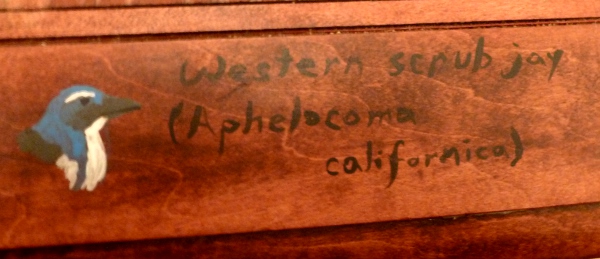
Scrub Jay painted by Lupa, 2010