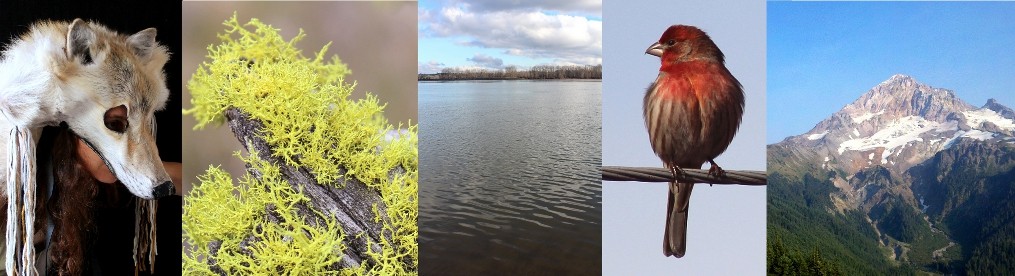
An Update!

So obviously my posting frequency here has gone down significantly since I started school. My initial reaction when I realized I hadn’t posted in a while was to try and justify my absence. However, that also brought up a recent spiritual experience that I had. I’ve been feeling pretty guilty about really slacking off on journeying and other more “officially” spiritual practices and rituals. I’ve been making my usual observations of the world around me and everyday meaning-making exercises, as well as my usual awareness of my decisions and their impact–and, of course, continuing with school. However, I haven’t really drummed in months. And so my usual pattern was “Feel guilty about not journeying/etc. –> Tell myself that I’ll do it soon –> Not address the underlying barriers keeping me from accomplishing my goal –> Feel even more guilty” (wash, rinse, repeat).

So a few weeks back I was hiking on Mount Hood with Taylor, and had a bit of a discussion with the Animal Father about this whole situation while there. I went in bemoaning the fact that I’d been a slacker, and essentially poured forth all the diatribes I’d been heaping on myself because of it. And when I was done, this is what he told me: “Adjustment is going to be a constant state for you”. This startled me, because he’s been one of the biggest proponents of me journeying on a regular basis. And while the last time I went a few months without journeying he told me he didn’t want it to happen again, he explained that it was pretty apparent that as things stood right then, that just wasn’t going to happen–and that it wasn’t the end of the world.

That made me feel a lot better. I think part of what was keeping me from journeying was fear that the spirits would be displeased at my long absence. Since that conversation, though, I’ve checked in at a few crucial points, and while there’s a desire to connect, there’s also patience with my current situation, and understanding that it won’t always be this way–and that adjustment will indeed always be something that’s a reality in my exceptionally busy life.

This goes along with a greater effort on my part to change the way I approach doing things. I am a recovering workaholic, and my time management involves me pushing myself as hard as I can until I either reach the point of short-term burnout, or someone (usually, though not always Taylor) pokes me and says “Hey, this needs to stop–it’s causing problems”. This isn’t as productive as it sounds.

The thing is, though, it wasn’t until I stopped the guilt cycle that I started making actual change. Pushing myself less and pacing myself more realistically has been a process, rather than an event, and while it’s been slow, I have noticed changes. I’m better at reminding myself when I begin to feel stressed about my ever-present to-do list that “Things will happen in their own time”. And I’ve finally, finally, finally been able to find effective strategies for cutting down on useless internet time and creating more time to actually do things away from the computer.

So there will continue to be a smaller flow of posts than there was a year ago–and there’s nothing wrong with that.

***************
ETA: Just wanted to add in this link to some thoughts over on my LJ that touch on some relevant topics here.

In other news, Scrub Jay and Stellar’s Jay have stepped (flapped?) forward to offer their aid in helping me connect with the Land and learn more about it. Scrub Jay seems to be more of a help with urban areas, whereas Stellar’s primarily aids with wilderness, though these are not hard and fast divisions. These are the settings where I see them the most, respectively. They help me in that whenever I see one of their children, it’s a reminder to me to be aware of the Land–not just in that moment, but as much as possible. It has helped; I finally remembered to pick up a couple of field guides for local plant life from PaperBackSwap.

I’ve been gardening again this year. Unlike last year, where it was containers only, I have a big planter box and a few extra patches of dirt, along with all the containers and a few extras. I also have slugs. And ants. And other critters vying for space and food. Plus the weeds. So this year’s gardening has been an object lesson in the balance between my own needs, and understanding that if I’m going to respect Nature, I have to respect it when it’s eating my garden. I still pull up the weeds, and I have beer traps out for the slugs until I can get my hands on enough copper wire/coffee grounds/egg shells to act as a deterrent, but I’m also aware that these are not just beings to take for granted as I do so.

I’ve also just begun to read Ecotherapy: Healing With Nature in Mind, an anthology edited by Linda Buzzell and Craig Chalquist. While I’ve got a pretty good handle on ecopsychology in theory, I want more on the practical applications thereof, and while my ecotherapy class last semester was excellent, there’s only so much you can fit into a couple of weekends. Also, here’s an article on ecopsychology in the local paper, and here’s the very first peer-reviewed journal of ecopsychology, first issue available for free online.

**************

Speaking of that, Chas Clifton posted a bit on ecopsychology, including a link to my last post on bioregionalism and the genius locii. Specifically, he observes that “But as an overarching concept…ecopsychology does not seem to have caught fire except in a low-level therapeutic way: ‘Gardening makes you feel better’.” Since my response is longer than my average reply, and it’s something that I thought would make a good topic for here anyway, I decided I’d write out my thoughts in this post.

Ecopsychology, not quite two decades from its initial inception as a cohesive concept as per Roszak et. al., is still quite a niche topic. I’ve had a good deal of exposure to it, but I also go to one of the most liberal schools in one of the most liberal American cities. I’m still finding out that not all psych grad programs are based in client-centered practices (which sometimes causes something akin to culture shock on my part), so I’m not surprised to consider that it’s very likely that something so nontraditional isn’t widespread in less liberal areas/schools/practices/etc.

One of the reasons I’m glad I got the ecotherapy anthology mentioned above is that we do need more practical applications of ecopsychology. What’s most commonly seen are either wilderness therapy retreats, or as was mentioned, therapists telling their patients to get outside more. What needs to happen, I think, is discussion of more ways to integrate ecopsychology into an actual clinical practice.

During the ecotherapy class, we discussed including questions about the environment in intake questionnaires; for example, “Are there any natural places that you feel close to?” or “Do you ever feel anxious about environmental issues?” Sadly, issues like these often don’t get brought up in more conventional therapy because it’s assumed that people don’t really feel emotions like grief for the environment, either on a small or large scale. One of the sadly ironic jokes that gets passed around is:

Client: I feel so upset about the environment; it makes me want to cry. I think I might be depressed because I’m worried about global warming, and species extinction, and just how big the problem is!
Therapist: So, tell me about your mother…

Another area where I see potential for more work is in addressing how environmentalists (and others)communicate information about issues. My instructor does a good bit of work with local activists; one of the points he (and other ecopsychologists) make is that guilt doesn’t work–and yet this is the tactic that activists have been using for decades. Guilt turns most people away, and often leads to counterproductive reactions (such as this new creation by Mike Judge, pointed out on Clifton’s blog–ouch!). While environmentalists may not intend to come across as holier-than-thou, because the messages we’re given to pass on are so often guilt-laden, it can be hard to avoid being otherwise.

In order to do this, we need to learn better forms of conveying our concerns. And this is where ecopsychology’s flexibility supports the relevance of numerous topics. One of my classes this semester is Communicating With Compassion; the textbook we’re using is Nonviolent Communication by Marshall Rosenberg. I just finished reading it today, and the class will be this weekend. Needless to say, I’ve picked up a lot of skills that are perfectly suited for not only being a better communicator on environmental issues myself, but that I can potentially use to help clients and others get away from the guilt-speak.

Ecopsychology isn’t a single model of therapy in the same way that, say, cognitive behavioral or client-centered therapies are. It’s more a way to approach all of these therapies, in that along with the mental, emotional, physical and spiritual levels of one’s psyche, there’s also the layer that resonates and responds to the environment one is in. This has often been seen in very narrow contexts, such as “home environment”, “work environment”, etc. (and can be studied in that respect in the field of environmental psychology). And because ecopsychology is a fairly amorphous field, not having tightened up into a rigid set of definitions, there are a number of things that could be considered “ecopsychology” that may not have that label on them, but which fit in anyway.

So I think ecopsychology, while it is still a niche, is a more powerful force than it may seem outside of that circle of folks who are immediately developing and utilizing it. Part of the solution to its low profile is defining more clearly what ecopsychology is or isn’t (and not cutting ourselves off from valuable resources in the process). Additionally, we need to be able to show even more that it has practical relevance, especially when managed care and other such forces continue to make CBT and other results-oriented, short-term therapies practically mandatory in some contexts where they may not be the most appropriate tools. I believe these will go a long way in helping to make it a more widespread and viable part of discourse and practice on psychology and therapy.

A Note On My Work With Totems

I was having a conversation on another blog, specifically about shamanic performance and my plans for eventually integrating that into my practice. I’m a big fan of ritual psychodrama and the element of Play as a way to help observers (and participants, as applicable) of a ritual suspend their disbelief. This need not always be Dour and Serious and Grave. As far as I’m concerned, there’s plenty of room for fun amid the serious work at hand. Journeying itself is generally something I see as serious, and not to be taken nearly as lightly as it often is in neoshamanism. However, that doesn’t mean that other elements of a ritual, especially a ritual performance, can’t be fun.

And that led me to think about my own experiences with ritual as an enjoyable, fun experience, even as important things were happening. While I’ve only been developing therioshamanism for a year and a half, I’ve been working with some of “my” totems for over a decade now. I’ve worked with them in several paradigms, including but not limited to chaos magic, neoshamanism, and generic Wicca-flavored neopaganism. I feel comfortable with them, and I’ve found that at least in my own experience, they’re perfectly happy with ritual play, even preferring it to more “serious” rites. Not that there isn’t a place for the latter, but it’s interesting how they explained it to me.

I mainly work with mammals and birds (especially corvids) as totems, so most of this is informed by them. For these totems and their physical counterparts, play is almost always preferable to fighting. Just as it is with humans, play is enjoyable and fun (even if it does teach survival skills that may mean the difference between life and death). Someone might get injured by accident, but generally not to the extent that injury occurs in a fight. Injuries are a lot more serious for other animals than they are for humans in the 21st century. There aren’t antiseptics and antibiotics and bandages, and in many cases no one to fetch food for you or make sure you aren’t left behind. A broken jaw for a human means a trip to the emergency room, and maybe several months of recovery. A broken jaw for a wolf that just got kicked in the face by an elk means death by starvation.

So it doesn’t surprise me that the mammal and bird totems I work with don’t have a problem with choosing play over real violence. We can be more serious when and as we need to, but they don’t see a need for real violence with no real reason behind it. While I’ve no doubt they’re perfectly capable of biting me, so to speak, I’ve never had them do anything over the past decade and change to make me feel I couldn’t trust them overall. While some animals are quite capable of deception for survival, I haven’t had a totem resort to trickery just to watch me get hurt (not even Coyote who, for me, more resembles the animal than the deity). And I haven’t had them lay a bunch of unreasonable demands on me, though they’ve certainly guided me through some very difficult experiences.

Perhaps, when so much of your existence revolves around survival and the cycles of life and death, having a chance to take a break and play is a welcome thing. I know it is for me; while the challenges I face every day are much different from those other animals in all forms face, I can still appreciate the time out that play provides. Hence part of my reason for wanting to incorporate ritual performance.

Replying to Owl, and Fox’s Tour

I journeyed again today to tell Owl about my answer regarding the Upper World. When I arrived, Fox and Scrub Jay were there, asking for my attention. I asked them to please wait until I could give Owl my answer, and they told me they would wait with me for hir arrival. So I called to Owl, and asked hir to please share hir time with me, if s/he was willing. S/he flew overhead, and told me s/he’d give me time if I’d catch a mouse for hir.

So I ran off into the underbrush, trying to scent out a mouse. I found where they were hidden deep in the earth, and also places where they had once been, but weren’t any more. Fox then came and said, “I can show you where you can get a mouse easily–follow me!” So I did, running up the mountain with hir. S/he showed me where there was a hollow log with a family of mice inside. I chased them from end to end, until one finally slipped out, a little confused, then realized hir mistake and tried to burrow under the log. I caught hir before s/he could get out of reach, and carried hir in my mouth. I was a little lost by that point, but Fox came back and led me back down to where Owl waited. I was a bit concerned that Mouse would be unhappy about me catching one of hir young, but Fox told me, “Mice get eaten all the time, including by Owl. That’s just the way of things.”

So I brought the mouse to Owl, who told me to kill the mouse. I did, and gave the mouse to Owl, who ate the carcass in two bites. Then Owl told me to tell hir my answer. I explained that my only reason for wanting to go to the Upper World was out of curiosity and a desire to know what was up there. Owl laughed and said, “That’s good enough for me. Now, when you feel you’re ready to go up there, let me know and I’ll show you how”. Then s/he flew away.

Fox then told me to come with hir. S/he took me down the trail to the west, and showed me where Mole lived–a recluse, and not easy to get to come out, but valuable to know. Then we went to the waterfall, and watched the river dragons leaping ecstatically over the cliff, laughing gleefully as they did so. I got the feeling they were analogous to the spirits that showed up as blue flames on the trail to the Upper World, that the river dragons guarded the way to the Lower World. This was one point where I could meet with them when the time came to go there.

Then Fox took me back up the trail a ways to a place that I had been interested in before. I couldn’t go there in waking time, but I was perfectly able to do so while journeying. I sniffed around there a bit, and Fox told me that this would be a good place to “put things, create things, build things”. Basically anything from a shelter for myself, to a place to do a ritual as needed, and most importantly, one of many places I could cache things I might need later on. I need to have some things on hand for offerings and gifts, and also have the spiritual “versions” of certain ritual items that I possess physically. Plus, in case I receive any gifts in return, it would be a good idea to have a place to keep them. Fox told me things should be safe so long as I hide them well; there really aren’t many other people who journey there.

Then Fox and I went back to the starting place, and I came back home. I noticed that while I still waver in and out of my altered state of consciousness while I journey, I’m doing it less, and staying focused on the journey more consistently. Practice makes perfect, right? (Or a reasonable facsimile thereof.)

You Mean I Have To Give a Reason?

I’ve started journeying again since the year turned over. Only once, but it was an important one.

I showed up at my starting place, in the form of a wolf per usual, and was met by the Animal Father. He carried me inside himself up the mountain to his home (no, it wasn’t squishy and I wasn’t making elbow room amid spiritual internal organs or whatnot–more like floating/flying up the trail, but feeling surrounding by the energy I associate with him). Then he set me down on the ground, and we began to talk about why I hadn’t journeyed in four months–or, rather, he began snarling at me about it. In fact, he ended up turning into a significantly larger wolf, bared fangs and all. This served primarily to put me on the defensive, rather than listening to what he had to say.

So he ended up turning into a mouse instead, which relaxed me quite a bit. We discussed the need for me to be journeying much more often–short version is, no more four month absences. This being the first week of school, I didn’t do the best job of increasing the amount of journeying I do, but now that I have a better idea of what my time commitments and schedule will be like, I have a better idea of where I can fit it in.

After this, he asked me how my progress on getting to the Upper world was, since I’d been trying to figure out that conundrum. I told him I was still stuck, and he suggested talking to the resident Owl, one of the totems specific to the area I start my journeys in. So he called hir to show up, and we were joined by Great Grey Owl (totems, for me, are species-specific). S/he and I had a conversation about the Upper world, and why I was having trouble accessing it.

The main thing s/he asked me, and which I puzzled over afterwards, was “Why do you need to get up there, anyway?” And I honestly couldn’t give hir a good answer beyond “To find information”. Owl told me to come back when I had a better answer for hir, and flew away. For my part, I ran back down the mountain with this question burning in my mind. Scrub Jay (the totem this time, not just a scrub jay spirit) and Red Fox both showed up. They offered their help in navigating this world, and Scrub Jay additionally told me s/he could help with the Upper World when the time came. I noted this, thanked them for the offer, and ended up needing to head back home.

For a few days, I couldn’t really come up with a decent answer for Owl’s question. Then one day, as I was on a walk, it hit me–why did I need to get to the Upper World, anyway? I didn’t have a specific reason, a particular piece of information to seek out. The only reason I could think of was “Because it’s part of what shamans are supposed to do–right?” Same thing with the Lower World. And here we get to one of the downsides to not being a part of an established shamanic paradigm–there’s no one to explain why, specifically, I might need to go to one or the other, or neither for that matter. I could read books, but even there the material is limited. I can talk to other practitioners, but how much of what they experience will be relevant to me?

To be sure, journeying is intensely personal, and I think there’s more subjectivity to it than a lot of practitioners want to admit. This means I can potentially look at the different worlds in the shamanisms of other cultures. But would these motifs and experiences be relevant to me, in my cultural context? And how much standardization is there, really? After all, there are other things that are “supposed” to happen in shamanism that haven’t quite matched my experiences. For example, according to most texts on neoshamanism, you’re “supposed” to climb up and down a tree to travel to the various worlds. I climb a mountain instead, one that I’ve visited frequently in waking time. And what I am practicing isn’t necessarily what other people are practicing; I am developing my relationships with the spirits from scratch, not following someone else’s template of expectations. In fact, most of the examples of neoshamanism I’ve seen have a lot of fundamental differences compared to what I’m doing.

This still left me with the problem: if I don’t know what’s in the Upper World or what to expect there, how do I know why I would want to go there? And then it hit me, as I was walking–right after I was presented with that problem, Scrub Jay and Red Fox offered me a solution: Don’t worry about the Upper World right now. Look for answers and explorations in this world first. It’s the closest, and the one I’m most familiar with. Where better to get more practice with journeying than the layer of reality that I’m most accustomed to? Not that everything will be a cakewalk, of course. But it makes a lot of sense.

I’m willing to bet that I’m not the first novice (neo)shaman to get caught up in the “Oooooh, I get to explore the Other worlds!” thing, to the point of neglecting this world. Now, I do tend to be a fairly pragmatic person. I’m the kind who will take mundane solutions before leaping into magical practice. So it’s not surprising to me, this concept of checking around the spiritual portions of this world first, before travelling further afield. I think I just got caught up in that whole “Shamans travel to the Upper and Lower worlds” concept a little too much.

Some of the Middle world stuff will no doubt be “mundane” things–like my venturing into psychology as a profession, for example, or finding other “everyday” solutions. However, I would imagine that journeying, as with various forms of divination, will help expand my perception of possible solutions (altered states of consciousness are good for that). I won’t make too many assumptions, but I think for now my journeys are going to be focusing on what Jay and Fox have to show me. They’ve offered, and I’ll follow. I should probably go to Owl and let hir know my current answer (“I actually don’t have a need to go there yet”) as well.

Totemic Therianthropy

A little over a year ago, I posted A Totemic Perspective on Spiritual Therianthropy, and a bit before that, A Mythological Perspective on Therianthropy. A few months later, I kicked around some ideas on therianthropy, Otherkin, identity, and hermeticism, among other things. These were some of the first written manifestations of thoughts and understandings I’ve been testing out to one degree or another for the past few years.

So I’ve finally come to a conclusion from all this testing of ideas. My therianthropy–the structure on which I examine why it is that I feel that on some (nonphysical) level I am wolf in nature–is directly related to and caused by totemism. It’s something that was given to me by Wolf, my primary totem, who has been with me my entire life. It is still something that permeates my being at all times, not something I can simply take off and put back on at will, and not something that is separate from me. I am wolf on some level, as I am also human on other levels (the physical included).

This isn’t something that’s easy to say. There are a lot of kneejerk reactions to mentioning therianthropy and totemism in the same sentence. There’s been a good deal of effort put towards making the differences between therianthropy and totemism very clear, particularly because there has been a lot of confusion (especially among newbies to the concept of therianthropy). What commonly happens is you’ll get someone who has recently (or not) discovered hir totem, whether s/he knows what it is or not, and because s/he feels a strong draw towards this animal, s/he assumes s/he IS the animal. Additionally, while most of the furries I know know the difference, there also seems to be some confusion among totemism, therianthropy, and the fursona. Often newbies will leap to conclusions without having done much research or self-searching and introspection, and try to speak as authoritatively as someone who’s actually done the work over time. Granted, this happens with newbies in any group–but I digress.

This results in a tendency to try to keep the lines between totemism and therianthropy as sharply delineated as possible. Unfortunately, this can occasionally mean situations in which the combination of the two in any way is discouraged, particularly if the nice, safe lines get blurred. I’ll freely admit that I avoided exploring this possibility for a while specifically because I’d seen so much negative press about it, and wanted to make sure I was “doing things right”. However, as my need for external validation diminished, and my ability to validate my own beliefs and experiences became stronger, I said “Fuck that noise” and decided to explore it anyway. I’m glad that it did, because it’s been the most fertile exploration related to my therianthropy I’ve ever had.

However, I didn’t come to this conclusion quickly or lightly. As I mentioned, I’ve been working with these ideas for the past few years, and have been working them out in writing (one of my best forms of processing) for over a year. Some of the material on personal mythology in A Field Guide to Otherkin, which came out in 2007, was a precursor to some of the ideas woven in to my current theory. But it wasn’t until I started developing my therioshamanic practice that I really reached a greater understanding.

While I’ve been an actively practicing totemist since the mid-1990s, and have had Wolf as a presence for my entire life (and became aware of it at a very young age), my relationships with the totems deepened significantly after I started practicing shamanism. Shamanism, by necessity, is built on relationships with the spirits. It isn’t about techniques, or shiny objects. First and foremost, it is communication with spirits and travelling to their realms (or in a few cultures, mediumship). The techniques and trappings stem from and support that communication and those relationships.

As I got to know Wolf better, s/he began telling me more about myself-as-wolf, as s/he felt I was ready for it. S/he told me the significance of our first meeting, when I first remembered realizing there was something wolfish in me–and that it never stopped being there, ever, no matter how much I sometimes tried to get rid of it. Most of the details are private, but I can definitely say that that which is wolf in me, was a direct gift from hir, and is part of the ongoing relationship that’s developed over this lifetime. It’s something that I did question a number of times, just to be sure I wasn’t making it up. S/he confirmed each time.

So, what of my personal experience is therianthropy, and what is totemism?

Therianthropy: I am wolf on some (nonphysical) level. This is not a wolf spirit carried within me, or any other being independent of me. It is not me carrying Wolf hirself in me, though I see what is wolf in me as having originated with hir. This is me. I don’t believe reincarnation factors in. The part of me that is wolf is something that, as far as I understand, is part of this life.

Totemism: Wolf is a totem, an archetypal being who embodies all that is to be known about wolves. Specifically I work with Timber (Gray) Wolf, who protects all the subspecies of that species. Wolf is an external being who gave me a piece of hirself that was integrated into who I am from the beginning. Just having a totem does not make me a therianthrope; it is the specific part of myself that Wolf gave me that is important. None of my other totems have given me something like that, and therefore I am not, for example, a fox therian, or a badger therian.

So, yes, I can definitely say that at this point the best way to explain my own therianthropy, myself-as-wolf, is through my relationship with Wolf the totem. I am wolf in and of myself, but it is something that was given to me by Wolf. I’m still going to continue exploring and working to better understand myself in parts and in whole, but this is the closest I’ve come to an explanation of myself-as-wolf.

Shamanically speaking, this gives me even more understanding as to how my therianthropy can be incorporated into my shamanic practice. It explains more of why Wolf has been around the whole time, and it also offers up some intriguing possibilities for forging stronger, potentially permanent connections with other totems. I’ve often wondered if, assuming they were willing, other totems could give me (or other people) similar pieces of themselves. Though it also may be something that is not easily given, or given at all. We shall see.

One final thing I want to make absolutely clear–this is something that is unique to my experience. While I know a very small number of people (count on one hand) with similar experiences, the vast majority of therianthropes who also practice totemism don’t (to my knowledge, anyway) have the same relationship with their totems that I do with Wolf, in that their therianthropy isn’t directly related. I do think it’s possible that this happens more often than I realize, but the thing I want to emphasize is that I came to this conclusion after nearly three decades of being aware, on some level, that there was something about me wolfish, after over a decade of active totemic work, and after a few years specifically spent on exploring the connection between my personal therianthropy, and my personal rel,ationships with my totems, including the intensity of shamanic practice. While I don’t want to discourage people from considering a similar possibility for themselves, I also want to make sure it’s understood that it’s not to be considered lightly–but then again, when is any of this to be decided through hasty processes?

The Journeying Continues…

Tonight I tried my first journey with a purpose beyond exploration. I had a favor to ask of Badger, and so I went to see hir. I had an offering in mind, something I could give hir now, and something later, if s/he would help me.

I asked Small Horse and Small Deer (the drum and beater) for their aid, warmed up the drum, then I played Small Badger’s song to ask him to help me to negotiate with Badger. He was quite pleased that I played the song for him and asked him for his help, though I may make it a habit to make a small offering besides that for the skin spirits and other helpers.

So we all went to go see Badger. I drummed for a bit to let Small Horse and Small Deer take me to the starting point. When I arrived, I sang Badger’s song as loudly as I could, just to let hir know I was there. In retrospect, I could have gone looking for hir, too, but s/he didn’t seem miffed about coming to me instead. This is probably at least in part because s/he was expecting me; we’ve already talked a bit about the situation, and this time I came armed with offerings.

Badger made hirself look very large and impressive, and s/he towered over me, even for being a normally close to the Earth animal. I was sufficiently awed, and s/he and I got down to business. I told hir what I wanted hir help with, and also what offerings I would make. S/he was surprised, though not unpleasantly so, that I was offering something now and something later. S/he knew how important this situation is, and also that it would take some time to complete. So s/he accepted, and I was happy. I sang Badger’s song for hir again, to boast about how wonderful s/he is, which tickled hir even more.

Then I came back, and sang songs for Small Badger and Small Deer, and played Small Horse’s drumbeat, though I don’t have a song for hir yet. I warmed the drum down, and set out to start making things happen on my end.

I am quite pleased to note that my ritual structure is coming together nicely. When I started all this stuff out last year, I was doing things in a much more generically neopagan manner. I did a circle casting with an athame still, and swept the place with a broom beforehand for purification. I won’t say that my ritual structure now is the exact same as such-and-such culture’s shamans do it, because it isn’t. However, the structure has changed quite a bit.

Part of this is due to my beliefs. I no longer feel that I need to create a “world between worlds” to practice in, and I see all space as sacred, even if the Land in one place is tougher for me to connect with than in another place. While I greet the totems at the directions, I don’t do this as part of circumscribing a circle to divide me from the rest of the world. I don’t see myself as calling them, either–they’re already there; I need only remember that.

As I’m also focusing more on journeying, the ritual structure has evolved to support that as a central practice in many of the rituals, preparing me to go in, and helping me to come back out, as well as interact with the spirits at all points throughout. And the drumming has become much more prevalent, essentially having replaced the athame in greeting the directional totems and others.

Obviously, there are things that are in common between the previous structure and what I use now. But these are the most significant changes I’ve ever made, taking whole sections and tools and things out, and adding others in because they work better. It’s made things a lot more effective, even in this relatively short period of time.

So we’ll see how things progress, and what Badger ends up bringing about. While at an earlier point in my life, particularly when I was heavily into Chaos magic, I was very focused on the end results of my magic to determine my success. While that’s still important, what constitutes a good result may vary more than “I asked for X and got X”. It may be something as simple as “I asked for X, but Badger decided that Y would actually be better–and s/he was right”. Or it may end up being something much more complex, something that can’t be quantified in a linear, cause and effect fashion. “Success” is a very subjective notion, and a ritual that didn’t result in the intended way may still end up being more success than failure.

Not that I’d mind getting what I asked for, of course 😉

Journeying vs. Guided Meditation

I know I’ve been a bit quiet lately. I have been journeying, though, primarily exploratory journeys to get used to the practice of it, and to also get an idea of the “geography” of the Otherworld, so to speak. I don’t really want to talk about a lot of the details, since this is part of the more private end of the path. However, here are a few highlights:

–I have a consistent starting point where I begin all my journeys. Physically, it’s a place I have a good connection to, though not what I expected. I’ve found myself starting here every time, so I think it’s a good sign.

–My “world tree” is actually a mountain. I’ve located the general vicinities of the entrances to the Upper and Lower worlds, but I can’t actually get to them yet (I’ve been presented with them as puzzles). None of this is at all what I expected, but it works.

–I have at least one, possibly two local-to-the-Northwest totems who want to work with me. One I was pretty sure about; the other one was a big surprise.

–I’ve encountered both totems and individual animal spirits while journeying. The totems are definitely more powerful; however, the spirits should not be ignored or dismissed easily.

Journeying is definitely not the same as guided meditation, IME. Guided meditation, from what I can tell, takes me into a “neutral zone”, where neither the spirits nor I have a distinct advantage. I have a lot more control over what happens, what my form is, what I do, etc. and it’s a lot easier to enter and exit.

Journeying, on the other hand, has turned out to be a lot more intense, and I am definitely out of my element there. I’m on the spirits’ turf, so to speak. I find that I tend to take one particular form there, and shapeshifting is much harder. Also, traveling is more difficult. Whereas with guided meditations I’ve been able to easily bypass blockages and manipulate the landscape, there’s no doing that with journeying. If someone says I’m not going past them, then there won’t be any sneaking, or flying up and past–at least at this point. Things that were feasible in guided meditations, aren’t so easy with journeying.

The other thing that I noticed is that the totems in particular are “more themselves” when I journey, especially when compared either to evocation rituals here on the physical plane of reality, or even guided meditation. I’m trying to figure out how to describe this…it’s not just that they’re bigger and stronger. It’s that when I journey, I can observe more of who and what they are, because this is where they’re native to. Conversely, I am more limited; only part of me travels, leaving my body behind. I never realized just how much of myself is wrapped up into my body. I wonder if there’s a spiritual counterpart, something that gets left behind when a totem or other spirit leaves to go to a neutral place, or to visit here through evocation/etc.?

Aside from the journeying, I’ll still be practicing songs; I still need to do songs for Bear and Small Bear. The songs and journeying are creating a nice variety for me that’s keeping me more engaged, especially as I’ve been getting busier.

The Return of Horse

Because I’m going to start doing more formal shamanic work, it became time to get a new drum. I’m still keeping the small goatskin drum I made for my Earth month a while back for practice purposes and backup as necessary (plus it’s quieter, good for apartment living). But I’d been told a while back that once I was ready to start practicing seriously, that I’d need to get a new drum for that. The timing was good–this is my last splurge for awhile, since I’m now a full-time student as of this week.

I chose to go to Cedar Mountain Drums, which is in my neighborhood. I’ve been there a few times, including when I got the kit to make my first drum. A couple of weeks ago, I went to a drumming circle they held there and had a chance to play a number of drums. I hadn’t been sure what sort of drum I was going to get, so this was a good opportunity to try out different sounds and creations. The one that I kept gravitating towards was a large horsehide drum on a cedar frame; the sound was lovely, other than a tiny, barely perceptible vibration at the end of the note.

So when I went today to get my own drum, I headed towards the 17″ unbleached horsehide on cedar frames. I was fortunate in that the owner of the shop had just made a few yesterday, and though they were just a wee bit damp still, they had a very lovely sound. It took me a bit, but I settled on one that had not only a nice voice, but also a good energy to it as well. I picked out a beater as well, and was ready to go. I paid, brought the drum home, and it’s now sitting up in the ritual area along with the smaller drum:

I won’t be playing the new drum yet, not until the Equinox when I’ll be doing a private anniversary ceremony, since it’ll have been a year since I first started on this path.

I do highly recommend Cedar Mountain Drums if you’re in the market for a drum; the owner has 17 years experience in drum making, and runs a very good business.

It is appropriate that the drum ended up being horsehide. I’m finding myself reclaiming some things from when I was younger, things that I had rejected or gotten burned out on. One of these is my relationship with Horse. Horse was the second totem to come into my life, after Wolf. When I was a preteen, not long after I turned twelve, Horse came in to the point that s/he temporarily replaced Wolf for a few years, staying with me until near the end of my senior year of high school.

This was an incredibly awkward time of my life. I was not the most socially adjusted teen in the world, and ended up being picked on more than just about anyone in the school. It wasn’t any one thing; I simply didn’t fit in. Most girls my age had been interested in boys and clothes and makeup for a few years. I was more interested in grubbing around in the woods, reading books about animals, and collecting Breyer Horses. Being in a small town with a small student population that was particularly prone to cliquishness, I didn’t have much in the way of friends. So I ended up spending a lot of time alone.

There were various attempts, over the years, to try to get me to conform in one way or another–a new haircut, an attempt to show me how to use makeup, an inquiry as to whether I should maybe try to make friends with such-and-such clique (who had never shown anything but contempt for me). None of it worked. I tried a few times to be like other people and blend in–and the results were usually disastrous. I simply didn’t get it, and wasn’t interested enough to try any harder.

What Horse did was support my independence, and show me that I didn’t need to conform. Unfortunately, I ended up blaming Horse in part for what I perceived as too much sheltering and the continued proliferation of my social awkwardness–instead of taking responsibility for my actions, as well as understanding that I wasn’t responsible for the emotionally abusive words and actions of my peers. So I ended up pushing Horse away once Wolf came back late in high school. For years I denied any connection with Horse whatsoever.

What was I so afraid of? Honestly, I think I worried that I would lose what independence I did have, and get sucked into some life that I didn’t want to be a part of. I wasn’t secure in myself at all, even into my twenties, and it took moving out on my own, along with some hard life lessons, to really begin to formulate a solid sense of self. Sadly, some of that was so wrapped up in being a Wolf person that I ignored most other totems, and deliberately avoided Horse.

Now, as I’m approaching thirty and looking back at the last decade, I’m beginning to reclaim some of the things I let go of which in retrospect were things I really do value. I don’t blame myself or castigate myself for my previous actions; in a way, these things had to happen for me to learn. But now I can look at them with more confidence, and not be afraid. I can still make boundaries with the things that I know even more don’t suit me, but still accept that other things are alright.

This includes Horse. I feel very honored that s/he has chosen to come back into my life. I’m hoping we can talk more about my experiences as a teenager and how they shaped who I am today. And I’m looking forward to Small Horse’s guidance as my drum.

Plus I’ll see what Horse has to say about the future, not just the past. I’m aware, for example, that the hide that is on my drum almost certainly came from a horse that died in a slaughterhouse. This is a charged issue; on the one hand, it’s been considered a victory that horses are no longer able to be legally slaughtered in the United States. However, this has led to an unexpected side effect–horses are now being shipped further away into even less humane facilities in Mexico. I wonder what Horse and Small Horse will have to say about this issue.

I am grateful for the return of Horse. May our relationship be renewed, and be healthier than ever.

A Slight Change in Plans

One thing about not being a part of a culture that has an ingrained shamanic path is that would-be shamanic practitioners don’t have much of a standard framework to go on, relatively speaking. A lot has to be done from scratch, including things like cosmology, relationships with spirits, ritual practices, and so forth. On the one hand, this can make it frustrating if you tend to worry “Am I doing this correctly? Should I maybe do it like those people over there? Or do I just read another book and keep listening to the spirits?” However, it can be advantageous in that it offers a decent amount of flexibility.

I did a drum journey to meet with the Animal Father tonight to try to confirm some murmurings I’d overheard from a few of the totems in the past several days. I first found myself clinging to the trunk of my tree, unsure whether to climb up into the branches, or down into the roots. However, I was told to simply drop off onto the grass, and start walking. I found myself in a forest that eventually led to a place here that is very special to me as well as to the Animal Father, but whose exact location is to be kept secret. I proceeded to a particular place, and made myself comfortable.

As I did, numerous animals came out of the trees. Some were native to the area, some were not. As they congregated, the Animal Father appeared as well, and approached me. He was smaller than I sometimes see him, maybe the size of a small black bear. He sat across from me and held my head in his paws and gave me a gift. Then he told me to stop drumming, and to lay back. I did, and he sat behind my head and held it in his forepaws again.

The short version of our conversation involved my work for the next several months. While I’m to continue creating songs and dances for the various skin spirits and corresponding totems I’ll be working with, I also am supposed to start doing more formal work with the totems and skin spirits who already have songs–Wolf and Small Wolf, Badger and Small Badger, Deer and Small Deer, and Coyote and Small Coyote. Additionally, I need to create songs for Bear and Small Bear as soon as possible.

Of these five, only Coyote and Small Coyote are of a species that I haven’t had much experience with. The others are ones I’m quite comfortable working with. In addition, I’ll be working with Horse, and my Small Horse will be my next drum. I’ve been pondering what sort of skin I’ll have on my full ritual drum (as opposed to the small practice drum I have right now), and last week I went to a drum circle where I had a chance to play drums of various sorts. The one that really stood out to me, both in sound quality and in spirit, was a 20″ horsehide with a cedar frame. I’ve had a relationship with Horse since I was a young teenager; it hasn’t always been a good relationship on my end, but Horse has been steadily, patiently there. Add in that Horse has historically stepped in on matters of travel, as well as crucial periods of growth, and it’s not surprising that I’d be drawn to a horsehide drum for journeying.

So, back to the journey at hand with the Animal Father. Once he said what he had to say, he went back into the woods, and the animals began to depart as well. I did stop Badger, though, to ask hir if she would be willing to work with me in a formal ritual. S/he asked me, “What will you offer me?” I replied “What do you want?” S/he stopped then, and looked very pointedly at me, then said “That’s a dangerous response at this level of the game. You’d be wiser to come in to such a situation with something already in mind to drive your bargain with. Come back when you have something to offer me”. Then s/he shuffled off into the woods.

This startled me momentarily, but in retrospect it doesn’t surprise me. While in the past the totems and other spirits I’ve worked with have been relatively lenient with me, shamanism is much more…hmmm…intense than my previous work, relatively speaking. There’s less room for errors (though I wouldn’t say no room for errors). And it was a good reminder to me to take care, that what worked before may not be the parameters I’ll be working with from here on out.

I drummed myself back home, as it were, and got myself grounded with some good food. I’m going to have to think of something significant that I can offer; what I’ll be asking for will be bigger than what I usually do, and more will be asked in return. I’ve had a lot of leeway in the past with regards to offerings, but if I’m going to be stepping up to do more serious shamanic work, I’m also going to have to accept the changes in how things work.

Which is fine; I expected this would happen. Am I worried? Some. As I said, there’s less room for errors. But I wouldn’t be going forward if I didn’t feel confident in my ability to adapt and grow. And the timing isn’t surprising. Next month it’ll have been a year since I started on this path; before that I’d been working with totems and animal spirits for a good decade from a neopagan (and sometimes Chaos magic) perspective. So it’s probably to be expected, at least to an extent.

I’m still here, amazingly enough, and as far as I’m concerned, that’s what’s most important.

Locos and Locals

My efforts towards creating songs for my dancing skins and their respective totems continue apace. I haven’t been blogging much about it, because it would essentially be “Today I practiced Deer’s song more, and came up with a drum rhythm for Small Deer”. Not particularly riveting when you’re not directly involved. However, I thought my recent work with Coyote was noteworthy.

For all my work with the Big, Impressive North American Birds and Mammals (BINABM), I’ve only worked with Coyote in a limited way; once was in a ritual to help protect hir physical children. I also sporadically worked with hir a few years ago when I was more heavily into Chaos magic. At that time Coyote was teaching me a bit about facing my fears, with one particular memorable incident where s/he helped me as I drove my car down a very steep icy hill one winter without panicking! Coyote and Small Coyote were the most recent volunteers to step forward in this endeavor, and so I started with Coyote’s song.

When I speak of Coyote, I don’t only refer to the Coyote referred to in the myths of a number of Native American tribes. Coyote-as-totem, to my understanding, shares some overlap with that other Coyote, but is not one and the same. My experience with totems has been that while they may have a number of bailiwicks, their initial connection with me has a more specific focus, and then as we work more I learn more about what that totem has to offer.

This time, Coyote mainly told me to sing about change and adaptability, as well as the illusory nature of subjective perceptions of reality (though not in those exact words!). While s/he briefly touched on creation myths and the Trickster archetype, these plugged into a main theme of Change. To be honest, I was a bit worried about working with Coyote in a deeper sense. Some (not all) of the Coyote people I’ve met have been chaotic in a very unhealthy, destructive manner; other people talk about Coyote the way that some practitioners of Asatru talk about Loki–a dangerous being that you shouldn’t bother with if you can help it. However, this initial reconnection with Coyote seems to be on common ground that I can understand and have experience with. I don’t expect everything to go smoothly or perfectly–but I don’t expect that with any of the totems or other spirits I work with. Sometimes the lessons we learn are difficult; and if Coyote will be dealing with Change, then it won’t be surprising if there are tough things to learn. However, if I can learn more adaptability, so much the better–that’s one thing I need more of. While I can roll with the punches, I could stand to be less stressed about life’s ups and downs. I think, perhaps, the fear of chaotic change may make some people afraid of Tricksters in general–who wants their lives entirely shaken up? What I understand so far, though, from my work with Coyote is that she’ll help me to learn ways to cope with chaotic changes, both in myself and in others.

I’m also slowly beginning to shape very rudimentary connections with the locals, as it were. Living in urban Portland, the vertebrate animals I tend to see the most are scrub jays, crows, and fox squirrels, with the occasional robin or kestrel. I don’t even see that many insects beyond the pollinators in the garden.

I’ve seen criticism in various online communities of neopagan totemism, specifically regarding the fact that many people seem to have totems whose physical children they’ve never seen. I’m a good example. Wolf’s been in my life since I was very young; however, I’ve only interacted with wolves at rescue facilities, and only on the outside of the pen. I’ve never seen a wolf in the wild, and never really been to a secluded enough place that could realistically support them. Yet Wolf has been one of the most persistent presences in my life over the years.

I did read something that actually makes a good deal of sense to me in Totem Popularity Contests: Why Some Totems Are More Popular Than Others, written by Ravenari. While all of her points are excellent considerations that I think should be talked about more, I particularly am interested in the last one, the idea that “Some animals are popularity-contest winners”. In my experience, there are totems who are more outgoing than others, and there are some who couldn’t care less whether we work with them or not.

While it’s a very, very rough comparison, and should not be seen as a one-to-one parallel, I think we can look at some pre-Christian religions that had large numbers of deities, including a major pantheon. The Romans are a good example; while they had their major pantheon including Jupiter, Juno, Apollo, etc., there were also countless minor deities, local deities, demi-gods, and so forth. It’s not entirely inconceivable that within a neopagan context, where we have the influence of that somewhat tiered structure, that there could be some totems who roughly correlate to a major pantheon, perhaps due to a greater tendency to interact with more people.

Continuing with the pantheon comparison, and especially within a neopagan/modern pagan context, most of the people today who work with the Olympians have never been to Greece, or any of the places where these deities originated from in pre-Hellenic times (or, for that matter, where they travelled to in ancient syncretic blending). So is it really surprising that many people haven’t actually ever “met” their totems “in real life”?

That being said, I do think there’s a lot of value in working with local spirits; some would argue that in order to really practice shamanism that it’s a requirement. I’ve spent much of my time, especially since last spring when I went to Arizona, connecting with the Land here as a whole. However, I’m beginning to make more specific connections. Scrub Jay in particular stands out to me, though Squirrel has also made hirself known, albeit in sometimes irritating ways (squirrels in the attic, squirrels in the garden!). There are a number of plants, one tree in particular, that have become particularly important. And, of course, there’s my ongoing “romances” with several individual places, such as Laurelhurst Park, the Multnomah-Wahkeena trails, and Mount Hood.

I’m willing to bet that the quality of the relationships that I create locally will be different–not necessarily better or worse–than those that I’ve created with the BINABM. Historically my work with the BINABM has primarily involved more overarching concepts, especially involved with personal metamorphosis; for example, Deer has always been the Dreamkeeper for me, and Bear has taught me a lot about healing and balancing it with the ability to bring harm. It will be interesting to see how working with the totems whose children live in the same environment I do will go. Of course, this is mainly conjecture at this point, and the actual results remain to be seen. But that’s what this journal is for–recording of my thoughts as I go along, and later on I can look back and see whether I was right or not!

For now, I’m going to continue focusing mainly on the songs I need to be writing. I’ve asked the Powers That Be whether I should be doing something else, but the message is generally “Nope. Keep writing the songs. Once you have them, then we’ll get into more detail of what you can use them for. Still, keep your eyes and ears open.” Which is fine; I tend to do better focusing on one main thing at a time, building on what’s come before.