Art, storytelling, and shamanism my path

I have some half-formed thoughts about the recent integration of storytelling with my artwork, as well as the very deep, significant spiritual elements of the acts of creation. Yes, the coyote and wolverine are the most recent and obvious syntheses, given that each has a “new” myth to talk about its origin. But Anput was also a spiritual story, albeit one in which I featured as a main character, and which was not just a story that I created in my mind, but something that happened to me in working with that Goddess. Even Lady Red Riding Hood was story, rewriting the tale to better fit modern parameters, though maintaining its “once upon a time” feel.

I’ve long been a spirit-worker, evoking and invoking totems, animal spirits, deities and others. And the spirits have often spoken through my art, and not just the skin spirits that are in the remains themselves. I’ve even created numerous ritual tools and costumery over the years that could mesh with certain beings or energies in ritual.

However, this feels bigger. I feel like I’m adding to mythology, if that makes sense. The process of creation is simply the vehicle thereof. Perhaps it’s hubristic to say so, but it feels as though I am *adding to* these beings, with their consent and even invitation. Along with transforming the animal remains and their spirits, I feel I am also making a bigger transformation than before to the bigger beings, the totems and deities. If a totem, for example, is “made of” the natural history of the physical animal, its relationships with all other species, and the human observations as translated into legend, lore, and mythology, then I feel like I am making a bigger contribution to the ongoing, ever-developing mythology.

Like when I make a small pouch out of recycled rabbit fur, I am transforming the fur into something new, and I am rejuvenating the spirit with a new purpose–or releasing it from its container if it so wishes. But Domestic Rabbit stays largely the same; the pouch may be used to connect to Rabbit, but the change is only on this end. However, I look at my experiences creating the Anput headdress, and it definitely feels *bigger*. If you give me the generous allowance that my UPG is more than just something in my head, then I have been shown an element of this Goddess that may have been previously unknown, perhaps by even the ancient Egyptians. I don’t feel I’ve so much added something that wasn’t a part of her before, so much as I helped to shed light on it.

I’m not the only person to do this sort of thing; Ravenari has long been creating these inspired works. Her As Totems series largely comes from the individual totems pressing her into making portraits for them, or asking others to commission her (as with me and Steller’s Jay). She also learns more about the totems in the process of creating these works, hence her creating about the only totem animal dictionary I give any credence to. I give it more weight because I am aware of her process as well as her general familiarity with the animals and her shamanic skills, and I know how much effort goes into the contact with each. Whether she changes the totems, adds to them, or simply enhances the focus on certain parts, I can’t say. But it is very impressive to watch.

And it’s incredibly fascinating to be going through this process; the exchange of energy and ideas that I’m sharing with the deities and totems and spirits in this is beyond what I’ve done before. Whether you see me as connecting with independent beings, or being able to better access these archetypes and channel them through my work, I would appreciate your constructive feedback on what I’m trying to describe here. Anyone else been here?

The Goddess Anput

While I’ve been creating ritual costumery and other tools out of hides, bones and the like for over a decade, more recently I’ve been getting into more elaborate projects. One of my most recent endeavors was a ritual costume in which I had a surprise spiritual experience–well, unexpected, but not entirely surprising. Here’s what I wrote about the experience at the time, just about a month ago:

Tonight, a Goddess found me.

For many years, I have acknowledged Anubis–Anpu–Yinepu–as the God of dead things, related to my art with the remains of animals. And he has watched over my work in the background, quietly, only occasionally coming forth to speak if he feels the need to add a bit of guidance. But still…so distant.

Then the day came when the hide of a black coyote came into my possession. Even having lived and died a half a world away and thousands of years past the jackals of Egypt that gave their form to the God, this coyote carried that energy, inexplicably and completely.

Almost.

Except this coyote was female, and held onto that beyond death almost defiantly. And through that skin spirit, Anput made Herself known to me. Where Anpu had been distant, though not uncaring, Anput settled Herself down in front of me, and in the same way Artemis had done so long ago when I was younger, She looked at me and said “Doesn’t something look familiar?”

Familiar? How could I even know what to look for, when I knew not Whom I beheld? I knew scant little of her, as did anyone today–the feminine aspect–some said wife–of the better-known Anpu, had had little surviving lore and few adherents today. “Goddess of the 17th nome of Egypt, with the standard of the jackal” told me little.

And so I returned to Her, perplexed. And before I could say a word, She saw my confusion, and She spoke. “I am the Goddess of funerary arts. When the stones were carved into the faces of pharaohs long-dead, My hand guided the chisel. When each set of canopic jars was formed, I shaped each detail and applied every stroke of the brush. And now, when you weave hide and bone into sacred art, My hands wrap around yours, and I see the work through your eyes”.

The black coyote then wrapped around my shoulders, wishing that I would prepare her to move on to the next person in her afterlife, for, as for so many, I am only a threshold, a transitional point. And so we enmeshed ourselves, for three days and nights, in the sacred preparation and creation of what would carry a piece of each of us.

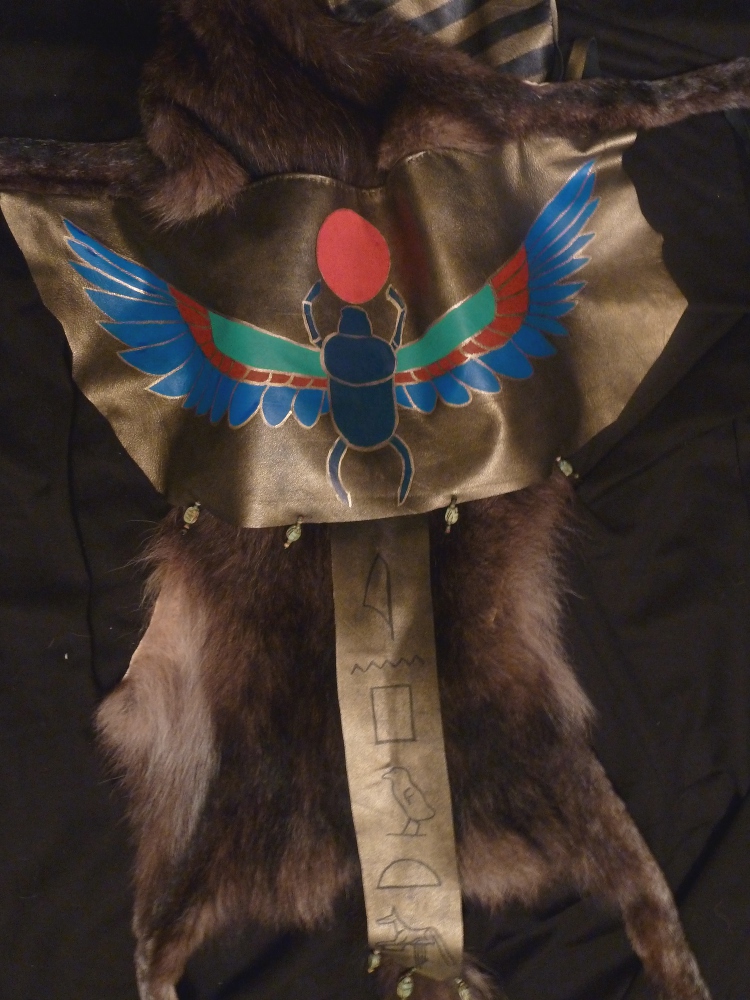
And at the end of the three days and three nights, I wore a cloak upon my shoulders, with the sacred mantle and hood as the Goddess directed me and as the black coyote concurred and as I created. Khepri stretched his wings wide, and the name and standard of Anpu—Input—cascaded in hieroglyphs.

This, then, was our inauguration, the Goddess and I. The black coyote would go forth as Her emissary while I would remain here and continue the sacred work as I always had, only with the consciousness of She who guided me.

***************

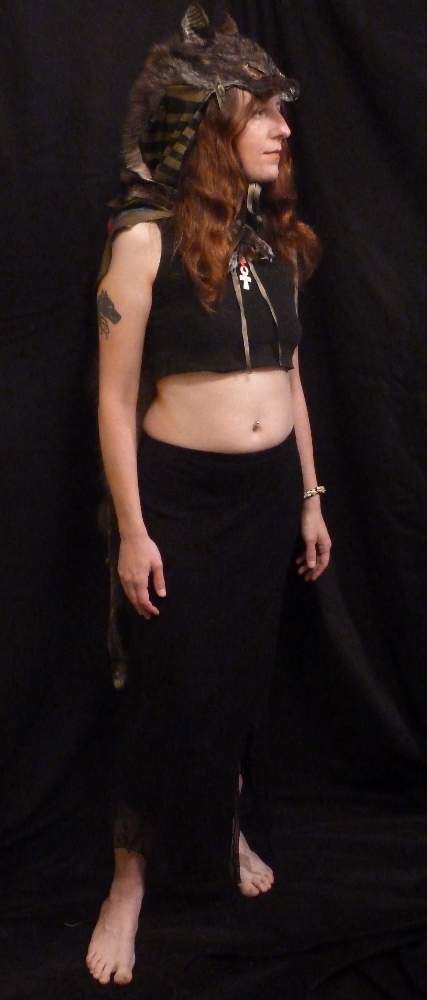
This headdress is dedicated to Anput, the female counterpart to Anubis. It is in no way meant to be an authentic replication of any traditional Egyptian creations, but is instead a hybrid of my own style mixed with elements inspired by a very general Egyptian aesthetic, guided by sacred inspiration (and many pictures of old statues and paintings from various dynasties!).

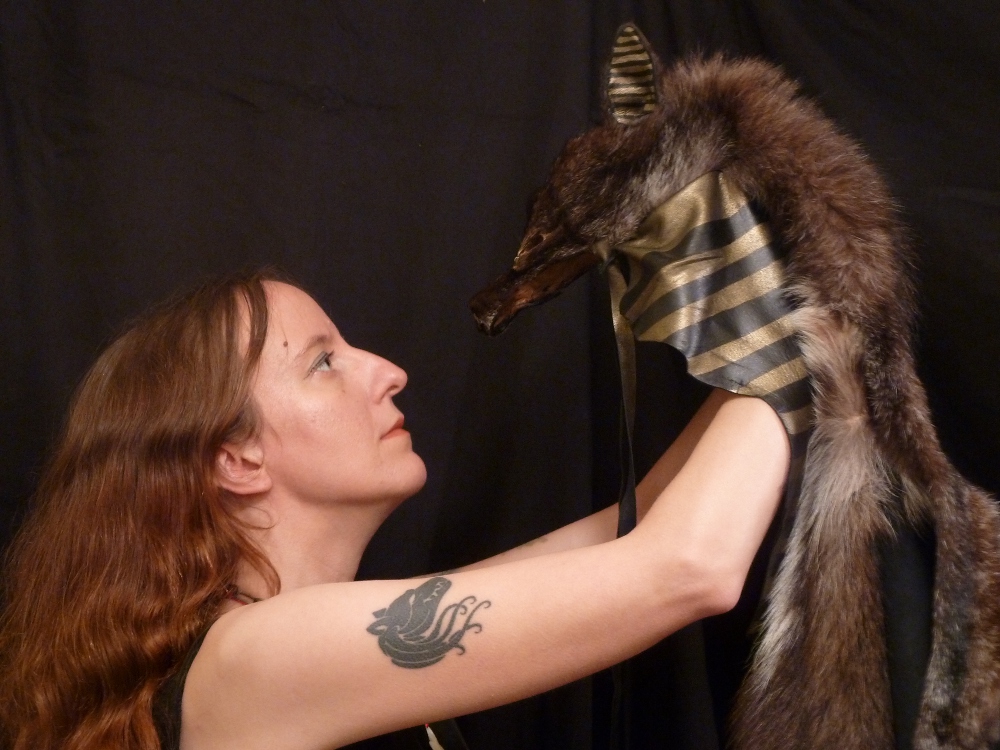
This headdress is based around a black (melanistic) coyote hide; this is a rare, but naturally occurring mutation in this species. This particular hide came from a small female, black with a white blaze on her chest. She is complete with all four paws and claws; the only piece missing is her lower jaw, which was removed for the purpose of this project. Her ears and face have been reshaped to a more natural appearance; they were originally rather flat and misshapen, as many hides are after tanning. Her face has been given painted details, to include hold around the eyes, and gold accents on her nose. I inserted gold and black leather in her ears to mimic the striping often found in the ears of depictions of Anubis.

The leather is one whole tanned lambskin hide, dyed black, and then with an overlay of gold on one side. It forms the side panels of the hood, again striped, as homage to the Nemes headdress that Anubis and other deities were commonly depicted wearing; there are very few images of Anput Herself that remain, and as I was working on this inspired piece this is what She indicated She wanted.

The mantle over the shoulders was the most difficult portion of this. I drew out the scarab and wings with a black fine tipped paint pen, and then colored it in with acrylic and oil paint pens in two shades of blue, green, and red, and detailed in gold. I tested all these on a scrap of the same leather to be sure of the colorfastness. The hieroglyphs descending from the mantle read “Input”, an alternate of Anput’s name, and below that is the standard of 17th nome (district) of Egypt, over which She reigned.

The beaded accents on these leather pieces are a combination of new (reproduction) faience scarabs, and genuine old Egyptian faience beads (exact dynasty unknown). Each one of these dangles is about 1 1/8” long.

The headdress ties on with straps under the chin, and the forelegs also are tied together with more leather strappage. It is one size fits most; for scale, I am 5’4” and 115 pounds.

This project did take me the better part of three days and nights with only small breaks. It is by far one of the most ambitious pieces I have done, and represents a shift to more elaborate and involved crafted artwork.

***************************

In the weeks since I created this headdress, Anput has been a quiet but strong presence in my workspace, and she has actually brought Anpu Himself forward more as well, not that I should be surprised. The feeling I get is that they are aspects of each other, rather than spouses, though perhaps the distinction isn’t so strict. Sometimes I work with them both, sometimes Her alone.

And as I work with the Divine in my art, I am beginning to feel the inklings of others who wish to have creations in their honor. I have long done this work with totems; every piece I create has been a tribute to the species’ totem as well as the individual animal spirit, whether a full dance costume, or a simple leather pouch. But there are other beings stepping forward now, adding yet another layer to what I am creating.

And I’m very much looking forward to seeing where this will take us all.

******************

Just as a side note, the Anput headdress is not meant to stay with me, nor are the rest of the creations I will be making. The Anput headdress may be found here on Etsy. If you are interested in giving this work a home, or in commissioning your own art, please feel free to contact me.

Why Basic Research Methodology Is Important To Magical Knowledge

Quick note–a couple of days after I wrote this but before it was scheduled to go live, I was interviewed regarding Otherkin on the Pagan Musings podcast with KaliSara and RevKess, as well as guest “Arthur”. It was a really good discussion; I jumped in about 45 minutes into the show as the special “surprise” guest. Take a listen if you’re interested; we get into what basics of what Otherkin are, but also some of the spiritual/religious and psychological elements of the phenomenon as well.

So. On to the intended post.

Recently on Livejournal I wrote a response to a post someone else wrote about proposed experiments to try to “prove” the objective existence of Otherkin. These experiments ranged from Kirlian photography to try to get pictures of phantom limbs, to using EEG to measure any neurological abnormalities in Otherkin compared to the general population. I feel it applies not only to proving Otherkin as something other than collective imagination, but also proving the objective existence of magic. Here’s what I wrote (with a couple of minor edits and some helpful links added):

With regards to experiments, most of the proposed quantitative experiments over time have been horribly flawed and have not been designed with solid research methodology. Here are a few particular potential flaws:

–Poor research design: A good piece of research starts with good design. What is the experiment meant to measure? How is it measured? Is it using any existing instruments, or is one created specifically for the purpose of that experiment? Is the instrument you’re using reliable–does it measure consistently? Is it valid–does it measure what you actually are trying to measure? Finally, the simpler, the better, especially in new territory such as this. Keep it to one independent variable and one dependent variable, if possible–and know which is which.
Confirmation bias: This is a BIG problem with anecdotal “evidence” of Otherkin, magic, etc. Confimation bias basically means seeing what you want to see, and excluding anything that doesn’t support your desired results. This is often done unconsciously. Example: I keep seeing signs that Tiger is my totem. I want Tiger to be my totem, so I give greater attention and value to things that support Tiger being my totem than not, even though, if the evidence is taken by the numbers, the evidence points toward Tiger not being my totem.
Sampling bias: This was a notable reason for why my surveys for the Field Guide were NOT formal research, and a big potential issue with trying to do any experimentation with Otherkin in general. Your sample is most likely going to be biased toward people who A) are willing to be identified in some manner as Otherkin and are not so paranoid as to assume even anonymous research may be used against them personally, and B) more often than not WANT for Otherkin/magic/etc. to be proven. It’s a small population to begin with, too, so you’re most likely going to have a small sample, which can heavily affect whether the research is even solid.
Confounds and Correlation vs. Causation: related to some of the earlier things I talked about, confounding variables are variables other than the identified dependent and independent variables that come into play and affect the results. Another, very closely related concept is “correlation does not equal causation”. Just because two variables seem to affect each other in one’s results does not mean that they automatically are causal to each other. There may be a confound or third variable that is the actual vehicle of causation, or the correlation may be coincidence. This is why multiple experiments need to be run, and the results thoroughly analyzed, before making any theoretical conclusions.
–Applying more significance to results than the statistics show: Statistics are how you analyse your results in various and sundry ways. They allow for a certain level of variation (such as standard deviations from the mean, or identifying outliers) and the statement thereof, and they also help you to rule out whether your results occurred by chance or not (whether your results are statistically significant or not). Through statistics you can use the hard data to determine whether or not you proved your hypothesis (or disproved the null hypothesis).

Because most “evidence” of Otherkin/magic/etc. is anecdotal, and experiments “proving” it often manipulate or inflate the significance of the results, and the best research so far has not supported the objective existence of magic and other spiritual things, any research done to try to “prove” Otherkin/magic/etc. on an objective level needs to be of the highest quality and avoid the above and other pitfalls.

I added one last postscript to my initial response:

(Or, tl;dr – a small handful of people who say “This happens when we do that” does not constitute proper research methodology and does not hold water when trying to prove anything objectively.)

Observing “Well, every time I do this, this happens” is fine if all you want to do is self-confirm a subjective experience. But if you’re trying to prove that magic really works as an independent, objective force (rather than your results being from your own psychological biases, or other external factors that are not “magic”), then you need more rigorous testing then just a handful of people doing the same spell, ritual, or meditation once or twice and comparing their results over coffee. Just because you claim you can replicate your results doesn’t mean that you can prove that your independent variable and your dependent variable are causative as well as correlated. Are you constructing your experiments with a large enough sample to make a statistical difference? Are you doing your best to rule out confounds and confirmation bias? Would your results hold up to heavy statistical analysis?

Every shoddily constructed experiment and instrument, every poorly interpreted or deliberately manipulated set of results, every anecdote held up as firm “evidence” across the board–all these things do absolutely nothing to further your cause, and in fact do much to harm it. This is one example of what happens when people push bad research into the general consciousness. (And before you say “Well, bad magical research never killed anybody!”, here’s a sizable collection of recorded instances of people being injured or killed by the misapplication of everything from faith healing to dream interpretation (and, apparently, also GPS systems.)

And before anyone tries to start a science vs. magic debate, or argue that there’s no such thing as objective reality, both derailments of which are going to get killed before they get on their feet because I do control the comments here*–my point that I am making is that if you are going to claim that magic can be proven through experimentation, then your methodology needs to not be half-assed. If you are going to claim that you have any authority on anything that involves proving something exists objectively, then you need to be literate in the methods used in proving something exists objectively. Finally, understanding the basics of research methodology is an incredibly valuable part of critical thinking skills, skills that are woefully under-represented in magic and spirituality, and really are a necessary part of being human.**

That last paragraph that I just wrote right up there? THAT’S the intended take-away. You want to prove magic (or any other similar force or concept) exists in an objective, consistently measurable manner? Then have the correct tools, and be willing to be wrong, if that’s where the evidence and statistics end up taking your research.

* I’m not avoiding them because I don’t think they’re good topics of debate, but I want to keep things focused on the actual topic I’m discussing here, rather than getting derailed. Thank you for respecting that.

** Even people who have never, and will never, run a formal experiment still benefit from knowing the basics of research methodology so that they can have a better idea of what the people who do those experiments tell the general public through their published results (and why that’s important to everyday life). Yes, people who are experts in their field and have access to knowledge and training the rest of us don’t do have an advantage and authority. But knowing the basic processes by which they acquire their knowledge, to include research methodology, can help those of us on the general level of “consumer” of information and products to have a better understanding of why, for example, “studies show Brand X is the best!” or parse out whether a news story on “This food/medication/material COULD KILL YOU” is worth paying attention to.

Douglas Fir as a Plant Totem

Note: This is part of the Animist Blog Carnival issue TREES, hosted by naturebum.

Most of the totemic work people do is with animal totems, and admittedly I am biased in favor of them. It’s not that I haven’t done work with others, but I just think to talk about the critters more. That, and the plants tend to be more subtle in their communications. Animals–we’re loud, and impatient, and move around a lot. (Well, most of us. Sea anemones and sloths are on the low end of that curve.) Plants, on the other hand, are more deliberate and patient. And they often whisper. Volume didn’t really have to be much of a thing until there were beings that didn’t send their roots into the great, intertwined network under the surface.

And I’ve found plant totem work to be focused on different priorities than the animals’ ideas. Animal totems seem to want to be dynamic, bringing change and motion and growth. Plant totems, from my experience, tend more toward rooting the self deeper in the now, what you have to work with right this moment, maximizing the use of immediate resources before expending the self to find more. Not that this particularly surprises me; these preferences in focus mirror the very nature of the beings and their totems themselves.

Douglas Fir is one of the most prominent plant totems in my life right now, and as I’ve been working with it I’ve been reminded that I haven’t really written about this part of my spiritual experience. In a way I’ve treated the plant totem work like a long hike in which I ooooh and aaaah at the occasional sighting of an animal, but see the trees and other plants as merely the backdrop. (Which isn’t the case when I’m actually hiking; I take lots of pictures of flora that fascinate me.) I’d like to start changing that and talking more about the plant work I’ve been doing over time. So allow me to introduce you to Douglas Fir.

I am not a native of Oregon. I was a military brat, and did much of my growing up in the Midwest, not arriving in the Pacific Northwest until early 2006. And, beyond that, I am not even a native of this continent; my family primarily emigrated here in the second half of the 1800s, and I was born on an army base in Germany–technically US territory, but not of this continent.

Occasionally this non-native status rankles a bit. I am well aware of the impact that European immigration and invasion of this continent had on the peoples who were here before (and are still here, despite attempts to erase their presence and acknowledgement). And I have heard the complaints from native Oregonians about the influx of people from out of state flooding this area in the past couple of decades as it’s become more popular a place to move (even though right now the job market here is still pretty well tanked).

Yet I am acculturated to this place. I didn’t have a choice in my upbringing, and although there is certainly something to be said for being an ex-pat, it is easiest for me to simply stay in the country where I have citizenship. And I like it here, especially Oregon. The Midwest wasn’t nearly as nice a fit culturally (though the Land liked me a good deal, and I love when I get to go back to visit family as well as places).

This mixed relationship to the place and the people may be part of why one of the first plant totems I connected to out here was Douglas Fir. Douglas Fir is a native species, but the trees’ relationship to the Land here has changed dramatically since the arrival of Europeans. As people began to clear the forests more for agriculture and farming, the opportunistic firs replaced other trees in the succession of forest regrowth. And because the firs grow so quickly, they’re a common seedling chosen for replanting logged areas to maximize profit, making their presence much more pronounced than before.

Both of these factors have homogenized much of Oregon’s forest land to one degree or another. While other native conifers such as Western hemlock or red cedar do still grow here, in many places they’re out-competed by the fir. Even some oak savannahs, highly rare any more in this state, experience firs as an increasingly invasive species.

This, of course, was not solely the doing of Douglas Fir, even with the trees’ competitiveness for resources after forest fires and other nonhuman disasters. The intervention of humans has often resulted in much more dramatic effects on ecosystems. And in the same way, I did not choose the accident of my birth, though I have decisions as to where I live and how I act as an adult, to include attempting to integrate into a different culture (even if I can never completely lose the markings of the culture I was raised and socialized in).

So Douglas Fir has been helping me to not only adjust to living in this place that I have decided to make my long-term home, but also to explore the various ramifications of that decision. There’s a certain level of responsibility that I need to keep in mind as I am here, and what it means that I have consciously made this my home. Who have I affected in this decision? How can I be a part of the community without being obnoxious and even harmful? And, more abstractly, how can I combine my work with social justice with my spiritual path?

These are just some of the things that Douglas Fir and I have worked together on. Fir is more of a presence than an active guide, providing a steady energy to tap into and a quiet reminder of connectivity, but it’s all very grounding to my little animal mind.

And so you have just one example of how my totemic work has extended beyond my fellow critters. I’ll try and talk more about it as time goes on.

(P.S. My friend Paleo has done a bit of writing on more domestic plant totems over here.)

Deconstructing the Totemic Guided Meditation

I’m still finishing up the book manuscript, but I wanted to take a break from writing to do some writing.

…wait, what?

Anyway, had this post idea come up and since it’s not going to take long to write it out, it gets to be my break from the much bigger, longer piece of writing.

I’ve been thinking about the structures within modern non-indigenous–neopagan, as I prefer to call it–totemism. One of the most common structures is that of the totemic guided meditation. There are countless examples of this; almost every book on animal totemism seems to have some version of it, and even Michael Harner included his own take in The Way of the Shaman in the chapter about finding a singular power animal. And yes, I wrote my own iteration of it several years ago which you can see in its entirety (and even use if you wish) here; it ended up as an Appendix in Fang and Fur, Blood and Bone, my very first book.

So–this thing gets around a lot. Why? because it’s effective. As I have maintained in numerous places, the guided meditation gets a person in direct contact with a totem, but without suggesting a specific animal from the get-go. It’s better than totem cards because you’re not limited just to the animals in the deck. It’s an improvement over having someone else “read” you, because there’s no intermediary to potentially miss something in the translation or add in their own biases. And it allows you and the totem to explore and establish your own unique ways of interacting with each other from the beginning.

The totemic guided meditation also offers you a relatively “safe” place to visit with totems. One thing I discovered early on in this whole Therioshamanism thing is that unlike proper journeying, which takes you deep into the spirits’ territory itself (which can be quite dangerous), guided meditation creates a sort of neutral zone that’s more mediated and less likely to present any dangers. However, it still allows for free-form exploration and communication, assuming it’s not such a rigidly structured thing that even the dialogue is scripted!

And while most totemic guided meditations are supposed to only have you meet your totem, I have found that the same meditation, slightly tweaked, is also quite effective for continuing to use the “neutral zone” to meet with the totem for ongoing work together. It’s simply a matter of going into the meditation with the intent of talking to a specific totem, instead of leaving yourself open to meet any totem, if that makes sense.

So let’s look at the different parts of the basic structure of the totem guided meditation:

The Entrance: This is usually a hole of some sort, either in the ground or a tree, but I have also had people that I led through the meditation travel through a hole in the clouds, or in ice or other water; these were their creations, not my suggestions, as I don’t specify exactly what the entrance should look like. The entrance is the starting point, the threshold between this world and the next. Once you’ve taken that first step in, you’re on your way.

The Tunnel: Traveling through the tunnel is a transition; it allows both the mind and the spirit to make the changes from the waking world to the neutral zone the person is going to visit. The tunnel may be in the ground, through trees, water, etc. It may look the same the whole way through, although the interior has also been known to shift in appearance and even size the further one gets from the waking world. The tunnel is a necessary component in the meditation, because it allows for a gradual and smooth adjustment in consciousness and spiritual state, rather than a sudden, jarring shift. For someone brand new to guided meditation, just spending time traveling down the tunnel, turning around, and then coming back can be good practice in maintaining a basic meditative focus, without the additional pressures of being in a complex new environment. The tunnel is relatively simple, and generally only goes two ways, so it’s easy to come back home as needed.

The Neutral Zone: This is an open arena where the person can explore the environment and see what totems may present themselves in first time through, as well as a known location for continued work. It is nonphysical in form, but it is a midway point between the person’s psyche, and the external spiritual world (though the boundaries between the two are often very blurred). While Harner has people stay in the tunnel, or rather, the tunnel becomes the neutral zone, I like to have people come out into an open environment where they can meet their totems. Again, as with the entrance, I allow people to picture it for themselves, rather than suggesting a specific place. This is because I don’t want them to have expectations of what animals they should or shouldn’t meet; for example, if I tell them to come out in a Pacific Northwest rain forest, but their totem is Koala, then they’re less likely to make the necessary connection. I also suggest that people explore while they’re there so that they can find the place again later. Additionally, since it is a mediated setting, people do have more control over what happens there; for example, I tell people I’m leading in meditation that if they ever lose the tunnel and need to go back quickly, all they have to do is look down at the ground at their feet and the mouth of the tunnel will appear there, and they can go right back home. Finally, it’s important to note any changes made to the neutral zone, whether within a given meditation, or over time. They may reflect changes in the totemic relationship, or even the location of the place in relation to the spiritual world (for example, if the neutral zone starts slipping deeper into spiritual territory, it may take on a wilder, more chaotic nature).

The Animal Totems: In the deconstructed guided meditation, the totem is the goal, the manifestation of the intent. Finding your totem often implies success, though I wouldn’t interpret things that strictly, personally–there’s a lot that can go wrong even if you find your totem, and a lot that go right even if you don’t. I’ve elaborated almost ad infinitum elsewhere about what your totem can be, but it basically boils down to: pretty much any animal species has a totem, you’re not limited to a certain set number of totems, the number of totems you have throughout your life can change, not every totem is permanent, and yes, I consider extinct, domestic, and mythological animals to still have totems, albeit totems with a much different perspective on the world we live in. A totem is an intermediary between its species and the rest of reality, to include human beings, though contrary to some approaches to totemism, we are not necessarily the center of a totem’s purpose for existing! (In other words, totemism isn’t just about “Get a totem to make your life AWESOMER!”) What role the totem plays in a person’s life varies from individual to individual; some see them as primarily symbolic, while others spend their lives working totemism as a daily spiritual practice. Again, this meditation can be used to either find a totem for the first time, or continue meeting with it. Just start each meditation with the appropriate intent, even perhaps saying something like “I am going to travel to meet my totem for the first time,” or “I am going to go meet with [name of totem]” before going through the entrance.

The Tunnel Back: The trip back to the waking world is just as important as the trip down the tunnel in the first place. It allows the person to integrate their experiences during the meditation, as well as readjust to being “awake” again. Most people tend to come out of the meditation too quickly, and spend their time grounding in this world with food and other physical things. While this is not bad, I feel it speaks of impatience, and doesn’t take full advantage of this important transitional stage of the totemic guided meditation. I recommend that if you do this sort of meditation, try to spend as much time coming back through the tunnel as you did heading down it.

Troubleshooting: If you’re new to meditation, or if you aren’t a very visual person, you may have trouble staying “in” the meditation long enough to find your totem. If that’s the case, try (as I mentioned above) just exploring the tunnel for a while, then graduate to just exploring the neutral zone a few times without the intent of looking for a totem. Stay in as long as you can before you feel you can’t focus any more, though do try to give yourself time to travel back through the tunnel and make a smooth transition back to being awake. If you’re doing a meditation to find a totem for the first time, and no totem shows up, or isn’t clearly your totem, give yourself a break for a couple weeks at least, then try again. If you are unsure of whether an animal is a totem, and you can get close enough to talk to it, you can always try asking whether it’s your totem or not. Also, while most people only encounter one totem at a time, it’s not at all unheard of to meet more than one in one meditation, and in fact there are some meditation structures, such as The Personal Totem Pole Process, that are created around meeting and working with multiple totems at once. If you end up with a totem you’re not comfortable with, don’t fear the worst. Sometimes it’s the animals that scare us that can really teach us; same thing goes for the ones we think are gross, or not particularly flashy. Conversely, if you get one of the “popular” totems like Grey Wolf or Tiger, don’t assume that you’re just being egotistical. Let things play out as they will no matter what totem shows up; in the end, you’re the one who gets to determine whether an experience was valid for you, not some internet peanut gallery.

…and there you have it–a basic explanation not only of totemic guided meditations, but part of what makes them work. There’s a lot more I could say, but this is just a quick break to give my mind some rest from the big, long, kinda scary book manuscript I need to finish up! I’m open to any questions about this post, if ya got ’em 🙂

More Random Thoughts While Writing “Neopagan Totemism”

Coming down the home stretch on the manuscript of Neopagan Totemism, for which Llewellyn gave me a deadline of October 14. Had a few random brief thoughts, not all particularly serious.

****************

Carl Jung’s Shadow is no doubt quite acquainted with the evil that lurks in the heart of men (and women, and everybody else…)

****************

I just figured out one thing that makes my eyelid twitch about both Michael Harner AND Joseph Campbell: Harner’s “core shamanism” and Campbell’s “monomyth” are both attempts by middle-aged white male Eurocentric academics to erase cultural nuances in shamanic practices and mythologies, respectively, faux “culturally neutral” one-size-fits-all theory that actually favors what (at least some) white, male, Eurocentric academics think is important. Or as my partner put it, “they’re both academic reductionists”.

Or one could look at it as intellectual laziness–“Look! Everything fits neatly into this one universal template! I don’t have to think about anything else! Okay, so that in and of itself is reductionistic; however, I’ve met entirely too many people who think these “universal” models really ARE universal and everything ultimately can be shoehorned into them and somehow zombies.

…okay, maybe not the zombies.

****************

You know what my mental image of the Wise Old Wo/Man Jungian archetype is? The Old Women with potions and the Old Men with swords (and occasionally broken doors) in the original Legend of Zelda game for the NES. Or, alternately, Carl Jung holding up a battered old copy of The Archetypes and the Collective Unconscious and saying “It’s dangerous to go alone! Take this.”

**************

Social Justice and the Shaman as Intermediary

Right now, I’m pissed off about a number of things. I’m angry that the death penalty is still used in the United States, and that today two men, one of whom had a lot of evidence pointing to his innocence, were killed by lethal injection. I’m angry that racism still exists in neopaganism. I’m angry that many areas of neoshamanism still seem to be largely concerned with white people flying to “exotic” far-off lands and spending money that could feed families in those lands for months. I’m angry that pagans and shamans and their ilk aren’t questioning the inherent privileges associated with even being able to consider things like wilderness and environmentalism and sustainability.

We face HUGE problems these days. It’s not just whether the crops will fail or whether the next village over will send their warriors to attack us, though these can even today be massive localized catastrophes. Instead, we have systemic racism, sexism, and other inequalities and injustices. We have a precariously balanced economy based largely on promises and virtual currencies, and which favors increasingly unequal distributions of resources. We have wars involving unbelievably lethal technology, and those who suffer most are the most disempowered. Climate change is a scientifically proven reality, and regardless of whether we caused it or not, we still face the unknown consequences of this shift, never mind the things we are responsible for like numerous species extinctions. We are much larger groups of people, and our problems have escalated in scale to match.

And yet neoshamans persist in working with templates that are based on older, smaller cultures’ shamanisms. To an extent, yes, you can learn from your predecessors, but it doesn’t do a damned bit of good if you can’t apply it to your own community’s unique situation. We face greater systemic problems than ever. It is no longer enough to only treat the symptoms of the client. The shaman’s role is not just on the person-to-person level, though this is important, and will never cease to be important. But most of the material on shamanism out there is on that level alone. We need to refocus neoshamanisms in ways that increase the shaman-to-society level of engagement, because society is the matrix in which clients and shamans alike are conditioned, and an unhealthy environment makes for unhealthy people.

I maintain that the fundamental role of a shamanic figure–at least as close to anything “universal” as you can get with varied positions in numerous cultures–is as an intermediary. Shamans bridge gaps between their society and other societies; or between humans and the rest of nature; or the physical world and the spiritual world; or between the individual and their self; or some combination thereof. In order to do this, you have to be ready and willing to engage with your community to the fullest extent possible. You have to meet your clients where they’re coming from. Our job is to be the one willing to reach out when no one else will. We have to challenge our comfort zones to a great degree, more than the average person in our communities. And we have a lot more potential discomforts to face.

This is no easy task. In many ways it is every bit as challenging and dangerous, if not more so, than traversing the riskiest realms of the Otherworld. But it is our duty as shamans to be the ones to make the first move, to reach out into the uncomfortable spaces and extend ourselves towards those in need, even at risk to ourselves. Shamanism as intermediary work requires us to bravely confront both the internal landscape where our biases live, on through potential interpersonal conflict involving other individuals, and the greater systemic problems that we as a society face regardless of background (though our unique background does affect the angle at which we face the system). Neoshamanisms, for the most part, leave their practitioners woefully underprepared to approach the systemic level of things, especially the human systems.

This is what I propose we need to do as shamanic practitioners if we are to more fully take on a role as social intermediary:

–We need to stop hiding out in other people’s cultures, and root our neoshamanisms more consciously and deeply in our own.

All cultures have things of great value, and I love how globalization has allowed a greater and more varied interplay and exchange of ideas, practices, and materials around the world (though access to that interplay is still mediated to a great degree by various factors such as socioeconomic status and access to education). But cultural elements are not plug and play. If you take something out of its original culture, to include a shamanism, it is necessarily changed by exposure to the new context. Just as a shaman needs to be able to bring things back from the places s/he travels to and utilize it in hir own community, so we need to be better at integrating what we learn from other cultures into relevant frameworks for this one. Most clients in the U.S., for example, aren’t going to want to work with someone taking ayahuasca, let alone take it themselves. But what is the ayahuasca trip supposed to do, and what’s a corresponding practice that is more appropriate to this culture? Great, take your five-figure trip to Peru and have your seminar and special training–value what you bring home, but then make it useful to home. If you’re from Brooklyn, don’t try to be a Peruvian shaman in Brooklyn. Be a Brooklyn shaman who brought some neat stuff from Peru to add to your Brooklyn toolkit. (P.S. Yes, I know ayahuasca isn’t from Peru. The examples of ayahuasca and Peruvian shamanic retreats were two common examples, but not linked together by anything other than proximity in the same paragraph.)

–We need to stop hiding in the wilderness in order to “purify” ourselves of the “taint” of humanity.

This has been weighing on my mind a lot lately, if you haven’t been paying attention to recent writings here. As an ecopsychologist, I am fully aware of and supportive of the restorative powers of nonhuman nature, from gardens to wildernesses to a single potted plant on a sunny windowsill. Walking through a downtown city park is nowhere near the same as hiking through remote old growth forest. And the latter has benefits that many people may never find in the former. The problem is in seeing ourselves as divorced from the wilderness–and whether we justify it through saying we’re superior, or through saying we’re a blight, the consequence is still the same. We widen the artificial divide that we perceive between ourselves and everything else. Worse, those of us who have learned to appreciate “nature” deny others the opportunity to do the same when we enter into the wilderness to “get away from everyone else”, as though “everyone else” has no right to be there with us. Solitude is one thing. Solitude can be healthy. But when we reluctantly re-enter human civilization as some loathsome fate, we are less likely to see fellow humans as deprived of the slaking draught of wilderness we have received. Anyone is a potential client, and those who have the most negative view toward nature may be those who are in the most need of reconnecting with it in a healthy manner. If we see our role as facilitating that connection, we have to examine our biases against humanity as “the enemy”, and instead have compassion for those who may see the wilderness as a worthless or even dangerous thing. We can’t bridge that gap if we only spend our time on the wilderness’ side of things.

–We need to stop hiding behind the spirit world as a way to keep from engaging with the physical world.

Yes, many shamanisms are largely about serving the spirits. But what good is a shaman who can only interact with spirits, and can’t complete the connection back to the physical world? If you only spend your time journeying and only serve the needs of the spirits, then you’re only doing part of the job. And it’s easy to get lost in one’s own Unverified Personal Gnosis. I have seen entirely too many shamans, spirit workers, and other such practitioners blatantly displaying all manner of dysfunction toward themselves and others while justifying it as “well, the gods/spirits/etc. told me, and it fits in with the rest of my paradigm, so it MUST be true!” Word to the wise: be a skeptic, especially when you don’t have much in the way of external validation (and especially if your outside validation consists primarily of people who think and believe like you do). If your UPG is saying you should isolate yourself from people you normally enjoy spending time with (when engaged in healthy activities), or that you’re justified in self-gratifying behaviors that wreak havoc on the relationships and lives of others, or that you should make some drastic decision in the moment without considering other alternatives, then it’s a pretty good indication that you’re getting too detached from the physical end of reality. Would you do these things in good conscience if you didn’t have spirits supposedly telling you what to do? Are you just engaging in escapism to ignore the problems of the world and your own life? All too often shamanism and other spiritualities neglect to ground themselves in the physical for fear of being “disproven”, yet the strongest shamanisms are those that can successfully navigate both the spiritual and the physical.

–We need to stop hiding behind mental illness challenges as though they are the only things that define us.

Again, I am not talking about invalidating mental health issues that are genuinely debilitating. I am talking about ceasing to even try engaging with everyday society because of challenges associated with mental health, and calling it shamanism. Some shamans face pretty damned significant mental illnesses. However, there’s a huge difference between “I am a shaman with a mental illness but I do my best to work around it and use it if/when possible” and “I have a mental illness and that makes me a shaman/mental illness is what defines shamanism/mental illness IS shamanism/wheeee, I don’t need meds or treatment because I’M A SHAMAN!!!!” If you can make your condition work for you, great–I’m all for people making the best of a situation. However, once again, part of what is required of shamans is the ability to engage with general consensus reality, because that is where most of our clients are coming from/wanting to get back to. If you’re so busy being in your own alternative headspace that you’ve given up on even trying connecting with more conventional headspaces, and especially if you justify this disconnection as your right as a shaman, then you’ve lost that crucial ability of a shaman to fully bridge two (or more) disparate worlds–in this case, losing connection with the sort of headspace that many, if not most, clients are going to want to stay in, regain a place in, etc.

–We need to stop hiding behind the idea of persecution as an excuse to avoid engaging with people about whom we are uncomfortable.

I am not, mind you, talking about directly engaging people who are real threats, those who have abused or assaulted us. I am talking about moving past dealing only with “people like us” in general. I keep coming back to the example of how most Americans wouldn’t go to a shaman because they think shamanism is immoral or crazy or otherwise discredited. Fine, then. Don’t engage with them as “a shaman”. There are plenty of other analogous roles in this culture that you may be able to draw on in addition to “shaman”, and which offer more perceived legitimacy that we can use to engage with a greater population in need. Again, it’s our job to make our way into that murky discomfort zone, to approach people that we may worry would persecute us if they knew we were “shamans”. We don’t have to use that word, though; instead, we meet them where they are and go from there. If you genuinely feel unsafe working outside of your preferred boundaries, at the very least take the time to examine why this is, and what would be the risks and benefits of challenging yourself, even if it’s only in theory. It’s preferable to assuming that anyone who is Christian, or a mental health care practitioner, or politically conservative, is automatically the enemy and therefore should never, ever be offered any sort of help because they might dislike us or discriminate against us. Owning your fear and your biases is action.

Do you see a pattern here? It can be summed up as “Helloooooooo, your clients are over here, and the best you can hope for is that they’ll meet you halfway–otherwise, plan to do more than your fair share of the walking”.

Social justice cannot be rendered by people who are not actively engaged in the society they wish to see justice in. Nor can shamans effectively shamanize if they turn their backs on the society that their clients are coming from. How one interacts with society is, to be sure, a personal set of boundaries. But how is it that so many of us will push boundaries in the spirit world, and yet won’t challenge physical-world boundaries, if not for our own sake, then for the sake of our clients?
Vegan Skindancing

So I’m in the process of writing a new book; it’ll be on totemism, but it’s going to be something of an experiment–and that’s all I’m going to say right this moment 😉 Also, in case you missed it, I have an article on animal parts and paganism on Witchvox this week.

Anyway, I was paging through my previous books about totemism and animal magic in preparation for working on the new book, and I read over the part in Skin Spirits where I talked about vegan alternatives to using actual animal parts. It seems a little odd to sandwich that into a book all about using dead animal remains for magical and spiritual purposes, but really, the basic principles in the book apply even if you don’t have actual animal parts to work with. Since not everybody has rushed out to buy the book (not that I would complain if you did!), and since I still really like this concept, I thought I’d share it here.

See, it’s all about the spirits in the remains. The main spirit/soul of the animal departs on death, but what is left is a sort of spiritual “residue”, a haunt or memory if you will. It’s that which I work with when I do skindancing, or make artwork, or anything else involving animal parts. The actual work described in Skin Spirits, though, can really be applied to any animal spirit.

Let’s take skindancing, for example. I started dancing in a wolf skin at Brushwood Folklore Center way back in 2002, and while the Pacific Northwest hasn’t yielded very many opportunities for dancing*, I still try to get out to dance when I can. (Sunfest next month will be my next known opportunity, and I’ve always loved dancing there!) Now, I’ve always danced in an actual skin; my first one has been retired, and I’m on my second, who hasn’t gotten nearly enough time out at the drum circles. The basic concept is the same regardless of what skin I wear, though: I am connected with the spirit in the skin, and with the more overarching totem, Grey Wolf in this case. The spirit in the skin helps to serve as a conduit for the totem, being closer in nature to that totem. (In my practice, I conceptualize totems as archetypal beings that embody everything about a given species, to include individual animal spirits.) So not only is the spirit getting a body to wear for an amount of time, but the dancer gets to experience a bit of what it is to be a wolf, or a deer, or a bear, or whatever animal is being danced.

You don’t, however, need an actual dead animal for this, though. Vegan costumery can also work just as well. After all, look at the various animal masks made of wood and other plant materials in indigenous cultures worldwide. Are those going to be less effective in connecting to the totem or other animal being than fur or feathers? Perhaps there may need to be a certain amount of work to add to the plant materials what comes naturally in animal materials, but this can be done. Some would observe that the very act of creating the mask or other costumery in the image of the animal creates the connection with the animal; however, you can even go a step further and make the costume into a spirit house.

Basically, you’re inviting an animal spirit that does not currently have any physical form to come and live in the costume you create. You can do this prior to creating it, during the process, or after; it all depends on how you want to make the invitation. Some people find that contacting the spirit beforehand and having its guidance during the creation process works well. Others may find that having a completed house ready is a better option, especially those who prefer to buy other people’s creations. How you invite the spirit in is up to you; while the actual trappings of the ritual may vary from person to person, the intent is to either invite a specific spirit in, or set a sort of “open house” sign up to invite a spirit of the appropriate species to take up residence. You can even talk to the relevant totem and see if s/he can connect you with an individual animal spirit to work with.

There’s also the potential for “created” spirits. If you put enough energy into something, it can literally take on a life of its own, even if you didn’t intend it that way. (This resembles the concepts of servitors and egregores in Chaos magic, by the way, among other parallels.) If you’re going to deliberately go this route, talking to the totem can be very helpful in getting feedback on determining what qualities of the species to infuse into the costume as you create it or begin working with it.

As to the actual materials? I’m a big fan of using secondhand things, so stuff like old faux fur coats works great. There are also manufacturers of fake animal teeth, claws and bones; the Bone Room has particularly high quality reproductions of a lot of different animal skulls. And if you’re artistic, creating your own out of various media is most definitely an option.

What you want is to have something that you can wear while dancing or otherwise invoking the spirit and the totem, and something that the spirit can feel comfortable living in, a sort of movable shrine. Whether this is made of real animal parts or not, may you find it to be a highly effective connection to the beings you’re working with!

* For some reason, at every pagan festival I’ve been to here in the Pacific Northwest, instead of dancing in a moving circle around the fire like everyplace else I’ve been, people just stand in a circle and dance in place. It confused the hell out of me at first. Some places have been wonderfully accommodating, and the people who have gotten to know me well have been awesome enough to share space with me so we can each dance our own way. Others…well…not so much. FWIW, I am always looking for opportunities for wolf dancing at drum circles! (Hint, hint!)

Still Not Dead

Though you might not know it from how seldom I post here. I’m still spending more time in the outdoors than anything else as far as my spirituality goes–that and still working with the skins and bones.

The thing is, for the past six months I’ve been going through that tear-down and rebuild process yet again, except it’s even more drastic and bare-bones than when I did it a little over three years ago when I started this blog. I had thought I had stripped my spiritual self naked back then. How little I suspected how much I had left to tear away.

I’m not entirely sure what things will look like for me in another six months, or another twelve. I don’t know how much my practice will resemble what I left off in the spring when this need to tear apart and rebuild came upon me so strongly that I had to act on it. My worldview has shifted so immensely, and yet I’m just nowhere near ready to talk about it yet. Not much, anyway. This is sort of my first attempt, maybe a pre-attempt.

So. I’ve still been hiking a lot, and going out to the coast, and taking my lover out into the Gorge. I’m still running a few times a week, which gets me out under the sky even when I’m too busy to do so otherwise. While ecopsychology isn’t as much of a part of my practice in my practicum as I thought it might be, it still has its own burner. I’m painting a bit more, too. Especially plants. For some reason, the flora of the Pacific Northwest have captured my imagination in my art, particularly my personal, private art. “I am a creature of conifers, ferns, and thick, green moss” indeed.

I’m almost afraid to write this, for fear it will become crystallized and stagnant by being placed into words. But the first thing that really seems to have coalesced into a statement of meaning is the phrase “In relation to”. On Halloween/Samhain, the day before my birthday, I went out to hike Drift Creek Falls. It’s my third year, but my first year going solo. Along with being an opportunity for a rite of passage leaving behind the last vestiges of what used to be married life, and back into a stronger singledom, it also ended up providing a valuable experience in getting to the core of meaning for me.

One of the problems I have–well, sometimes it’s a problem–is that it’s hard to get my mind to shut up. I’ve never been good with “sit down and be quiet” forms of meditation. I can do them, but I don’t like them, and I normally don’t get a lot out of them. However, I was getting frustrated on my hike because I so often found myself spacing out and missing the place I was in while my mind was floating off in a dozen different directions. “How often did I get to come to this place?” I thought. “I shouldn’t waste my time here thinking about things that concern me back in Portland!”

So I decided to just shut the thoughts off. It took a little effort, but it wasn’t more than a few moments before I was able to clear my mind. The result was both startling and telling. My physical spatial awareness snapped into sharp focus. I became very aware of where I was with respect to every tree, stone and animal I could perceive within my vision, and I had a sudden sense of space that put me firmly within my environment. Things that I normally screened out, such as the subtle movement of my visual field as I walked, became more apparent. I became present in a way I very rarely get to experience.

I realized that this feeling I was having through conscious effort of clearing my mind in this specific environment was the same feeling I got when struck with wonder by a particularly beautiful wild place. Only instead of having to be smacked over the head by the experience to actually pay attention, I was allowing it in. And I felt that sense of connection with everything else that is at the core of so much that I think and do. I don’t go throughout my day with a constant sense of that connection, but I remember enough of the times that I have experienced it that the memory is enough to motivate my actions and decisions. My choice to buy recycled paper products, for example, is directly a result of feeling connected to trees that could be cut down for pulp, even if I am not feeling that connection at the very moment I am purchasing toilet paper made from 100% recycled office paper content.

And that sense of connection has always been at the heart of meaning and wonder for me. I don’t believe I’ve ever felt it so purely, though, without the trappings of religion and paganism and shamanism and spirituality. All those things? All those are abstractions of that feeling. This is not a bad thing. There is nothing wrong with emanations and symbols.

But one thing I have had many conversations with my lover about is how often people mistake the map for the territory. Therioshamanism, my forays into chaos magic, my extensive explorations with animal totemism–all of these are maps. The maps are meant to help describe the territory of the experience with the world around me, particularly but certainly not exclusively those wild places that are such pure wellsprings of meaning for me.

And I think that’s perhaps where I…well, I won’t say I went wrong, because I don’t believe there are wrong things in spiritual exploration, only meandering and detours and “this is where you happen to be right now”. But I think three years ago I was also searching for the territory without having the map in the way, and I just didn’t quite get as much of the map out of my perception. And now I’m much closer to experiencing the territory for itself.

Hiking in the forest, with my awareness of that place and my place within that place–that is the purest spiritual experience I have had. More than Otherworld journeying that takes me out of an important layer of myself. More than rituals that are supposedly in “a world between worlds”. More than gods of the forest, spirits of the forest, I connected with the forest.

“In relation to.” That is the key phrase. I am just rediscovering where I am in relation to everything else. I am going without my expectations that there are fairies in the bottom of the garden, and without anything other than my own perceptions. Let me see what I perceive there, without what I’ve been told by years of pagan books and festivals and rituals and networkings what should be there.

Let me make my own map in relation to the territory, and let me not mistake the map for the territory.

Administrata and Self-Forgiveness

First of all, I’ve realized that the FAQ and Bibliography for this blog are wayyyyyyy out of date. I know they’ve been linked to recently; please be aware that I need to overhaul them.

Also, I got a lot of comments on the racism post in particular; thank you so much to those of you who shared your thoughts. I’m mostly reading at this point, but I’ve really appreciated the insights people have provided. This is the sort of thing that makes putting this blog out there even more worth it.

So. On to the main meat of this post.

I recently read Coyote’s Council Fire by Loren Cruden. It’s a collection of interview questions with a variety of contemporary shamans and neoshamans, with each section opened by Cruden’s commentary on such issues as cultural appropriation and gender issues in shamanism and indigenous religions/cultures.

The first portion of the book is Cruden’s discussion on neoshamanism and issues of cultural appropriation. It’s by far one of the most balanced and thoughtful pieces of writing on the matter that I’ve read. While she acknowledges things like the romanticization of the Noble Savage, as well as the concept of privilege, she also makes a sympathetic argument for the need for non-indigenous people to develop shamanic practices that are appropriate for our own culture–not the cultures of our ancestors. A number of things she said resonated deeply; here’s a good example:

Caucasians [who practice non-indigenous shamanism] seem to be struggling in a betweenness. Those trying to transplant traditions from their European roots find their severance from the past frustrating. Those engendering new paths are mostly cobbling piecemeal structures out of eclecticism, and those seeking an integration of their cultural roots with their current life situations are contending with Native reaction and the difficulties inherent to such an evolution. It is an awkward phase needing both more sympathy and more useful questioning than it’s getting. (p. 23)

Yes. Nail. Head. You got it.

It’s no secret that I’m critical of the shortcomings I see in neoshamanisms in general, core and otherwise. Issues of racism and cultural appropriation, downplaying the potential dangers of journeying and other shamanic work, watering shamanism down into a milquetoast New Age pablum, core shamans claiming that core shamanism is “culturally neutral”–these things drive me up the wall, across the ceiling, and out the window. I don’t want people to stop practicing the way they practice, but I want to encourage mindfulness and discussion surrounding these and other issues.

However, I also admit that I can come down harder than I probably need to, not only on other practitioners, but also on myself. And a lot of that is insecurity. Nobody wants to be told they’re wrong. I know that no matter how carefully I tread, someone’s going to take offense to the idea that some white chick is practicing “shamanism”, and no amount of trying to explain what it is I’m trying to do will help. So I think sometimes I spend too much time worrying about whether some person on the internet will think what I’m doing is right, instead of being concerned with what I, anyone I do work for, and the spirits think is right.

I go back and forth on this. Sometimes I think it’s best to just leave other people to whatever’s going to happen, and if someone gets eaten by a grue while they’re out journeying, it’s not my problem. But then I also recognize that by not talking about something, I’m doing less to change it for the better (at least, my idea of “better”). So it’s not always easy to know what to say or do, when to say or do it, and at what point to quit.

But after reading that book, I do think I need to be more forgiving–most of all, of myself. This all stems from my own insecurity and projecting it outward. And that’s not good for anyone. So I think in addition to being honest about my potential shortcomings and flaws, I also need to be honest about my efforts and successes. And I need to be okay with where I’m coming from in all this, which is:

I’m a white American. I am not German, Czech, Austrian, Alsatian (woof!) or any of a number of other nationalities of my ancestors. I have never been in contact with any of these cultures or been to any of these lands, nor do I intend to change that. I have to start from the place where I am, the Pacific Northwest U.S. I intend to stay here. Which means that I need to work on creating and improving my relationships with the land and its denizens, physically and spiritually. This includes the human community as well as what people commonly think of as “nature”. Since I am not indigenous, I cannot assume that indigenous ways of relating to the land will work for me. So I’m on my own to a large degree.

I’m also convinced, by various experiences in my thirty-one years on this planet, that the world is alive in a way that most white Americans don’t see–I am an animist. And there are spirits who need me to do things for them, and also people in my community who need me to do things for them, and the manner in which these things are done often necessitates things like me going into the spirit realm (not physically, obviously) and certain ritualized practices designed to facilitate the necessary suspension of disbelief that will trigger appropriate psychological (and spiritual) states to get the job done.

But I am of a culture that does not have a set method of relating to the land other than as a commodity, and in which Christianity is the dominant method of engaging with spirituality, and other people are often competitors for resources. None of these suit me, and I will not shoehorn myself into something uncomfortable simply to be more culturally appropriate. So I find ways to recreate a “shamanic” role that fits this culture, but also answers my needs and the needs of those I work for.

Becoming a licensed counselor is one strategy, because it’s intermediary work and can integrate spirituality in some cases, but is acceptable in this culture for the most part. But that can’t be all of it. The need I have for mythos and ritual can’t only be limited to the carefully balanced parameters of ethics, competency and professional boundaries of counseling, even if I were to integrate a certain amount of core/neo-shamanism into it at some point down the line.

And that’s where a lot of the problem is. I work with animal and other nature spirits. I have been doing so for over a decade. But white American culture, however you want to define it, doesn’t have a set way of dealing with such animistic tendencies other than outmoded psychological diagnoses (“you’re all schizotypal!”) or a Christian (not THE Christian, mind you) opinion of “that’s evil”. There’s neopaganism, but that’s a huge umbrella, and there are plenty of controversies there, too. And, of course, there’s the plethora of animal totem dictionaries and related core/neo-shamanic material out there that shamelessly imitates indigenous practices without context or apology.

Those are my only choices? Unacceptable.

But I can’t just sit here and do nothing. Not when I know what needs to be done. Not when I have spirits (or, fine, figments of my psyche, if you want to see them that way) poking at me for attention as they have for over a decade. Not when I and others who are similarly rootless have a strong need for connection and ritual and mythos and meaning. Not when I am in a good place to facilitate these things for all of us, which can help heal the wounds and insanities of our culture which helped bring about a lot of the problems we (not just white Americans) are facing in the first place.

So I’m doing my best to find a particularly meaningful way to engage with the natural world (physically and spiritually), coming out of a culture that doesn’t possess existing ways to do so that satisfy me. It’s guaranteed that I’ll screw up sometimes, and that at some point I will always be doing something that will offend someone somewhere. So I do my best to educate myself about potential pitfalls, and act according to my conscience.

And that’s the best I can offer, which I think is pretty darn good, all told.