A Quick Thought on Critters

I’ve just started reading Denialism by Michael Specter (haven’t gotten deeply enough into it to determine whether I agree with all the negative reviews–which I haven’t read deeply anyway so as to not bias myself). It’s the latest in a number of influences ranging from a scientific-rationalist-transhumanist partner, to reading things like Dawkins’ The Selfish Gene, balancing out a lot of the more woo-woo reading and interaction I do. I’m of the firm belief that my spirituality does not have to be antithetical to science; in fact, I see science as an augmentation of my understanding of my cosmology. Totemism, for example, stems in large part from a metaphorical extrapolation of human observations of animal behavior. And there are plenty of ridiculous and even unsafe behaviors that can come as a result of being chronically ungrounded and out of touch with consensus reality (regardless of how much you personally disagree with that reality, it’s still important to be keenly aware of its existence and the mutual effect you and it have on each other).

One of the things that I tell people curious about totemism is that one of the best ways to get to know totems is to study their natural history and biology, to get to know the physical animals attached to the totems. What I see all too often is a romanticization of animals, and a lack of understanding of actual animal behavior. For instance, there’s the oft-related myth that non-human animals never injure or kill another except in self-defense or for food. Yet this ignores a host of documented, and sometimes common, animal behaviors. Male lions taking over a new pride will kill the young of their predecessors so they can breed with the lionesses. Male dolphins rape females. Foxes and other canine/vulpine predators have been known to kill an entire flock of chickens (or, in the case of larger predators, sheep), much more than they can eat and cache.

And there are other projections of human ideals onto animals. Look at the lone wolf, for example. In American culture, rugged individualism is prized, and wolves are often seen as the symbol of the wild (independence). Thus the ideal of the “lone wolf”. Yet in actuality, a lone wolf is generally one who is marked for death if s/he can’t find a pack to join. S/he may be too old, or may have been driven from the family pack to avoid inbreeding. Hunting large ungulates, which are important food in cold months especially, is too dangerous to do alone–a single kick from an elk can snap a wolf’s jaw or leg, which is essentially a death sentence. Hence wolves having evolved to hunt in packs. Therefore, the lone wolf ideal is just that–an ideal, not reality.

Even concepts that were made in good science at the time can be changed. L. David Mech, for example, has publicly rescinded the alpha wolf concept he introduced way back when. That’s not a bad thing, as far as I’m concerned. Science is not a perfect system, but it is designed to minimize errors. You simply can’t have a 0% rate of errors when dealing with human perception and behavior.

And natural history and biology are ways for me to gain better understanding of the totems and animal spirits I work with, as well as the greater cosmology (way of understanding the universe) I work with. I’m admittedly fond of myth and metaphor as structures for understanding, but I keep them in addition to, not opposed to, literal, materialistic, scientific explanations. I know, for example, that my perception of Brown Bear being a totem of healing for me has a good deal to do with human interpretation of certain traits and behaviors of brown bears, and the mythos that has grown up around that. That doesn’t mean that physical brown bears will walk up to me and give me a healing herb if I end up sickened in a forest in Alaska. I’d rather know how to safely avoid conflict with large omnivorous animals that could do me some serious damage if I don’t respect them and their territories.

I am even more convinced that one of the best ways to get to know more about a totem is to study the behaviors and other traits of its physical counterparts, whether you have access to the animals themselves directly or only through media. Not only does it give one better knowledge about the animal, but it also helps to reduce unhealthy romanticization that can give incorrect information about the physical animals, which can then lead to inaccurate public perception which can affect the realities of things like species management and reintroduction efforts. Yes, we want people to know that grey wolves are not the vicious killers that European-based folklore paints them to be. But we do need to acknowledge the complaints of ranchers who actually have lost stock to wolves; if they feel heard and included in the debates, then perhaps they’ll be more amenable to finding solutions that benefit the wolves but don’t leave the ranchers completely out of the loop. (Hence not hyper-romanticizing wolves as never, ever preying on livestock, etc.)

I have a longer post on science and spirituality I want to write at some point, the gist of which is “Science is not a way of controlling the world; it is a way of understanding the world. You don’t make reality happen through science, and it’s not some force to be combated with magic or spirituality. It’s simply a systematic way of perceiving the world in great detail, and that does not have to be antithetical to spirituality”.

Directional No More?

I’m continuing to refine my ritual structure. If you look at the very early posts in this blog, you’ll note that my practice was originally pretty heavily influenced by my background in generic Wicca-flavored neopaganism; my first six months involved a directional/elemental approach to revisiting the basics to get some grounding, and to establish something of a regular focus. I’m really trying to get away from that. I can’t completely start over from scratch without tossing out all the valuable things that I’ve learned and developed over the years, but the past two years have involved a lot of reassessing what of my previous practice was something I wanted to carry over into my shamanic work, and what was simply something that no longer worked for me.

Since the very early time of my practice, I’ve done a fairly typical circle-casting, greeting totem animals I associated with the four cardinal directions–Gray Wolf at North, Brown Bear at West, Red-tailed Hawk at East, and a variety of animals, most recently Red Fox, at South. Along with these directional totems came the standard neopagan, derived from ceremonialism and old grimoires, elemental and other correspondences. And for years, that sort of abstracted structure worked pretty well.

However, now I’m really interested in creating a practice based on my immediate experiences and environment. Granted, to an extent there are still some things that don’t quite fit that model; for example, I’ve still never met a gray wolf in the wild, and my only experience with elk has been nearly getting run over by a pair of them in a dark field at night. My totemic work nonetheless is something that is still central to my path, and I’ll still continue to work with totems whose physical counterparts I don’t have much direct experience with, even as I increase my work with those whom I have, such as Scrub Jay.

But in thinking about how I want to structure formal rituals, I find that the cardinal directions don’t really have much in the way of personal meaning, and the totems I associated with them were mostly arbitrarily drawn from early neoshamanic readings, other than the South totem, who has always represented the change in my life at the time. Or, rather, it’s the concept of the directions themselves that don’t really resonate with me now that I’m doing more shedding of rote correspondences.

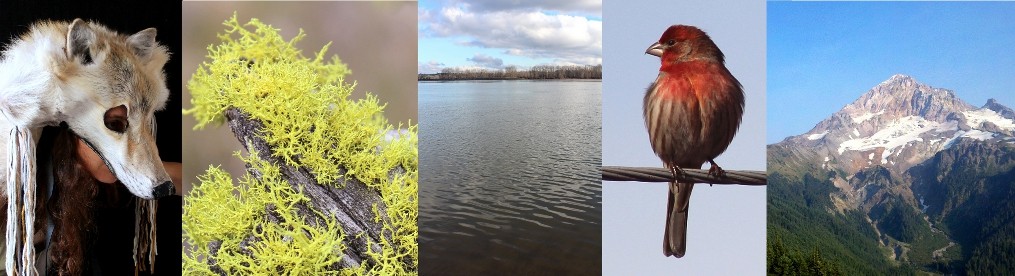
What is important to me are the natural landmarks and other phenomena found near the physical location where I am doing a ritual. For example, at home I have the Cascades to the east of me, the Columbia River to the north, Johnson Creek to the south, and the Pacific Ocean to the west, all at varying distances. And that’s not even including the urban spirit of Portland and all that includes.

So I’m thinking that what I’m going to do is focus on, prior to the ritual, familiarizing myself with local landmarks surrounding the place where the ritual will happen. At home this won’t be an issue, but if I do any traveling, it’ll necessitate some research, as well as introducing myself to the Land itself, and seeing if any of the spirits in particular request/require acknowledgment or permissions. It seems more appropriate than simply greeting fairly generic directions, though it also takes more work (and some people may prefer the quicker broad-brush “spirits of the North, etc.” I’m not even thinking the actual directions they’re in in relation to me would be all that important in and of themselves, other than as a note of orientation (what if the biggest nearby body of water is to the traditionally airy east, not the watery west, for example?)

The thing I need to remember, as a final thought, is that this path is of my own creation. If I want to do it properly, I need to be deliberate about it, and have good reasons for what I do and why. There’s a lot of freedom in being able to create one’s path essentially from scratch, but there’s also the lack of inherent checks and balances that normally come from working within an established path, or developing with a group. I was talking to someone I met today at the Esoteric Book Conference about how I have people that I trade notes with and go to with questions. Sometimes the practices these people engage in resonate strongly with me. But I don’t just copy what they do and say I’m doing the same thing. Ultimately there’s a lot of “me” in what I’m creating, and if I just took things whole-cloth from others without really considering why I adopted those things, and whether they really fit for me, then I’d be doing everyone a disservice.

Thus it is that I’m rethinking the whole circle-casting-inspired, generic-correspondence-laden approach to opening a ritual that I’ve been used to, and trying to come up with something that better fits this thing that I’ve been putting together formally for two years now.

Some Musings on Bear Work

Aside from my emotional personal work with Elk, I’ve been exploring new territory with Brown Bear. As I’ve been returning to the more ritualized portion of my shamanic practice, Bear has been right there with me, telling me what s/he needs of me and how to do it. Part of this, of course, is for hir benefit; however, it’s also been great training for putting together the more formalized ritual practices I’ve been developing piecemeal for a while now. Much of this is stuff that I’m simply not able to talk about just yet–not out of any sense of “Woooo, I have mysteries that you can’t comprehend!”, but in the sense that it’s not yet ready for me to share, and the spirits would be unhappy if I brought it out prematurely.

Thinking back, I’ve realized that Bear has been the first one to step forward when I’ve wanted to try something new along (neo)shamanic lines. When I first started exploring totemism beyond Wolf, Bear guided me through some of my first rituals. And now s/he’s here again as my practice begins to branch out past my own personal needs, and I prepare to start shamanizing for others.

I was talking to Bear during a journey last week, and I told hir of my concerns as to whether I was “doing enough”. I talked about a friend of mine who is a much more experienced practitioner who’s been doing some serious work as of late. I look at what I do, and I feel like I’m such a novice. Even though I’ve been a pagan and magical practitioner since the mid-1990s, with shamanism I feel as though I’m just beginning to reach a new depth of experience that I really haven’t gone through before. This path has challenged me more than any other, though I think it took me until two years ago to really be ready for it. (Wow, has it been two years already?)

Bear told me that I’m giving myself more expectations and therefore more pressure than I need to. Even within a specific community, different shamans not only have different strengths and specialties, but also different commitment levels. If I end up not being as intense a practitioner on some levels as some other shamans in this culture, it doesn’t necessarily mean that I’m not trying hard enough. There’s a tendency toward competition and one-upsmanship in American culture, and in many magical traditions it manifests as “Who can be the most non-fluffy?” Shamans may compare tough journeys and sacrifices as though the more you suffer, the better you do objectively speaking.

Yet Bear simply told me that we’ll see what I’m realistically capable of. I can’t just drop everything else in my life to try to eke out a living hanging up a shaman shingle. Granted, grad school and my future profession are linked to the shamanism, but I also have a life outside of that–significant others, friends and family, video games, Western martial arts, etc. Shamanism proper may never be an all-consuming things, and my “official” profession as a therapist may always eclipse the ritual work to some extent. But then again, it may not. Bear has a very wait-and-see attitude, and the long view of the fact that I’m only thirty, ideally I have a few more decades to live, and plenty can happen in that time.

So once again I’m grateful to Brown Bear for hir perspective and reminding me that this isn’t a competition; there are enough people (and other beings) in need that I don’t need to prove I’m more 1337 than the next shaman to be able to help.

What I Did On My Summer Vacation, Part 2

Eeep. So this was a little later than “tomorrow”. But better late than never.

So I didn’t really get a chance to talk about the big OMGSPIRITUALEXPERIENCE I had when I was out on the wilderness therapy (WT) retreat. One of the tools used in WT is the “solo”, which is basically the really short, really watered-down version of what non-indigenous people assume to be a “vision quest”, though the WT people I was with were well aware of the cultural issues, etc. Anyway, a solo happens late in a WT experience (which generally will take anywhere from a few days to a couple of months, depending on the program). It’s long enough for the individual person to have had a lot of experience not only with practical wilderness skills and teambuilding, but also to reflect on the problems encountered both in the backcountry, and in the setting that person left behind. The solo itself is where the person gets left in a particular spot for a matter of a few hours to a few days to have that time to hirself for reflection. After, there’s a period of time for reintegration back into the WT group, followed by transition back to the life left behind.

My solo was only a few hours, appropriate for a four-day retreat. We hiked up West Hardy Ridge, going about three and a half miles one way, with roughly 2,000 feet elevation, at a pace of about 3mph average. It’s rough, rocky terrain, especially higher up on the ridge, so it wasn’t easy going. In fact, it’s the toughest hike I’ve done to date; we didn’t stop for breaks, and my pack was about a fifth of my body weight since I took a lot of water to account for the 90+ degree heat.

Honestly, there were a few times where I seriously considered just sitting down on the trail and not going any further. I’m in good physical condition, but the many factors wearing at me combined to create a really tough challenge. I have a tendency to get frustrated when things go beyond a certain level of difficulty. But I did recognize that I was getting frustrated, and I was able to take a step back and observe myself in that frustration–and I was able to tell myself that it would pass, and that I had a goal worth going for. So I worked through the frustration, while acknowledging that I felt it, something nearly unprecedented for me (and also an important step in my Elk work).

We made it to the top of the ridge, and we were then escorted to our individual spots. I ended up getting a really choice one, a rock slide overlooking the Columbia River, surrounded by small conifers and underbrush. Granted, the rocks were all small, to the point where I really had nowhere comfortable to sit, and I had to secure my gear to keep it from sliding down the ridge. But other than that? Excellent place.

I took a little time to settle in, getting some water and food, and letting myself rest. Then I took in my surroundings in brief, just to get some orientation for where I was. My clearing was about fifteen feet wide, and the slide itself was roughly fifty feet long from the top of the ridge to where the brush began again.

Then I started thinking about how I should spend my time there. Should I do work with Bear, who had been wanting my time and attention? I’d brought my drum, after all, since it’s not heavy at all and hooks onto my pack nicely. Should I meditate? Should I try talking to the Land? I tried for the lattermost option, opening myself up and expecting a dialogue. Instead, the Land simply kept telling me to look at the plants. So I did. Though I didn’t know most of them, I took the time to study them in detail, how they grew together in layers from the ground up, and how I was surprised by how many deciduous trees there were mixed in there. Then I looked at the stones around me, and the fallen logs. And then I noted the animals, who are normally the ones I notice first.

First came the flies–not biting flies, thankfully, but sort of housefly-types. At first I shooed them away when they landed on my skin, and they persisted. But then I saw that what they wanted was my sweat–there wasn’t any water nearby, so moisture must have come at a premium on that hot day. So, exercising patience again, I let them land on me and drink their fill, even though it tickled, and there was part of me conditioned to feel revulsion at having “dirty” flies touching me. But once they were done, they left me alone for the rest of the time.

Much of my company was flies, a few spiders and other arthropods. However, I ended up with an awesome spot for birdwatching. I startled a scrub jay who was about to come in for a landing on a tree next to me, but then thought better of it after seeing me. There were some swallows (not sure of the exact species) flying overhead, and of course I heard the occasional raven. Later on, a quartet of turkey vultures came flying overhead, harried by a peregrine falcon (the falcons nest nearby on Beacon Rock). And then at one point I heard the “keeeeeer” of a bald eagle, and was fortunate to stand up quickly enough see a mature adult cruising parallel with the river, fifty feet away at the most!

What I realized in all this is that I saw so many things I would have missed if I hadn’t sat down to be patient. I have a tendency to be an impatient person, hence my common frustration. Being out in the woods like that, settling down quietly for a space of hours, showed me one of the many rewards of patience. In fact, this was a really good trip for Elk work in that vein. I had ample opportunities to experience the natural challenges associated with being in the wilderness and to face my own behavior patterns that came up as a result. And I came away with some good lessons.

I also actually got to do my first sort of “official” shamanic work on behalf of others. I know the human-based portion of my shamanic work has largely focused on myself and making myself a better vessel for this sort of thing, but I’m starting (finally!) to get to the point where I can do work for other people. It wasn’t anything too elaborate; one of the instructors for the course asked me to drum as part of the preparatory ceremony before we started out on our hike. (Ecopsychology doesn’t equal animism, but ecopsychologists do strongly draw on animistic practices in a secular context, such as the role of ritual.) So I very briefly explained the importance of my drum and what I was about to do, and told people that I would be calling on Horse, Deer and Elk, and that they were welcome to ask any/all of them for their guidance and protection on our “journey”, such as it was. And then I drummed while one of the instructors smudged all the participants with sage picked in eastern Oregon before we got going.

I’ve done some work since then, but I’m not ready to talk about it just yet. Needless to say, things seem to be evolving more as I’m coming back to my practice more actively. But my wilderness therapy excursion was a definite turning point.

What I Did on my Summer Vacation, Part One

I just spent the past four days in the woods out at Beacon Rock State Park for a wilderness therapy intensive for grad school. It was incredibly rejuvenating in some ways, and very challenging in others. However, I have a much clearer view of what wilderness therapy is, why it isn’t just “wilderness boot camps” like the media portrays (even though many of the teenage participants are there under duress, mainly because it’s a last resort to keep them out of jail/alive–which is a tough controversy we discussed), and how I as a therapist-to-be can incorporate elements of it into my practice as well as help clients figure out whether it may be a viable option for them or their children.

Where a boot camp mentality deals with strictly regimenting teenagers to challenge them through tough hierarchies, rigid scheduling, and pressure to conform to authority, what we learned about are ways to use the challenges that naturally come up during long-term hiking and camping as parallels to challenges the kids face in everyday life. It’s a matter of waiting until the individual participant hits a point where they need support, offering that support, and helping them to learn a better solution of how to deal with challenging situations than what they’ve been doing. They also learn the value of working with others, not through being ordered to do so, but because cooperation helps everyone involved.

We actually incorporated a few of the more common teambuilding techniques in our intensive experience. One of the most important ones for me was meal preparation. We were divided up into three teams of four (twelve students) and each team cooked one of the three meals each day. In order to get it done efficiently and with the limited gear we had, we had to work together–not as one leader telling the rest what to do, but as a quartet working together, adopting or delegating tasks as needed to get things done. There was no competition between the groups (well, other than a round of rock, paper, scissors to determine who did what meal), just shared appreciation for the work that went into the meals. There were other exercises, but this seemingly simple daily ritual really helped to demonstrate to me the difference between being ordered to do something, and doing it for mutual shared benefit and the pleasure that comes from it.

Anyway, there was a lot more to the formal educational portion of the experience, but I wanted to explore a few things that happened that are relevant to the spiritual aspects of what happened. This is one of two posts that will cover that.

This one deals with a drawing that I did as a bit of art therapy in one of our exercises. We were asked to draw the various influences–media, cultural, spiritual, experiential, etc.–that contributed to our understanding of the word “wilderness”. I ended up drawing an open book near the bottom of the page. Above it there were pictures of lots of wild animals, wolves, elk, foxes, etc., and lots of trees and ferns. Below the book, in a very small space, were the small animals I had encountered a lot in my childhood and beyond–songbirds, snakes, rodents, etc.

What this spoke to was my actual experiences with wilderness, which aren’t very many. I grew up in a family that didn’t hike or camp. And since I didn’t have much in the way of friends growing up, I didn’t really have anyone to take me out to the woods with their families. As for Girl Scouts? Forget it. My troop leaders’ idea of “camping” was having us all sleep in sleeping bags on the floor of an old commercial bakery, where the only wildlife was the cockroaches. So this led to a life completely devoid of camping until my twenties. Seriously.

Living in the Pacific Northwest has made me really self-conscious of this fact. A lot of people here are avid hikers and campers, and not just the kind that park a camper somewhere and walk down the paved road in the middle of the campground. We’re talking through-hikers on the Pacific Crest Trail, and those who can take a single backpack into the woods and stay for a few days, no problem. I really envy them, though people have been really awesome about helping me get up to speed.

Anyway, one thing that I realized as I was making this drawing was that I got my early conception of the wilderness primarily from books. As a child, I must have read Jack London’s White Fang and The Call of the Wild countless times. London, of course, described the Arctic regions in very stark, manly-man, eat or be eaten terms. So that informed a lot of my understanding of wilderness growing up–which just made me even more attracted to it, especially since I mainly had yards and open lots as my substitute for wilderness (and which I still found endlessly fascinating).

And as I got older, and I continued to have really limited access to anything but generic suburbs, I found more and more that I formulated my understanding through books. In a lot of ways being a nerdy little bookworm helped me out a lot. However, I often substituted the map for the territory to the point that I often didn’t realize the difference. I ended up with a lot of abstracts based on not a lot of actual experience.

In some ways I wonder how much my spirituality is based more on the abstracts I’ve constructed. As I’ve finally been able to start fleshing out my experiences, it’s been sobering to see just how much I haven’t been in contact with the natural world. My increased exposure has changed my spirituality quite a bit. I’m finding more ways to ground my beliefs in my experiences, a good example of this is more work with local totems like Scrub Jay. And admittedly I’m pretty embarrassed about the fact that I’ve never seen my primary totem, Gray Wolf, in the wild, even if it’s mainly because I haven’t been in places where I’ve had that opportunity open to me.

I don’t think it’s a matter, though, of scrapping everything I’ve created. Even the abstract bits have helped give me a personal mythological structure to work with. Like my current Elk work. I haven’t met an elk in the wild, either, other than the two that nearly ran me over in a field back in June. But it’s helped immensely, as my next post (when I’ve time to write about it) will explain.

But I do think that I’m going to be spending more time grounding my spirituality in the Nature that it’s supposed to be based in. Neopaganism is full of abstractions, which just helped me to further distance myself from the source of my spirituality. (When you have people who worship deities of natural phenomena who claim they aren’t practicing a Nature-based religion, that should say something to someone, somewhere.) I think, perhaps, that therioshamanism has been in part a way for me to get that groundedness, even if I didn’t consciously realize it until recently. I’ve always enjoyed the outdoors, and I’ve observed principles of my spirituality at work in it (and vice versa) but I think now I’m trying to make the distinction between the spiritual and the physical less…well…distinct.

More tomorrow.

Elk’s Journey, Elk’s Gift

Today I did my first journey for a purpose other than exploration. I’ve been doing a lot of internal work lately, trying to work through the unhealthy conditioning and behavior patterns associated with depression and especially anxiety. They’re not a constant active influence in my life, but they do have a tendency to pop up with the right amount of stress in my life. I don’t like them, they don’t like me, and since I had an open invitation from Elk for help with emotional regulation, I decided to take hir up on it.

I’ve been thinking a lot lately about trying to develop a more formal ritual structure, but not based on the generic Wicca-flavored neopagan ritual structure I used to use. One of the challenges of essentially creating a practice from scratch is that there’s no authority telling me “Well, you need to do things this way or that”. I’m the one who decides, for the most part. The spirits will occasionally have a suggestion, but as far as they’re concerned, most of this is for my benefit and (eventually) the benefit of anyone I do this sort of work for. I have a desire for formality, though, so it’s up to me to create something appropriate that works.

Before my break over the past few months, when I journeyed I basically asked the drum and beater if they’d work with me, and then we’d drum together and I’d head off to where I needed to be. As I’m coming back, though, I’m finding myself being more deliberate about things. I still ask the drum and beater–and the horse, deer, and elk spirits in them–for permission. But then I warm the drum up with my hand, and then the beater; this is inspired by Ravenari’s method of doing so, and the spirits of the drum and beater really seem to appreciate it. It also helps me to ease out of my everyday headspace with all the concerns and stresses and distractions, and into the focus I need for any sort of ritual work.

I also asked the horse spirit in the drum to carry me to my starting point, instead of taking myself as I normally do. She agreed, and it made the trip a lot smoother, again partly because it helped with transitioning from one headspace to the next. I’m a little rusty, particularly in maintaining the visual aspect of journeying (I’ve always had trouble with consistent, unbroken visuals), but I had a good connection, and even when I let my “sight” relax, I was still definitely over in the spirit world.

So the drum-horse got me to the starting point, and I got onto the ground and turned into a wolf. I then worked to pick up the scent of Elk, and went to find hir. I found hir down in a valley not too far away; s/he’s been expecting me. I went to hir asked formally asked for hir help, turning back to a human being. I then held out a small elk antler tine I had brought with me as a symbol of what we were creating. Elk flinched a bit, and said “That smells like Death. Here, let’s go put it in that stream over there to cleanse it”. So we ran over there, and I placed it in the water, feeling the cool stream over my hand as I looked at the antler against the stones.

Then Elk turned into a human with an elk’s head, and so I turned into a human with a wolf’s head to match. We sat facing each other and spoke about the work we wanted to do together with helping me with emotional regulation. Elk brought up how soon the bull elk would be going into rut, and would be a lot more easily provoked, both by each other and other beings. Like the elk, I can be aggressive when I want something and can’t immediately get it or perceive something in my way. However, Elk pointed out that the bull elk don’t use any more force than necessary, even in rut, because injury is a serious thing when you’re a wild critter. Most confrontations between bull elk only end in one running away, and fights often don’t result in serious injury. (It’s still a lot of work for the bull who has a harem, who may barely eat during rutting season!)

Elk put antlers on my head and said the tine I brought was appropriate because while I can wield my own tines and harm others with them, I can also be injured by someone else’s antlers. Therefore it’s important that I’m doing this regulation work to avoid not only exhausting myself with unnecessary effort, but also injuring others or bringing injury to myself that wasn’t really needed.

Additionally, Elk talked about how there is a season to all things. There are times to be aggressive to get what I want, but that’s not all the time. I need to learn which time is which. With regards to depression and anxiety, these conditions are attempts to gain control–which is an illusion. I can’t control the world around me beyond a very limited scope, and the anxiety and depression are my way of trying to grasp at control in a situation where I feel like things are getting out of control. These are obviously maladaptive, and the better choice is to learn to adapt and roll with the punches that life throws–because nothing is ever going to be perfectly safe and secure, and that”s alright. So instead of facing the world with antlers lowered and ready, I need to learn to relax and only react when it’s actually warranted, and only to the degree that it needs to happen.

Then Elk had me retrieve the tine from the stream so I could take it back home with me, as a physical reminder of my commitment to healing myself with Elk’s help. I then offered Elk a set of three brass bells that I had brought with me as a gift for helping me. Elk laughed and said that s/he would have done this for me anyway, but that s/he appreciated the gift. S/he told me I could go; I stood, and waited to watch hir leave, but s/he just stood there waiting for me to go! Finally, s/he snorted and stomped, and I took off, with hir laughing in amusement as I did so.

I scrambled back up out of the valley to where the horse spirit was waiting. I climbed onto hir back, and s/he took me home. Soon as I came out of the journey and brought the drum back down again, I treated the drumskin to some mink oil; she’d been feeling dry and thirsty, and I’d promised her some treatment. Next, I drilled a hole in the elk tine, and put a piece of deerskin that Deer had donated to the cause. Here’s a pic:

As to the bells? Well, a while back, I believe it was Erynn who had suggested that I add bells to an elk antler that I didn’t know what to do with. So as my gift to Elk, I attached the bells to the ends of three of the tines and wrapped the rest of the antler in braided artificial sinew and waxed linen cord. The bells will later on be used in rituals as a way to help keep me oriented to where my body is so I can find my way back home. Here’s how it turned out:

So it was a successful journey overall, and I feel more confident in satisfying my need for structure. It’s all coming together, piece by piece.

On Totems and Categorizing

I’ve recently started working with Elk for help with emotional regulation. I’m working through some of the most deep-seated issues I have, and needless to say it’s been a real roller coaster–only not as much fun for me and those around me. Now, just out of curiosity, I did check a few totem animal dictionaries out of curiosity to see what Elk had taught other people, because s/he wasn’t who I would have expected to help me with this particular effort. I didn’t find anything specifically on healing psychological aches and pains, though I did find some emphasis on community involvement and intense emotions. This isn’t surprising, given the herd formation (particularly of females) and the aggression of bull elk during rutting season.

But then I found that I was really trying to come up with a label for Elk. Was Elk my emotional totem? My heart totem? My psychological health totem? My working through depression and anxiety totem? And I realized just how limiting a mindset that really is. Having been neopagan for over a decade, I can look at countless examples of books and other sources that treat not only totems but also deities and other beings as pigeonholed, categorized, and neatly shuffled into place, like so many correspondences. I even have heard plenty of pagans talking about which deity or totem or spirit to “use” for what purpose. Yes, different beings have their bailiwicks, but there’s almost no talk of the individuality and personal evolution of the spirits.

I decided I had to stop myself from doing was trying to put Elk into a category. I have the habit of thinking of Brown Bear as my healing totem, Whitetail Deer as my dream totem, and so forth, because those are the main ways they’ve interacted with me thus far. But I also know they’re not limited to these things, especially as I begin journeying again, and as my shamanic practice has deepened my relationships with them.

And that’s really one of my biggest complaints about the dictionaries–they unnecessarily limit our perception of what different totems can do, to the point where it almost becomes plug-and-play totemism. It’s a bad habit I need to get out of, myself. Totems are individuals; yes, they’re archetypal in nature, but archetypes continue to be shaped by the changes in what feeds and becomes them. For instance, our relationship as humans to elk as animals, as well as symbols, has changed over time, and from culture to culture. It doesn’t mean that older observations and relationships go away; they simply are joined by newer ones. And that all goes into the continuing evolution of Elk as totem. It’s that way for everything and everyone–we shape the world and the world shapes us, even if that shaping varies depending on the nature of the individual beings involved. Totems aren’t physical human beings or even physical animals, and to treat them as such is inaccurate.

At the same time, totems and other archetypal beings aren’t labels. Yes, it can be useful to have some shorthand ideas for casual discourse among totemists and others. But as I’ve maintained for years, what a particular totem tells me may not be what that totem tells someone else, and it’s ridiculous to expect that everyone will get the same message. Part of why I avoid going to dictionaries when I get a new totem or other animal spirit in my life is because I want to get to know them on our own terms, not bias myself by seeing what others had to say. Yes, I went and checked up on Elk in a couple of dictionaries, but that was after we’d already established some form of relationship, and I went in with curiosity, not seeking answers.

So I’m going to continue de-conditioning that tendency to say “Bear is the healer, Deer is the dreamkeeper” because it’s too limiting, both for them and for others–as well as myself. It’s a really bad habit, and I suggest my readers who work with totems in a neopagan/neoshamanic sense take a look at similar patterns in your own views of the totems and other spirits you work with.

Okay, I’ll Play Along…

The pagan blogosphere seems to have latched onto this nifty declaration of International Pagan Values Blogging Month. It’s given me a good excuse to put down some thoughts that I’ve been having trouble putting into words as of late.

The biggest problem with trying to define “pagan values” is that, as others have noted both in this blogathon and before, is that “neopaganism” doesn’t describe just one religion–it describes a plethora of them. As Sannion pointed out, a lot of the time “pagan” often ends up being interpreted (not overtly, generally) as “Wicca, or Wicca-flavored”. Not surprising, since so many of us cut our teeth on books by folks like Scott Cunningham, and many pagans never really define themselves beyond “generic Wicca-flavored pagan”. From my experience in the communities I’ve participated in (both in person and online), and in going to a wide variety of festivals the past few years, “generic Wicca-flavored pagans” outnumber any other single group of pagans. This isn’t necessarily a bad thing; it just means that there’s no simple set of pagan values when you have that much variety.

The other issue is that values are ultimately subjective. Even among members of the same pagan religion, you may have a wide variety of values that individual people adhere to, whether due to the tenets of their faith, or other factors informing their everyday choices. And I do mean that last bit–values do not only have to come from religious sources, though the two may inform each other to the extent that they may seem inseparable.

One of the things I’ve been kicking around in my head as of late is the idea that we (not just pagans) create religion (and, by extension in many cases, values) out of whatever comforts us. We may not consciously realize we’re creating religion, and as most people view religions primarily in a literal sense, some may be offended by the idea that their experiences are anything other than direct contact with the Divine/spirits/other intermediaries. Still, people seem to match their religious beliefs pretty well; the structures within which they interact with the Powers That Be connect to things that give them some form of comfort and security. (And I’ll most likely write about this more later when I’ve brought together my thoughts on it more cohesively.)

I know exactly where my comfort in Nature comes from. I was a weird kid growing up. While all the other girls in my small town Catholic grade school class were playing with Barbies and putting on kiddie makeup and starting to get interested in clothes, I was grubbing around in the woods catching garter snakes. I didn’t really have friends, for the most part, and got picked on a lot. My family loved me like nobody’s business, but I think sometimes they just didn’t know what to make of me. My only sibling was significantly older than I was, so I ended up spending a lot of time alone.

Living in a small town, I was able to run around our yard, the neighbors’ yard, and the Big Hill across the street where the retirement home was. I even repeatedly sneaked off to the semi-wooded lot on the other side of the hill, even though I was supposed to. (After all, that’s where the best place to find garter snakes was!) So I spent long days in cool shade on mats of moss and grass and clover, under poplar trees and juniper bushes, watching Monarch butterflies come out of their chrysales, chasing (but never catching) cottontail rabbits. When I was indoors, I was reading voraciously, getting every book on animals from the library that I could lay hands on.

Nature was comforting to me. When people were confusing, or mean, or simply didn’t get that no, I wasn’t interested in doing things their way, I knew I could turn to the natural world and find a place where I wasn’t judged. Sure, the animals ran away when I came stomping through the woods, but they did that to every human, and even to each other to an extent. That’s just the way they were. They weren’t out with an agenda beyond day to day survival, and they didn’t single me out. And in turn, if I was quiet (and lucky) enough, I got to observe the denizens of the wild and witness their goings-on with wonder (though this was easier with plants, which tended to just stay put regardless of how much I looked at them). And yes, I did tell stories to myself about Nature; there was more to it than just what the books said. I never told anyone about these personal myths, but they sowed the seeds for meaning-making.

This continued well into my mid-teens. When my parents and I moved to a new home in the very early 1990s, there was one of the last farms to survive the sprawling of my town right behind our home, and I had a few acres of woods that weren’t immediately fenced in to explore. I grew very attached very quickly, especially because it was bigger, with a creek running through it (I’ve always been attracted to running water), and more variety in inhabitants and geography. Even as I entered into the awkwardness of junior high, I continued to find the most solace in those woods.

And then, one day…I came home on the school bus to find that my woods had been completely bulldozed to make way for a new housing subdivision. To say I was devastated, crushed, would come nowhere near describing how I felt. I honestly think that’s what touched off the depression I fought with for years afterward. I had lost my anchor, the place I went to when people simply didn’t understand. worse, I had lost a piece of my soul.

When I discovered paganism at the age of 17, a few years later, I immediately latched onto the nature-based aspects of it, especially animal magic and totemism. Neopaganism gave me a structure to try to rebuild the rapport I had had with Nature that had been so shockingly destroyed. In the few years between the destruction of “my” woods and discovering paganism, I had reacted so badly to the trauma that I distanced myself from nature as much as I could, and lost that innocent connection I’d had for so long. Even now I find myself having to fight seeing Nature in too many abstractions, trying to keep from mistaking the map for the territory. And yet, the older I get and the more of that initial connection I rebuild, the more comforted I am, and the more depth my relationship to Nature gains. Granted, I have a much healthier social life than I did when I was younger, but that hasn’t caused my comfort in Nature to cease.

So what’s the point to this long, rambly narrative? Where do values come in? First, I wanted to illustrate how our values–including those that are formed through religious experience–may very well be tightly linked to what comforts us. But second, and perhaps more importantly, I wanted to show where my own values come from. Because, as I mentioned, I can’t blog about “pagan values”. They simply can’t exist in a universal form, not even those based on the assumption that pagan = reveres Nature. While I can argue up and down, for example, that you can’t separate an Earth or Harvest deity from the actual, physical Earth, there are numerous pagans who will deny that their paganism is Nature-based, instead saying that their religion is “based on the worship of the Gods” (never mind that their gods are personifications of natural phenomena), or some other explanation. (My rant about the artificial dichotomy of “natural” vs. “not natural” will have to wait.) It’s not that there aren’t other pagans whose values resemble mine; it’s that these values cannot be universally described as “pagan values”. But I can confidently extrapolate on my own!

If you look through the posts in this blog, it’s pretty easy to see where my values are. While I may not always be capable of acting in the most harmonious ways when it comes to valuing being a part of an interconnected set of natural systems involving numerous beings on all levels of existence and evolution, my values most definitely do direct the decisions I make–even if that means keeping certain ones in mind for later when they’re more feasible. Now, I am not a philosopher; while I’ve done a little reading up on the differences between values, ethics and morals in order to prepare for this post, the differences are still kind of fuzzy for me. So here are the essentials, and I apologize if these aren’t properly explained as “values”:

–Nature is sacred. Not just in an abstracted, symbolic, archetypal way, but in its very immediate physical reality, from the rich dirt that I work composted cow manure into every year before gardening, to the Columbia River Gorge where some of my favorite wild places are, to the countless microflora in my body, living in symbiosis with me (most of the time). It is sacred not only for its meaning, but for the very fact that without it, I die.

–The above assertion is not antithetical to scientific knowledge. When I say my prayers in the morning and evening and honor the Earth, the Sky, the Sun, the Moon, and others, I am not only saying these things to anthropomorphized symbols. I am saying them to the Earth that is the basis of my life-support system, and the Sky that contains the necessary atmosphere to create climates and weather patterns. When I journey and speak with totems and other spiritual beings, I am not only speaking to spirits, but to embodiments of entire species and natural phenomena that exist in a very physical way.

–The assertion directly above this one is not antithetical to the existence of a meaning-making system composed of my personal mythology, as well as the elements of greater cultural mythologies that interweave with it. When I say my prayers, I do not only say them to the physical manifestations of natural phenomena. I am saying them to the archetypal energies that have been built up around them through countless years of human attention and belief, as well as through the strength of my own connection and the meaning-making activities I have partaken in my entire life. When I journey to the totems and others, I do not only limit my knowledge of them to natural history, but also interact with totems-as-archetypes, vastly complex symbols that resonate with my psyche on multiple levels.

I endeavor to live in such a way as to honor all the above assertions equally. However, I do this with the understanding that ideals and reality may not always mesh well, particularly in the physical realm. For instance, I would love to be able to have a greywater system, and a yarden (yes, an entire yard converted to veggies and fruit!), and a number of other things that require me to not be a renter. Unfortunately, we’re still several years off from being able to buy a house. While I know that going vegetarian is better for the environment, I simply do not thrive well without meat (and yes, I’m currently going through medical professionals to see about this, just to see what’s up).

But there are decisions I can make, and have made, that are in line with my values. I am in grad school to get a degree in counseling psychology, and my emphasis (though not exclusively) is on ecopsychology, as well as narrative therapy and other tools for aiding others in meaning-making activities (and, of course, better mental health!). While I’m not yet a subsistence gardener, I’m doing my best to learn better skills as I go along. A lot of my day-to-day purchases have environmental impact in mind; I’m a frequent shopper at Goodwill and other thrift stores, and haven’t bought anything from a mall or a Wal-mart in years. These things are as much a part of my values, and really, my spirituality as a pagan, as any rituals, journeying, and other activities I do.

Paganism, for me, is not limited to the overtly spiritual practices, and neither are the values I associate with my paganism. If I do not do my best to integrate what I believe into what I do to the extent that is currently possible, then why do I believe it?
An Update!

So obviously my posting frequency here has gone down significantly since I started school. My initial reaction when I realized I hadn’t posted in a while was to try and justify my absence. However, that also brought up a recent spiritual experience that I had. I’ve been feeling pretty guilty about really slacking off on journeying and other more “officially” spiritual practices and rituals. I’ve been making my usual observations of the world around me and everyday meaning-making exercises, as well as my usual awareness of my decisions and their impact–and, of course, continuing with school. However, I haven’t really drummed in months. And so my usual pattern was “Feel guilty about not journeying/etc. –> Tell myself that I’ll do it soon –> Not address the underlying barriers keeping me from accomplishing my goal –> Feel even more guilty” (wash, rinse, repeat).

So a few weeks back I was hiking on Mount Hood with Taylor, and had a bit of a discussion with the Animal Father about this whole situation while there. I went in bemoaning the fact that I’d been a slacker, and essentially poured forth all the diatribes I’d been heaping on myself because of it. And when I was done, this is what he told me: “Adjustment is going to be a constant state for you”. This startled me, because he’s been one of the biggest proponents of me journeying on a regular basis. And while the last time I went a few months without journeying he told me he didn’t want it to happen again, he explained that it was pretty apparent that as things stood right then, that just wasn’t going to happen–and that it wasn’t the end of the world.

That made me feel a lot better. I think part of what was keeping me from journeying was fear that the spirits would be displeased at my long absence. Since that conversation, though, I’ve checked in at a few crucial points, and while there’s a desire to connect, there’s also patience with my current situation, and understanding that it won’t always be this way–and that adjustment will indeed always be something that’s a reality in my exceptionally busy life.

This goes along with a greater effort on my part to change the way I approach doing things. I am a recovering workaholic, and my time management involves me pushing myself as hard as I can until I either reach the point of short-term burnout, or someone (usually, though not always Taylor) pokes me and says “Hey, this needs to stop–it’s causing problems”. This isn’t as productive as it sounds.

The thing is, though, it wasn’t until I stopped the guilt cycle that I started making actual change. Pushing myself less and pacing myself more realistically has been a process, rather than an event, and while it’s been slow, I have noticed changes. I’m better at reminding myself when I begin to feel stressed about my ever-present to-do list that “Things will happen in their own time”. And I’ve finally, finally, finally been able to find effective strategies for cutting down on useless internet time and creating more time to actually do things away from the computer.

So there will continue to be a smaller flow of posts than there was a year ago–and there’s nothing wrong with that.

***************
ETA: Just wanted to add in this link to some thoughts over on my LJ that touch on some relevant topics here.

In other news, Scrub Jay and Stellar’s Jay have stepped (flapped?) forward to offer their aid in helping me connect with the Land and learn more about it. Scrub Jay seems to be more of a help with urban areas, whereas Stellar’s primarily aids with wilderness, though these are not hard and fast divisions. These are the settings where I see them the most, respectively. They help me in that whenever I see one of their children, it’s a reminder to me to be aware of the Land–not just in that moment, but as much as possible. It has helped; I finally remembered to pick up a couple of field guides for local plant life from PaperBackSwap.

I’ve been gardening again this year. Unlike last year, where it was containers only, I have a big planter box and a few extra patches of dirt, along with all the containers and a few extras. I also have slugs. And ants. And other critters vying for space and food. Plus the weeds. So this year’s gardening has been an object lesson in the balance between my own needs, and understanding that if I’m going to respect Nature, I have to respect it when it’s eating my garden. I still pull up the weeds, and I have beer traps out for the slugs until I can get my hands on enough copper wire/coffee grounds/egg shells to act as a deterrent, but I’m also aware that these are not just beings to take for granted as I do so.

I’ve also just begun to read Ecotherapy: Healing With Nature in Mind, an anthology edited by Linda Buzzell and Craig Chalquist. While I’ve got a pretty good handle on ecopsychology in theory, I want more on the practical applications thereof, and while my ecotherapy class last semester was excellent, there’s only so much you can fit into a couple of weekends. Also, here’s an article on ecopsychology in the local paper, and here’s the very first peer-reviewed journal of ecopsychology, first issue available for free online.

**************

Speaking of that, Chas Clifton posted a bit on ecopsychology, including a link to my last post on bioregionalism and the genius locii. Specifically, he observes that “But as an overarching concept…ecopsychology does not seem to have caught fire except in a low-level therapeutic way: ‘Gardening makes you feel better’.” Since my response is longer than my average reply, and it’s something that I thought would make a good topic for here anyway, I decided I’d write out my thoughts in this post.

Ecopsychology, not quite two decades from its initial inception as a cohesive concept as per Roszak et. al., is still quite a niche topic. I’ve had a good deal of exposure to it, but I also go to one of the most liberal schools in one of the most liberal American cities. I’m still finding out that not all psych grad programs are based in client-centered practices (which sometimes causes something akin to culture shock on my part), so I’m not surprised to consider that it’s very likely that something so nontraditional isn’t widespread in less liberal areas/schools/practices/etc.

One of the reasons I’m glad I got the ecotherapy anthology mentioned above is that we do need more practical applications of ecopsychology. What’s most commonly seen are either wilderness therapy retreats, or as was mentioned, therapists telling their patients to get outside more. What needs to happen, I think, is discussion of more ways to integrate ecopsychology into an actual clinical practice.

During the ecotherapy class, we discussed including questions about the environment in intake questionnaires; for example, “Are there any natural places that you feel close to?” or “Do you ever feel anxious about environmental issues?” Sadly, issues like these often don’t get brought up in more conventional therapy because it’s assumed that people don’t really feel emotions like grief for the environment, either on a small or large scale. One of the sadly ironic jokes that gets passed around is:

Client: I feel so upset about the environment; it makes me want to cry. I think I might be depressed because I’m worried about global warming, and species extinction, and just how big the problem is!
Therapist: So, tell me about your mother…

Another area where I see potential for more work is in addressing how environmentalists (and others)communicate information about issues. My instructor does a good bit of work with local activists; one of the points he (and other ecopsychologists) make is that guilt doesn’t work–and yet this is the tactic that activists have been using for decades. Guilt turns most people away, and often leads to counterproductive reactions (such as this new creation by Mike Judge, pointed out on Clifton’s blog–ouch!). While environmentalists may not intend to come across as holier-than-thou, because the messages we’re given to pass on are so often guilt-laden, it can be hard to avoid being otherwise.

In order to do this, we need to learn better forms of conveying our concerns. And this is where ecopsychology’s flexibility supports the relevance of numerous topics. One of my classes this semester is Communicating With Compassion; the textbook we’re using is Nonviolent Communication by Marshall Rosenberg. I just finished reading it today, and the class will be this weekend. Needless to say, I’ve picked up a lot of skills that are perfectly suited for not only being a better communicator on environmental issues myself, but that I can potentially use to help clients and others get away from the guilt-speak.

Ecopsychology isn’t a single model of therapy in the same way that, say, cognitive behavioral or client-centered therapies are. It’s more a way to approach all of these therapies, in that along with the mental, emotional, physical and spiritual levels of one’s psyche, there’s also the layer that resonates and responds to the environment one is in. This has often been seen in very narrow contexts, such as “home environment”, “work environment”, etc. (and can be studied in that respect in the field of environmental psychology). And because ecopsychology is a fairly amorphous field, not having tightened up into a rigid set of definitions, there are a number of things that could be considered “ecopsychology” that may not have that label on them, but which fit in anyway.

So I think ecopsychology, while it is still a niche, is a more powerful force than it may seem outside of that circle of folks who are immediately developing and utilizing it. Part of the solution to its low profile is defining more clearly what ecopsychology is or isn’t (and not cutting ourselves off from valuable resources in the process). Additionally, we need to be able to show even more that it has practical relevance, especially when managed care and other such forces continue to make CBT and other results-oriented, short-term therapies practically mandatory in some contexts where they may not be the most appropriate tools. I believe these will go a long way in helping to make it a more widespread and viable part of discourse and practice on psychology and therapy.

Bioregionalism and the Genius Locii

I haven’t been posting much here lately; I’ve pretty much resigned myself to the fact that graduate school is going to eat my life as long as I’m here, and I’m going to have to do most of my ritual work on breaks and during the lighter summer semester. I could handle it better when I was working forty hours a week, come to think of it. My once consolation is that the grad work, and the internal psychological development I’ve been doing as one result of it, are also an important part of my development of therioshamanism, so it’s not as though I’m not getting anything done. I miss regular journeying, and I’ll be glad when the semester’s done at the end of the month.

One of the valuable things I have been getting out of grad school has been the ecopsychology classes. This semester I’ve been taking the ecotherapy course; this is the second of two weekend-long intensives for it. Ecotherapy, in very brief, is utilizing the natural environment in therapeutic practice. This can include anything from having natural objects in one’s office, to wilderness therapy outings that last days or even a couple of weeks. Like ecopsychology, it’s not a linear, strictly defined set of techniques, but rather an integrative approach that can be applied to any formal school of psychological thought and practice.

One of the concepts we touched on today was that of bioregionalism. Normally Americans describe their location in terms of human phenomena–streets, addresses, buildings, and other such landmarks. I would describe my location as Portland, in the state of Oregon, in the Pacific Northwest region of the United States. Bioregionalism, however, orients a person according to natural phenomena, both very local and larger ecosystems. So I would therefore describe myself as living in the Johnson Creek watershed, which is a part of the Lower Columbia River Estuary, which is part of the larger Cascadia bioregion composed of the temperate rainforests of the west coast.

This is a very different way of approaching one’s location, but it’s also exceptionally telling when thinking about the way we perceive the world around us and place our priorities. We are exceptionally anthropocentric in every portion of our cognition, emotions, and descriptions thereof; using the metaphorical imagery of other animals, for example, is usually about as far from that as most people get.

And yet ecopsychology calls us to not only consider the environment we are in (human and otherwise)–but it also calls us to identify and embrace our ecological self. According to Winter and Koger:

“We experience our ecological self when we feel the connection between our self and other people, other life forms, ecosystems, or the planet. We experience it when we sense a deep resonance with other species and a quality of belonging and connection to the larger ecological whole…the ecological self leads to environmentally appropriate behaviors, not out of a sense of self-sacrifice or self-denial, but out of a sense of love and common identity”. (1)

What does this sound very much like? Animism. Even if we don’t look at spirits as literal entities, a more metaphorical animism still provides a great deal of meaning to an ecosystem that we too often just see as the backdrop for the grand plans of humanity. It could be argued, of course, that this sort of modern storytelling and mythmaking isn’t even necessary to be able to appreciate the beauties and amazing phenomena of the natural sciences–and I would agree. Yet there is also value in this meaning-making process.

Bioregionalism gives more meaning to the natural phenomena that surround us. It takes the focus off manmade objects, where it has been almost exclusively for quite some time, and causes us to stop and think about that where that focus has been–and what we’ve been missing out on. We need that so much in this culture; we are so disconnected as a people from the cycles that we rely on. Not everything postindustrial is evil and wrong, mind you–but we do so much completely out of touch with what we’re affecting by our actions. Bioregionalism is just one of many ways to find reconnection, and as Muir said, “When we try to pick out anything by itself, we find it hitched to everything else in the Universe”. Finding one connection invariably leads to another, and another, and we only cease finding connections when we stop looking–or caring. The bioregion is a series of connections that reminds us that streets and addresses are only one of many forms of connection.

This, the bioregion, is the genius locii, the Spirit of Place. This is the Land that I refer to. Not a singular spirit, of course, but one for each place, many overlapping and enfolding and not as linear as some might like. Like my home range, for example. There is the spirit of my garden, and all the individual beings in it. Then there are the wetlands that my yard drains into. And then, from the wetlands, we go right into Johnson Creek itself. These are all their own entities, and yet part of larger watersheds and waterways–and that’s not even looking at geology, or air currents, or, for that matter, the spirit of the city and neighborhood.

This approach to bioregionalism, in which psychology and ecology and spirituality all combine in varying manners, is just one of the reasons why I am incorporating a career in therapy in general, and ecopsychology/ecotherapy in specific, into my shamanic practice. As I have mentioned before, I see therioshamanism as an attempt–albeit still in its relative infancy–to create a shamanism for the culture I am a part of. In order to effectively incorporate the role and functions of “shamanism” as a broad, general concept into this culture, it is necessary to work within the parameters and language (not just English, mind you) of this culture. Psychology is something that, although it is not fully understood by everyone in my community and culture, is still recognized as a way of healing and of discourse and of creating connections and meaning. Granted, these are more abstract concepts than, say, journeying to speak to the spirits–but most people in my culture wouldn’t fully accept animism in its raw form.

So I choose to not only work with literal animism, but also with metaphorical animism, in part through ecopsychology and related disciplines. One thing I am learning as a future therapist who will be incorporating several styles of therapy in my practice is that a diverse toolkit is a great benefit. Along with such things as client-centered, Gestalt and narrative therapies, I can also have ecopsychology and ecotherapy, and I can even have some elements of my shamanic practice on the occasion I get a client open to such things. But despite the means, the end goal is still the same–to promote better connections between humans and community, humans and spirits/nature, and humans and the self.

1. Winter, Deborah Du Nann and Koger, Susan M. (2004). The Psychology of Environmental Problems, p. 193