Niche

First off, happy Earth Day! Here are some of my thoughts on this day, care of my Livejournal.

I’ve been thinking more, since I got back from Arizona, about my thoughts on what is being asked of me as a shaman. In the past month, my understanding of just what it is I’m supposed to do has deepened quite a bit. “I serve the Land” has become a good bite-sized summary. However, a post in a friend’s Livejournal sparked some thoughts.

S/he was talking about hir discomfort with the concept of “service”; hir personal interpretation of the word involved things that I’m also not a huge fan of–mostly having to do with unwillingness and feeling forced into situations and giving in to power-over. Basically, the idea that just because a deity or other entity is bigger than you, that you must give in, and that it’s a drudgery rather than a gift.

I’m pleased to say that my understanding of service has become more thorough as I’ve continued to develop my path and my relationships with the Land and other entities that I’m involved with. And I’m finding that it’s something I’m not opposed to, nor have I run up against any indication that I’ll be dragged kicking and screaming into virtual torture just because some god or another says I must or else.

I think the best way to explain things is that the more I learn about what I need to be doing, the more Right-with-a-big-R it seems. Much of what I’ll be doing already coincides with things I’ve already been putting into place, or am not adverse to doing. And as I’ve grown in my path, the parts of me that are more attuned to what needs to be done–for myself and for others–are coming to the forefront more. I am becoming, more and more, the person I need to be.

This isn’t just about self-improvement; nor is it just about giving up everything for the Land. What I need and what the Land and others need from me–these needs are not contradictory. They parallel each other so neatly that at this point I may as well not distinguish between one and the other. I can simply say, “This is what I need to do”, and I can understand that this covers everything and everyone I am involved with, including myself.

Were I another sort of magician, I might say that I am following my True Will. And in fact someone dear to me once told me that if you follow your True Will, you will find that the Universe aligns to accomodate you. I don’t think it’s so much that, as it’s a matter of finding your True Place in the Universe. I recently finished reading Bill Plotkin’s Nature and the Human Soul (which I strongly recommend) and very much resonate with his argument that part of healthy human development involves finding your soul work–the place that is naturally yours in this reality. So it’s not so much the Universe remolding itself to accomodate me, as it is the Universe and I finding just the right combination for each other. After all, I am part of the Universe–I am the Universe. As are we all.

This doesn’t mean that the way ahead will be smooth sailing. You don’t just slide into your spot and sit on your laurels. Shamanism isn’t an easy path, and while I haven’t been through a bunch of horrible challenges that stretch me to my limits, I’m also still relatively new to all this. Seven months isn’t that long a time, relatively speaking, though I’ve done a lot in that time. But I don’t feel adverse about potential challenges ahead of me. Scared? Sure. But I’m not afraid of the Land, or the Animal Father, or anyone else deciding that I must suffer needlessly for their gain. Their agenda for me and my agenda for me are one and the same, or so it seems the more I understand it.

Essentially, I feel acceptance and peace with my path. I’ll still question things as necessary–who’s to say that I’ll never misinterpret what I hear/feel/etc. again? Better to be alert and aware than to blindly follow and potentially walk off a cliff because you lost the trail in your stumbling. But I am not a slave. I am not a toy. I am a part of the Universe, and on a more local level, I am a part of the Land I live on.

I think sometimes we humans get so wrapped up in power play–power-over, power-with–that we obsess over it and perhaps sometimes forget the possibility that there isn’t a power struggle going on, that it isn’t about hierarchy. Look at what assumptions people make about wolves–if you read some accounts of pack hierarchy, you can see the military-flavored overlay that has been applied to that social structure, and how lupine behaviors have too often been interpreted through human filters. Yet more enlightened, recent explorations of wolf behavior takes wolves as they are, without trying to push them into human pigeonholes. While there is hierarchy, it’s much more fluid than was originally assumed; the Omega, for example, isn’t just some poor beaten-up wolf that nobody likes, especially in the wild (captive wolves often show exaggerated hierarchical behavior due to being confined). Rather s/he has hir own place in the pack, and is accepted as such. Yet there’s still obsession over “Oooooh, the Alpha!!!!” when humans talk about wolves–no surprise that I’ve seen countless wolf therians and other wolf enthusiasts describing themselves as “alpha wolves”.

If we project our power play this much onto wolves, who are our fellow mammals (and from whom we may have legitimately learned some social skills way back when we were still getting used to not being tree dwellers, though chimps also offer valuable clues to our past), what’s to say we aren’t projecting similarly on our interpretation of noncorporeal beings such as deities?

For that matter, what’s to say that I’m not projecting my feelings of harmony and working-with onto my experiences? There’s no guarantee that I’m not also biased and that my path doesn’t reflect that. However, I also tend to believe that reality is a lot more subjective than many people are comfortable with. I’m not a solipsist–it’s not all in my head. However, I don’t believe in an objective reality that’s universal–our perception of reality will always add in a personal touch, so to speak. Even if what we’re being told is the same, our interpretation of it can vary widely from person to person, and even in the same person from time to time.

Given that possibility, do you really think I’d want to give up a relationship with the various deities and spirits I work with that’s based on mutual cooperation and willing service to each other, for one where I am a lowly being who does things because she must, where obligation is the name of the game? I’d rather make a difference and do what I need to do in a life where life doesn’t suck, than do the same in a life where I resent what I feel I’m forced to do. I know in the former case I’ll be a lot more productive and effective. And I think that suits everyone a lot more.

I have my niche–I serve the Land. The niche may change as time goes on, but I have it, and I’m happy in it. I’ll be making the most of it for the benefit of as many as possible.

Back to the Drumming

Tonight I felt a strong urge/call to drum; Sunday nights are generally good times for me to work, since I’m relatively well-rested from the weekend (though after this week I should be better rested at all times, thanks to a lack of a commute–w00t!). So up I went; I cleared out my half of the ritual area (I really need to clean up the art-clutter!) and sat down in the dark to drum.

I started with a steady drumbeat of just a little faster than one beat per second, maybe one every 2/3 second. I let myself ease into it, and eventually found the beater going clockwise around the drum. As I continued with this, I began to feel something “open up” spiritually around me. I decided to keep going to see what would happen, since I wasn’t getting any feelings to do otherwise. The drumbeats began to form a pathway for the spirits to arrive on; I could see it in my mind’s eye, extending far into the Sky above me and also from the Earth below me at the same time (though I’m not sure if these were literal directions, or just how my mind chose to parse them). The path was filled with animal spirits of all sorts. I recognized a lot of my skin spirits, both the ones that are “mine”, so to speak, and those in my artwork bins waiting to be made into ritual tools and other such things. I also recognized Taylor’s dragon spirit, among others. They were all animals, though, and mostly “native” rather than “mythical animals.

I began to panic a bit. What was I going to do now that I had invited them all? I asked the Animal Father for his advice. He simply told me to explain what I was doing. So I stopped drumming once they were all there, and proceeded to thank them for their time and patience while I was learning to call them. That seemed to satisfy their curiosity (and confusion, in a few cases), and nobody seemed particularly miffed.

Then I began to drum again to give them a path to head back home to, wherever home might be–for some, it was the skins, skulls and other animal parts; for others, it was unknown realms. I had a faster drumbeat, maybe twice per second, and the beater went counterclockwise. I saw them retreat back up the path I had created, to wherever they went, and felt their presence diminish over time. Once everything seemed clear, I stopped drumming, and thanked the drum and beater for their help.

Once thing that stood out to me was that I was visited by individual animal spirits; there were no totems or deities of any sort, and no human spirits (though I work with very few of those)–there were a couple that I recognized, but they were in animal forms they sometimes used. This goes along with the strong suggestion I had prior to going to Arizona to start working with the skin spirits, and apparently now other individual spirits.

So it looks like I’m going to have to get started on writing songs and drumbeats for different spirits I work with, since they seem to want individual “calls” for me to work with them. The drumbeats I used tonight were apparently inviting and farewell “calls”, but the whole middle of the ceremony is missing. it makes sense–call the spirits, call forth specific individuals with their own songs, and then go to work. That’s what their expectation seemed to be as they were waiting for me to do whatever I was going to do once I’d called them.

I also spent some time meditating with my favorite tree at Laurelhurst Park. I was a bit distracted since everybody and their mother was there as well, and I was getting quite a bit of amusement at curious squirrels coming quite close to me as I sat motionless. (Though they quickly retreated up the nearest trees and got rather frustrated that I wouldn’t leave and let them come down!) I’m becoming more acquainted with the Land here as well; once it’s warmer I may do some drumming at the park, since the animal spirits would really like to work with me outdoors, and the Land would like that as well.

Believe me, I have plenty of reasons for wanting it to get warmer. That’s just one more.

More Thoughts, and Blatant Omnivorism

First, a bit of an addendum to yesterday’s post. Although I talk about drawing on the energy of the Land, it is an exchange, not just a feeding. Pore breathing is like lung breathing (at least in my experience)–breathe in, breathe out, not just breathe in. It’s an exchange of energy; for everything I draw in, I release part of my own back out. It was interesting walking to Laurelhurst last night; I’d had a particularly bad day, and was feeling really “ick”. Soon as I got outside into our neighborhood, even before we got to the park itself, I felt all that “ick” unloading. Bringing the energy of the night, of the neighborhood, and then of the park, felt like clear water flooding my pores, and my whole body. Exhaling flushed the “ick” out through the pores, so I felt that my skin was covered in rivulets of water stained grey with numerous particles of soot.

Despite this, the Land gladly took my energy. I knew that I meshed well with this place, but last night I felt utterly and completely enfolded and protected there. No one seemed to mind the trail of shed “ick” (which ended up pretty quickly absorbed or scattered). I’ll take this as further confirmation that the Land there wants to get to know me better–or, rather, vice versa. So I’m going to try to make it my goal to visit at least once every other day/night. Plus it’ll help once I can go hiking further out, too–I’m going to shoot for heading to Multnomah Falls next weekend.

Speaking of connections, I’m working on being more mindful of the living beings whose bodies become my food. Night before last, my husband Taylor and I went on a date after I got off work (Jim Butcher book signing FTW! Yes, I am a geek.) For supper, we went to an American-Chinese-Japanese buffet. This, of course, equaled utter and complete heaven, as among other things I could have unlimited quantities of two of my favorite foods–crab legs, and sushi. However, there were a number of other things I’d never tried before–clams and crawdads being among them. So I took the opportunity to exercise some neophilia.

I was doing great until I got to the crawdad–which was whole, face and all. Now, rationally, I realize that pork, beef and chicken meat all once had faces, too. However, in a society where even shrimp routinely end up decapitated before hitting the market, to come literally face to face with my food was a different experience. (It didn’t help that I had no idea how to eat a crawdad, and there were a lot of legs…) I almost didn’t eat him, but then I realized that if I ate faceless mammal meat and got completely squicked by a very complete crustacean, there’d be a definite note of hypocrisy in there.

I’m not going to go into great detail about the experience. Needless to say, Lupa figuring out New Food is almost always an entertaining experience (Taylor can tell stories of the first time I cooked a whole duck and found the neck in the body cavity while I was cleaning the bird.) What more concerns me is the interaction between the crawdad spirit and me during this process. He didn’t seem particularly upset about being dead; however, he seemed rather amused by my squeamishness. “C’mon, don’t feel so bad–I used to dismember and eat my food when I was alive, too!” and gave me a good mental picture of the average crawdad tearing up and eating a minnow.

I did eventually figure out that the tail was the best part. However, I also carefully picked my way around the guts, too, for random little pieces of meat. This was largely due to the fact that many of the spirits of the animals whose flesh I was eating insisted that I try to eat as much of it as I could, especially the shrimp, crabs and crawdad. Maybe it’s a crustacean thing, but there was the definite sense that the more of them I took into my body, the more I honored their deaths. And that’s something that isn’t limited to crustaceans–or even animals.

As I’ve mentioned in other places, I am an animist–everything has a spirit. I’m also a pantheist–the spirit is the spark of the Divine in all things. However, unlike most people in the U.S., I do not see myself as an inherently superior being just because I’m human. Unique? Sure. But so are all beings. Acorns, goldfish, boulders, yeast, and so forth–they’re all fascinating and can do things we can’t.

I know some people are vegetarians or vegans because they refuse to eat anything with a face. Personally, I find this view to be too anthopocentric–and anthropocentrism is what got us in our current mess. It’s an improvement, to be sure, because it acknowledges that beings other than humans are worthy of regard. However, it’s still anthropocentric to only give regard to beings that are like us–beings that have the same kind of body, nervous system, etc. We regard them because they’re like us, not because they are unique beings. If they were regarded for being unique, then we’d regard plants, too. Of course, even some vegetarians show selective regard–sure, trees are impressive and amazing and maybe even house dryads (who, surprise surprise, are often depicted in humanoid form)–but that carrot is just food. Dead food at that. If it doesn’t have a face, it doesn’t have value. Or so it would appear. (I know that’s not the truth, the whole truth, and nothing but the truth for all veggie folk, just FYI.)

I come at things from a spiritual perspective. If it has a spirit, it deserves regard. Just because a plant’s body doesn’t have what we recognize as a nervous system doesn’t mean that its spirit doesn’t suffer when it is injured or killed. Anthropocentrism can go jump off a cliff for all I care. The spinach in my salad deserves regard as much as the crawdad on my plate. I admit a historical bias towards animals, but more recently I’ve come to actively honor other spirits, too, though I don’t have nearly as strong a relationship or long a history with them.

Why do I honor them? Well, let’s look at my body. Other than a few chemical traces picked up from earth, water, and air pollution, and some residues from processed food (which were once more recognizable as animals or plants long ago), every molecule in my body came from a natural animal or plant that I ate in some form or another. I carry in my body pieces of cows, carrots, baby octopi, dandelion leaves, spaghetti squash, rabbit, cocoa beans, Cornish game hens, buffalo, rice, and numerous other living beings. They may not be recognizable as such now, but that’s what they once were before I consumed them. And before that they may have been grass, clover, plankton, corn, tiny fish, and other smaller bits of food. Someday when I die (and hopefully have a green burial) I will dissipate in the stomachs of thousands of earthworms and countless bacteria, and in the roots of grass and trees. Where do “I” end? Does it really matter?

The point is that without the plants and animals, I die. Face or leaves, feet or roots, lungs or stomata, they all deserve my respect. So I’ll be doing my best to get food that’s humanely raised as possible (including organic produce), clean my plate, compost what I can’t eat, and maybe get a digester for things that are bad for a composter’s diet.

What’s Been Happening Lately

I think this is the longest I’ve gone without posting in this blog. (Which has been what–a week? Okay, more like a week and a half.) I promise I haven’t forgotten about the comments–I will reply at some point sooner rather than later!

I’ve pulled away, not because I don’t like it any more (though I still feel a little weird reading some of my writing which, until two weeks ago, made a lot more sense, and not so much now that everything’s been shaken up). Rather, I’ve just needed some space. (Well, and my day job has gotten busier since I returned; I think they decided to save everything up for when I got back from my Arizonan Odyssey.) In the week and a half since I got back home, I’ve been taking a break. Some of it is a need to rest; some of it is also allowing things to process. I really pushed myself at times in my first six months, and the Ecoshamanic training was even more intense.

However, a lot of the time has been spent adjusting. My experiences brought on a lot of changes in a relatively short period of time, and in addition coming back to my everyday life, my day job, and my schedule created a bit of a shock. Right now, I spend an average of twelve hours out of the home every day, Monday through Friday–nine hours at work, and three hours of commuting by bus, train and walking. I work in a cubicle at a computer all day, and have very little exposure to the outdoors except evenings and weekends. The fact that it’s been winter has made me even less inclined to go outdoors, though one of my goals is to make myself less cold-phobic.

I’ve been living in cities since the summer of 2001, though I grew up in a rural area, surrounded by wilderness for most of my life. I’ve always been sensitive to energy, and have been particularly comfortable in natural areas because of this. There’s less “noise”, or at least discordant “noise” in the wild than in the average city. It’s not that cities are all horrible, terrible places; they have personalities, too, and not all urban energy is unhealthy. But even in the nicest cities, it’s just not a substitute for regular exposure to the wilderness for me.

I think, over the years, as I’ve spent less and less time in wild places due to numerous factors–lack of accessibility, lack of time, gas prices–I’ve begun to try to shut off that need for wild energy, to try to ignore that part of myself, without really realizing I was doing it. I can look back at my magical practice and my spirituality and see where that detachment even filtered into that part of my life. Now that I’m on a path that’s made me more aware of, among other things, my health, I’ve been paying more attention to that need for wild energy. Being broken open again in Arizona brought this home even more acutely.

In the week and a half since I got home, I’ve been very aware of the energy of the Land where I live, and where I work. For example, Portland is a livable city because, more than other cities I’ve lived in, the natural world and the manmade city, while not in perfect balance, are closer to symbiosis. However, I still need to go to Laurelhurst Park or even Mt. Tabor Park a few times a week to feel better, and I notice now more when I haven’t been there for a few days. I work out in the suburbs, where the damage to the environment is more recent–what used to be farmland less than twenty years ago is now strip malls and condos. The attitude towards the land is less respectful, too–a commodity to be used. Most of the plants there are cultivated–grass, domestic shrubs, etc. Chemical pesticides are the norm. There’s no urban growth boundaries in the suburbs. When I go there, I feel the energy of the Land; much more fragmented, because unlike the land in Portland proper, it hasn’t had time to heal. Portland feels like a hybridized ecosystem; the suburbs just feel like sprawl.

Due to my re-opening, I’ve been feeling decidedly uncomfortable. After spending four days and nights in a very wild place (once you’re outside of Sedona it’s nothing but desert and a few houses and ranches–and Sedona’s not that big) coming back to a much larger urban area has been a bit of a shock to my system. On top of it I’m finding that I’m just not very happy working in a cube farm. Granted, it’s a contract, so it’ll end eventually, but I really wish I worked someplace where i had easy access to a window. I don’t even know what it’s like outside unless I leave my cube.

I know that with some time I’ll find a good balance, though I don’t want it to be through shutting myself down again. Still, right now my shamanic activity is mainly limited to doing things to try to adjust–walking more, and energy exchange with nature wherever I find it, even in the hacked-up land of the suburbs. (A side note on the energy work–I’m finding that what I’m doing is essentially the same as Franz Bardon’s pore breathing, all over my body. I’ve done pore breathing before, but this is the most I’ve noticed it happening on a not-quite-conscious level, more like the programmed instinct of lung breathing.)

As for more “stereotypical” shamanic work, that may have to wait a bit. A couple days after I got home, I went upstairs to the ritual room to do a little artwork, and realized how LOUD it was with the various spirits chattering in there (it’s where I keep my skins, plus a couple dozen animal skulls, and so forth). I think at this point I’m mainly going to be concerned with “volume control”, so to speak, learning to be aware without listening to every single thing in Dolby Surround Sound. Once I get a little more used to this, my first task is working more with the skin spirits, since I promised them I would (they’re being patient, though really eager to get working).

I’ve also picked up a copy of James Endredy’s Earthwalks, which has a lot of exercises which should help me to incorporate getting used to all this with one of my favorite things–going for walks. He already demonstrated a couple of them while I was in Arizona, and what I saw when flipping through the book before buying it also looked really promising.

Fortunately, nobody’s pressuring me to do more than this, which I appreciate. Right now I’d just like to get used to the changes that have already occurred, and learn to make a healthier relationship with the Land where I am, before embarking on more complicated things.

Reconsidering…

When I first started my shamanic path six months ago, I had the idea of creating a more formal practice involving the totems, skin spirits, and other animal spirits I worked with and who had been herding me towards the idea of shamanism. Therefore, I used the term therioshamanism as a convenient label, since in my mind to name something is to give it more form. “Therio” means animal, and I figured that since I’ve focused largely on animal spirits over the past decade and change, my shamanic work would follow the same trend. This idea continued as I developed a relationship with the Animal Father, protector and embodiment of all animals.

However, as my experiences have deepened, and I have begun to incorporate more sustainable practices into my everyday life, spiritually and otherwise, I began to find that my awareness was expanding beyond the animal spirits, that I was finding more connection to plants and the land itself. I didn’t think much of it, since I was still mostly working with totems and skin spirits. And wouldn’t environmental activism contribute to helping animals in preserving their homes?

This weekend shook me out of my stubborn adherence to animal-centric practice. Over the past few days I have been introduced to the Land as a whole—not just the animals who populate it (most of whom were asleep or hiding while I made my diurnal sojourns into the desert) but also a wide variety of plants, stones, and the spirit of the Land itself. I have spoken with a cliff covered in petroglyphs left by the ancestors of the Hopi Snake Clan, and with ancient juniper trees. I have had prickly pears and crucifixion thorns as my companions, and I have conversed with caves as I sat in their depths. My encounters with animals were brief, though special—a circling vulture, a hummingbird following me down a path as I walked blindfolded, tiny lizards, a startled kit fox in a tree.

All of these came together to contribute to the Land, sustained by it and being a part of its very fabric. Yet I persisted in my single-minded focus. How could I, an animal shaman, divide my time among the animals, the plants, and the stones, never mind the spirits of Lands in numerous places? After all, hadn’t it been the Animal Father who called to me at the beginning of my path? Hadn’t the animals been the ones who kept me company and taught me over the years? Was I losing my focus?

But as I continued to walk the Land, and especially when I took my solo pilgrimage to a personal power spot on Friday, where I spent five and a half hours with no one but the Land to talk to, I found it harder and harder to ignore the draw that it had on me as a whole. And as I watched my instructor, James, calling on all manner of spirits who aided him, from mountains to totems to various plants, I finally began to open myself up to the possibility that perhaps I’d been a bit hasty in assuming that my shamanic path would just be a continuation of my previous animal-based practices.

Finally, I gave in. One of the main themes of the weekend for me was learning to open myself up more to the Land, not just the parts that I found most interesting; in fact I think it was intentional that my interaction with other animals was minimal compared to the plants and stones. And once I opened myself fully, allowing the Earth to embrace me, calling on the Fire and telling it my story, I became aware of a much, much bigger picture.

As I worked with the Sun, and the Wind, and the Fire, and Growth, and numerous other forces of nature, the Animal Father tossed me an idea that I’m amazed I totally missed before (and yet my lack of observation doesn’t surprise me). He explained that like the Sun and Moon and Earth and Wind, he himself is the embodiment of a force of nature, specifically the animal kingdom. This makes sense to me on so many levels, not the least of which being why he didn’t “read” like other deities to me, and why he struck me as more primal than deities I’ve worked with in the past. Not that deities can’t be primal; however, there’s not the amount of anthropomorphization that often accompanies many deities. He is to the various Horned gods what Father Sun is to Apollo or Lugh; while the deities may be associated with these natural phenomena, they have become somewhat removed from their roles as embodiments of the phenomena themselves, acquiring other traits along the way. While there may be myths and stories involving the Earth Mother, the Sky Father, and other such entities, their primary role is still within the natural processes themselves.

Or perhaps it’s just my perception, that I find my connection with them not so much in the myths and stories, as in the direct interaction with them on a daily basis. I’ve known of people who worship Odin, Zeus, and other sky gods, or deities associated with the wilderness, or fertility, or death, and then deny that their religion is even remotely nature-based. There’s no getting around that here; what I am discovering is less a worship of a pantheon of deities, and more a worldwide pantheistic animism in which the spirits may be much bigger than ancestors or plant spirits. Beings such as the Animal Father seem more to be like animal totems—archetypal embodiments of natural phenomena (or specific animal species in the case of totems) that have connection to all of their “type”, but are independent beings. It’s just that the Animal Father and others embody much larger, more widespread phenomena.

Either way the truth may be, this weekend has made my way much clearer. While I am going to continue my work with the animals, I’m also going to broaden my experiences to a great degree. And this feels right. Not easy, not a cakewalk—the desert made it clear to me, for example, that while it allowed my presence for a few days, it could also kill me if it wanted, or if I didn’t respect it. There’s a definite respect here that doesn’t allow me to just waltz on in without asking permission. I’m much more aware of my place in the natural cycles, civilization or no.

In my wanderings and readings I’ve run across numerous definitions of “shamanism”, ranging from “anyone who likes animal totems” to “you do whatever the gods tell you to whether you like it or not, and you have no choice”. What I have discovered here, or rather, what James taught me, is the definition that a shaman serves the community. In terms of ecoshamanism, this includes (but isn’t limited to) being a mediary between the natural world and humanity—which is pretty much what I’ve been trying for the whole time. He’s just done it more thoroughly and eloquently, and with a hell of a lot more experience! While I’m not going to give up my own “flavoring” and the useful things I’ve learned, I’m going to be incorporating a lot more ecoshamanic techniques in my practice, because they are exactly what I’ve been looking for.

It’s not that I wasn’t aware of them before; I first read Ecoshamanism in 2006. However, there’s a difference between reading about something, and seeing it demonstrated. Having not only seen the ideas and practices in person, but actually being able to apply them practically for a few days, has made a huge difference, and made the impact that much greater. Now I understand more fully why you can’t just learn to be a shaman from a book; my own previous experiences showed me that to an extent, but this made a much more vivid point.

A good example of this is something quite simple—the titles Grandfather/Grandmother, Mother/Father, Sister/Brother as applied to the spirits of natural forces. I used to avoid using these terms like the plague, mainly because I thought that the neopagans using them were “just playing Indian” (especially since a lot of my exposure to them was through books that were steeped in mishmashes of practices presented as “genuine Native American”). However, I’ve spent the past few days working within a “nondenominational” shamanic path; James doesn’t claim that ecoshamanism is 100% genuine Huichol shamanism, though his training in the shamanisms of that tribe and shamanisms have influenced him to an extent.

What I found, as he referred to Brother Wind and Sister Water, Grandfather Fire and Grandmother Growth, and as I started to make my own connections with these great beings, was that these titles fit. The immense presence and power of these spirits didn’t require titles, but it seems almost inadequate to refer to them without the titles of respect and honor. I didn’t feel, as I used these titles myself, that I was “playing Indian”. Instead, I simply felt I was calling them by proper names; I felt humbled by them, and felt the need to give them respect—and this is one way of doing so. However, because they are familial terms, they also acknowledged my connection to the spirits, rather than distancing me even more. Some things are less about culture than they are about experience; as far as I’m concerned at this point, calling the wind my Brother is no more culturally-specific than being immensely grateful for a cool breeze on a hot day, or the power of the wind blowing on a mountaintop, or praying to a gale to spare you when you’re caught in a storm on the water. Being in awe of natural phenomena isn’t limited by culture; it is only limited by one’s perception which may or may not align with the perception of the majority of people in your culture.

So I have found a path that really fits, and I have found who and what I will commit to—the Land and all its denizens, whether that Land is the Sedona desert, or Multnomah Falls, or even a distant star. I think I can be comfortable saying “I serve the Land”, rather than “I am the slave of X deity and have no choice in the matter” or “Shamanism is all about fixing my psychological problems and all the spirits are there just to help me actualize my Higher Power”. Not that these can’t be valid paths, of course; YMMV. But this path, service to the Land, made a lot of things click into place for me this weekend. Of course, there will no doubt be more lessons to come, and more recalibration as I grow and experience more. This weekend offered me a lot of answers to what I’ve been seeking.

As to other aspects of shamanism, such as drumming, journeying, the Tree with Three Worlds, and other such practices that are common, I’ll wait and see what emphasis needs to be placed on each. While I will still most likely start spending more time getting to know the skin spirits and practicing journeying with drumming and other methods, my priority has become more about getting connected to the Land. I’ve learned some valuable skills that I’m taking home and applying in my own “territory” as it were; the Sedona desert was a good teacher, but that’s not my home. The mountains and forests and ferns, and the deserts on the east side of Oregon—those are my home, and those are the places that I will be trying to develop deeper relationships with.

Refocusing…

I have learned a lot over the past few days; it’s been an incredibly intense experience. Four days immersed in the Arizona desert, learning how to connect with the land in a deeper manner than I expected, and having some very powerful encounters with the land itself, has done me a world of good. I’ll probably be doing a series of blog posts over the next few days as the words come to me; there’s a lot to digest here. Needless to say, this has been a life-changing time for me.

In my last post, I talked about how there were going to be some major changes in how I do things. (Never fear, I’m not going to delete this blog, though the nature of the posts may change somewhat.) One of the most important realizations I came to was just how strongly neopaganism and the community have impacted how I go about things. Working with someone who is coming from a primarily shamanic background, to include extensive experience with indigenous practitioners, really pinpointed some very neopagan things I’ve been doing. This was further demonstrated when I took the lessons I had learned and put them to practice on my own. When I say “neopagan habits”, I don’t mean that every single pagan does things this way; rather, these are habits and patterns that I picked up from neopaganism in general, and which are an interpretation of my experiences thereof, not neopaganism as a whole. Additionally, they may be found outside of neopaganism as well–but this is where i picked them up, personally.

One of the “neopagan habits” I’ve picked up has been wanting to try to put things in too a structured manner. I look back at the first six months, and while working with the elements on a month-by-month basis did help quite a bit, I can see where I focused too much on expecting things to go in a particular order, and to learn certain things. Not that I didn’t learn a lot; however, from here on out my approach is going to be more holistic—less compartmentalizing, more approaching the All of what I’m doing.

For instance, rather than expecting that the next six months will be spent getting to know my guides better, and then move on to other things, from here on out I’m going to let things be more free-flowing. I think I’ve been trying to direct my progress a little too much, breaking it up into easy-to-digest pieces. However, while it’s useful to be able to break things down, I’m finding that in practice it’s going to be better if I simply allow the lessons to come on their own terms. One very good reason is that, while my former way of doing things was well-intended, it was pretty slow. I would have to learn about each thing separately, and then try and put it all together. The techniques I have learned are valuable if for no other reason than they have a more complete perspective—instead of learning about Earth, then Air, then Fire, then Water, and so forth, I was immersed in the land, and all the elements, entities and components thereof. I found this to be much more effective. Granted, if I were a rank newbie to magic in general, I would probably want to learn some basic correspondences, just to get my bearings. However, I’m well past that point, and though my first six months were a good reminder, I think that the approach I have picked up this weekend will be a lot more effective and efficient going forward. “Let go and let gods.”

The other habit I picked up that I’ll be altering deals with books and expectations. Being in the pagan community since the mid-1990s, I’ve seen the tidal wave of fluffy, poor-researched source material that overran the big box stores, and I’ve seen the subsequent backlash of nonfluffiness. While I do completely support better research where historical and other verifiable information is concerned, I also have seen a rather unpleasant attitude that has arisen in conjunction with the “nonfluffy” movement. It isn’t universal among all “nonfluffy” folk, to be sure, but it exists among a minority.

Essentially, it’s an attitude of superiority, and an attempt to be more-correct-than-thou, no matter what. There’s also an obvious sense that the people get some smug satisfaction out of their destructive criticism, even if it’s couched in Authority and Experience. A healthy attitude, IMO, is one that corrects misinformation and disseminates good information, particularly in factual issues. (It’s not perfect, and may need to vent and bitch now and then.) However, I have seen in a minority of pagans a tendency towards mean-spiritedness and huge chips on shoulders. It’s not enough to offer naïve newbies good information, or to herd people away from known sources of bad information and internet trolls. These people, instead, seem to have taken it on themselves to try to be as right as possible, and anyone whom they disagree with is automatically WRONG. They go the extra mile to prove themselves, even going to the extreme of personal attacks and harassment. I’m not even talking about “bunny hunters” who chase “toxic bunnies” with their horrid misinformation across the internet, though I have my misgivings about that practice. I’m talking about stupid interpersonal politics and going out of your way to attack anyone you disagree with at any chance you get, without even considering the possibility that they might be right, and that you just might be–gasp!–wrong.

A good example is the issue of UPG (Unverified Personal Gnosis), a topic I’ve seen a number of good, thoughtful posts on recently. There’s no rule that says everyone has to accept your UPG, or that you have to accept theirs. However, I’ve seen through the joys of the intarwebz a number of occasions where disagreeing with someone’s UPG wasn’t enough—the Righter-Than-Thous went completely Dalek in their attempt to EXTERMINATE! And their targets weren’t ungrounded flakes pulling things out of their asses and accepting it as holy writ; they were fully functional, experienced pagans who could show where the UPG they’d had had a positive impact on their practices, and who displayed a healthy amount of skepticism and reflection with regards to their UPG. For their attackers, though, if it didn’t match something in a book, it couldn’t possibly be real.

Most of the examples I’ve seen are less drastic than that. Still, there seems to be an underlying current of sneering at UPG, especially where it deviates from “known quantities”. There’s also a strong adherence to books and established traditions as being superior, to the point where I think sometimes experiential evidence is downplayed to the detriment of all involved. After all, having seen what happens when someone else claimed that, after one meditation, they had determined that the Native Americans actually came from Atlantis, not across the Bering Strait, who wants to chance being seen as equally weird and subject to ridicule? Because it’s not just the Atlantean Native Americans that get attacked–it’s people with things that may deviate a bit from traditional lore, but aren’t completely out of the question.

Where this ties into my recalibration is that the “you must back this up!” attitude has unfortunately rubbed off on me to the point where I think I’ve been a bit afraid to stretch my wings with my own experiences. Modern shamanism in the neopagan community is particularly contentious, because on the one hand you have people who read a few books and declare themselves real-live Native American shamans, and on the other hand you have pagans who opine that if you aren’t a part of a tribe, there’s no way you can call yourself a real shaman or function in that capacity, no matter how you work with the spirits. Scylla and Charybdis, indeed! And I think I’ve been listening to the latter people too much. Not that cultural appropriation isn’t an important topic to discuss, and not that I shouldn’t be aware of what I’m doing and what I’m calling “shamanism”; however, I think I’ve been trying too damned hard to prove that I’m not Fluffy McRunningWolf.

It’s time to stop trying to prove my authenticity. I’ve stated that I’m not a member of indigenous culture, and I’m learning from a variety of sources, from books to personal interaction with the spirits, and now some training in Ecoshamanism. I’m aware of cultural appropriation, and I have made my own decisions regarding my boundaries with that. And you know what? That’s all I need to say. Polite questions can be answered, experiences can be shared and notes can be traded. Constructive criticism is welcome, and I’m open to healthy dialogue. The rest can go stuff itself. What’s more important? Not being wrong on the internet and trying to convince some ass-umptions by people who don’t even take the time to ask what’s up? Or creating a healthy relationship with the land and showing others how to do the same so hopefully we can try to curb the path of environmental and human destruction we’re currently on? Somehow, what someone says on their Livejournal just doesn’t seem so important any more.

And I’m tired of working within the constraints of expectations, either my own or others’. I’ve spent too much time worrying about whether what I’m doing matches what others are doing, and not enough time simply experiencing. (More on that in a later post.) If you study shamanism in indigenous societies worldwide, while there are some common threads, there are also numerous differences and approaches. Shouldn’t this hold true with neoshamanism as well?

I do want to make something clear—I am not saying that structure and scholarship are in and of themselves bad things. However, what I am finding is, that for my own purposes, and the path I am walking, these are two elements that will need to be toned down some in lieu of more experiential and organic growth. It is part of my recalibration of what I’m doing. As always, YMMV.

Therianthropy (and Otherkin) and Universal Connection

I’m going to deviate a bit from the shamanic end of things and delve into some other thoughts–specifically thoughts sparked by reading Green Hermeticism by Wilson, Bamford and Townley. Published last year, it’s a marvelous work on hermeticism and alchemy with a strong ecological focus. I’ll have a review up hopefully by the end of the week over at Pagan Book Reviews.

The part that really got my gears going was in Bamford’s chapter, “Quilting Green Hermeticism”, specifically the section “Perception and Imagination”. It’s an examination of a way of perception that differs dramatically from most folks’ everyday perception. Found throughout various spiritualities and magical traditions, it is the application of the idea that all things are connected to the point that true perception involved not just observing and analyzing something, but instead breaking down our barriers and experiencing it, experiencing what it is to be it, identifying ourselves with it to fully know it. Bamford cites Paracelsus’ example of the Scammonea herb. Instead of only knowing facts and figures about Scammonea, Paracelsus says, “When you overhear from the Scammonea the knowledge it possesses, that knowledge will be in you just as it is within the Scammonea and you will have acquired the experience as well the as knowledge”. (p. 148)

This perspective also echoes the concept of the holographic universe, in which every individual thing contains a reflection of the All, the entirety of Existence (including beyond what we are aware of). It breaks down the habit of dichotomy and duality, and instead embraces the union of opposites. Rather than perceiving based on either/or, we perceive both/and. Green Hermeticism espouses a viewpoint that is based on the understanding that the entire Universe is alive and aware. Rather than looking at a bunch of individual components that are all separate from each other, we are encouraged to start by looking at the One Universe, and then move outward from there. However, Bamford puts this perspective much more eloquently than I can:

Hermetic thinking…works through paradox and metaphor (and patience) which essentially overturn the laws of logic in that they demand the ability to hold two contrary realities simultaneously in the heart/mind as a unity…Whereas ordinary thinking and science begin with a multiplicity of parts and somehow hope to move from the details of the many to some kind of wholeness or unity, Hermeticism begins with the unity or wholeness of opposites and seeks to realize their reality in the experience of the world. (p. 136, bold emphasis mine)

So what has this to do with therianthropy and Otherkin? A good deal. Back when I was writing A Field Guide to Otherkin, my editor (and husband) Taylor questioned the role of the concept of Otherkin (including therianthropy for simplicity’s sake). Specifically, he wanted to know what purpose the concept has beyond identity. That’s a damned good question, given that a significant number of Otherkin seem to be so concerned with remembering every single detail of their (assumed) past lives as a (insert nonhuman being here) that they never seem to think outside the identity box (Rialian has dubbed such people “identitykin”). While they are far from being the majority of Otherkin, identitykin are still pretty common.

And Taylor is far from being the only person who has raised the question of what good is being Otherkin besides having a nifty identity. How does being Otherkin benefit a person, other than perhaps explaining some questions about themselves? What does it do besides apply a label? That’s something I’ve really been focusing on since Taylor brought the query up to me well over a year ago. It’s not that I didn’t have purpose besides identity for my therianthropy, but I’d never really thought about it.

Reading the above ideas in Green Hermeticism helped me to take some vague ideas that have been floating around in my head ever since, and put them into something resembling a coherent idea. So here, for your reading pleasure, is the initial result. Please keep in mind that I only speak for myself; not all Otherkin work with magic and esotericism. Additionally, many Otherkin are leery of putting the concept of Otherkin into anything but literal, attempted objective terms; metaphor, subjectivity, and minority perceptions are often eschewed for fear of “invalidating” the concept of Otherkin in the eyes of others. (Never mind that what someone else thinks should have no bearing on the personal validity of one’s own experiences; if you’re trying too hard to please others, you’re probably distracted from more important things.)

The statement “I am a wolf therianthrope” boils down to this: while I am in a human body, raised by humans with human conditioning in human civilization, there is a significant part of me that says, sincerely, “I am a wolf”. It’s been there almost as long as I can remember, and no amount of denying it made it go away, so I simply integrated it, using the concept of therianthropy as a framework to understand it better. In doing so, I have opened myself to the possibility that I am more than what is apparent, and that the boundaries of identity are more fluid than commonly assumed.

However, I want to take this idea further. Let’s assume that the hermetic perception is correct, and that it is possible to not only know about, but to experience anything in this Universe–animal, vegetable, or mineral, as the alchemical trinity is composed. Let’s also assume that experiencing anything will allow the perceiver to fully understand that thing in a way that simply knowing about it cannot.

Having already experienced numerous times what it is (or what I perceive) to be a wolf as well as a human (the latter of which may be considered my starting point and home base), and, through invocation, having experienced (to a lesser, more temporary, degree) what it is to be various other animals, as well as deities and other spirits, it is not entirely out of the realm of possibility that I could extend that ability to experience toward literally anything. Since “wolf” is what I understand best through therianthropy (the idea that I am wolf as well as human), could I not take the lessons and dynamics learned through balancing wolf and human to begin to integrate other things into “I am”? Does being Otherkin give one a potential head start on union with the All, in that it requires a person to accept that s/he is not only human, but not-human as well?

If this is true, then it stands to reason that for some people, the concept of “Otherkin” can be taken far beyond mere identity. Of course, that gets into the argument of “Well, what if people start ‘becoming’ Otherkin, or adding new Otherkin selves like new clothes?” From a “normal” perception, that is a concern. However, it’s a perception that is based on division and boundaries, rather than unity and exploration of the unity through multifaceted experience. In order to make this exercise work, being able to adopt the latter, hermetic perception is necessary. Otherwise it’s kind of like looking at a 3-D movie through sunglasses instead of 3-D glasses with their red and blue lenses–right idea, wrong filter, and you miss out on the important parts.

This will also prompt more thought on labels, and our adherence to them. We use labels as convenient ways to communicate, and they have their place. However, we sometimes cling to them too tightly and don’t stop to think what those labels really stand for. Additionally, there’s that aforementioned tendency to want to try to put the concept of Otherkin (which is already highly questioned by skeptics) into as literal a format as possible to try to maxmize its legitimacy in the eyes of everybody, ‘kin and non-‘kin alike. To look at it through a perception that has been degraded for centuries as outmoded, crazy, and dangerous just makes people more insecure about it overall. Yet I believe if we are to truly understand and utilize the potential of “Otherkin” as a concept–and as, to be honest, a practice–then we have to be willing to go outside of our comfortable pigeonholes. There is a time and place, true, to argue legitimacy and literalism. However, I am speaking from a current headspace of transcendence and alternative manners of thought and understanding that flow beneath the surface of commonly accepted consensus reality. We already believe that we are Other than what our genes (and society) dictate we are, which challenges consensus reality enough as it is. There’s value in challenging it further, and this is just one potential way of doing so.

I am far from being an expert on hermeticism, so if there are any flaws in my logic on that account (or any other) feel free to constructively critique. (Same goes for anything else you may feel like commenting on.) This is a very rough draft of an idea, the first time I’ve been able to find anything even approaching the right words. I feel humbled by the eloquence of Bamford and his co-authors, who have expressed their ideas on green hermeticism most excellently. Still, this is a good start, and something I will continue to chew on, especially as the “Everything Is Connected” is a significant part of my cosmology. It may not be “pure” shamanism, per se, but it’s integral to what I’m personally working with.

Animal Father =/= Horned God

Over the weekend I came into the possession of a marvelous set of eight-point red stag antlers, a vintage mount on a velvet-covered board. My original intent was to incorporate them into some sort of artwork. However, not long after I brought them home, the Animal Father started hinting that he’d like them as part of a personal shrine, since Artemis has one herself. (We’re still debating, since I had some ideas for these antlers, but I’m also not completely opposed to keeping them around–and the stag spirit wouldn’t mind, either.)

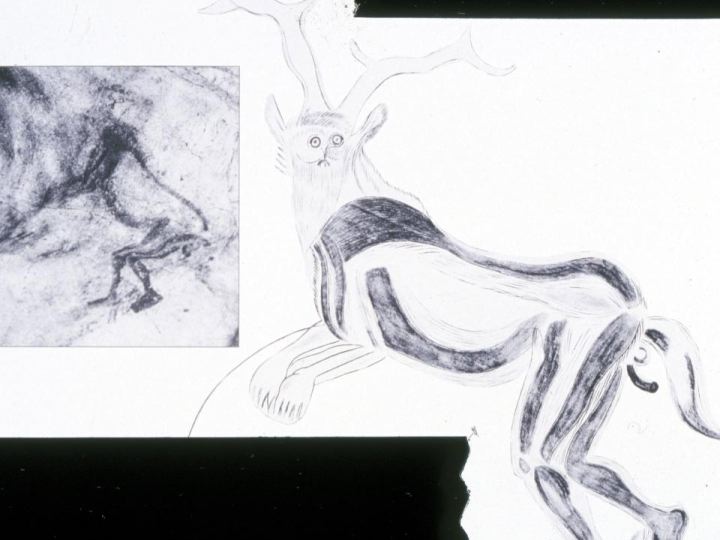
This whole business with the antlers brought up something that I’ve been aware of since I began working with the Animal Father–he is not the same deity as the Wiccan Horned God, or the various horned deities who get tossed under that aegis from time to time (Cernunnos, Herne, etc.). Yes, he’s depicted with antlers, but he has made it very clear to me that he is is own being, and that the Horned God motif doesn’t fit him.

One reason is because he has a much less “human” feel to him than the Horned God. He would never be found on horseback, with or without the Wild Hunt. He is only as anthropomorphized as is necessary for humans to interact with him, and to bring forth the melding of humanity with other animals. As he is a patron of shapeshifting, something that primarily concerns humans, having some human traits helps to connect him, in our minds, to that particular practice. However, he is no more (or less) human than he is any animal. Even in his anthropomorphic form, he is much less humanoid than many other deities. Most depictions of the Horned God and various associated deities show a rather normal looking man, maybe with a beard–and antlers. In fact, the antlers, and maybe a couple of dead pelts, are all that really show the Horned God as being an animal deity. One could easily see a humanoid Goddess lying in the grass with the humanoid-with-horns Horned God. However, rutting with the Animal Father might be just a little too close to less savory practices.

Additionally, while the Animal Father does have antlers in the most common depiction of him, he is not a “stag god” as the Horned God has more and more come to be in modern paganism. Nor is he limited to hoofed animals, or mammals, or vertebrates. He could actually show up as any animal or combination of animals; he is the Animal Father, and he could be anything from a worm to a whale. While he could show himself as entirely human, he generally does not, particularly in this day and age where humanity is so far removed from its animal self. It would be a most unpleasant experience for him, to my understanding–we’re talking about a deity who much prefer to meet with me out in the wilderness, rather than my ritual room or even the nearby park. The wilder, the better. To draw from the energy of modern humanity, even with the remaining indigenous hunter-gatherer and agrarian cultures, would be too alien an experience for him. So he chooses to appear only as part-human when necessary.

The antlers have become well-known, and he knows that they would be quite evocative for me, though he would want me to incorporate other animal parts to the shrine as well, if I give in to his wishes. The culture he came from and the pagans he has since worked with are most familiar with large mammals in their religions. These tend to evoke a lot of primal feelings in humans, moreso than, say, carp or June bugs. So he most often wears the guise of creatures that cause us to remember that we, too, are animals, and we can only distance ourselves from Nature so much.

And that’s something I came to realize this weekend as I was writing about the term “therioshamanism”. “Therio” already refers to the animal spirits I work with, and the spirit and physical animals that are part of my “community” as a shaman, and for whom I will be shamanizing once I’m trained. However, one thing I’ve noticed during my first six months is that my training has reminded me that I am an animal. I’m not just talking about my therianthropy and that which is wolf in me. I’m talking about myself as the human animal–maybe something I need to know about even more than me-as-wolf. My training has not only gotten me in more touch with my instincts, but has helped me to have a better awareness of my physical body, my needs and my health. The therianthropic aspects are there, but they aren’t necessary to this aspect of “therio”. I could be not a therianthrope, and it would still be the same.

Back on the main topic, those are the main reasons that the Animal Father is not the Horned God. I did a flocked post in my Livejournal about the antlers and the Animal Father, and had a couple people tell me that they’ve actually worked with him before, or are otherwise familiar with him other than through my work. This pleases me–perhaps I’ll have something besides my own UPG to go on as time goes on. Not that my UPG isn’t “good enough”, as it were, but it’s nice to get some external validation.

ETA: Another consideration: I’m not an expert on Indo-European mythology. However, a bit of research brings up potential links between the Hindu Pashupati, and later horned deities such as Cernunnos. Assuming that the Animal Father does stem from the painting at Les Trois Freres (if not earlier) then he would still predate the proto-Indo-European peoples (from whence both the Indians and the Celts sprang) by several thousand years.  Thoughts?

Some Rambling on Totems

I’ve been chewing some more on my conception of totem animals within a neopagan context, specifically my personal neopagan context. (I’m not the only one; while I was still chewing, Paleo beat me to the punch on the topic with this great post. Zeitgeist!)

Unlike most people, I have worked with numerous totems over the years. Wolf’s just my primary; there are plenty of others, from Deer to Silver Dollar, who have graced my life for various amounts of time. Totemism has been central to my practice pretty much from the beginning. It’s a neopagan form of totemism, rather than anything traditional–I work with totems on an individual, rather than group-based, basis.

I don’t see the totems as individual spirits; Wolf is not just a random wolf spirit, nor is Wolf really Greymuzzle the Ancient Wolf Spirit Reincarnated Fifteen Times. I don’t see totems as a replacement for power animals, skin spirits, and other helper spirits. While I haven’t yet determined my power animal(s) (if, indeed, I have any) and I’ll be spending the six months between the Spring and Autumn equinoxes finding and working with spirit helpers of all sorts, I don’t confuse the power animals with the totems. Wolf the totem is a very different animal from a wolf spirit that becomes a power animal. Additionally, Bear the totem is a different being from the bear spirit that resides in my bear skin that I dance with (and which could potentially be a power animal at some point, if my understanding of power animals is correct).

As I’ve mentioned in the past, I perceive totems as archetypal beings that embody all of the qualities of a given species of animal–natural history, human lore, and the relationship between humans and that species. However, unlike a strict interpretation of archetypes, totems don’t solely exist in my head. They’re independent beings with their own existences. It is simply in their nature to be archetypal; they are embodiments of their species.

And they’re much “bigger” than individual spirits. I see totems as akin to deities; deities can also be archetypal in nature, but are not just constructs of our minds. Deities are to humans as totems are to nonhuman animals, very roughly speaking. So sometimes it boggles my mind that the totems rarely seem to mind when I contact them for various purposes, whether to ask for help with a particular situation, or to satiate my curiosity about them. I find them to be much more approachable than deities. How many people can just “walk up” to any member of a given pantheon of deities and start communicating? There seems to be a lot more protocol and pageantry associated with that particular endeavor. Totems, on the other hand, seem to not mind what I’m wearing, or how much formality I go into before talking to them. If anything, they seem to get impatient if they need to talk to me and I spend a lot of time setting the stage, as it were.

I wonder if this familiarity with them is really so unusual. Sometimes I feel like such a small being surrounded by great giants, and yet they seem to respect me just the same. And it’s been that way from the beginning; while they haven’t always been happy with me (especially when I screw something up, or neglect something I said I’d do), they nonetheless seem to appreciate my place in their lives as much as I appreciate their places in mine. I’ve even had them be downright overjoyed to see me and work with me, and not just because I’m paying attention to them.

I think the nature of our mutual relationship is part of why I’m so invested in them. As Paleo mentioned in her essay, linked above, if you work with totems long enough there’s a tendency to take the relationship deeper than the initial “Bear is the Healer, Wolf is the Teacher” dictionary and stereotype interaction. People who work with totems long term, and as a significant part of their paths, almost always become more aware of physical animals and their needs, whether domestic or wild. (This also goes for people who work with animal spirits and other animal entities.) For me, at least, it’s a way to help the totems that have helped me so much. The physical members of a species are the young of their totem; part of that totem’s existence is completely concerned with their safety and well-being in this world.

I’m currently working on DIY Totemism: Your Personal Guide to Animal Totems. One entire chapter is dedicated solely to offerings to the totems. This isn’t just things like leaving a bit of food in the woods (which I argue against for a number of reasons). How better to help a totem whose children are endangered than to take part in activism to help those animals? Or to work magic on behalf of the totem to help with something s/he’s concerned with? When we work with totems, we aren’t just working with abstract concepts; it’s too easy to anthropomorphize a totem to the point where we only see what benefits us directly–and what we can get out of the deal. Yet it’s a two-way street. What do we give back to the totems? What do they ask of us? Where do their physical counterparts figure in? For that matter, are we really listening to anything but our own wants and needs?

Left to my own devices, I doubt I would have seriously considered shamanism as a life-path. I was pretty content with what I had. However, one of the main reasons I’m developing therioshamanism is for the totems. They’ve done a lot for me over the years, and this is one way for me to give back to them. They asked it of me, as I’ve asked so much of them, and I decided to at least give it a try. If it works out, then great–this helps me to help them. If it doesn’t, then we figure something else out.

And I think that’s part of why I’ve worked with them for so long. I don’t just feel like they’re trying to get something out of me, or get me to worship them or follow their rules and taboos. They genuinely like me, and we’re involved in mutually beneficial and enjoyable relationships. I help them, not because I feel like I have to, but because I want to–and vice versa. I’ve been approached by a few deities over the years who wanted worship, attention, power, energy–and I turned them down because I simply wasn’t interested in that kind of relationship. I had gotten spoiled by the totems, who actually worked with me even before I met Artemis. (I don’t worry too much about getting harassed by rejected deities–some of the more protective totems in my life, Wolf in particular, have proven to me in the past that they’re not just going to stand aside and let bad things happen for no good reason.) Why would I want to be in a relationship where I felt like I was being essentially bullied, when I have numerous relationships with powerful beings who genuinely like me?

Eclipse

This evening as the eclipse hit, I was walking home from the bus stop. I asked the spirits if I should take advantage of the rare full lunar eclipse and do any magic. Their reply was a very loud “No”. When I asked them why, they simply said “Bad energy”.

Whether that holds for this eclipse or all of them will remain to be seen; they’re being a bit tight-lipped about it. However, I’m glad they told me to stay indoors. Not long after I got home, I heard a bunch of shouting and noise on the next street over, followed shortly thereafter by sirens. Normally this is a nice, quiet neighborhood, but the full moon brings out the crazies…and perhaps people took advantage of the darkness of the eclipse to do something nefarious? Though it got nowhere near as dark as in a blackout.

Meh. I’ll bother the spirits about it later when they’re more prone to talking. Tomorrow is the beginning of my final month of my first six months, so I’ll have plenty to keep me occupied in the meantime.