A Modern-Day Ordeal

If you’ve been reading this blog over the years, you’ll notice that one of the themes I keep coming back to is Therioshamanism as a (neo)shamanic creation based on my own social and cultural background. The dominant non-indigenous culture in the US doesn’t have a clear shamanic figure, though I feel there are professions and roles here that can be analogous. On the one hand, American (neo)shamans may face accusations and feelings of illegitimacy, as though our lack of roots makes anything we do insufficient. And yet at the same time, there’s a great opportunity for creativity and flow in making something that is new and suited for the setting we found ourselves born into. I feel it is a fine balance between acknowledging how other cultures have formed their own shamanisms and related practices over hundreds or thousands of years, and making something that is uniquely ours instead of just wholesale copying. There’s a lot of trial and error, to be sure, and at times I really respect my fellow practitioners who are similarly trying to create something with no single existing cultural framework.

One of the themes that comes up as a topic of discussion is that of the ordeal. I have met people who claim that you must have an ordeal in a traditional manner–either a life-threatening physical illness, or a severe mental illness/breakdown–and that it absolutely can’t be a positive or constructive experience whatsoever. Nor, they say, is it something that you can openly seek out; it has to crash down on your head and ruin everything. Supposedly all these things separate the wannabes from the hard-core practitioners. I have a gentler approach. Not every ordeal a person goes through is a shamanic one; as attributed to John Watson/Ian MacLaren, “Be kind, for everyone you meet is fighting a hard battle“. What I think distinguishes a shamanic ordeal, at least in part, is whether it directly contributes to one’s work as a (neo)shaman. It may still be a great challenge with a significant risk of failure, but it can be something you willingly choose to enter into as a furthering of your path and development. In this, it doesn’t always have to be the initiatory ordeal; ordeals can also be ongoing challenges.

Many of the things I have gone through weren’t ones that I chose. I would be lying if I said that over a decade of bullying leading to the development of an anxiety disorder was something I decided to experience. At the same time, while it did directly lead to my walking this path, I could potentially have chosen other ways to focus the aftermath of those feelings. I could have ended up an addict trying to drown out the anxiety attacks and traumatic memories. I could have ended up a Catholic nun in a cloister, seeking refuge in a holy sisterhood. In short, I don’t feel that my eventual walking of a (neo)shamanic path was something preordained. But it’s where I ended up, and that personal set of decisions and paths has to be factored in as well as the cultural milieu.

Because I live in such a highly individualistic society, I don’t find it surprising that so many (neo)shamans enter their paths in part due to personal benefit–not in the case of “making lots of money”, but in “finding a focus for things that hurt” or “a way to grow in a healthier manner”. Rather than being a wholly self-serving path, though, (neo)shamanism has the added benefit of reminding us that we are part of a community, and emphasizing the need to be an intermediary in that community. Individualism is not in and of itself a bad thing, but sometimes the dominant US culture errs a little (or a lot) too far to that end. All things in moderation, to include self-identity and group-identity.

That being said, I don’t think there’s any shame in a (neo)shaman actively pursuing an ordeal in part to better themselves as practitioners and as people. The more any practitioner of any art, science, etc. knows and experiences, the better they are to serve their communities. This entire post came up in my head in part because I recently acquired my Wilderness First Responder training and certification. It was very much a challenge; for 8 days straight I spent 8-9 hours a day in ongoing training, to include daily hands-on drills and practice, plus an additional 2+ hours of homework every night. I had to process an immense amount of information each day and demonstrate that I understood its applications, and I went home every night almost too exhausted to do my homework. For those 8 days, WFR training was all I did–and there was no guarantee I’d pass. It challenged me in many ways, physically, mentally, and emotionally, and when I came out of it with my certification, it took me a while to absorb the reality that I’d succeeded.

Just as with going to grad school for a counseling Master’s degree, this is something that I chose to enter into despite the challenges because I wanted to be better able to serve my community. I spend enough time outdoors, both alone and with others, that I wanted to be able to act in case of a medical emergency. And as I do sometimes lead workshops at pagan events, to include some that are outside in fairly remote areas, I want to be able to take care of the participants on multiple levels. (Even if I don’t hold sweat lodges, I certainly haven’t forgotten about James Arthur Ray.) And even outside of a backcountry context, having basic first aid training could come in handy some day.

These all tie into my ongoing development of a (neo)shamanic role in my culture. I’m still in the process of developing what the counseling end of all this will look like (and I’m continuing to take a few courses through my alma mater), but each experience I have pulls it into more cohesion. I’m okay with it taking a while to come together; I’m still able to help people through writing and workshops and one on one work together. And I think whatever I end up with, it’ll be something that I feel fills that void, to an extent, that we have in this culture through the lack of a single shamanic figure. It’ll most likely be an ongoing work in progress, too, which I’m okay with. No system is stagnant, and if I can leave something for others to build on in the future, so much the better.

In my vision of a (neo)shamanism for my culture, I don’t see ordeals as being these uniformly awful things to be avoided. Challenging, yes, but there’s already so much negativity and discouragement here that I don’t want to include that idea of “it’s not real unless you hate it” in what I’m developing. I want to be a constructive practitioner, offering support and compassion to a community that’s all too often cynical and jaded, and I want to continue excising these things from myself. It doesn’t mean putting on rose-colored glasses and ignoring the problems in the world, or the fact that some ordeals and challenges are unwanted and destructive and we don’t always come out for the better. But the skills learned in constructive ordeals can come in quite handy when dealing with destructive experiences in general, and isn’t being able to weather the storms better a good thing in general?

A Caution Against Pagan Fundamentalism

A caveat to start with: No matter how well a writer writes something, inevitably someone will misinterpret what they were trying to say. Such is the limitation of language. In that spirit, allow me to make one thing very, very clear before this essay even starts: I am not equating hard polytheism with religious fundamentalism. I am concerned that because of certain patterns I have seen among some, not all, hard polytheists, that this may, not necessarily will, in the future give rise to a form of pagan religious fundamentalism. Additionally, the “You’re wrong, I’m right” attitude that I’m observing is not limited to debates regarding polytheism, but other areas of paganism as well, and any of these could also give rise to a form of fundamentalism given the right circumstances. Polytheism happens to be the topic of the moment which finally gave me a chance to voice some concerns about fundamentalism in paganism that I’ve been chewing on a while. There. Now that I’ve said that, feel free to proceed.

I’ve been watching the recent discussion on several pagan blogs concerning hard polytheism, “bringing back the gods”, and so forth with some interest. I admit that the older I get, the more I am moving toward a more pantheistic viewpoint, with a good dash of humanism as well. It’s not that I discount the existence of the Divine, spirits, and so forth, but that my experiences with them simply haven’t led me to adopt a hard polytheistic view (and anyway, I tend more toward totems and nature spirits than gods).

So that obviously colors my perspective on all this. I don’t have a stake in the proven reality of deities as independent entities, but neither does it bother me that some people do. What concerns me is the possibility of the rise of pagan religious fundamentalism. (Yes, I know there are polytheists dropping the term “pagan” from their experience because they associate it with Things That We Aren’t, but for the purposes of my discussion, polytheists are still pagan, in part so I don’t have to keep writing pagans/polytheists over and over.) Fundamentalism as a concept was originally described in certain areas of Protestantism in the early 1900s. These people had a very strict and literal interpretation of their religion, and today “fundamentalism” is often used to describe any of a number of religious perspectives that hold similar, inflexible views on God(s) and the way humans are supposed to act.

There are a lot of pagans (and other people, but let’s stick to pagans for now) who have had bad experiences as a result of fundamentalism, usually of the Christian variety. The community is full of stories of people growing up in strictly religious households and being treated pretty poorly for the mistake of exploring new beliefs. These could range from having their pagan religious tools and effects taken from them and destroyed, to being assaulted or thrown out of the home. Adult pagans have lost jobs, homes, and children due to religious persecution. Pagan prisoners are routinely denied access to religious materials and clergy, and it’s rare for a pagan clergyperson to be asked to lead a prayer in a civic setting where such things still occur. While Christian fundamentalists proper were not always the opposition in these cases, the attitudes of fundamentalism tend to leak out into the wider cultural consciousness (I’ll talk more about that in a minute).

With these consequences of fundamentalism in mind, it seems strange to see echoes of them in paganism. Yes, of course there’s the fact that people often subconsciously emulate the behavior patterns they were raised around, but surely that can’t be the source of every single instance of “You’re wrong, I’m right!” in paganism. And while not every one of those “I’m right!” instances constitutes fundamentalism, the long-standing tendency for some pagans to tell others “You’re doing it wrong!” seems to be heading closer to fundamentalism to a troubling degree. And so while I don’t want to point at any single claim of “hard polytheism is the best and only way!” as fundamentalist, because of the general trend I do want to put forth a warning against the dangers of falling prey to fundamentalist stances. Allow me to present a few points for consideration.

Not all pagans are theistic, and paganism is not just about the gods.

I really like Christine Kraemer’s Venn diagram in this recent post. It’s a reminder that “paganism” isn’t ONLY about gods, or ONLY about nature, or any other single influence. I agree with her when she she says in her own words (and italics), “for some pagans, polytheism is not a main focus for practice or belief.” Her post was in response to this one by P. Sufenas Virius Lupus whom I should mention, for disclosure’s sake, is a friend of mine and someone I respect highly. He wrote a really good essay (even if I don’t quite agree with all of it) that sparked a lot of discussion, and one of the key ideas was the possibility that the emphasis on “nature-based” paganism is to make non-pagans feel more comfortable with us, and that those of us who don’t embrace polytheism are making that choice because we’re uncomfortable with polytheism.

I’m not uncomfortable with polytheism. I spent most of my pagan “career” that started in 1996 being a polytheist to one degree or another. The shift toward pantheism has been a more recent thing, ironically brought on by my attempts to deepen my practice (another thing I’ll touch on more later). Being more comfortable with pantheism does not automatically mean a discomfort with polytheism, any more than choosing to be pagan means a discomfort with any other religion. If I’m uncomfortable with anything it’s the growing resemblance to fundamentalism I see in some sectors of hard polytheism, but that’s not why I am not a polytheist any more.

As my spiritual practice becomes more entwined with my path of service to the environment and to other humans, I find myself more and more rooted in this world. And my increased engagement with the physical world brings me closer to being a naturalist, with a combination of armchair scientific study and feet-on-the-ground, hands-in-the-dirt direct experience. So pantheism–seeing the Divine as directly manifest in the natural world that I interact with–makes more sense to me at this point. Truth be told, my involvement with most deities, other than Artemis, has never been particularly deep. I worked with the Animal Father as part of a personal pantheon early in my Therioshamanism work, but he eventually faded back into the wilderness from whence he came, and the energy I touched with him I see in every living animal, and I connect more strongly that way. As to Artemis? She’s always been an internal part of me much as my primary totem Gray Wolf is; it’s hard sometimes to tell where the boundaries fall between us. These days I’m simply not that concerned with proving once and for all whether my invisible friends are independent beings or manifestations of human consciousness and myth, and I’ve never had much note from any of the beings I work with that suggested they cared what I thought, either. What’s important to me and to them are the immediate and measurable manifestations of my practice, whether that’s a shamanic journey or a day spent cleaning up litter along the river.

The anger and debate seem to all be on the human side of things. When someone doesn’t perform a ritual properly, or refers to several goddesses as aspects of one Goddess, I haven’t seen divine bolts of lightning streak down and smite them. There are historical debates, of course, where we can argue the facts of what the people of such and such ancient and no longer extant culture did, but that doesn’t lead to proof of what a particular deity or spirit wants. It’s always the people arguing over whether a particular practice or belief is correct, sometimes to an absurd degree–I’ve seen people on Tumblr debate whether a store-bought strawberry tart was a fitting offering for Loki. Regardless, it always comes down to the “You’re wrong, I’m right” debate; it’s only the details that differ.

Saying that everyone MUST believe or practice in a particular way is at its heart fundamentalism.

Religious fundamentalism is characterized by people insisting that their way is correct and everyone else’s isn’t. It’s what keeps fundamentalism alive. As social creatures, we like having something sure to crowd around to unite us, and religion makes a great standard for rallying. Unfortunately, we also get this idea that the more right we are, the stronger we are, and so in order to increase our strength and security we have to prove our rightness. This fervor is part of how religion has very often been used as a tool for political and social machinations and power plays. The people involved are so focused on the surface message of “You’re wrong, we’re right” that they ignore the men behind the curtain. Look at the Crusades, for example; Pope Urban II called for them in part because the nobles in Europe were being rather rowdy, and he figured that sending them east under the guise of a holy war would at least get them out of the way for a while, as well as ingratiate him to the Byzantine emperor Alexios I who was being attacked by Muslim forces. Most people think it was just a matter of Christians versus Moslems in a grand melee for the Holy Land, but that was just the surface.

Religion in general plays on a lot of human behavioral tendencies, and while these can sometimes be beneficial, as in prayer and meditation to relieve stress and anxiety, and the benefits of a healthy community, fundamentalism has a poison to it. It’s divisive and exclusionary, and it builds identity not on connection but on isolation. And this isolation can be a very bad thing indeed.

Fundamentalism has a tendency to breed ignorance.

When you build your entire worldview on an idea, any opposing idea becomes a threat to that power base. There is absolutely no incontrovertible proof that any religious belief is more objectively and measurably true than any other, and the number of people who adhere to it does not increase its truth. Because we can’t prove a belief in the same way we can prove that gravity exists, or that water is composed of two hydrogen atoms and one oxygen, or that a mammal’s fur retains heat, adherents of beliefs can sometimes become very insecure about what they believe.

Now, there’s nothing wrong with a strongly-held belief in and of itself, even if you can’t prove it. But one of the defenses against having your worldview shaken is willful ignorance. I would imagine that most, if not all, of my readers are aware that homosexuality isn’t dangerous, that gay people are not more likely to be sexual predators, and that if gays get married it won’t cause the collapse of civilization as we know it. Yet because the Bible happens to mention in a couple of places that homosexuality is a bad thing, there are people who latch onto that and who absolutely refuse to consider any other evidence to the contrary.

We live in a 21st century where for a lot of us (though certainly not everyone) we have an inconceivable amount of information at our disposal through the internet and other forms of media. Even a quarter of a century ago when I was in elementary school writing my first essays I had access to several different sets of encyclopedias, dozens of magazines, and thousands of books, just in my little school’s library. The information is there; ignorance is the choice to not access it. And, I suppose, for some people the idea that they might be wrong is a terrifying thing, so much so that they don’t step out of their safe sphere.

I’ve made peace with the idea that I might be wrong. There was a feeling of liberation a while back when I finally felt the tyranny of “I HAVE TO MAKE SURE I’M RIGHT ABOUT EVERYTHING” lift away from my shoulders, and I had the liberty to move through the world unencumbered by that obsession. And it allowed me to be even more curious about the world than I already was. A sure belief doesn’t have to extinguish curiosity, but my own experience has been that allowing myself ambiguity has freed me to focus more on exploration and learning for its own sake, come what may.

Ignorance is dangerous.

Again, having a strongly held belief isn’t automatically ignorance. But ignorance, when it happens, has its own dangers. When we tunnel-vision so tightly on a belief that we refuse to listen to anything else, it can hurt us and others. It’s been proven again and again that vaccinations have absolutely nothing to do with autism, and yet there are increasing numbers of parents in the United States who refuse to vaccinate their children because of the strongly-held (and incorrect) belief that autism is somehow transmitted through common shots. As a direct result, diseases we’d significantly reduced or even almost eradicated, like pertussis and measles, are on the rise, along with the highest rates of deaths from these diseases in decades. We can prove without a doubt, due to decades of statistics on vaccination effectiveness and illnesses and deaths from these diseases, that these people likely died as a direct result of lower vaccination rates. And it’s not just the people who chose not to allow vaccinations who suffer: the dead include unvaccinated children who could still be alive today had they been given routine childhood vaccines.

Sometimes ignorance is on a grander, even deadlier scale. People have slaughtered each other for millenia based on religious and political propaganda which very often doesn’t paint the whole picture (remember Mark Twain’s The War Prayer?) And while modern paganism has not birthed such theocratic efforts, perhaps it’s only due to a lack of numbers and chance, as well as the persistent tendency for pagans to eschew preaching and converting–at least toward non-pagans.

And, in and of itself, insisting that the gods are real, independent entities a la hard polytheism isn’t particularly dangerous. You can believe whatever you like and still not be a problem to others if you just leave it to yourself and those who agree with you. It’s the desire to make others agree with you that’s the problem. And that desire stems from insecurity in one’s own belief, with ignorance another common side-effect. Ignorance only allows a person to learn about other ways far enough to be able to rail about how they’re wrong, to have fodder for their fight. They can’t venture too far from those shaking beliefs they hold for fear they’ll fall and so, like a dog chained to a rickety old dog house, they bark and snarl at the world around them, only knowing of the things that come close enough to feel like a threat.

Maybe the surest counter to this dangerous ignorance is genuine curiosity, and an openness to the world. There’s a certain strength in being able to hold your beliefs even when you’re learning about others, not out of the desire to disprove them, but simply to know more about them. This isn’t just knowing the words of others’ beliefs, but opening yourself to why people hold them. A little immersion in this way won’t make a person a convert, and the potential for a change in one’s own worldview shouldn’t be reason to shut the rest of the world out.

Fundamentalism is contagious.

Most adherents of a religion are not fundamentalists. However, many adherents do have some beliefs they hold strongly, and their communities help them to bolster that faith. Again, this in and of itself is not a bad thing; it’s part of religious communities as vessels of social memetics. But as we can see throughout history, extremists of any sort tend to attract a crowd, and while some may discount them, others catch hold of their message. Sometimes that extreme eventually becomes the norm; look at how Christianity grew from a tiny little cult surrounded by other tiny little cults into one of the dominant religions on Earth. Unfortunately, sometimes the messages that are the most contagious are also the most negative.

I can tell you a story of this from personal experience. When I first started this blog in 2007, it was part of my quest for a deeper, more meaningful spiritual path. I had watched a number of people I knew in the pagan community engage in some truly beautiful devotional practices to deities and spirits, with wonderfully elaborate schedules of celebrations, and creative shrines and altars. While I had certainly had good experiences with the totems and other spirits I worked with over the years, I felt the need to have something similarly focused and devotional. You can look back at the first year or two of this blog to see where I was really trying to build that. Ultimately, as I mentioned earlier in this post, I ended up finding my depth and meaning in a totally different direction, but that doesn’t invalidate the appreciation I still have for the devotions of others.

Unfortunately, one of the things I also picked up from a few–definitely not all–of the people who inspired me was a thread of one-true-way-ism. Usually this would be people who were trying to reconstruct a particular ancient polytheistic pagan faith, and who were so dead-set on doing it right that they openly criticized anyone doing things differently. I suppose, having seen that modeled, I latched onto core shamanism as my target of “You’re wrong!”, and again you can read through some of my earlier thoughts in this blog. As I’ve gotten older and more comfortable in my path, while I still have personal disagreements with core shamanism (especially when it’s presented as “genuine ancient shamanism”), I no longer feel the need to attack it as a whole path. There are people for whom it works just fine; in fact, I’ve seen some people in the counseling field integrate elements of it to help their clients in very genuine ways. How can I argue with that effectiveness?

Honestly, I feel like an asshole for being that heavily critical. It did speak to a certain level of insecurity on my part, and I feel bad that I probably influenced other people to be critical to a similar degree. Granted, I am not responsible for what people choose to do based on their interpretations of my writings, any more than the people who I saw modeling hyper-critical behavior were responsible for my wholesale attacks on core shamanism. But it does demonstrate the tendency of people to copy those they wish to emulate, sometimes without considering what it is, exactly, they’re emulating.

If proper fundamentalism takes greater hold in paganism, I worry about what direction it may take the community as a whole. Maybe instead of polytheists dropping out because they don’t feel any connection to everyone else, it’ll be pluralists fleeing the damning whip of fundamentalist criticism and harassment as the “You’re wrong! I’m right” arguments go from small bickering online to greater pressure to conform to one party line.

We do not need fundamentalism to be legitimate.

I’ve seen the argument that if we pagans are going to be taken seriously, we have to present a more hard-line, united front of beliefs. Supposedly because we’re a group of people with a wide variety of paths and faiths, this means that there’s no way we can rank up there with well-defined single religions–never mind that they at least have denominations that may vary widely from one to the next.

And yet I’ve seen some really admirable interfaith efforts on the part of people representing paganism in general. Look at what Patrick McCollum has been doing over the years in criticizing the “dominant religion lens” of Christianity in the U.S. He hasn’t only been advocating for Wiccans, but for pagans in general, and in fact his work could very well benefit people of many other minority faiths. He’s just one of many examples of how paganism can be a legitimate religious presence in the cultural and social consciousness without having to resort to fundamentalism for strict definition.

Final Thoughts.

As it stands, we are not embroiled in a massive pagan fundamentalism movement. I have no problem with hard polytheists wanting to define themselves more as such–or anyone else taking the time to more clearly explain who they are and what they believe and why. I don’t even particularly care about the existence of the ongoing “You’re wrong! I’m right!” argument that’s manifested in everything from the “Only Brit-trad Wiccans are REAL Wiccans” debate to the current trends toward a more hardline polytheism. What worries me is the possibility of any of the “You’re wrong! I’m right!” debates to turn into genuine fundamentalism with all its problems and poisons. I feel it’s better to bring it up now, before it ever happens–if it even ever happens for that matter–than after the fact.

Because I don’t feel I’m being too cautious about potential fundamentalism. We don’t really know for sure what happens when you offend a god, but we sure as hell know what happens when someone is so very focused on keeping others from offending the gods that they’ll go to extreme, dangerous, and even lethal lengths to prevent or avenge that offense. Even if that’s not a real threat in paganism today, let’s start creating a setting now that will keep it from being a reality in the future.
Free Introduction to Animal Totems Online Workshops Jan 4 & 5

Hey, folks!

I am hosting two FREE sessions of my Introduction to Animal Totemism workshop in January! The workshops will be held on Livestream, where you can participate either via video or chat. Here are the relevant dates and times (the links also have more relevant information):

Friday, January 4, 2013, 7pm PST
Saturday, January 5, 2013, 11am PST

You can sign up for either time slot; if you aren’t sure what time it’ll be where you are, here’s a good time conversion tool. I deliberately am offering two different times in the hopes this will allow some of the folks outside of the US to join in!

Here’s more info about what I’ll be covering:

What’s my totem?

How do I find my totem?

Can any animal be a totem?

These are just a few of the questions people have asked me about animal totemism over the years. In this free workshop, I’ll provide my answers to those and more as I discuss the basics of animal totemism, including their nature, how to find and work with them, how to integrate them into your daily life, challenges and troubleshooting, and much more!

In addition, I’ll be discussing new material I haven’t covered in workshops before, to include some information from my newest book, New Paths to Animal Totemism. There’ll be ample time for questions as well, and you can ask either via livestream or chat. I’ve been practicing my own totemic path since the mid-1990s, and I’ve worked with a wide variety of animal totems over the years. Don’t miss this chance to not only hear me speak on this subject that’s near and dear to my heart, but ask me questions, too!

And, again, I’m offering this workshop free of charge! If you’d like to support my work financially, feel free to check out my books at http://www.thegreenwolf.com/books.html or my ritual tools and other artwork at http://thegreenwolf.etsy.com Thank you!

Masks in Ritual Work

I’ve had a few people ask me specifically about this topic as of late, so for the curious, here you go–a late Solstice present!

Some of you dear readers are already acquainted with the purpose of ritual garments and the like. For those who are not, the short version is that rituals are special occasions. It can be powerful to have a set of clothing that is reserved solely for spiritual practices. Just putting them on signals to your subconscious mind that it’s time to do special things you don’t normally get to. To an extent, it appeals to that part of us that likes to play dress-up with costumes and fancy clothes and the like–it touches on Homo ludens, the part of us that learns and develops through play. (Of course, as grownups we often feel we have to come up with some “serious” reason to dress up in funny clothes any time besides Halloween–though there are those of us who will come up with any reason to don a costume of some sort, hence steampunks and cosplayers and SCAdians and…)

At any rate, most religious traditions have some form of ritual garments that are worn by the officiant(s), and sometimes for the laypeople as well. Even churches are full of congregants in their Sunday best. These clothes and other wearables are also often a form of identifying people of a similar tradition–if you see someone with a kippah you can pretty well bet they’re Jewish, while someone wearing a cross is likely to be Christian of some denomination or another. In paganism, there’s no single set of garb that will denote “that person is pagan!”, though flowing robes, historical clothing, and a variety of symbolic jewelry (far from limited to the pentacle) will be in abundance at many pagan events. (There will also be a cranky minority grumbling about how we all need to dress like normal civilized people, not Harry Potter or our long-lost Viking ancestors.)

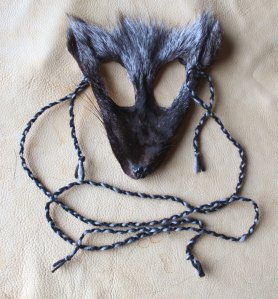
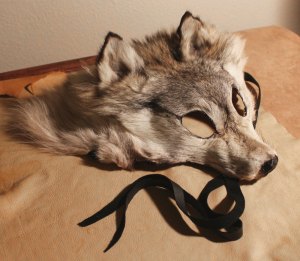
Wolf mask by Lupa, 2012.

Wolf mask by Lupa, 2012.

Masks are a particularly specialized form of ritual wear. We most commonly focus on a person’s face when identifying them and communicating with them. (I’ve yet to meet someone who could tell who was approaching by carefully examining their elbows.) A mask covers up the face, and thereby the person’s identity. A person putting on a mask also temporarily puts on a different persona. Even someone trying on a rubber werewolf mask will briefly “get into it” by making claws out of their fingers and going “RAWR!”

We like to imitate other people and other beings. It’s a skill that we’ve evolved over millions of years as social beings. We like things we can relate to; it’s safer than being different. So we developed the tendency to imitate others in our social group (whether that’s goths or Young Republicans). And, by extension, we enjoy imitating other animals. Our ancestors may have done so in part to teach the young how to recognize threatening behavior on the part of other species, but these days we mainly do it–you guessed it–to play.

The masks help with that. Most of us could imitate a Tyrannosaurus Rex without any costumery–just stomp around with your arms pulled up close to your chest and roar! But put a T-Rex mask on, and you may very well find yourself hamming it up in order to make yourself even more convincing as a giant scaly lizard with big, sharp teeth and teeny arms.

We can channel that into ritual purposes as well. Instead of just pretending to be an eagle flying in the sky, flapping our arms while running around an open field for the fun of it, we can instead use that imitation to draw on the energy that is Eagle. By creating a mask that looks like an eagle, we get into that aquiline mindset even more deeply. The same goes for wearing masks for other totems, for deities, for spirits, and so forth. The mask allows us to set aside our own identity temporarily, and take on another.

Some people even feel this invites the spiritual being itself into us, through the process of evocation. In this way, the mask is a channel for that being to enter into the ritualist. When the mask is removed, the connection is severed. That’s part of why the process of removing the mask and other costumery should be done with as much care as the preparation of putting it on.

The construction of the mask adds another layer to consider. Using natural materials such as paper, grasses and other malleable plant material, wood, leather, fur, and other such things can help a person connect to the type of being that provided said materials. For example, when I wear a wolf mask, I am connecting to both the totemic, archetypal Wolf, and the spirit of the wolf who once wore the skin (which, incidentally, is one of the main reasons I work with these sacred remains and skin spirits in my art and spirituality).

The process by which the mask is made also contributes to its purpose. A mask may be mass-manufactured and still be effective, but a handmade mask may be created with the specific intent of embodying a particular being or spirit. When I make wolf masks, for example, I am intentionally working in the energy of both the wolf spirit and Wolf the totem. Creating masks and other ritual wear may be a ceremony in and of itself, depending on the artist, and some work only within a strict spiritual setting.

If you have a mask you would like to work with, here’s one possible way to connect with it:

–First, find a safe space where you won’t be disturbed for at least an hour, and preferably where you can move around unencumbered. Turn off phones and other distractions, and prepare the space for ritual however you see fit.

–Sit with the mask in your lap. Look at it, touch it, and otherwise examine it. What impressions do you get? How does it “feel” to you? What emotions does it evoke in you? Do you get the sense that it has a spirit or personality, or is it connected to some being already in existence such as a deity or totem? If it’s from natural materials, do you get a sense of the living beings they came from?

–If you feel comfortable, put the mask on. Don’t get up yet; just sit and wear the mask. How do you feel now? Do you feel your sense of self shifting at all? Do you feel closer to the mask and the energies it embodies?

Silver fox mask by Lupa, 2012

Silver fox mask by Lupa, 2012

–Again, if you feel comfortable, get up and move around a bit. Don’t rush it; if you don’t feel like dancing, walking is perfectly acceptable. See how that changes your perception of yourself and the mask. Do you still feel that you’re yourself? Do you feel different? How does it feel to wear the mask?

–Spend as much time wearing the mask as you like. If you feel scared or otherwise uncomfortable, sit back down and carefully take it off, then set it on the ground in front of you. Once you have taken the mask off for any reason, spend a few minutes grounding, without physical contact with it; breathe deeply and slowly, and come back to yourself. (If you feel really disconnected from yourself, recite your name, address, and phone number over and over again.) Reflect on your experiences with the mask, and write them down or otherwise record them if you wish.

This is just an introductory exercise. If you feel comfortable continuing to work with the mask, feel free to try it again, and perhaps elaborate on it. You can even create rituals specifically for the mask; for example, you can do a ritual to celebrate the spirit, totem, or deity it’s connected to, or incorporate it into Sabbats and other seasonal celebrations as appropriate. (If you choose to do so in a group setting, check in with the other group members first, and especially the ritual coordinator(s).)

On the other hand, if the mask makes you uncomfortable, spend some time trying to figure out why. Is there something about the physical mask you dislike? Or did the energy just feel too intense? Was it weird shifting out of your “normal” mindset? Give yourself a couple of days to sit with these feelings and examine them. One bad experience doesn’t necessarily mean that you need to get rid of the mask. If you like, try just sitting with it again, and perhaps striking up a conversation. Often the beings who scare us have valuable lessons through that fear, and many times aren’t as threatening as we first felt.

I do recommend sticking to one mask per ritual. It can be exceptionally difficult to shift mindsets mid-stream, as it were. One exception would be a deliberate transformation ritual, for example a rite of passage in which you start off wearing a mask that represents your old self, and then change to one that represents your new self.

Finally, what to do with masks that just don’t fit you in some capacity? I am a firm believer in “waste not, want not”. You can give the mask away to someone for whom it’s better suited. Or if you want to dispel the energy it carries, do a purification ritual to cleanse it; you may even wish to disassemble it and find new uses for the materials. You may also just wish to let it sit on a shelf a while, and perhaps later on you’ll feel better about it.

This, of course, is just the beginning! There are some good resources out there on further mask work; one of my favorite texts is Sacred Mask, Sacred Dance, which came out a few years ago but still possesses a wealth of information, ideas, and rituals. And, as always, I’m happy to field questions as well!

Portable Skin Spirits

I’ve been really busy in my studio making my hide and bone art, and it’s given me some time to reflect on where my various pieces have ended up. Over the years I’ve really enjoyed getting to see the extent to which people have incorporated these creations into their spiritual practices—and their everyday lives. It really has ranged from those who only bring them out during certain rituals, to those who carry them throughout their day. Of course, some of that depends on what they have. A small pouch or a piece of jewelry incorporating a bit of hide or bone from one’s totem is a lot easier to carry around than a full hide headdress.

chokerFor myself, I live a very active lifestyle, and so I tend to prefer to be very streamlined about my personal talismans—if it won’t fit in my pockets or closely around my neck or wrists, I leave it at home. And I live in a place where it rains a fair bit, especially in the winter, so I don’t wear fur where it can easily get wet, which can damage it. I also don’t feel the need to “advertise” my spirituality to the masses that I did when I was a shiny-eyed newbie; I don’t need to carry a miniature ritual kit with me everywhere, and I don’t need to wear a wolf hide to the grocery store. (Yes, I used to do the former, along with wearing the neoshamanic equivalent of the dinner plate pentacle. I was never quite so brash as to wear a wolf into the store—my headdresses have always been strictly for sacred rites, not showing off.) Still, I sometimes keep a few small things about my person as needed; the rest have their honored places at home.

But each person’s preferences vary. You may be happy wearing a fox tail everywhere you go, or your tail may never leave your ritual space. Either one is okay. If you do wish to have some small reminder of your totem with you when you’re out and about, here are a few suggestions:

–Pocket talismans: This can be as simple as a single tooth, claw, or bit of hide. You can tuck them into your wallet or purse, or in the little side pocket in a pair of jeans. These are wonderfully simple and often the most inexpensive option. The downside is that if you aren’t wearing something with pockets and don’t carry a purse, you may have to figure out some other option. Additionally, the smaller something is the easier it is to lose, and so you’ll need to take care when taking something else out of the same pocket the talisman is riding in.

–Bracelets, necklaces, and other jewelry: Wearables have a great advantage in that you can put them on pretty well whenever you like. Additionally, unlike pocket talismans, you can have direct physical contact, which some people find comforting. There are those for whom putting the jewelry on every day is a small ritual of reconnection. Obviously this won’t work for everyone. I find my skin gets irritated if I wear fur for too long, and I’m rather hard on jewelry which means that smaller bones used as beads will occasionally break, so I usually keep my critter bits for special occasions. Also, if you have an occupation or hobby that requires a lot of movement or use of your hands, you may find the jewelry getting in the way. And depending on your job and location, you may not be able to wear animal parts at work due to sanitation issues, customer sensitivities, dress code, etc.

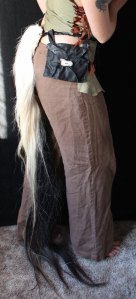
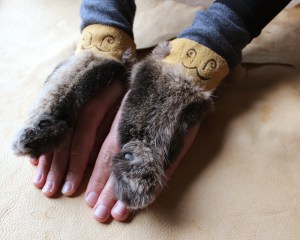
il_570xN.352925005_fx4c–Tails and other “minor” costumery: These are generally accessories that are a tad bit more noticeable and unusual than jewelry, but aren’t complete outfits. If you’ve ever been to any sort of convention that caters to a geeky crowd, you’ll likely see at least one or two people wearing real fox or coyote tails. Some people feel comfortable wearing these in everyday life, even with the risks—I’ve had to repair more than one tail that was broken when a teenager wore theirs to school and someone thought it would be funny to yank on their tail. Others save these more overt creations for sacred and safe spaces where people are more likely to recognize personal boundaries. If you decide to wear such a thing out and about in the world, prepare for the occasional curious question, as well as chuckleheads saying stupidly insulting things now and then (and occasionally forgetting civil boundaries by invading your personal space). However, having that ready connection to your totem, and being able to experience it in a variety of setting with assorted levels of distraction can be a valuable practice.

–Headdresses, clothing, and other “major” costumery”: This can be anything from a full hide headdress to elaborate clothing and costume pieces. Generally speaking, these are reserved for formal ritual events, partly because they tend to carry a lot of power, and also because they can be fairly pricey and the general public doesn’t always respect that. I don’t recommend these as everyday fashion pieces for those reasons; rather I suggest keeping them for special occasions and settings. If you should decide that you absolutely have to wear that boar’s head mask on the bus, be aware of how much space you take up, watch out for the aforementioned chuckleheads with poor boundaries, and decide whether you feel this diminishes the ritual efficacy of the piece.

And, as always, know your legalities before you buy or scavenge!

How Bobcat Got Married

Now Bobcat, she was always a tough one. She knew her own mind, and she wasn’t about to let anyone change it—not without her permission, anyway. Her range wasn’t the biggest, not like her cousin Lynx’s, but she defended it fiercely. And she knew it well. Nobody stepped onto Bobcat’s doorstep without her knowing about it. Not much escaped her when it came to prey, either. She was sleek, well-fed, and came out of every Winter with a shiny coat and a smile on her lips.

She never hurt for suitors, and why should she? Why, a fine huntress like Bobcat would be an admirable mate, and the beauty of her spotted coat and well-tended whiskers didn’t go unnoticed, either.

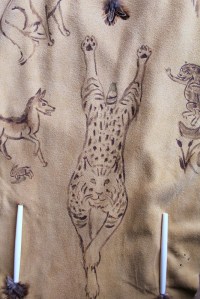
paintingdetailBut she chose not a single one of them. Not Coyote, with whom she had hunted on more than one occasion, and who told her he’d never seen such sharp, deadly claws on any creature smaller than a bear. Not Wolf, either, who invited her into her family pack despite Bobcat’s solitary nature. Nor did she choose River Otter, though her playful antics amused the feline huntress on more than one occasion. She even refused the attentions of mighty Grizzly Bear, himself a rather blustery and forceful sort, but good-natured when well-fed.

And yet they continued to visit her, and one day the four of them arrived at the same river where Bobcat preferred to drink, all at once. They soon began to fight for who would gain Bobcat’s love first. It started first as a friendly rivalry, but then Coyote said something quite rude about Bear’s hunting prowess, which then turned into Otter making a snide remark about Coyote’s other talents, and Wolf declaring that the lot of them were all off in their heads if they thought Bobcat would choose such contentious suitors. The commotion they raised in Bobcat’s back yard was so great that they woke the cat from her nap, and she silently stalked to the river to see what the fuss was all about.

When she arrived the four suitors were taking turns tearing into one another, until finally Bobcat had to hiss and growl to get their attention. Coyote flicked his torn ear, Wolf licked at a scratch on her leg, Otter pawed at a bump on her nose, and Bear grumped about the bite that someone had unceremoniously delivered to his short little tail. But they all sat at attention when Bobcat approached.

“Why do you bring this noise, this arguing, into my very home? Whatever did I do to you to deserve this cacophony? Do you think this will attract me? Is this how the fine folk of the forest propose love to their intended?” Her eyes glowed bright amber, and the tips of her whiskers trembled furiously. She sat and groomed herself into calm again.

“Dear Bobcat,” Wolf said, “we only wished to each come to you with our intentions”. “Yes,” continued Coyote, “we had not planned to all be here at once”. Otter added, “We would each want to have our time with you, without the rest here”. “Is there anything we can do to make it up to you, anything at all?” Bear implored.

Then they set about begging and pleading with her to allow them to do something to make up for their trespass that she finally cried out “Enough! All of you, that’s well enough! If you must do something, then bring me the following: the hide of a deer, the feathers of a pheasant, the bones of a buffalo, and the clay from the river that flows at the southernmost edge of our forest.” And then to keep them from fighting about that, she told Wolf to bring her the deer hide, Coyote the pheasant feathers, Bear the bones, and Otter the clay.

bobcat2It took the suitors three days and three nights, but on the fourth morning they each returned with their offerings. They laid them before her so that she could not refuse them without being impolite, and immediately began to quarrel over whose gift was the finest, and which one Bobcat had wanted the most, and to whom she would give her love. To escape their fighting, but so as to not make the arguing worse, she carefully took up the gifts, and silently ran away to the deepest part of her range.

It took three days for the suitors to stop fighting and notice she was gone. It took another three days for them to find her in the tangled underbrush of her range. And on the morning of the seventh day, she came forth from her hiding place.

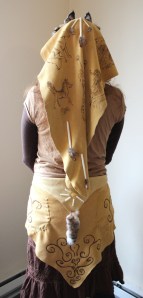
She had taken the deer hides and created a veil and belt which she wore. She had decorated them with the feathers and the bones, and with the clay she had painted both images of her suitors’ follies, and her own victories. She walked toward them, while they looked upon her power and beauty in awe.

“You fight over me as though I am a prize to be won and owned. You gave me these gifts as recompense for that insult, and then the giving became yet another argument of ownership. So I took the fruits of your conflict, and I created something beautiful.

“And today I am to be married—but not to you. I am marrying myself, with my sharp claws and my solitary home, my laughter and my hunting prowess. For no matter who I am with, I am always with myself, at the beginning and the end, and today I honor that love.”

“Shall we no longer be able to court you?” the suitors asked. “We apologize for fighting so much. We were so busy arguing we forgot about you. Will we never be able to visit you again?”

Bobcat sat in her veil and her belt, and she thought. Then she went up to each of them and touched their noses with hers. “You each wish to marry me for your own reasons. Coyote admires my success in hunting, and Otter loves to make me laugh. Wolf wishes to make me part of her family, and Bear wants to share food with me. These are no small things, but they are not all that I am. If you so desire, you may join me as you will to learn of all that I am. Perhaps I will someday marry one of you, or even all of you. But today, I marry myself, and you are welcome to join in that celebration.”

And so they did celebrate Bobcat’s wedding, all together in the forest. And then each of them, Coyote and Bear, Otter and Wolf, visited Bobcat in her range, and no longer did they fight. Perhaps they were married after all; only the forest knows for sure, and the forest keeps its secrets well.

paws

Death To All Styrofoam!!!

I have declared a war on styrofoam. Or at least a small portion of it.

See, as part of my ongoing efforts to walk my spiritual talk, I’ve adopted a stretch of the Columbia River through the Adopt-a-River Program. It’s a half mile stretch of beach along the east side of Sauvie Island, and it gets a fair amount of use from fishers and people walking their dogs, among others. Unfortunately, not everyone obeys the “pick up yer damned garbage or you get a $500 fine!*” sign in the parking lot. This includes the river, which carries all sorts of refuse from the city and tosses it up on the shore. So between the Columbia’s cache of Portland trash, and human visitors’ inability to pack out their carryout containers and baggies of dog poo, the beach was in sore need of cleaning when I went to visit it last Thursday.

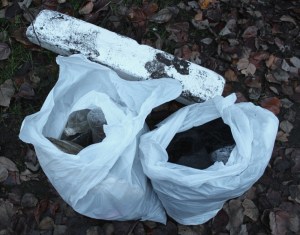
trashBy the time I was done I dragged out two full 13 gallon kitchen trash bags, along with a chunk of styrofoam longer than my arm. (I was proud of that piece, though–I had to chase it down the river twice to finally fish it out for good!) In the bags there were plastic forks and fishing line. beer cans and soda bottles, countless cigarette butts, and lots and lots of tiny chunks of styrofoam. Some were from takeout containers or foam coffee cups, but most were from various floatation devices for docks, buoys, and other aquatic equipment. There was so much I couldn’t get all of it before it began to get too dark to see, and I intend to go back later this week to try to sift through the sand for more styrofoam and cigarette butts. At least I managed to keep what I collected from going into the ocean or being eaten by wildlife thinking it’s food. Still, if you want to make my life (and those of other cleanup volunteers) a little easier, make sure you throw away your butts, and consider taking Tupperware on a blind date with your leftovers when you go out for supper.

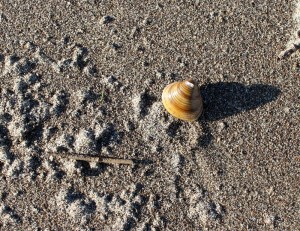
Of course, it wasn’t all stooping over to pick up plastics and biohazards. I spent the first part of my visit wandering along the beach, taking in the sights and sounds and smells and textures. (The blackberries were long gone, so no tasting this time.) Part of my commitment to the adoption program is a quarterly report on the flora, fauna, and general state of the riparian habitat. For being so close to human habitation, this was a busy place! I saw no fewer than ten hawks, or maybe the same pair flying over again and again, though some were red-tail and at least two looked like rough-legged. There were Downy woodpeckers and a Northern flicker, mourning doves and cormorants, gulls and juncos, little clams in the sand, and a Great Horned owl sleeping high in a tree. Speaking of trees, the landscape was covered in black poplar trees, and while the underbrush was predictably choked with invasive Scotch broom and Himalayan blackberry, a few snowberry and Nootka rose bushes managed to make an appearance.

columbiariverAnd then there was the river, the great Columbia. It’s like the Pacific Ocean–almost too big to talk to, preoccupied with the goings-on of countless beings within it and on its surface, communicating with all its tributaries and estuaries, personality and spirit shifting mile after mile, flowing like its water. For all that I love the Gorge and other areas along the Columbia, I tend to connect with the land forms more than the river itself. Not because I can’t or don’t want to, but because the Columbia is such a vast presence, and most of it is the alien world of “underwater”. No wonder it’s the gateway to the Underworld when I journey: dark mysteries and people barely skimming the surface unawares fit the river well.

The parameters on land are more familiar. I have a clearer idea of the spirit of the land I’m working with here. While the beach and I aren’t best buddies just yet–we’ve only met today, you know–its boundaries and spirit were much easier to connect with. It appreciated the trash removal, and I appreciated the abundant wildlife sightings. While I connect with the places I hike, and I do some trash pickup there, I’m looking forward to being a more dedicated caretaker of a particular place and seeing where that takes us both. In addition to my present duties, I’m also on the list to be trained in water quality monitoring this spring, especially important since my beach is downstream from Portland itself. And who knows? Maybe I can get permission to take a shovel to some of those blackberries, too. It’s all got to start with the periodic pickup, though.

Which brings me back to the *%^$#$%&#ing styrofoam. And all the rest of the trash. I know a half mile of beach along a river that’s over 1,200 miles long isn’t much, and the amount of stuff I haul away from there is miniscule in comparison to what gets dumped, dropped, and washed into there on a daily basis. But I’ve declared a one-person war on this buildup of refuse. It’s so on.

* Not the exact wording, but the sentiment is similar.

clam

Baker’s Yeast as Fungus Totem

As I’m spending more time indoors and getting back to cooking, I’ve been finding that the domestic totems are speaking up again. Last time I posted about my work with Tomato, and now as I do some baking work I’ve been getting back into the swing of things with the totem of Baker’s Yeast, technically known as Saccharomyces cerevisia. This fungus doesn’t just make bread rise, but also contributes to the creation of beer and wine, and when eaten provides B-complex vitamins and other nutrients. It is possibly one of the most important fungi to the human species, up there with Penicillium spp.(from which we derived Penicillin and the concept of fungal antibiotic sources).

I admit I feel bad every time I put dough in the oven to bake. Here all these little living beings have been eating and multiplying and making the bread rise, and I’m about to burn them to death. Even if they don’t recognize it in the way that a mammal would, it’s still a moment of sadness and appreciation, the same as I feel for a carrot I uproot in the garden, or a freshly-killed free range chicken I purchase at the farmer’s market.

Baker's yeast up close and personal (marks are 1 µM apart for scale). Photo by Bob Blaylock, http://bit.ly/ULp0ZO.

Baker’s yeast up close and personal (marks are 1 µM apart for scale). Photo by Bob Blaylock, http://bit.ly/ULp0ZO.

Like Tomato, Baker’s Yeast helps me to appreciate just how much we rely on other living beings to survive. We often think of fungi in negative terms—unpleasant infections like athlete’s foot or ringworm, or black mold infections in our home and respiratory system. Outside of a few edible mushrooms, most people don’t really consider fungi in a positive light, or at all for that matter. Fungi even routinely get lumped into the “vegetable” category even though they’re closer to us as a kingdom* than plants. But from the fungi that occur naturally in our bodies to Penicillium and Baker’s Yeast we have received quite a bit from this often-ignored kingdom of beings.

I also find Baker’s Yeast to be a source of wonder. At some point someone left unbaked dough out too long and a yeast ended up taking up residence long enough to make it rise. Perhaps instead of throwing it out, the enterprising baker tossed it in the oven anyway, and a new tasty treat was created**. The process is so simple, too. Put a tablespoon of commercial yeast in some warm water, let it sit fifteen minutes or so, add it to the dough and presto—the little fungi start working on the leavening right away! I can even watch the dough rise if I so choose, although I’m sure it’s much more exciting for the yeast than it is for the observer. Still, sometimes I think all the works of the alchemists never could equal the awesomeness that is fresh-baked bread. (I certainly wouldn’t want to ingest most of what the alchemists were concocting.)

But Baker’s Yeast also reminds me of the ingenuity of humans, as well as the value of experimentation. Part of what has made us so successful as a species, from an evolutionary perspective among others, is the fact that we have been so curious about the world around us and willing to take risks. The history of both Homo sapiens and our immediate predecessors took place in environments that were often subject to great changes in relatively short periods of time, and the rate of change has accelerated over time.

Sliced bread. Photo by Can Atacan, http://bit.ly/YWP5Iw.

Sliced bread. Photo by Can Atacan, http://bit.ly/YWP5Iw.

Our omnivorous nature gave us an advantage over species with more specialized diets. And as starvation was a very real threat, even after the dawn of agriculture, our ancestors were willing to try all sorts of potential foods. While this sometimes resulted in unfortunate episodes of mushroom poisoning and the ill effects of scavenging dead sea creatures that had sat around too long, it also gave us the joys of lobster, cheese, and, of course, bread.

None of this could have happened without other living beings. While Baker’s Yeast didn’t emphasize that interconnection as much as Tomato did, I still can’t help but be appreciative for everything we’ve gotten from these little fungi. Yes, as with tomatoes and other domestics we do help propagate generation after generation of yeast, so they get something out of the bargain. And we could certainly live without bread. But the discoveries of leavening and fermentation revolutionized our culinary opportunities, and we can at least be grateful for greater options of preservation and tastiness.

Like Tomato, Baker’s Yeast is an important totem of the home and hearth, as well as certain industries. This winter is going to be a good time for me to work with yeast and its overarching Yeast-being, as the chill settles in and bread-baking becomes a more serious endeavor. Lately I’ve been wanting to improve our home; my partner and I have been in our current apartment for a year and a half, and while it’s somewhat put together there’s still some residual clutter in the closets and we want to rearrange a couple of the rooms. I think perhaps having some fresh-baked bread for us to nosh on while we work will help make this place feel even more like a good, cozy home, and perhaps I’ll dedicate a little spot of kitchen just to Baker’s Yeast while we’re at it.

*Yes, I totally admit that when I wrote this I immediately thought of the Mushroom Kingdom in Nintendo’s Super Mario Brothers games. Princess Toadstool totally reigned before Peach ever stepped up to the throne.
** And now we have doughnuts. Thank you, Baker’s Yeast!

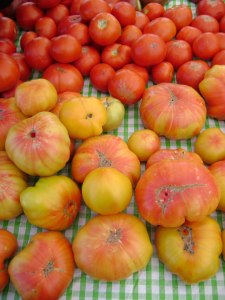
Domestic Tomato as Plant Totem

When I was a kid I couldn’t stand raw tomatoes. I thought they were too acidic and they bit my tongue. My family, on the other hand, loved them, and every summer when they put a garden in there would be ample numbers of tomato plants, mostly beefsteak and cherry. I didn’t really understand the appeal until I was older; my tastebuds had changed, and I had had a chance to try fresh garden tomatoes again. They still weren’t my favorite food ever, but I gained a certain appreciation for a “wolf peach” right off the vine.

In 2006 when I moved to Seattle for a year I planted a couple of lone tomato plants in our back yard, my first attempt at gardening. I had been told they were relatively easy to grow, and the young plants were cheap and readily available. The soil in our yard was hard and somewhat depleted from neglect and too much lawn, and the plants ended up being pretty stubby. But even with my inexperienced care they grew enough to produce a few ripe fruits. By the time I moved to Portland the following year, I wanted to do a better job.

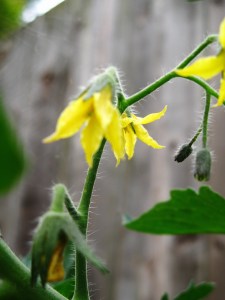
Yellow Tomato Flowers by Glenda Green, http://bit.ly/U1ge6k

Yellow Tomato Flowers by Glenda Green, http://bit.ly/U1ge6k

In the years since, I’ve become a slightly less amateur gardener. I’ve learned how to use organic fertilizer (carefully and not too much or too often), and how to know when the garden needs watering (the tomatoes are usually the first to look wilted). I’ve managed to grow carrots, peas, beans, and the most enthusiastic broccoli I’ve ever seen. But my tomato plants are always my favorite, even if I do still have to plant with starts instead of seeds.

I’ve found that the totem Tomato (say that ten times fast!) is akin to Domestic Dog in nature—it likes humans and the attention they give its green children (as long as it’s not abusive), is pretty open to working with just about anyone, and tends to be very forgiving. When I managed to kill a few starts I tried growing from seeds, Tomato didn’t get angry, but rather assured me that a lot of them don’t make it, especially when taken out of their native soil, and that getting them from seed to healthy start can be a challenge. The effort was appreciated nonetheless and I was encouraged to try again at a point when I had better growing facilities.

Tomato-the-totem has been at the center not only of my gardening, but also my other domestic experiments such as cooking and canning foods. (I’ve been told I make a mean pizza sauce from fresh tomatoes!) Tomatoes themselves can add a lot of flavor to even a simple dish, and complement a variety of recipes and cuisines, making them a good beginner’s ingredient. They’re also a good first subject for canning; their acidity makes them less likely to grow moldy or otherwise go bad (though I tend to add a little extra lemon juice to every jar, just in case). And tomato’s children can be VERY prolific; many of us have had a neighbor foist some tomatoes off on us in the summer when they had too many to eat themselves, and have perhaps returned the favor! In this way, Tomato invites people to try new things with these fruits, being plentiful, tasty, and versatile whether fresh or cooked.

Of course, Tomato’s children benefit from these things. As I mentioned in my post Plants Need Animals, And Other Necessary Connections, the plants that win on an evolutionary level are those whose genetics are passed on the most frequently and successfully. Tomatoes and other domestic crops have persuaded us to spend a significant amount of time propagating their seeds and seedlings. While unlike other animals we may not necessarily spread the exact seeds we eat (except into the sewer or septic tank), our species still makes sure that the plants that feed us continue on genetically. In that respect we’ve got a good mutual relationship going on.

On the other hand, recently we haven’t been treating those plants so well. Some varieties of commercially available crops can’t survive without human intervention, making them completely reliant on us. And in conventional farming, the plants are often coated in pesticides, and their roots burned with chemical fertilizers that destroy the fungi that would normally help them take in more nutrients from the soil. Debate rages on about whether genetically modified tomatoes and other plants are safe to eat and strengthened through modern technology, or whether they’re “Frankenfoods” that may have more risks than benefits.

Tomato Still Life by Vince Mig, http://bit.ly/UsZ5E0

Tomato Still Life by Vince Mig, http://bit.ly/UsZ5E0

Tomato’s feelings on this, from my experience, are that we’re forgetting the importance of our relationship, that we’re taking tomatoes and other crops for granted. It’s fine that we want to eat and that we want to have more tomatoes in the future. But we’ve lost the appreciation for the careful balances that are involved in good farming and good eating. We don’t even necessarily have to change the way we produce food, except perhaps to make the processes more eco-friendly—fewer chemical fertilizers, more crop rotation, more sustainable shipping and packaging. What does need to change is our attitude toward plants only as commodities, where we assume they’ll always be available to us, and that we only use them without appreciation.

Just as we’ve started to see the animals, domestic and wild, as fellow creatures rather than put here for us to do with as we will, Tomato encourages us to also examine our relationships with the plants. Plants are not only valuable as food, or dried herbs for health and magic, or sources of wood and paper. They also indispensable parts of every ecosystem they reside in, and we literally couldn’t exist without them. It’s become somewhat of an environmentalist’s cliché to remind people that without plants (and plant-like cyanobacteria) we wouldn’t have oxygen to breathe, and the image of a protester chained to a tree they’re trying to save has become ho-hum. But Tomato gives us a way to start examining these relationships in a much more personal, immediate manner.

The call of the garden tomato may be a sillier idea than the romanticized howl of the wild wolf—wolves don’t just go “squish” when we step on them, after all. But perhaps it’s because Tomato has grown so close and familiar to us that it feels more comfortable speaking to us in this manner, about sustainability and preservation. We value the wolf and the tomato for very different reasons: the wolf symbolizes the wilderness that we wish to preserve, but the tomato represents the kitchen and the table of domestic serenity and creativity.

I didn’t get to plant a garden this past summer because I was too busy, and I definitely felt the absence of Tomato as a result. Yet Tomato kept the line open anyway—a single skinny little tomato plant, not even strong enough to hold a fruit, grew up from a seed that had fallen into the soil last year. This little plant gave me one more reason to go onto the balcony where my pots are and water the few remaining troopers from the previous season, and created a connection for me to hang onto. In that way Tomato has continued to be persistent and forgiving and ever patient, and I look forward to gardening next year.

Brief Commercial Break: My New Book is Here!

booksarehere

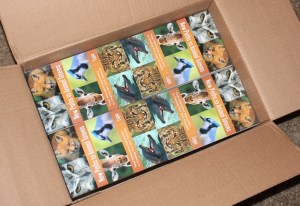
Just wanted to drop a quick note here that my newest book, New Paths to Animal Totems: Three Alternative Approaches to Creating Your Own Totemism, is now available and I have a bunch here in my hot lil’ hands! (Though not as many as before I filled all those preorders–thanks, y’all!) If you’ve been reading this blog in part because your answer to cultural appropriation is to create your own traditions instead of ganking from someone else’s, you may find this a good source of inspiration! And it’s geared toward a general audience; if you’re new to this whole animal spirit thing, there’s plenty to help you get started–but there’s also a good deal for more experienced practitioners to chew on, too! And if you’ve been reading my previous works, never fear–this isn’t a rehash of my older works.

Here’s where you can order your copy–and thank you 🙂

(P.S. I have a couple of content posts sitting ready to go on my laptop; I promise I’ll try and get them uploaded here later this week! However, the garage needs to be cleaned, and we’re trying to overhaul the apartment here, and lots of other stuff and things. But I did write stuff for you!)