Mt. Hood At Last

Festival season is over, and I’ve been trying to shift gears into a slower, more home-based lifestyle. I’ve started picking up my practice of weekly hikes, and yesterday I decided to reach for one of my personal goals–hike on Mt. Hood itself.

Mt. Hood is the closest and most noticeable of the snow-covered peaks surrounding Portland; there are places in the region where you can see all the way from Mt. Rainier in Washington to Mt. Jefferson in central Oregon. But Hood dominates to the East, a large gray andesite peak with remnant glaciers adorning the top. The Multnomah tribe, a small group of the Chinook Nation who were wiped out by European-borne disease in the 1800s, referred to the mountain as Wy’east; some people still choose to use that name. While for me the Columbia River is the heart of my home, Hood has been this brooding presence ever drawing my attention. I’ve hiked near it, at Twin Lakes near Barlow Pass, and Mirror Lakes, and I’ve driven 26 and 35 all the way around it. But it wasn’t until I found out about the McNeil Point hike that I decided that I was ready to get to know this mountain more closely.

The hike itself was rather pleasant, not as steep as I had thought. My idea of “strenuous mountain hike” has been steep switchbacks on Dog Mountain or Kings Mountain, and most of the trail here was pretty level. There was a surprising number of hikers, too–the parking lot was so full that I had to park on the side of the road with a few other cars! I kept running into these two nice guys, too, who were on the same course (and made one of the same wrong turns, too!) I also chatted a bit with a couple of members of Friends of the Columbia Gorge; we talked a bit about politics in an election year, and I asked about their organization, which I think I’m going to join.

The wildlife was out in force, too. I flushed several Northern flickers from the grass on the sides of the road as I drove up to the trailhead, and I heard, though didn’t see, the occasional raven. There were lots and lots of chipmunks; I startled one near the start of the hike, but he (or she) quickly recovered, and sat about four feet away from me foraging for seeds and berries. Might have been the most chill chipmunk I’ve ever seen outside of a city park! The juncos were in full attendance as well, and higher up in the talus slopes I could hear pikas making their squeaky-toy noises. (If you’ve never heard a pika, allow David Attenborough to introduce you to this most adorable of mountain critters.) Lots and lots and lots of Douglas fir and hemlock trees, too, and the trail was lined with thick clumps of beargrass and some wild rhododendron. Erratic boulders deposited by long-retreated glaciers sat like large resting animals in the brush, and glacial streams trickled down the slopes.

It wasn’t the steepest hike I’ve done, but it was the longest–partly because I went almost a mile the wrong way down the Pacific Crest Trail and then had to turn around. Between that and another wrong turn and backtrack I added two miles to the nine miles of the McNeil hike proper I managed. I’d had the grand plan of going all the way up to the stone shelter at the edge of the treeline and snowline, though things didn’t work out quite that way. The trail disappears once it dips into the valley of McGee creek, and so I just poked around the valley a bit before deciding to head on back. I’d gotten a later start than I had intended and didn’t reach the valley until 4pm; with only three hours of daylight left and this being a new trail to me, I wanted to make sure I wasn’t stomping around in the dark and cold!

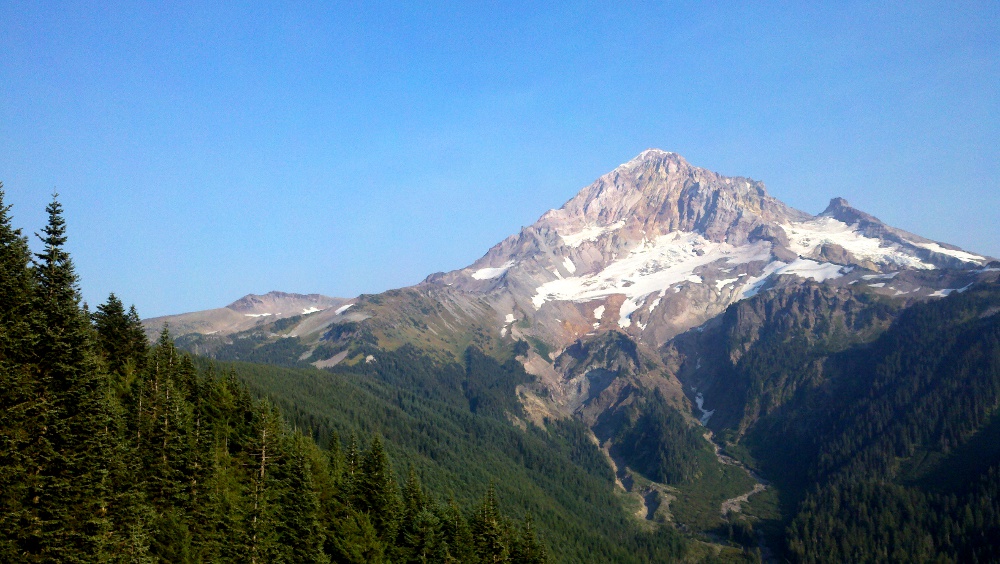
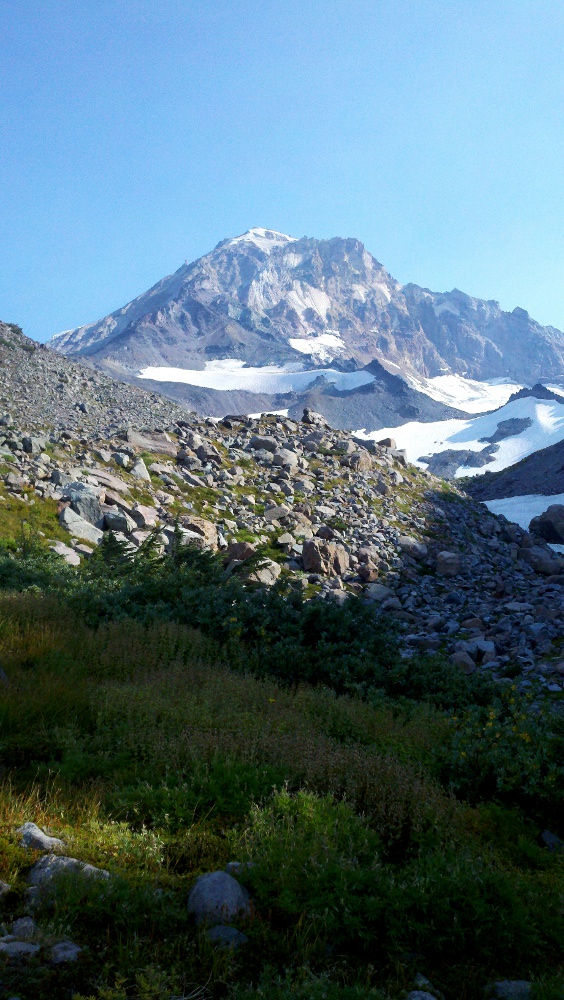
Still, I had the time to be truly amazed by being so close to Hood’s peak. I went far enough up McGee’s valley that I was probably within a quarter mile or so of the base of the peak proper. You can see in the photo here just how close I got! (I’ve seen several other people’s versions of this shot online, too, so I know it’s a bit cliche, but I wanted to mark the moment for myself.) Surrounded by wildflowers and the cold meltwater of the McGee, I imagined I was in another world. And Hood didn’t seem so scary, either–perhaps a little brusque and cranky, but I’d had so much help from other hikers and the trails themselves getting there that I felt rather welcomed.

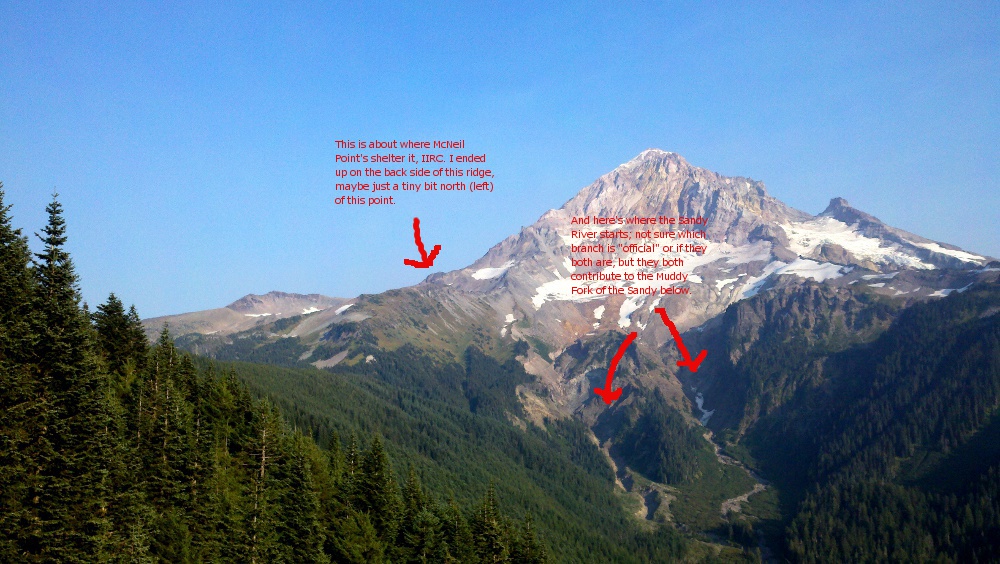
I am normally a solo hiker; I prefer going at my own pace, and dislike too much chatter. But as it was getting late and I needed to hurry back down the mountainside, I met up with the two hikers I’d been sort of pacing with earlier, and asked to accompany them down to the lower trail. So we rather quickly ate up about two miles of rough trail in an hour, and once we were within a mile of the trailhead I bid them good evening, with plenty of sunlight left to make my own way back. There are two options for taking the Timberline Trail back to the Topspur trailhead where I started; one goes through fairly standard fir and hemlock woods, but the other follows a narrow trail overlooking the valley of the Sandy River–not only do you get a great look at Hood in all its glory, but you can see the tiny glacial trickle that is the source of the Sandy. In the late afternoon sunlight Hood was beautifully illuminated, and I kept stopping to gaze in awe. Here’s my last photo before I headed back into the forest:

Just for fun, here’s a version of the above photo with a bit of notation–you may need to click on the photo to get the bigger version so you can see my notes!

All in all, it was a very good hike. While I’m definitely not in a place where I can climb Hood’s peak proper, I feel much more comfortable with the spirit of the mountain. It truly is a place of beauty, with the deep evergreen forests, and the alpine meadows with little surprising ponds. I think next year I may try doing a backpacking trip up there, though I might take another shot at the shelter on McNeil Point later this month.

Chinedere Mountain, 1 August 2012

[I am coming into the final stretch of the festival season; by mid-October I should hopefully be posting more often. In the meantime, here’s a bit of something to read.]

Earlier in the month I took my very first solo backpacking trip, heading up Chinedere Mountain southwest of Hood River, OR. I had done this hike before as a backpacking trip with a friend a couple of years ago, but needed to make it my own this time around. So I chose the night of the full moon for the best lighting for late-night bathroom breaks and whatnot, and with a pack roughly a third of my own body weight (I am a tiny thing, so even having an ultralight kit is a lot of weight for me!) I did the two mile hike up to the peak of Chinedere. It’s a relatively easy hike, with a nice gradual climb most of the way, and the scree at the top has been arranged to make roomy paths and some sheltering dugouts on the lee side of the peak to give tents a little extra wind protection. There’s an excellent view of Mt. hood’s north side, too, one of my favorite features of it. Since I was there in the middle of the week there was nobody else there, though I had plenty of phone reception in case of emergencies, and it’s not an area frequented by bears or cougars, so I was pretty safe.

The full moon is the one time during the month when the moon rises at the same time the sun is setting. Where I live in Portland there are too many trees and buildings for me to see either happen, so this was a really unique opportunity for me. I was inspired to a bit more poetry, and so here it is:

In talus nest I sit
Between the sunset and the moonrise,
He sunk as low as she is risen.
They have agreed I shall not be without light while I am here.
For before she beds again, up he will fly,
Over that ridge in the east,
On which she sits, a queen enthroned.
She takes up the tattered hems of his robes
And mends them over her shoulders
Brass into silver.
He draws up a well of ink
With which to clothe her hips,
One last gift to her before he sleeps.
For a moment, Hood blushes to see them
So intimate across the entire sky.
The sun climaxes in a flood of amber and rose;
The moon sings her love in blue and mauve.
Their tenderness rings the world around me,
Safe in my talus nest.

And here is what I woke to in the morning (you can click it to get a bigger version):

Photo by Lupa, 2012

Working With Black Morel Again

I’m currently working my way through Mycelium Running by Paul Stamets, in an attempt to learn more about fungi in ways I can’t just by looking at wild mushrooms through layperson’s eyes. I’m only a few chapters in, but already the author has made it quite clear just how intricately entwined fungi are in the very workings of life on Earth itself. It’s not just the fruiting mushrooms that we can see above ground; more important, perhaps, are the vast networks of mycelia, the thread-like filaments of fungal being that may produce the mushrooms themselves. Mushrooms are a temporary state; mycelia are the permanent self of the fungi; or, to use an analogy, mushrooms are to apples as mycelia are to the apple tree.

One of the most fascinating roles of fungi, in my opinion, is that of mycoremediation–the healing and restoration of damaged landscapes. Fungi are the processors of the Land’s “body”; they digest things, and convert them into usable forms for themselves and other beings. They are alchemists. So when a place is damaged, whether through fire or deforestation or disease (often caused by parasitic fungi), it is the native fungi of a place that are often the first to recover. They break down the dead organic material to create healthy soil, and are often the forerunners of the recovery of the place. Stamets says of morels:

These fast-growing and quick-to-decompose mushrooms emerge where seemingly no life could survive. As these succulent mushrooms nature and release spores, they also release fragrances that attract insects and mammals…Flies deposit larvae in morels, and as the larvae mature they attract birds and other maggot lovers. Birds and mammals coming to eat morels defecate seeds of plants far from the fire zone…Each mushroom-seeking organism imports hitchhiking species from afar with every visit, essentially carrying its own universe of organisms, an ecological footprint of flora and fauna. Then, with every mushroom encounter, each animal is dusted with sores, leaving an invisible trail of them as they wander on. As animals crisscross the barren terrain, the layering of ecological footprints creates interlacing biological pathways. Morel mushrooms…are pioneers for biodiversity, first steering animate vessels of genomic complexity into an otherwise near-lifeless landscape. (Stamets, 2005, 55-6)

This matches my previous experiences with Black Morel as totem. Morel struck me as a very opportunistic totem; not that it’s alone in that, but that’s where we connected first. So I talked to Morel more about what I read, and the habits of morels in a place scorched by fire or cleared by loggers.

Morel pointed out that sometimes opportunism has more than just a personal benefit. When morels spread out into a scorched landscape, there’s absolutely no competition, but plenty to eat in the form of charred plant and animal material. Morels make the most of that, along with other fungal opportunists. However, as Stamets eloquently described, the morels are far from the only benefactors of this pioneering and experimental nature.

This connected with a recent experience of mine where I was interviewed about my participation in the pagan community as a leader. My place there is through my writing; in neopaganism, if you write enough apparently it gives you some authority (moreso if you write well and people get something out of it!) One thing that I pointed out was that I write primarily for myself. My writing is a record of my spiritual path; that’s what this blog is. You can look over the past five years of posts here and see my progress in this path, and the many places I’ve explored as a result.

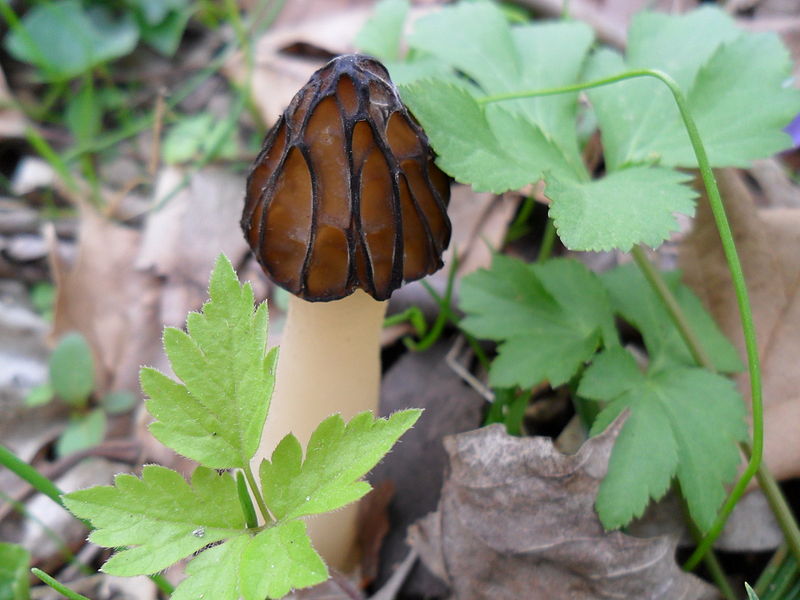
Long-neck morel. Photo by MrGreenBean from http://en.wikipedia.org/wiki/File:LongNek1.JPG

However, I deliberately shared it so others could benefit from what I found as well. While this was more conscious than the activities of the little wrinkled mushrooms, the pattern is the same–a few pioneering beings move into new territory, and leave a trail for others to follow, and soon an ecosystem is created. While Therioshamanism is still a relatively new phenomenon (and generally still my own personal path rather than a shamanic tradition per se), I have found people drawing on my experiences and integrating them into their own paths.

And going forward, Morel reminded me of the importance of remembering how my explorations can be helpful to others. It’s still perfectly acceptable to act in my own self-interest. But if, in the process of doing so, I make things better for others, so much the better. Morels also thrive in complex ecosystems, not just scorched earth, and there’s a lesson in that to be sure.

Source:

Stamets, Paul (2005). Mycelium Running: How Mushrooms Can Help Save the World. Berkeley: Ten Speed Press.

Coming Out of the Crazy Closet

This is a post I’ve written and re-written a number of times. It’s probably one of the most difficult posts I’ve composed, simply because I feel so vulnerable about it. But I’m finally at a place where I feel comfortable sharing this here.

I have a mental illness, specifically Generalized Anxiety Disorder (GAD). It’s something I’ve struggled with for most of my life; I can remember its roots in being a particularly sensitive and easily-worried child still in elementary school (and it just got progressively worse from there). But I wasn’t formally diagnosed until a couple of years ago, when I was seeing my therapist for sessions during graduate school. I told her of my suspicions, as I’d read the DSM-IV cover to cover for my diagnosis class, and so we sat down with the book and looked at the criteria for a variety of conditions. GAD was the one that fit the best, and all of the criteria were very familiar to me.

So why am I telling you this here, on my blog that’s supposed to be about shamanism? For one thing, it’s the platform I use the most for writing these days, and I want to have a basic “here’s Lupa on GAD” post that I can refer to when talking about this later on. Talking is good therapy for me, writing being included in “talking”. If being more open about my anxiety helps me to get better, then that’s an additional bonus.

I am a strong supporter of mental illness awareness and advocacy, moreso after having gotten my Master’s in counseling psychology. Even though I understand and empathize with my reasons for having stayed mostly closeted on this matter in the past, I have felt for a while like a hypocrite. I encourage others to be open about their mental conditions if they deem it the right time, and I feel that more open discussion about mental health, to include careful self-disclosure, can help facilitate better resources and less prejudice.

Yet I have hidden my anxiety away like a bad habit. Even having that degree, even having worked as a counselor, even knowing and believing beyond a doubt that mental illness is nothing to be ashamed of, my own fear–and the anxiety–kept me quiet. And now I’m breaking that silence. Why?

While I have not yet “officially” used my Master’s degree, having spent the year since graduation being a fully self-employed author and artist (and recovering from the stress of grad school and corporate life before that), there’s still the possibility that some day I may need to get a job as a counselor at an agency. Even though the counseling profession is supposed to work against the stigmatization of those with mental illnesses, there is still a strong taboo against mental health professionals who are mentally ill. Even though such professionals as Marsha Linehan (the developer of Dialectical Behavior Therapy) and Kay Redfield Jamison have publicly discussed their illnesses, the stigma remains–especially if you aren’t a well-established professional yet. So even though I did well in my year-long internship counseling addicts in an inpatient setting, and was open with my supervisor there about my GAD, and we worked together to make sure it wasn’t a liability, I still worry that other supervisors, potential employers, and the like may not be so supportive.

Clients can go either way. Some clients are put off by knowing their therapist isn’t perfectly psychologically hale, especially as mental health professionals are often idealized as “perfect authorities”. But some clients feel more comfortable knowing that the person in the chair across from them might know a bit about what they themselves have been struggling with. I never told any of my clients in my internship about my anxiety, but having GAD did help me to empathize more with them. It also made me more aware of my own boundaries, and where the GAD could weaken my ability to deal with sometimes very challenging clients.

Then there’s the more general stigma. Many people still equate mental illness with everything from homelessness to senseless shootings as in Aurora, CO. Mental illnesses are seen as ticking time bombs. Or they’re dismissed; we are told to “just get over it”. We who have these illnesses are marginalized and stigmatized. It’s easier to ignore us or make fun of us than to help us and try to understand the complexity of our different way of viewing the world. Some people still even conflate alternative spiritual views as a whole with mental illness, and there’s the chance that me being out of the crazy closet will just fuel their misconceptions.

Continuing to hide my anxiety disorder just perpetuates stigmatization. One of the most effective methods of teaching is modeling. If I model the idea that it’s okay to be mentally ill and open about it, if I can just talk about it like an everyday (albeit unwanted) part of my life, then hopefully I can help others to do the same, whether they’re mentally ill or not. I’ve gotten so many emails from people who have told me that my writing here, and in my books and other places, has been a huge help and inspiration to them. By coming out as having GAD, my hope is that I can continue to provide inspiration to others fighting their own battles with mental illnesses.

There’s one other reason I’m bringing my anxiety up here, and that’s shamanism itself (see? It IS relevant here!) There is a misconception that because some indigenous shamans have had mental illnesses as part of their initiations/shamanisms, that this means that you have to have a mental illness to be a shaman, or even that mental illnesses ARE shamanism. I find these to be inaccurate and dangerous conflations.

First, it’s demeaning to indigenous cultures to assume they don’t know the difference between someone with a mental illness, and a shamanic practitioner. While there is some crossover in some cultures between SOME mental illnesses and SOME shamanic and spiritual traditions, it’s specific in degree and nature in each culture and even each community, and to say that they all see them as one and the same is short-sighted and inaccurate.

Second, here in the dominant culture in the United States, it is downright dangerous to equate mental illness with shamanism. “Mental illness” is a broad, broad concept. If we include the various entries in the DSM-IV (some of which are developmental disorders rather than “sicknesses”), we’re talking everything from autism to depression and anxiety disorders to Cluster B personality disorders such as Antisocial and Borderline. If shamanism helps you deal with your mental illness better, whether as a client or a practitioner, great! But there is no cure-all or universal treatment for mental illnesses in general, and I oppose the broad-brush assumption that shamanism is the magic bullet.

And there is one more reason I am talking about my anxiety disorder here on my shamanism blog: I want to emphasize that for me, GAD is NOT a facilitator of my shamanism. I know some shamanic practitioners of varying traditions for whom their mental illnesses are assets, or at least tools. And some of them do help manage their illnesses with their shamanic practices.

But I know for a fact that I am not the only shaman who would give up their mental illness in a heartbeat if they had the chance. Reducing the stigma against mental illness doesn’t mean automatically stopping treatment and accepting things as they are forever more. I’m still trying to get rid of my anxiety disorder. GAD does not make me a stronger person. GAD is my weakness, my Achilles’ Heel. If I did not have my anxiety, if I could shuck it off of me like an overworn, stinking old coat, I would be so much the better for it. I could function better as a person, as a shaman, as a professional of several fields. GAD cripples me at times. It is not my friend.

Do you know what GAD is like for me? It’s daily, almost constant, worrying over things that I know I shouldn’t worry about, but that my limbic system tells me to be on guard against anyway. I’m not talking about being aware of spirits. I’m talking about nights of insomnia fueled by the fear that I’ll get up the next day and all my money will be gone, or that my partner will suddenly leave me for someone else, or that I’ll die of cancer before I ever get the chance to own my own home. It’s overreacting to small setbacks because my brain automatically catastrophizes and focuses on the very-worst-case scenario in perceived self-defense. It’s being irritable and short-tempered because everything just hurts, where emotionally and psychologically I feel like I’ve been flayed and every single stimulus is agony.

It’s being so exhausted from trying to keep my emotions on an even enough keel to be able to function on a day to day basis that I sometimes have to take a mental health day to recover from the fatigue of that daily battle. It’s the constant ache in my trapezius muscles because I carry all that tension and worry in my shoulders. It’s knowing that the chronic acid reflux the anxiety caused could kill me early with esophageal cancer. It’s knowing that I am at a greater risk of heart disease because my anxiety puts such constant heightened stress on my body, to include abnormal levels of adrenaline and other such chemicals.

None of these things make me a better shaman. Okay, yes, you can argue that my experiences have been “character building” and I’m a better shaman and person for having “resiliency” and “empathy” built from dealing with anxiety for decades. But some day I want to be able to say “I used to have GAD, but I finally overcame it, and I’m better for it”. I refuse to let go of that goal to settle for the consolation prize of “might as well just be a shaman since I’m nutty as a fruitbat anyway”. Part of being a shaman is healing others, but part of it is also healing the self, and even if I never do get completely better, I’m not going to stop trying to find my cure, and my path to a life without abnormal levels of anxiety.

So there you have it. I’m out of the crazy closet. And I want to note that I use the term “crazy” not in its derogatory manner, but tongue in cheek, and with a bit of cynical humor. When the anxiety really gets going, I really do feel crazy in that out of control, my-brain’s-been-hijacked way. But I’m so used to talking about “anxiety” in serious, overwrought tones that talking about “the crazy” or “I had too much crazysauce today” or asking my partner “You still love me even though I’m a crazy girl, right?” allows me to acknowledge it with some contextual silliness. Those I use it with know I’m not crazy in the stereotypical sense, but it’s a convenient code for the illness that pervades my life.

So hi, I’m Lupa, and I’m crazy. But I’m working on getting less crazy.

(As with all my posts, comments are screened until I decide they can come out to play. I know most, if not all, of you will be perfectly cool and supportive about all this. On the off chance someone decide to be an asshat, know that your comment will be BALEETED before it has a chance to gasp for its first breath of air.)

A Quick Pun Break

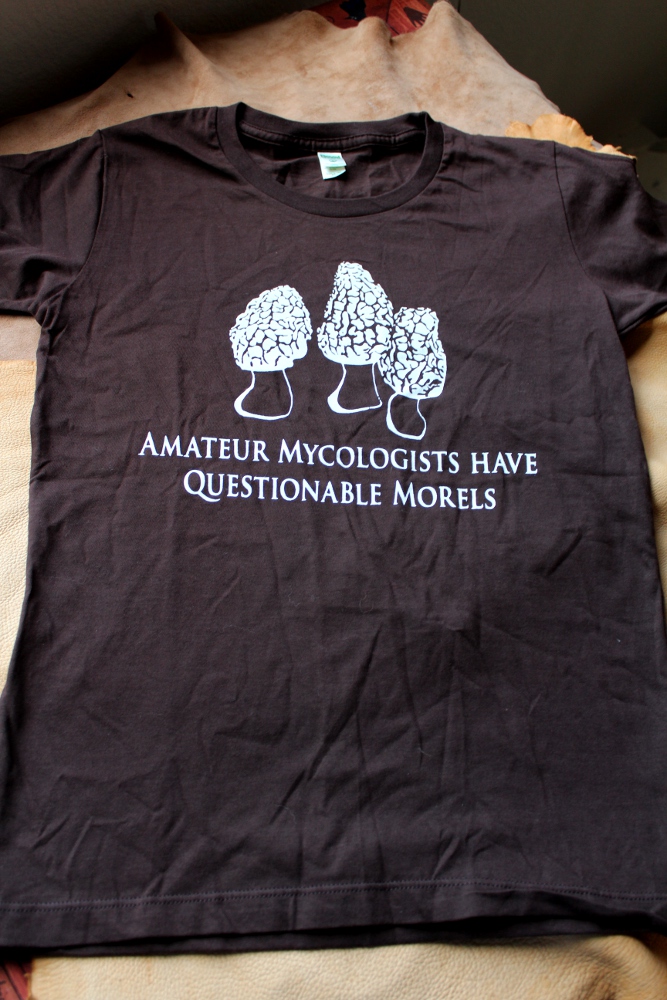
So this past Saturday I vended at the Mississippi Street Fair here in Portland. It’s a hell of a lot of fun, though since I was vending solo most of the day I didn’t really get to escape much. I did make a couple excursions for food, and on the way I passed the booth for Lonely Dinosaur, a local independent (made in the basement!) t-shirt company specializing in entertaining puns and other humor. One of their new ones caught my eye, and given my recent writings, I figured it was appropriate. So it became mine!

Forgive the wrinkles–I had to carry it home in a knapsack; I swear it was nice and neat when I got it! If you want one of your own, here you go! I highly recommend checking out the rest of their selection as well; very good quality shirts, and you get to support independent artists, too!

Geological Totems

I think I may be too linear for my own good. See, I had this grand plan of expanding outward in my writing, from animal totems, to plant and fungi totems, to geological totems, and so forth. I’ve been working with all of these to varying degrees in my ongoing work with bioregional totemism in a multilayered form, but I’d planned to be more in-a-row with the writing. As is so often the case with spiritual beings, somebody didn’t like that–specifically, the geological totems. So to make them happy, allow me to introduce them.

First, I need to explain what I mean by geological totems. A geological totem is the presiding spirit of a given specific geological phenomenon. It is not defined solely by a specific type of stone, or a single landslide, but instead is more a conglomerate of forces coming together to create a particular phenomenon, like a canyon or a mountain or watershed. And they overlap quite a bit, too, to the point that, like sediments turning into sandstone, their identities can merge into one even as the individual grains are still perceptible.

Columbia River Gorge near Hood River, OR. Photo by Lupa, 2012.

The Columbia River Gorge is a very good example. The oldest rocks are from volcanic activity 40-20 million years ago. The high walls of the Gorge are made of dozens of layers of basalt, which formed 15-10 millions of years ago from incredibly large lava flows. Volcanoes around what is now the border of Idaho and Oregon produced so much lava that eventually the basalt was over a mile thick in places. Even more volcanoes erupted to create the Cascade mountain range 2-1 million years ago; the Columbia River flows through these mountains. And as if all that volcanic activity weren’t enough, 16,000 – 14,000 years ago all that volcanic matter was carved and sliced and ground into the Gorge we know today–by massive flood of water. The enormous Glacial Lake Missoula, created by meltwater from glaciers at the time, would periodically flood, sending walls of water up to several hundred feet high down the course of the Columbia, deepening and widening its bed.

Each outpouring, whether from volcano or lake, added its spirit to the Gorge; the oldest volcanic matter from before the basalt floods, and the rocks carried from Glacial Lake Missoula, are equally a part of the totemic Gorge. When did the Gorge proper begin, though? Was it the same totem before the Missoula floods, when the land was more gently rolling and the river traveled a narrower path? Not only are geological totems layered in terms of composition but, it would appear, in time as well.

And each section of the Gorge has its own smaller place spirit as well. Some of them have territories that are very starkly defined; you can tell when you get from one part to another as the energy of the place changes–I’ve noticed, for example, a distinct shift as soon as the Gorge comes out of the Cascades on the eastern side. Other times the spirits flow together more gradually. The spirit of the Gorge near Multnomah Falls is different from that at the Bonneville Dam, but the shift between them happens over several miles. All of them come together, though to be the Gorge, and the Columbia River itself also maintains its unique identity even as it, too, becomes a part of the overall totem of the Gorge.

This brings up the idea that totemic identities are, to an extent, arbitrary. We can’t pinpoint when one species of animal evolves into another. At some point we say that Group A of a species has differentiated itself enough from Group B to be a new species, but you can’t look at a parent and young and say “this one is of Group A and this one of Group B”. What makes some geological totems unique is that they can sometimes have very marked beginnings and/or endings.

For our purposes, we can delineate a geological totem in part based on its current form and how it got to be that way. Some, like the Gorge, have a relatively quick birth (2,000 years of flooding is next to nothing in geological time);. The totem of that area was a very different being when the land was more sloping and gradual with a smaller river running through a narrow v-shaped canyon; it died (or, perhaps, was reborn?) when the floods carved out the Gorge itself and changed the landscape in other drastic ways. Others shift incredibly gradually, like the slow movement of tectonic plates and the rearranging of continents. There are places in the Midwest where I grew up that, other than some farming and mining by humans, have remained the same for millions of years. The totems of these places are ancient, with a long continuum of memory.

Perhaps trauma and sudden change mark the beginning and end of the “life” of a geological totem. Whether the totem itself dies and is replaced by another, or simply changes as drastically as its physical features, is unclear. I am working primarily with meditations and journeys to various places, to include visiting the memories of totems past in a sort of spiritual time-travel. I have not yet witnessed a place before and after such a great change, and most of these changes (mountain uplift, erosion, etc.) would take longer than my lifetime to complete. The best bet would be to visit a volcano that exploded itself into oblivion and then was replaced by a new volcano, but that would require a lot of luck and great timing (and also not being around when the explosion itself occurred!) I’d be interested to hear from anyone who has experienced such a thing.

To a lesser degree, humans do change a place. We have learned to destroy mountains and fill in rivers and wetlands, but these feel more like slow suffocations than rebirths. It’s like the workings of our hands and machines just aren’t enough to equal the cataclysmic rebirths of entire places. Again, visiting a place before and after a nuclear bombing might show a marked change, but if all goes well we’ll never have that happen again.

Geological totems also are defined more by what has formed them than by supposed inherent qualities of their materials. Those who work with crystals and stones on spiritual and magical bases may attribute certain qualities to a given mineral–healing for amethyst, protection for tiger’s eye, etc. But stones from a particular place are to the geological totem of that place what individual animals are to the totem of that species. Animals are mostly defined, roughly speaking, by a common set of physical and behavioral traits common across the entire species (even if it’s spread across several different locations. But stones and their totems work differently. In my experience, stones, crystals, and the like are not so much defined just by being “amethyst” or “granite”, as they are by the specific set of phenomena that created them, and the overarching totems of those phenomena and their aftermath.

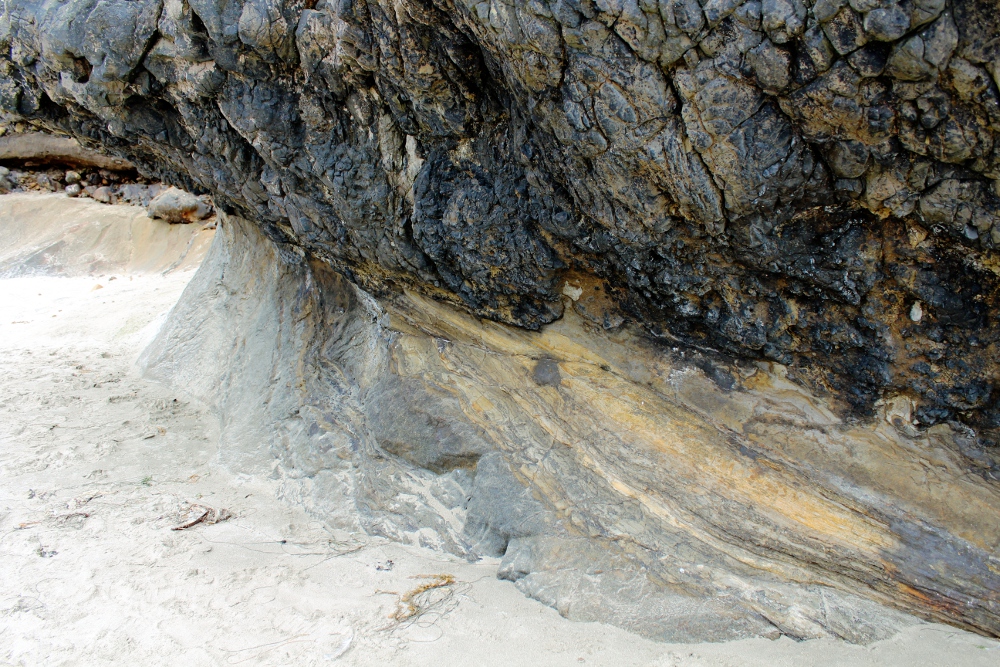
Coastal basalt formation near Waldport, OR. Photo by Lupa, 2012.

While basalt created in Hungary can have some similar qualities to that created in Oregon, and their origins in terrestrial basalt floods may give them a kinship different from basalt from other sources, each carries the spirit of the flood that created them, as well as the places they settled. I have on my place altar two pieces of basalt, one from Devil’s Rest just west of Multnomah Falls in the Gorge, and one from the Oregon coast near Waldport, OR. These are from the same sets of basalt floods that created much of Oregon’s bedrock, but they likely came from two different flows, and were sited over 100 miles apart. In the millions of years since they cooled from their lava state, they’ve become part of very different landscapes with their own individual stories, and have seen quite a bit. There’s a bit of resonance because they had similar sources and chemical compositions, but they are very different stones, and I would not say they had identical qualities.

So I don’t work with the totem of Basalt, though there’s nothing wrong with that. Instead, I work with the totem of the Gorge, the lava flows and waters that created it, and the ongoing human influences of dams and roads and such. Every piece of natural history that comes out of a place carries the spirit of the place, but it is the geological totems that remember the most. The plants and animals may come and go as extinctions and evolutions occur, as climate changes and drives some away while attracting others. They are the bedrock on which a bioregion is formed, and the soil that feeds its fauna and flora; they are the courses of waterways as well (I’ll give water totems their own post soon, too). It’s a shame that stones and others are usually seen as only spell components and materials for tools, for the totems of the phenomena that created them are some of the oldest, most powerful, and most well-storied. They may not be truly permanent; every mountain erodes, streams dry up, and lava buries the land below it. But if you really want to get to know the bioregion you’re a part of, to include on a spiritual level, start talking to the geological totems, of floods and flows, scrapes and sediments.

An Introduction to Drum Journeying

I realized, after having someone recently ask me about basic shamanic techniques, that I really haven’t written much about the foundational nuts and bolts of what I do. I suppose it’s another case of me assuming that readers already have the basics of (neo)shamanism under their belts; it’s actually more of a challenge for me to write something on that most basic and bare-bones level because I have to think hard about things I normally take for granted. So I’m going to take a shot at explaining the basics of how I do drum journeying, and some starter points for readers as well.

Why drumming?

I’ve enjoyed dancing at drum circles for many years now. Dancing and drumming are effective forms of trancework for me, but trying to keep an eye on other dancers can be distracting, never mind dodging the occasional drunk person with poor boundaries. So I’ve learned to drum solo for my own personal shamanic work. It took some work, since I hadn’t really been a drummer before, but with practice I learned to go into trance while dancing (or sitting) and drumming, and now the action of drumming is closely interwoven with the trance state. The rhythm of my body beating the drum helps to lull me into the initial trance, and helps carry me deeper with physical cues as I drum faster or slower, louder or softer.

Drumming is one of the most common forms of trancework in shamanic practice; most (though not all) shamanic traditions worldwide incorporate drumming. Sometimes the drum is only a tool; other times it’s a vehicle to the otherworld; and still other drums are the map to get there. While shamanic drumming does rely some on keeping at least a very basic “heartbeat” rhythm, you don’t have to be a virtuoso. Also, it’s wonderfully universal experience; while their perception of the percussion may differ somewhat from hearing peoples’, those who are deaf can also make use of drums, shamanically and otherwise.

You may already have some experience with trancing while drumming. If not, the first thing you’ll want to do is to practice altering your state of consciousness to the sound of drums. There are lots of drumming CDs out there, and you can also find some free videos by searching for “shamanic drumming” on YouTube. If you’re lucky enough to have a drum circle near you, you can even listen in person; a lot of them won’t have a problem if you don’t drum yourself, so long as you aren’t disruptive. You can, of course, drum as well, but the main thing is to practice “sinking into” the drum beats regardless of whether you yourself drum or not.

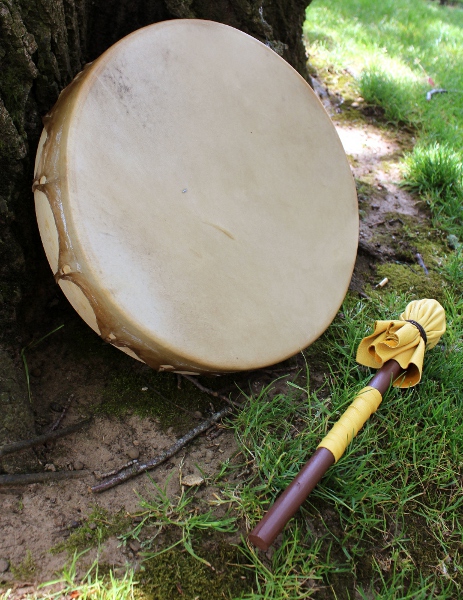
Deerskin drum and beater by Lupa, 2012.

You will also want to practice drumming itself. Play with your drum; try out different beats, and see how each part of the head sounds–the tone near the edges may be very different from that in the center. Really listen to the drum’s voice and get to know it as an individual. Don’t worry about being technically proficient; don’t even necessarily worry about keeping a perfect beat, either. Just play with it and see what happens.

Once you feel comfortable enough with both skills, try bringing them together. You can drum at the drum circle, or drum by yourself and ride the rhythm you create. And most of all, practice, practice, practice. Nothing replaces that. You may find that you dip a bit into the spirit world as you’re practicing. That’s okay. Generally you’re not going to go in deep enough at this point to get in any trouble. If you have trouble “coming back out” again, ground yourself by getting up and walking around a bit (with company if you feel a bit wobbly) and eat something protein-heavy to settle your body down again.

What sort of drum do I use?

My personal choice has always been natural hide drums. My first one was a goathide bodhran, but my current journeying drum is a horse hide frame drum that I got after completing my first year of intensive Therioshamanic work. Horse has long been a totem of travel and protection for me, so it was fitting that the horse hide drum was the one who chose to work with me. Not only do I work with the physical drum, but also the spirits of the horse and yellow cedar whose physical remains create the drum, and the deer whose leg bone is the beater. She has a deeper voice, but varied, and I’ve gotten to know her voice well enough that I can play her without even looking at her and still know exactly where to strike to get the right pitch.

The spirit of the horse hide is also the ones who carries me to the spirit world. It’s safer to have a guide to take me there, and she has been known to rescue me when things got a little (or a lot!) too risky. She can move much more quickly there than I can, and can sometimes gain entry to places that I can’t go by myself. Plus it takes effort to move around, even in the spirit realm, so having someone to take the first leg of effort allows me to reserve my strength for once I arrive. There have even been times I was so tired afterward that she was the only thing getting me back home safely.

There’s a wide variety of drums out there; each with its own voice and playing style. A djembe is going to have a different personality than a bodhran, and they’re played differently, too. If you’ve spent some time at a drum circle you may already know what type of drum you prefer. However, if you’re still unsure, go to a drum circle or shop and check out how each is played. If you don’t have access to a drum circle there are videos of some on YouTube, though it may be tough to figure out which drum has which voice. And the same if you need to order your drum online–you can search for each type of drum and generally find lots of videos of people playing them.

One other consideration: despite my love of hide drums, I have occasionally regretted not having a synthetic drum as a backup. Hide drums don’t like moisture, and if I’m at an outdoor festival where it’s raining, my horse hide drum is going to sound flatter than a dead tire. Some people dislike synthetic drums because they’re, well, synthetic. However, you can imbue a synthetic drum with spirit in much the same way as vegan skindancing.

Whether you buy or make a natural or synthetic drum, or even make one out of common household products, the important thing is that you have a good connection with it. You may find that it takes you a couple of tries to get the right drum. Just make sure that your old drum goes someplace where it’ll be appreciated. Consider making it a gift to a friend, or donating it to a music program for children.

(And, as a bit of shameless self-promotion, I make and sell hide drums as well.)

How do I warm the drum up?

If you’ll forgive the slightly risque comparison, even drums need a little foreplay. Some of this is to get an idea of what the drum needs–is it too humid? Too warm?–as well as to tone up head and your arm! More importantly, it’s a greeting to the spirit, who may be sleeping. And it’s just plain polite.

I first warm my drum up by rubbing my hand over it in clockwise circles, starting at the outer edges and spiraling inward. As I do so, I quietly call to the spirit of the drum, and ask her to wake up and join me. Once she’s ready, I pick up the beater and run it over the drum in the same pattern–not hitting the drum, just moving the head of the beater over it.

I also cool down my drum in the same way; once I have finished drumming, I run the beater over the head, only counterclockwise and moving out in spirals from the center. I then do the same thing with my hand, and if need be put the spirit back to sleep.

If your drum is one that needs tuning, now’s a good time to check. You can also look for damage and other maintenance issues. I like to treat my horsehide drum with mink oil to keep the hide hydrated and conditioned, and to help waterproof it a bit.

What sorts of drumbeats do I use?

Honestly, I’m a fan of single beats. The tempo and timing may vary, but I’m happier with a drum that I just hit with one beater, rather than something like a djembe that is elaborately played with two hands. I like starting out with a “heartbeat”–a single beat rhythm that matches my own heartbeat. The heartbeat in the drum does connect to my own heart, which is useful for keeping me from completely losing the connection to my body while I journey. Once the horse spirit is ready, I start drumming along with her hoofbeats instead, for as long as I am riding her in the journey. After that, the drumbeats often follow either my heartbeat or my footsteps (or pawsteps if I’ve shifted in the journey).

Again, play with the beats. I usually recommend the heartbeat when starting out and finishing, since it’s simple and easy to find. You may find that the beat naturally changes depending on what’s going on in your journey. You may also wish to create special drumbeats, such as for the beginning or ending of a journey, when a particular spirit arrives or departs, when you need to call on a spirit helper, etc. Many of these may develop organically, but if you have a specific idea in mind, try it out and see what happens. (If it’s for calling on a specific spirit, try it BEFORE you find yourself needing help in a serious journey!)

What happens when I drum journey?
As mentioned earlier, I always start with the horse spirit of my drum arriving to carry me to the spirit world. My “starting place”, where I begin every journey, is one specific spot out in the Columbia River Gorge. So the horse will carry my spirit over the land to get to that place, and then drop me off there. From there I can choose to go down a number of paths, or even directly into the forest (though the paths are safer).

As I am drumming, I can still feel my arms holding and playing the drum; the drum acts as an anchor to keep me from getting lost. And yes, sometimes my arms do get tired; I can feel it as I go through the spirit world, too, though I find if I rub my arms spiritually, it’ll help my physical arms, too. If I’m shapeshifted into a wolf or other animal in my journey, I can still feel the drum, though it feels sort of like a double exposure photo–both layers of “Lupa” are there, but they don’t quite match.

As mentioned, the drumbeats often change to match what’s going on. Many times this isn’t conscious, except when I am deliberately using the drumbeat to call a helper, to get an emergency ride from Horse, to honor a being, etc. Occasionally I’ll need to stop drumming entirely, if I m in a place in the spirit world where I need to be quiet. I still hang onto the drum, and as mentioned the basic heartbeat that I start and close every journey with allows my physical heart to beat in lieu of the drum as needed. I still resume drumming as soon as I can, though, as it helps keep me focused on the journey.

How do I care for my drum?

I mentioned earlier that I use mink oil to condition the hide. I also keep the drum out of damp places, and if it gets wet I air-dry it as quickly as I can. Unfortunately, I’ve had situations where a cup of water got dumped on a hide drum, and the entire thing had to be redone, so be careful around water!

Spiritually, sometimes I play the drum just for the sake of playing it. It’s a good bonding activity, and keeps us both in practice. she hangs out under my Bear altar, and while i don’t give her any special offerings (she just wants good basic care) you’re welcome to make offerings to you drum above and beyond keeping it in good condition. Some people like to purify their drums before and after a journey, and if the spirit of your drum is injured during a journey, make sure you tend to it before the journey is done.

What if I need to change the drum’s head?

Limited repair may be done to a drum head. Very small (pinhole sized) holes can be filled with a good epoxy; let it dry at least 24 hours before testing the playability. Be aware that this may not stop further damage to the hide once the stress of playing starts again.

Beyond that, you’ll almost certainly have to replace the head. Even with the best of care, eventually everything wears out, even good quality hide drums. If your drum’s head wears out or is irreparably damaged consider it not just a swap of materials, but a changing of the guard.

First, consider what worked well with the drum head you had, physically and spiritually. Do you want a similar one, or do you want to try something entirely different–a new hide, or even a synthetic? Do you feel you can change the drum head yourself, or do you want someone else to do it?

If you’re changing it yourself, treat the old head with reverence. The spirit’s not gone or dead; the form is just too damaged for its present purpose. Thank the spirit for its service and help and ask it what it would like to do next. Some may like a nice retirement, while others may wish to be incorporated into other projects. If the drum head is big enough and the damage is close enough to one edge or another, you may even be able to put the undamaged part on a smaller frame.

Make sure that the spirits of your frame and the new head are introduced before you put them together. You may even wish to let them sit next to each other for a few days before prepping the head to be stretched on. You may also wish to have the old head there as well, so it can pass on its experiences to the new one.

When you put the new head on, have a conversation with it about what you do and how it can help. See if you can identify the nature of the spirit in it. Ask it if it would like any particular offerings or other special care. Once the new head is completely dry, take the drum out for a “test run”. Play it just to get to know it as you did with the old head, learning the voice and feel of it, then proceed from there.

Conclusion

So there you have it: my attempt at explaining Drum Journeying 101. How’d I do? Anything else you may want to know about that I didn’t mention? (And, as always, thank you for reading!)
Taking the Plants and Fungi for Granted

I was sharing around the link to my last post about working with Black Morel as a totem. While choosing tags for it on my Tumblr, I had a bit of a chuckle thinking of how disappointed some people might be when searching for “mushrooms” and “totem”, and getting thoughts on a rather choosy, wrinkled edible rather than stories of far-out psilocybin trips.

It got me thinking about our biases as humans and spiritual practitioners engaging with the world around us. With animal totems we have a tendency to privilege those wild beings that we consider most charismatic and “powerful”–Gray Wolf and Bald Eagle and American Elk and so forth—though I and other totemists have worked to expand awareness and spiritual work to the totems of other species. People still don’t work with the totems of “mundane” domestic animals much, other than sometimes Dog or Cat, probably in part because we don’t feel they’re “special” enough.

By Lupa, 2012.

With plants and fungi, most of the spiritual writings and work seems to be with those that benefit us the most, physically or emotionally. The majority of books on plants and fungi in spirituality are herbals that tell how to use the physical plants, some druidic and other writings on trees (which are big and charismatic), and a handful of texts on connecting with the spirits of psychedelic plants (because they can get us high, man!). We value them according to their uses and attractiveness, not necessarily their spirits. So again our biases are showing.

A lot of that is most likely due to our tendency to work with what’s most immediate and familiar. We’re getting more used to connecting with unusual animals, even at a distance, because it’s relatively easy to recognize something of ourselves in them. And thanks to biologists, environmentalists, animal rights activists, and the like, we know that animals are not just dumb automatons with no feeling, but are intelligent and adaptable—and we know we are animals ourselves. So it doesn’t take that much imagination to be able to spiritually connect with the totem of an animal that lives on the other side of the planet.

Plants and fungi are a different story. We’re conditioned to see them as background and landscape, not active participants in our animal-dominated view of the world. The plants that do break into our conscious awareness are usually those we get some use out of, or appreciate aesthetically.

Take mushrooms, for example, since they’re a recent topic here. Googling “mushroom spirit” primarily brought up a bunch of writings about working with psilocybin, amanita muscaria, and other mind-altering “shrooms”. Often the fungi themselves were only spoken of physically, while the “spirit” was limited to the abstract concepts the tripper experienced while under the influence, the mushrooms themselves only mentioned as the vehicle for something bigger–something to be used. Even my writing on Black Morel was precipitated by me finding edible morels near my home, and the other examples of fungi I thought of were largely those I had encountered in person.

It is not a bad thing to connect with what is around us. Everyone needs a good starting point. Even my plant and fungus totem work started with those I know best. But I feel it’s time to step away from privileging utility and human chauvinism with plant and fungi totems, just as we have been learning to do with animal totems. We need to stop approaching the plants and fungi as “what can they give us?”, and add in more “how can we work together?”

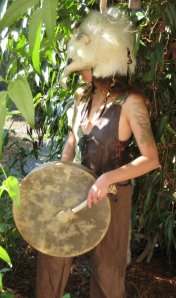
Black wolf headdress by Lupa, 2012

And we need to look at why we feel so free to use plant and fungus parts in our spirituality as well as our mundane lives without the care we tend to give animal parts. Most animal spirituality practitioners don’t have their primary connection to the spirits and totems through hides, bones, claws and such, and some are appalled by such things. Those who do work with animal parts very commonly engage in care for the spirits of the remains, and see the remains themselves as sacred and not to be wasted. Yet both fresh and dried leaves, flowers, roots and other parts are commonly utilized in everything from incense to sachets to ritual food, without the same care we see given to animal parts. But just because a life was not lost in the procuring of herbal leaves does not mean a sacrifice wasn’t made. Plants still need to use energy and resources to regenerate what was taken, and the wounds can still become infected and kill the plant long after we have taken what we wanted.

We still take the plants and their totems for granted by thinking of them as ingredients in a way most of us would not think of animal remains. Yes, there are magical practitioners who engage the spirits of the plants, and their totems, with the same level of care and reverence, and gardeners often feel as strongly for their plants as they would for animal pets. There are those who give a thanks and offering, not just to “the Earth”, but to the plant itself, when collecting leaves, berries, etc. But there are still plenty of people who throw dried herbs into a sachet only thinking of “magical properties” that can benefit them, not where those leaves came from.

We need to treat plants, their spirits, and their totems with more regard and reverence than we have. We need to stop only approaching them with the mindset of usefulness and consumption, and confront our biases and human chauvinism. We need fewer herbals that treat plants and fungi as our personal medicine cabinet, and more thought toward dried herbs as sacred remains.

We’ve been doing well overall, we totemists and neoshamans and animists, with being less anthropocentric in our work with animal totems and spirits. Let’s start extending that more to the plants and fungi in our world as well.

Black Morel as Fungus Totem

Pity the poor mushroom. Whether in spirit or in salads, this soft, squishy living being often gets lumped in with “plants”–at least if it’s edible or pretty. After all, a lot of people don’t want to think that the tasty portabella is of the same kingdom as ringworm (even if they’re only very distant relations).

Yet it is very important to remember that fungi are their own beings, without chlorophyll or flowers, and transmuting the nutrients of the soil in their own way. While they share some characteristics with plants, they are in fact more closely related to animals, believe it or not.

Still, for purposes of my work, I’ve been expanding my awareness of my bioregion not just to the plants, but to these other relatively quiet beings that attach themselves to a spot and stay there (generally) for life. They’re oddly compelling, with their almost alien appearances, and their ability to spring up quickly, sometimes literally overnight. I’ve seen colorful shelves on nurse trees in the forest, and carefully picked my way around little brown “umbrellas” on the dew-covered lawn early in the morning. In my home, too, they’ve made their presence known, whether in baking yeast or in the black mold that plagues many older Pacific Northwest buildings.

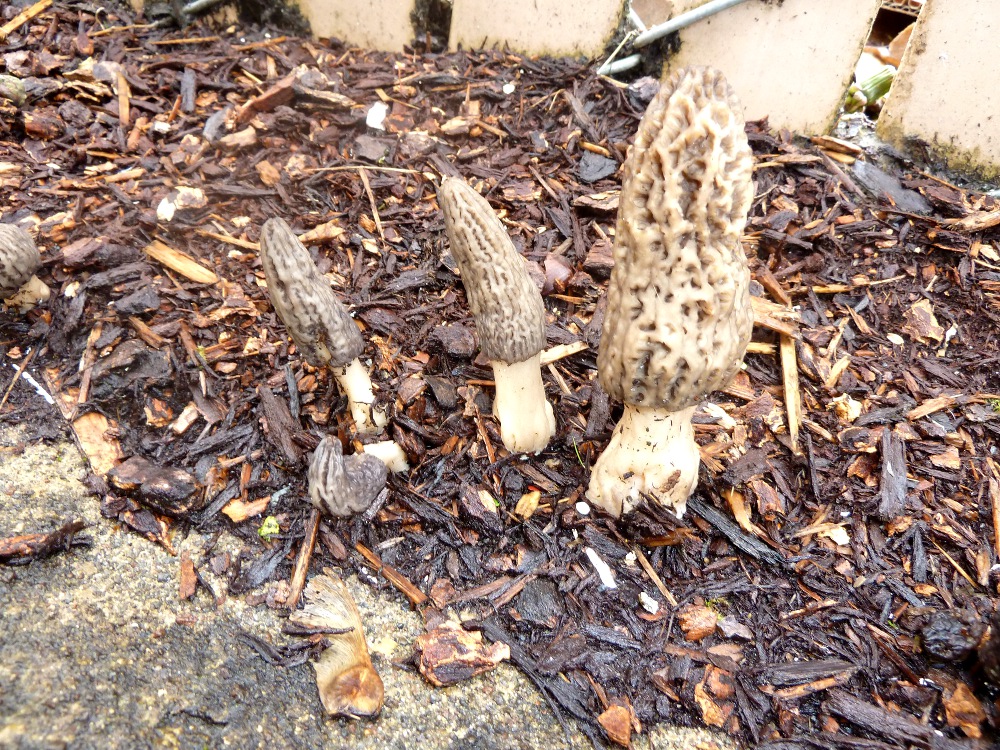
One fungus in particular made a recent appearance, not just in the flesh as it were, but on a totemic level. Every week I clean a set of buildings owned by my rental company in exchange for a rent reduction. In the back of one of the buildings is a strip of mulch between a sidewalk and a fenceline; no one really does much there other than go out to smoke, and it’s too far away from the landscaping to ever get any real care (to include chemicals). Several weeks ago, when Portland was still having its wonderfully rainy spring, I happened upon several rather wrinkly, golden-brown mushrooms in the mulch. A few had already been stepped on and the ground around them was littered with cigarette butts, so I was reasonably sure no one was particularly concerned about them (never mind actually knowing what they were).

I, on the other hand, was incredibly excited. After triple-checking their identity, I went back and collected the mature mushrooms, and a few weeks later gathered a smaller bunch before the rest were trampled. I ended up with about two pounds in total by the time all was said and done, a very good deal given that these can fetch a pretty high price!

See, morels are notoriously difficult to cultivate. You can spread spores on a log like other mushrooms, but this particular species is quite finicky compared to others. The wild spawning sites of morels are very closely guarded by those who know where to find them, and even then not every spot will have morels every year. Hence the high price these command at markets.

So it was no small thing that I managed to procure so many of these mushrooms at no cost other than my research and effort. In the process of carefully cleaning and preserving the morels, I worked with the totem Black Morel. Not surprisingly, this totem commended me on taking the rare opportunity I stumbled upon. Like the mushrooms themselves, I had a small window to act quickly, I made the most of it, and was rewarded for my efforts. I learned more for the future, too, both for that particular location and research for future morel hunts.

And this is a pattern that has resonated in other areas of my life. Part of what has helped me be successfully self-employed has been the ability to see a good opportunity when it presents itself, and being willing to go out and search for even more if need be. I’ve taken chances in relationships as well, and while I’ve had my fair share of upsets, I’ve generally come out ahead, with a long history of wonderful partners and lovers.

I’ve also learned caution. Just as a morel won’t come up if the ground is too dry, or conditions are otherwise unfavorable, I’ve also learned when to wait, and when to cut my losses. Not every time is the best to act, and timing choices right—whether in business, love, or culinary activities—is crucial to success. Caution in information is also a must-have. While morels are one of the easier mushrooms to positively identify, there are a few poisonous look-alikes, and even morels can be toxic if incorrectly prepared.

These are the places where Black Morel and I connected, and while we’ve only had a little time to work together since we first formally met, the combination of knowing when to take action and when to wait has been something we both value deeply. Black Morel has already helped me to be more resourceful in my everyday life, and has helped me hone my awareness of the opportunities around me. Not surprisingly, I’ve even had a few unexpected windfalls and offers come my way in the past several weeks.

In return, Black Morel has simply asked me to treat hir children well when I pick them, to leave some to spore for the next season, and to always prepare them with care and reverence. S/he seems to enjoy watching me and helping me with the ongoing balance of “act and wait”. As they say, I believe this could be the start of a beautiful friendship.