The Goddess Anput

While I’ve been creating ritual costumery and other tools out of hides, bones and the like for over a decade, more recently I’ve been getting into more elaborate projects. One of my most recent endeavors was a ritual costume in which I had a surprise spiritual experience–well, unexpected, but not entirely surprising. Here’s what I wrote about the experience at the time, just about a month ago:

Tonight, a Goddess found me.

For many years, I have acknowledged Anubis–Anpu–Yinepu–as the God of dead things, related to my art with the remains of animals. And he has watched over my work in the background, quietly, only occasionally coming forth to speak if he feels the need to add a bit of guidance. But still…so distant.

Then the day came when the hide of a black coyote came into my possession. Even having lived and died a half a world away and thousands of years past the jackals of Egypt that gave their form to the God, this coyote carried that energy, inexplicably and completely.

Almost.

Except this coyote was female, and held onto that beyond death almost defiantly. And through that skin spirit, Anput made Herself known to me. Where Anpu had been distant, though not uncaring, Anput settled Herself down in front of me, and in the same way Artemis had done so long ago when I was younger, She looked at me and said “Doesn’t something look familiar?”

Familiar? How could I even know what to look for, when I knew not Whom I beheld? I knew scant little of her, as did anyone today–the feminine aspect–some said wife–of the better-known Anpu, had had little surviving lore and few adherents today. “Goddess of the 17th nome of Egypt, with the standard of the jackal” told me little.
And so I returned to Her, perplexed. And before I could say a word, She saw my confusion, and She spoke. “I am the Goddess of funerary arts. When the stones were carved into the faces of pharaohs long-dead, My hand guided the chisel. When each set of canopic jars was formed, I shaped each detail and applied every stroke of the brush. And now, when you weave hide and bone into sacred art, My hands wrap around yours, and I see the work through your eyes”.

The black coyote then wrapped around my shoulders, wishing that I would prepare her to move on to the next person in her afterlife, for, as for so many, I am only a threshold, a transitional point. And so we enmeshed ourselves, for three days and nights, in the sacred preparation and creation of what would carry a piece of each of us.

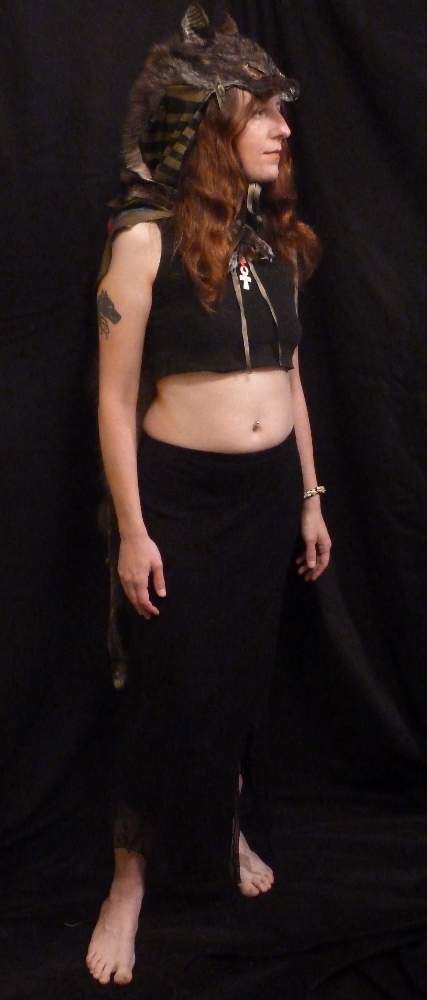
And at the end of the three days and three nights, I wore a cloak upon my shoulders, with the sacred mantle and hood as the Goddess directed me and as the black coyote concurred and as I created. Khepri stretched his wings wide, and the name and standard of Anpu—Input—cascaded in hieroglyphs.

This, then, was our inauguration, the Goddess and I. The black coyote would go forth as Her emissary while I would remain here and continue the sacred work as I always had, only with the consciousness of She who guided me.

***************

This headdress is dedicated to Anput, the female counterpart to Anubis. It is in no way meant to be an authentic replication of any traditional Egyptian creations, but is instead a hybrid of my own style mixed with elements inspired by a very general Egyptian aesthetic, guided by sacred inspiration (and many pictures of old statues and paintings from various dynasties!).

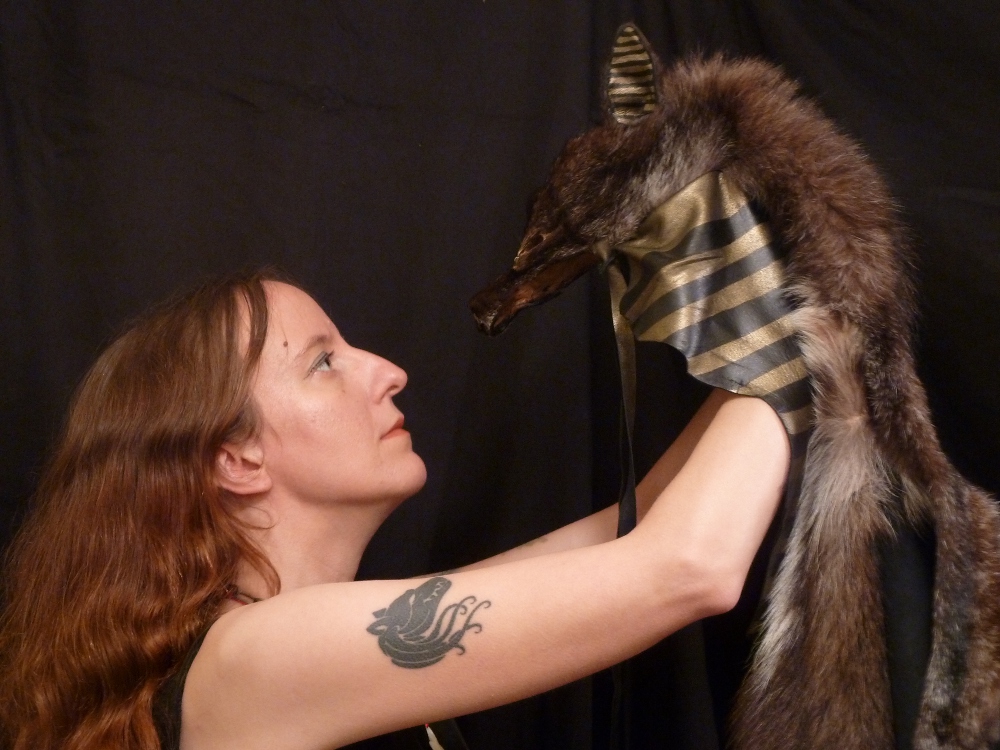
This headdress is based around a black (melanistic) coyote hide; this is a rare, but naturally occurring mutation in this species. This particular hide came from a small female, black with a white blaze on her chest. She is complete with all four paws and claws; the only piece missing is her lower jaw, which was removed for the purpose of this project. Her ears and face have been reshaped to a more natural appearance; they were originally rather flat and misshapen, as many hides are after tanning. Her face has been given painted details, to include hold around the eyes, and gold accents on her nose. I inserted gold and black leather in her ears to mimic the striping often found in the ears of depictions of Anubis.

The leather is one whole tanned lambskin hide, dyed black, and then with an overlay of gold on one side. It forms the side panels of the hood, again striped, as homage to the Nemes headdress that Anubis and other deities were commonly depicted wearing; there are very few images of Anput Herself that remain, and as I was working on this inspired piece this is what She indicated She wanted.
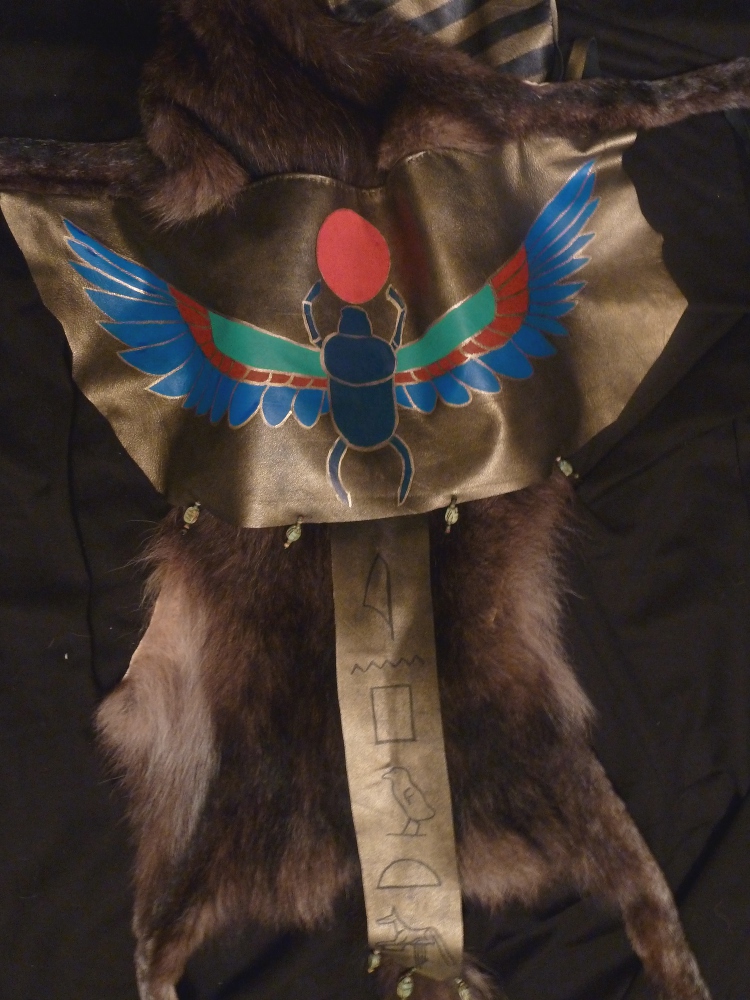
The mantle over the shoulders was the most difficult portion of this. I drew out the scarab and wings with a black fine tipped paint pen, and then colored it in with acrylic and oil paint pens in two shades of blue, green, and red, and detailed in gold. I tested all these on a scrap of the same leather to be sure of the colorfastness. The hieroglyphs descending from the mantle read “Input”, an alternate of Anput’s name, and below that is the standard of 17th nome (district) of Egypt, over which She reigned.

The beaded accents on these leather pieces are a combination of new (reproduction) faience scarabs, and genuine old Egyptian faience beads (exact dynasty unknown). Each one of these dangles is about 1 1/8” long.

The headdress ties on with straps under the chin, and the forelegs also are tied together with more leather strappage. It is one size fits most; for scale, I am 5’4” and 115 pounds.

This project did take me the better part of three days and nights with only small breaks. It is by far one of the most ambitious pieces I have done, and represents a shift to more elaborate and involved crafted artwork.

***************************

In the weeks since I created this headdress, Anput has been a quiet but strong presence in my workspace, and she has actually brought Anpu Himself forward more as well, not that I should be surprised. The feeling I get is that they are aspects of each other, rather than spouses, though perhaps the distinction isn’t so strict. Sometimes I work with them both, sometimes Her alone.

And as I work with the Divine in my art, I am beginning to feel the inklings of others who wish to have creations in their honor. I have long done this work with totems; every piece I create has been a tribute to the species’ totem as well as the individual animal spirit, whether a full dance costume, or a simple leather pouch. But there are other beings stepping forward now, adding yet another layer to what I am creating.

And I’m very much looking forward to seeing where this will take us all.
******************

Just as a side note, the Anput headdress is not meant to stay with me, nor are the rest of the creations I will be making. The Anput headdress may be found here on Etsy. If you are interested in giving this work a home, or in commissioning your own art, please feel free to contact me.

Douglas Fir as a Plant Totem

Note: This is part of the Animist Blog Carnival issue TREES, hosted by naturebum.

Most of the totemic work people do is with animal totems, and admittedly I am biased in favor of them. It’s not that I haven’t done work with others, but I just think to talk about the critters more. That, and the plants tend to be more subtle in their communications. Animals–we’re loud, and impatient, and move around a lot. (Well, most of us. Sea anemones and sloths are on the low end of that curve.) Plants, on the other hand, are more deliberate and patient. And they often whisper. Volume didn’t really have to be much of a thing until there were beings that didn’t send their roots into the great, intertwined network under the surface.

And I’ve found plant totem work to be focused on different priorities than the animals’ ideas. Animal totems seem to want to be dynamic, bringing change and motion and growth. Plant totems, from my experience, tend more toward rooting the self deeper in the now, what you have to work with right this moment, maximizing the use of immediate resources before expending the self to find more. Not that this particularly surprises me; these preferences in focus mirror the very nature of the beings and their totems themselves.

Douglas Fir is one of the most prominent plant totems in my life right now, and as I’ve been working with it I’ve been reminded that I haven’t really written about this part of my spiritual experience. In a way I’ve treated the plant totem work like a long hike in which I ooooh and aaaah at the occasional sighting of an animal, but see the trees and other plants as merely the backdrop. (Which isn’t the case when I’m actually hiking; I take lots of pictures of flora that fascinate me.) I’d like to start changing that and talking more about the plant work I’ve been doing over time. So allow me to introduce you to Douglas Fir.

I am not a native of Oregon. I was a military brat, and did much of my growing up in the Midwest, not arriving in the Pacific Northwest until early 2006. And, beyond that, I am not even a native of this continent; my family primarily emigrated here in the second half of the 1800s, and I was born on an army base in Germany–technically US territory, but not of this continent.

Occasionally this non-native status rankles a bit. I am well aware of the impact that European immigration and invasion of this continent had on the peoples who were here before (and are still here, despite attempts to erase their presence and acknowledgement). And I have heard the complaints from native Oregonians about the influx of people from out of state flooding this area in the past couple of decades as it’s become more popular a place to move (even though right now the job market here is still pretty well tanked).

Yet I am acculturated to this place. I didn’t have a choice in my upbringing, and although there is certainly something to be said for being an ex-pat, it is easiest for me to simply stay in the country where I have citizenship. And I like it here, especially Oregon. The Midwest wasn’t nearly as nice a fit culturally (though the Land liked me a good deal, and I love when I get to go back to visit family as well as places).

This mixed relationship to the place and the people may be part of why one of the first plant totems I connected to out here was Douglas Fir. Douglas Fir is a native species, but the trees’ relationship to the Land here has changed dramatically since the arrival of Europeans. As people began to clear the forests more for agriculture and farming, the opportunistic firs replaced other trees in the succession of forest regrowth. And because the firs grow so quickly, they’re a common seedling chosen for replanting logged areas to maximize profit, making their presence much more pronounced than before.

Both of these factors have homogenized much of Oregon’s forest land to one degree or another. While other native conifers such as Western hemlock or red cedar do still grow here, in many places they’re out-competed by the fir. Even some oak savannahs, highly rare any more in this state, experience firs as an increasingly invasive species.

This, of course, was not solely the doing of Douglas Fir, even with the trees’ competitiveness for resources after forest fires and other nonhuman disasters. The intervention of humans has often resulted in much more dramatic effects on ecosystems. And in the same way, I did not choose the accident of my birth, though I have decisions as to where I live and how I act as an adult, to include attempting to integrate into a different culture (even if I can never completely lose the markings of the culture I was raised and socialized in).

So Douglas Fir has been helping me to not only adjust to living in this place that I have decided to make my long-term home, but also to explore the various ramifications of that decision. There’s a certain level of responsibility that I need to keep in mind as I am here, and what it means that I have consciously made this my home. Who have I affected in this decision? How can I be a part of the community without being obnoxious and even harmful? And, more abstractly, how can I combine my work with social justice with my spiritual path?

These are just some of the things that Douglas Fir and I have worked together on. Fir is more of a presence than an active guide, providing a steady energy to tap into and a quiet reminder of connectivity, but it’s all very grounding to my little animal mind.

And so you have just one example of how my totemic work has extended beyond my fellow critters. I’ll try and talk more about it as time goes on.

(P.S. My friend Paleo has done a bit of writing on more domestic plant totems over here.)

Deconstructing the Totemic Guided Meditation

I’m still finishing up the book manuscript, but I wanted to take a break from writing to do some writing.

…wait, what?

Anyway, had this post idea come up and since it’s not going to take long to write it out, it gets to be my break from the much bigger, longer piece of writing.

I’ve been thinking about the structures within modern non-indigenous–neopagan, as I prefer to call it–totemism. One of the most common structures is that of the totemic guided meditation. There are countless examples of this; almost every book on animal totemism seems to have some version of it, and even Michael Harner included his own take in The Way of the Shaman in the chapter about finding a singular power animal. And yes, I wrote my own iteration of it several years ago which you can see in its entirety (and even use if you wish) here; it ended up as an Appendix in Fang and Fur, Blood and Bone, my very first book.

So–this thing gets around a lot. Why? because it’s effective. As I have maintained in numerous places, the guided meditation gets a person in direct contact with a totem, but without suggesting a specific animal from the get-go. It’s better than totem cards because you’re not limited just to the animals in the deck. It’s an improvement over having someone else “read” you, because there’s no intermediary to potentially miss something in the translation or add in their own biases. And it allows you and the totem to explore and establish your own unique ways of interacting with each other from the beginning.

The totemic guided meditation also offers you a relatively “safe” place to visit with totems. One thing I discovered early on in this whole Therioshamanism thing is that unlike proper journeying, which takes you deep into the spirits’ territory itself (which can be quite dangerous), guided meditation creates a sort of neutral zone that’s more mediated and less likely to present any dangers. However, it still allows for free-form exploration and communication, assuming it’s not such a rigidly structured thing that even the dialogue is scripted!

And while most totemic guided meditations are supposed to only have you meet your totem, I have found that the same meditation, slightly tweaked, is also quite effective for continuing to use the “neutral zone” to meet with the totem for ongoing work together. It’s simply a matter of going into the meditation with the intent of talking to a specific totem, instead of leaving yourself open to meet any totem, if that makes sense.

So let’s look at the different parts of the basic structure of the totem guided meditation:

The Entrance: This is usually a hole of some sort, either in the ground or a tree, but I have also had people that I led through the meditation travel through a hole in the clouds, or in ice or other water; these were their creations, not my suggestions, as I don’t specify exactly what the entrance should look like. The entrance is the starting point, the threshold between this world and the next. Once you’ve taken that first step in, you’re on your way.

The Tunnel: Traveling through the tunnel is a transition; it allows both the mind and the spirit to make the changes from the waking world to the neutral zone the person is going to visit. The tunnel may be in the ground, through trees, water, etc. It may look the same the whole way through, although the interior has also been known to shift in appearance and even size the further one gets from the waking world. The tunnel is a necessary component in the meditation, because it allows for a gradual and smooth adjustment in consciousness and spiritual state, rather than a sudden, jarring shift. For someone brand new to guided meditation, just spending time traveling down the tunnel, turning around, and then coming back can be good practice in maintaining a basic meditative focus, without the additional pressures of being in a complex new environment. The tunnel is relatively simple, and generally only goes two ways, so it’s easy to come back home as needed.

The Neutral Zone: This is an open arena where the person can explore the environment and see what totems may present themselves in first time through, as well as a known location for continued work. It is nonphysical in form, but it is a midway point between the person’s psyche, and the external spiritual world (though the boundaries between the two are often very blurred). While Harner has people stay in the tunnel, or rather, the tunnel becomes the neutral zone, I like to have people come out into an open environment where they can meet their totems. Again, as with the entrance, I allow people to picture it for themselves, rather than suggesting a specific place. This is because I don’t want them to have expectations of what animals they should or shouldn’t meet; for example, if I tell them to come out in a Pacific Northwest rain forest, but their totem is Koala, then they’re less likely to make the necessary connection. I also suggest that people explore while they’re there so that they can find the place again later. Additionally, since it is a mediated setting, people do have more control over what happens there; for example, I tell people I’m leading in meditation that if they ever lose the tunnel and need to go back quickly, all they have to do is look down at the ground at their feet and the mouth of the tunnel will appear there, and they can go right back home. Finally, it’s important to note any changes made to the neutral zone, whether within a given meditation, or over time. They may reflect changes in the totemic relationship, or even the location of the place in relation to the spiritual world (for example, if the neutral zone starts slipping deeper into spiritual territory, it may take on a wilder, more chaotic nature).

The Animal Totems: In the deconstructed guided meditation, the totem is the goal, the manifestation of the intent. Finding your totem often implies success, though I wouldn’t interpret things that strictly, personally–there’s a lot that can go wrong even if you find your totem, and a lot that go right even if you don’t. I’ve elaborated almost ad infinitum elsewhere about what your totem can be, but it basically boils down to: pretty much any animal species has a totem, you’re not limited to a certain set number of totems, the number of totems you have throughout your life can change, not every totem is permanent, and yes, I consider extinct, domestic, and mythological animals to still have totems, albeit totems with a much different perspective on the world we live in. A totem is an intermediary between its species and the rest of reality, to include human beings, though contrary to some approaches to totemism, we are not necessarily the center of a totem’s purpose for existing! (In other words, totemism isn’t just about “Get a totem to make your life AWESOMER!”) What role the totem plays in a person’s life varies from individual to individual; some see them as primarily symbolic, while others spend their lives working totemism as a daily spiritual practice. Again, this meditation can be used to either find a totem for the first time, or continue meeting with it. Just start each meditation with the appropriate intent, even perhaps saying something like “I am going to travel to meet my totem for the first time,” or “I am going to go meet with [name of totem]” before going through the entrance.

The Tunnel Back: The trip back to the waking world is just as important as the trip down the tunnel in the first place. It allows the person to integrate their experiences during the meditation, as well as readjust to being “awake” again. Most people tend to come out of the meditation too quickly, and spend their time grounding in this world with food and other physical things. While this is not bad, I feel it speaks of impatience, and doesn’t take full advantage of this important transitional stage of the totemic guided meditation. I recommend that if you do this sort of meditation, try to spend as much time coming back through the tunnel as you did heading down it.

Troubleshooting: If you’re new to meditation, or if you aren’t a very visual person, you may have trouble staying “in” the meditation long enough to find your totem. If that’s the case, try (as I mentioned above) just exploring the tunnel for a while, then graduate to just exploring the neutral zone a few times without the intent of looking for a totem. Stay in as long as you can before you feel you can’t focus any more, though do try to give yourself time to travel back through the tunnel and make a smooth transition back to being awake. If you’re doing a meditation to find a totem for the first time, and no totem shows up, or isn’t clearly your totem, give yourself a break for a couple weeks at least, then try again. If you are unsure of whether an animal is a totem, and you can get close enough to talk to it, you can always try asking whether it’s your totem or not. Also, while most people only encounter one totem at a time, it’s not at all unheard of to meet more than one in one meditation, and in fact there are some meditation structures, such as The Personal Totem Pole Process, that are created around meeting and working with multiple totems at once. If you end up with a totem you’re not comfortable with, don’t fear the worst. Sometimes it’s the animals that scare us that can really teach us; same thing goes for the ones we think are gross, or not particularly flashy. Conversely, if you get one of the “popular” totems like Grey Wolf or Tiger, don’t assume that you’re just being egotistical. Let things play out as they will no matter what totem shows up; in the end, you’re the one who gets to determine whether an experience was valid for you, not some internet peanut gallery.

…and there you have it–a basic explanation not only of totemic guided meditations, but part of what makes them work. There’s a lot more I could say, but this is just a quick break to give my mind some rest from the big, long, kinda scary book manuscript I need to finish up! I’m open to any questions about this post, if ya got ’em 🙂

Some Totemic and Related (Rambling) Thoughts While Writing

I have a few comments on other posts that I haven’t yet approved and replied to; it will happen, and thank you for your patience. In the meantime, I have put the better part of 10,000 words into a chapter on bioregional totemism for my next book, Neopagan Totemism. I had some random thought-tangents that I jotted down here as an aside.

**************

I haven’t talked a lot about my work with bioregional totemism, but I should. It’s been a crucial part of my work especially since moving to the Pacific Northwest, and especially Oregon.

Scrub Jay and Steller’s Jay are good examples. They’re the two local totems I connected with first. Scrub Jay made a bunch of noise as soon as I landed safely in the inner northeast neighborhood of Portland that I call home. Sitting in my apartment in an old Craftsman house, I was quickly introduced to the “VWEEEEET! VWEEEEET!” of this cocky asshole of a bird. Since then, he’s helped me to become a part of Portland, both in navigating the human territory (hey, somebody’s gotta speak out against the epidemic of passive-aggressiveness here, and who better than Scrub Jay?), and in reminding me that even deep in the city I am surrounded by, and a part of, nature. Every time I start perceiving myself as detached from nature, along comes Scrub Jay to smack me out of that notion.

And then there’s Steller’s Jay. Not quite so pushy, and more prone to showing up in the forests and mountains, this totem is to the wilderness here what Scrub Jay is to the urban areas–a reminder of the balance of humanity and the rest of nature. Unlike many animals, Steller’s Jay isn’t so shy of humans that she won’t make an appearance on the trails, and her beautiful coloring easily catches the attention and acts as a portal to just how amazing her home really is. I even had art of her commissioned a while back (and at some point when I have some spare funding I need to get a companion piece of Scrub Jay).

I’ve connected to others since then, but these two were the first to welcome me here.

**************

We need to give ourselves more credit as a species. I see a lot of kowtowing to deities and other spirits only because they’re supposedly more powerful than we are. And yes, in their own bailiwicks, they can be pretty impressive. I stand in awe of Mt. Hood every time I see it, and all it’s apparently doing to the average eye is sitting there, being this massive mountain in the landscape. However, just because we don’t have the sort of magic that shoot fireballs from our fingertips doesn’t mean that we aren’t impressive. I think between the ubiquity of technology, our general understanding of how it works (as opposed to the mystery of magic), and the tendency to see technology as “evil” because some of it has had negative side effects (or intended effects), we really downplay what power we do have.

Technology, art of all kinds, spirituality–these and more really are testaments to our ingenuity and adaptability. We are apes with huge brains and opposable thumbs that we evolved as a response to environmental pressures, and we’ve utilized these developments to unprecedented levels. And yet we have myths of technology and art as our downfall. Icarus fell into the ocean and drowned because he tried to fly too high with his wings. Ariadne was turned into a spider because she wove better than a goddess. These and more discourage us from climbing higher.

Yes, we need to be very aware of the effects of our works. Climate change is, perhaps, one of the greatest examples. But look at our everyday lives. We don’t have to spend all winter in chilly homes where we huddle around a fire or temporarily warm warming pan for bits and pieces of comfort. We can heat an entire home to seventy-five or eighty degrees if we like, even if outdoors it’s below zero. The methods we use to do this need to be reengineered to not destroy the environment, but for fuck’s sake–I can walk around naked in my bedroom at three in the morning when it’s twenty degrees outside, while communicating on the computer with people around the world I’ve never met face to face, about stopping human rights violations in another place none of us have ever been to. I am alive because of good nutrition, and if it weren’t for antibiotics I would be dead multiple times over.

If that’s not power, I don’t know what is. And to only look at the negative effects is to disempower us, as much as the idea that our power is lesser because we know where it comes from. There may be deities of different sorts of technology and other creation, but it’s human hands that made it happen. We can be both powerful and responsible, but part of that is owning our power without shame, because shame makes us want to hide things, and hiding things is what leads to the sorts of problems we face today. By reclaiming our power responsibly and transparently, without shame or degradation, we can take a more honest assessment of the baby and the bathwater of the human condition.

***********

If having wildlife not run away upon your approach means you’re somehow spiritually advanced, then being swarmed by mosquitoes or rabid raccoons must be a sign of Bodhisattva status. Mosquitoes in particular are the messengers of the gods, carrying precious droplets of blood and malaria to the heavens. Every itch is a deity’s whisper of thanks, and the sacred scratching we respond with only serves to open our veins with further offerings of life.

Or something like that.

But seriously: Snow White is not a role model. This is not a Disney cartoon. I want the animals to run away. It means they’re healthy, and they don’t see me as a source of food. (Especially grizzly bears. And mountain lions. And mosquito swarms.) I am a lazy ape. If they’re doing the part of running away, it saves me the effort.

(Also, my tendency toward multiple instances of almost being run over by startled elk does not mean I am an Elk Shaman. Probably.)

Skindancing: Shapeshifting Dance

You know how I got into making totem dance costumes in the first place? It’s because I wanted to dance in my own wolf skin! My old grey wolf skin, shown in this post, has been with me since about 1999. However, I didn’t start dancing with him until 2002, when I started going to pagan festivals. I had no one to show me how to wear him, so through a process of trial and error I figured out how to properly split him to wrap him around me, plus trying to find the best places to put the various leather straps to distribute the weight. And then I had to figure out that whole shapeshifting thing–not physically, of course, but allowing the spirit of the skin to “ride” my body, even as I felt, for the moment of the dance, what it was like to see through the eyes of a wolf. And I want to be able to share that with you, so here’s a brief tutorial on how to make it happen.

First, you need to know what skin you’re going to dance. You may, like me, prefer full skin dance costumes. However, that’s not necessary; you may be working with a headdress or tail, or even just a small skin pouch. You don’t even need actual animal parts–even vegans may participate in skindancing! What’s important is how you connect with the skin spirits, regardless of their “housing”.

If you’ve never talked with the skin spirits before, I wrote out my own method here; it may be useful to you, though you may find your own personalized way as well. Being able to connect with the spirit, whether you see it as a literal being or not, is crucial to shapeshifting dance. So before trying this more advanced practice, spend some time getting to know the skin you’re going to dance with. It’s especially important to be able to tell when the spirit is or isn’t wanting to work with you at a given time, because you’ll want to ask permission each time you want to dance with it or otherwise work with it.

Once you have a good working relationship with the spirit, it’s time to try it on for size. A pouch will probably hang with no problem around your neck or from a belt, though it’s best to have at least some physical contact with it. However, something larger may take a little practice to get it to fit just right–every person’s body is shaped differently, and so one person may have to wear the same headdress further back or forward on their head than another one. So before you even get out to the dance circle, spend some time just wearing the skin in your home and learn to adjust its fastenings and your movements as needed.

If you haven’t danced much before, or you’re not feeling quite sure of yourself, you can try dancing at home as well. One thing I recommend to people is to either watch the actual living animals in the wild or at a zoo or wildlife park, or watch videos of them, to see how they move. Then imitate that to the best of your ability. In many cases we simply aren’t able to move in the same way–we can’t fly, for example–and you may have physical limitations particular to you that need to be factored in. Never fear–it’s not about perfection! Again, the connection is what’s important.

And that’s the other half of this practicing–you want to invite the spirit to be a part of you, and allow you to be a part of it, during this dance. For a while, it may just be you moving around, concentrating on just “getting it right”. However, eventually you may find that you can feel the spiritual boundaries between you and the skin melting away. (This is why I don’t line any of the dance costumes I make, other than as needed to strengthen older hides. Direct physical contact with the skin helps facilitate spiritual connection as well!) Take some time to keep practicing and getting to know each other as dance partners.

You may also find that the totem of the species you are dancing, as well as the individual spirit of the skin, may come to dance with you. This can be a VERY powerful experience, but it can also differ from just dancing with the skin spirit. It’s easier to get overwhelmed, but it’s also good practice in deeper spiritual connections and invocation. Have a plan to get out of the trance and ground yourself if things get to be too intense; generally speaking, a totem will leave if asked politely, at least in my experience.

Once you feel ready to do this in a group setting, such as a drum circle at a pagan gathering, there are a few things to be aware of. You may find yourself distracted the first few times you do this, either by trying to not get stepped on by other dancers, or being overwhelmed by all the drumming, or overheated by the fire. (If you’re wearing a full skin dance costume, wear as little clothing as you can and still be decent in the given setting–a swimsuit, for example. Yes, even in cool weather–fur and fire will make you warm in no time!) Don’t worry; it happened to me when I was first starting out, and I still have recent experiences where someone bumped into me and knocked me out of trance. That’s another thing–know who you can go to if you need some help grounding. Taking the skin off breaks the connection, but it won’t necessarily get you back to your baseline headspace. If there are no professional fire tenders, have a friend or two there who can help you come back to yourself.

An important note: Be aware of the animal’s behavior versus your own preconceived notions! I have seen people use skindancing and other shapeshifting practices to act out–basically using the imagery of Wolf to excuse their inability to control their own anger and aggression, for example. How much of yourself are you projecting onto the animal? How much aggression does the animal actually use on a daily basis versus what popular media states? Wolves can be aggressive, but they’re also highly social, and the pack hierarchy is much more relaxed in the wild, as opposed to in the sorts of captive refuge situations where a lot of observation has taken place. (Captive wolves tend to exaggerate the hierarchy due to being in such close quarters.) So dancing Wolf isn’t just about being a snarling beast embodying all the animal qualities we humans tend to repress; it’s also about being loving and playful and sleeping a lot after a big meal!

You don’t have to restrict yourself to just one animal, either. I primarily dance Wolf, but I have also dance Bear, Deer, Buffalo, Leopard, and many others. And even if you dance multiple skins of the same species, get to know them as individuals. Some like dancing more than others, and some just prefer special occasions.

There’s a lot more to this, but these are the basics. If you want to know more about my work with skin spirits, feel free to read more of the entries in the Skin Spirits category of this blog. You may also purchase a copy of my book, Skin Spirits, in the bookstore portion of my website. And I’m always happy to answer questions and give feedback as my time allows 🙂

Wolf and Environment

For a number of years now, the grey wolf has been the primary North American charismatic megafauna to be associated with the environmental movement, particularly that involving preserving wilderness habitats. Beyond the environmental movement, wolves capture imaginations (and cliches) like no other animal in the American consciousness, from werewolves (both scary and…uh…well, not quite sparkly) to truck stop t-shirts, and then some. Unfortunately, attraction in the symbolic value of wolves doesn’t always translate to care for the actual physical animals; I’m willing to lay odds people spend more money on wolf statues and shirts and other tchotchkes than they do donating time and/or money to nonprofits that work to preserve wilderness, or contacting their elected officials about wilderness and wildlife protections.

And because Wolf is such a popular totem, s/he’s often taken for granted. It’s gotten to the point where some people are reluctant to admit that Grey Wolf is their totem because so many others essentially choose Wolf because s/he’s “cool” (to borrow an idea from this excellent essay by Ravenari). And, bringing things back to the environmental movement, I’ve heard environmentalists stereotyped by more conservative factions as “just people who think wolves are puppies and trees need hugging”. Which can make it tough sometimes to admit either being an environmentalist or liking wolves/Wolf the totem/etc.

To be fair, there are reasons for the sparkly stereotypes. There are environmentalists who think that all you need to do is recycle your old newspapers, or who are convinced that everyone needs to get off the grid and be vegans. And there are people who claim Wolf as a totem who never go any farther than that claim, and maybe reading the entry for Wolf in Animal-Speak (not no actual books about wolves). Sometimes people grow out of it and get more critical thinking skills or depth of understanding; others simply stay put. Either way, Wolf often becomes a mere mascot for surface interpretations of pretty complex topics. But that doesn’t mean that there is no value to the Wolf = environment connection.

For example, I was reading about how wolves are not only hunters but skilled scavengers as well. Hunting is dangerous, especially when it comes to going after big game. The payoff is better in the amount of meat, but the risk of severe injury or death is significantly different between hunting a rabbit, and hunting an elk. And carrion is even less dangerous, as long as it isn’t too old and moldy. So what wolf, needing to eat out in the wild to survive, would turn down an easy meal? Yet scavenging isn’t seen as sexy in American culture, other than in certain subcultures where the DIY (do it yourself) ethic is valued. Wolves, in mainstream culture, are usually depicted as ferocious hunters taking down large game, sometimes even supposedly as lone hunters. (Anyone remember that scene in Wolf where Jack-Nicholson-the-werewolf takes down a full-grown deer all by himself–in human form?*) In popular media, scavenging is largely left to the much-maligned vultures (this maligning is largely undeserved, as I explain here).

Human scavengers get a bad rap, too. There’s a lot of pressure in this culture to buy the newest, most bestest material goods EVER. If you buy secondhand, or get things repaired, it’s assumed that it’s because you simply can’t afford anything else, poor you (literally). Yet a lot of the people who apply the Reuse portion of Reuse-Reduce-Recycle to their everyday lives are perfectly capable of buying new–but choose not to. Of course, you have people who have to go that route, whether it’s only being able to buy clothing at Goodwill, or spending a lot of time dumpster diving out of sheer necessity.

So we can metaphorically equate the scavenging efforts of wolves to those of humans, as well as the attitudes toward scavenging–it’s supposed to be invisible in the powerful. At the same time, hunting, and particularly solitary hunting, is seen as the epitome of skill and worth, and so people who primarily make their living at a well-paying day job and throw their money around are seen by many as more successful or important than someone who lives more modestly within their means. The pursuit of the individual paycheck, and the hunt for the big game, is seen as superior to making use of what the “successful” have discarded.

Yet Wolf is an important symbol in all this. Wolf does both, and finds both to be nourishing. Having the skills to be able to both hunt and scavenge means more opportunities than in specializing in only one of those. In addition, scavenging carcasses is a necessary way to prevent the spread of disease, and other effects of leaving dead bodies around too long, as well as requiring fewer deaths overall; it’s good for the environment. Similarly, though for some different reasons, human scavenging and getting the most use out of secondhand resources is also good for the environment by creating less demand for new materials and reducing waste.

So there’s a good bit to be learned from Wolf in all this. Versatility, and not being afraid to do what needs to be done, regardless of what that is, are key points here. Wolf is both Hunter and Scavenger, and perhaps Wolf’s human counterparts may be able to take this lesson and apply it to real-world change.

* Okay, admittedly, Jack Nicholson made an awesome werewolf as far as I’m concerned. However, his awesomeness should not be taken as natural history by any stretch of the means.

Who is Wolf?

The stock definition of totemism that I give, as I experience it, is “a totem is an archetypal being that embodies all of the traits of a given species”. But what does that entail?

Let’s look at Grey Wolf, my primary totem (and probably the most popular one in neopagan totemism).

Wolf is made of the ever-evolving river-flow of genetic code of Canis lupus, which includes a number of subspecies with individual genotypical and phenotypical traits.

Wolf is all of the variety of behaviors, both instinctual and learned, that are exhibited by any and all members of that species throughout its history.

Wolf is the niche that wolves have sculpted into the complex ecosystems they are integral to, reflective of the mutual refinement between environment and inhabitor.

Wolf includes the relationships that wolves have to other species, the dance of death with prey, the standoff with other predators over a kill.

Wolf embodies the relationship that we humans as a species and as individuals have to wolves in the wild and captivity.

Wolf is all the stories we have told, from Lupa the mother of Rome, to the Big Bad Wolf menacing little girls in red and barnyard critters, to personal interpretations of authors of totem animal dictionaries, and the archetypal weavings of Clarissa Pinkola Estes.

Wolf is every piece of art depicting hir children, from cave paintings to natural history illustrations to the fanciful creations (and criticisms) of wolfaboos over on DeviantArt.

Every time a person forges a connection with Wolf, Wolf changes. This is why it is important when working with Wolf (or any other totem) to make a personal relationship, rather than just going to whatever totem dictionary is handy and assuming that’s the answer.

Because Wolf is bigger than that. There’s so much there that narrowing Wolf down to a few paragraphs in an ephemeral paperback is futile. And the only person who can navigate through that collective of information and ideas on your behalf, is you.

Wolf Skin Ritual

Aha! I think I figured out how to keep you folks with RSS feeds from getting slammed with all the pictures! Let me know if it works.

Anyway, today I did the ritual I had planned to retire my old wolf skin and dedicate the new one. Only a few folks showed up, but it was a good group, and it was a really successful ritual overall. I’ve got a full writeup and some pictures to share here–enjoy!

I’ve been dancing with this old guy since 2002:

He was my very first wolf skin, purchased in the late 1990s, and he told me before I went to my first pagan gathering that he wanted to dance with me. So I split him open, rigged him up with some leather straps to tie him to me, and we went out and danced at the fire circle, with great success! Since then, we’ve danced together around numerous circles. Sadly, I didn’t know much about taking care of hides til much later, and between rainy, damp nights in tents, and heat from the fires, he decomposed over time even though his was a pretty good quality tan.

So I recently made the final payment on my new wolf skin, and wanting to have him dedicated before going to a Beltane festival next weekend, today was prime time for making the ritual happen. Here’s a picture of him right after he arrived in the mail:

At some point I want to post a tutorial on how I got him from that to his present state, but now’s not the time.

So I got things set up for the ritual. Here are a couple of pictures of the altar:

There are some items from the permanent Grey Wolf altar in my art/ritual room, along with my Black Bear rattle which I use to call and send home spirits, a fern frond and a turtle shell of water that I use to purify the ritual area prior to ritual, my ritual knife, and a platter with pouches for part of the ritual later on. You can also see the two hides curled up together, and a collection of spare musical instruments, as well as my own drum.

I started the ritual with purification by sprinkling water with the fern, since I dislike smoke and therefore smudging. (Sprinkling water on people is especially fun depending on their reactions. I’m definitely keeping this!) I then called the various spirits and places of the directions to join us, along with a couple of other beings I wanted to invite, Grey Wolf included.

Then I picked up my old wolf skin and carried him around the altar, talking about our history together, how he taught me to wolf dance, and some of the things we had been through. I talked about how it was going to be our last dance together, and that this was a very special event. Then I put him on for the last time, and while the other participants drummed and rattled, we danced around the altar. I could feel how tired and worn-out he is, but he made a good go of it, and we ended it with three good, long howls.

Then I took him off, and I was crying as I did so. I thanked him one more time for the good years dancing together. I laid him out on the floor, and stretched out the new skin as well. I took the leather straps from the old skin and transferred them to the new skin, whom I had previously prepared.

And then I danced the new skin. And I could most definitely feel the difference! This guy was ready and raring to go! We didn’t so much dance as run, leap, pounce, and gambol. (Yes, I said gambol.) It was tough at times to get him to stay focused on the dancing, which was fine–I’m just glad he was so happy to be moving around again. There’ll be time enough to work out etiquette between us. It was good, though, and I’m looking forward to the fire dancing next weekend.

We then took a break to chow down on the potluck goodies people had brought, and enjoy some social time. After that, I had people bring the small leather pouches I had given them, and I cut off small bits of fur from both wolves and put them in the pouches. Mind you, I never give away fur from my personal wolf skins, so this was a really unusual thing–those who got them received very special gifts. And then I closed down the ritual, said farewell to the assembled (both corporeal and otherwise) and went to ground.

I put the old wolf skin on the permanent altar; here’s a pic:

You can see the Brown Bear altar beneath it, and also some assorted ritual and art effects on the floor at the base. No surprise, I’m already running out of room on the Wolf altar.

And while I didn’t have pics taken during the ritual, here are a few pictures of me in the new wolf skin. (No, that’s not my ritual wear–it’s the outfit I wore during the pics I took for the potential tutorial I may do.)

It takes a very large wolf skin to be able to fit over my 5’4″ frame like that. It’ll take some time for us to adjust to each other; I need to fit the straps properly, and add a couple of others. Also, my arms do fit through the holes that his forelegs went through on the front leg skins, but it’s a tight fit. It’ll loosen over time, though. Still, he fits nicely like my old skin did, and we were very comfortable dancing together.

Also, small bit of timing–my period started in earnest while I was dancing the new skin. Given that the moon is waxing, and Artemis has recently come into my life again, and I am a Luperca in the Ekklesia Antinoou it’s an interesting series of convergences to note.

The Quandary of the Other

As I was poking around in my garden today, pulling weeds, turning soil and traumatizing earthworms in preparation for early spring planting, I was thinking about some of the “why” of what it is I’m doing here with this whole shamanic experiment. Because it really is an experiment. I’m testing a whole bunch of concepts, most of which have been tried in varying combinations by other people, but not, to my knowledge, in quite the way I am.

What I was thinking about was an extension of my thoughts in my last column in Rending the Veil, In Defense of the BINABM. Many neopagans and others criticize the fact that Americans (and other Westerners) have a tendency to gravitate toward the Big, Impressive North American Birds and Mammals (BINABM) like Grey Wolf and Brown Bear and Bald Eagle. And even I’ve done the same; hell, a lot of why I wrote DIY Totemism was to help people break out of the idea that those were the only totems with any power.

But I keep finding myself working with these BINABM in my shamanic work, and a large reason is because those are the animals most commonly in our cultural consciousness as being “properly totemic”. Rationally, some of us can realize that other animals have a lot of intense and amazing qualities we can learn from. And we can also realize that we downplay the importance of animals we have domesticated, partly out of guilt, and also out of familiarity. So we don’t really romanticize Domestic Dog, Cow or Pigeon in the same way.

Instead, we look to the totems of animals that many of us will never meet outside of a zoo or sanctuary, and maybe even not then. I mean, I’m a great example. I was only about two or three when my relationship (obsession?) with Grey Wolf began–way before I was cognitively capable of any sort of reasoning or belief. There had to be at least something cultural in there, from all the books (and, to a lesser extent in my case, television) and other media I had been exposed to even at that young an age. There’s something there, and it’s valuable in the practice of meeting people where they are.

See, all those BINABM? They’re one representation of the Other. Generally speaking, in American culture*, the only one I can really speak of with any authority, there’s a pretty severe tendency toward strict duality. We create dichotomies that are sometimes violently opposed to each other, and it’s tough to get people to consider the model of a continuum instead. This leads to a lot of really pointless arguing about everything from men vs. women to science vs. religion to my academic theory vs. your academic theory, in which people throw away the chance for a deeper, more integral understanding of reality in favor of planting a flag somewhere. Anything less than 100% dedication to your cause is seen as weak, untrustworthy.

I do believe there is a place for the concept of the Other, but it isn’t this either/or model. It’s the both/and. Just because I do not see myself as violently opposed to people of other races, cultures, sexes, genders, etc. does not mean I see myself as being the same as them, or being able to speak for them. Far from it. But neither do I see allowing their influence into my understanding of the world as a threat. And it’s the same way with “nature”. I consider myself ultimately to be a natural being; I eat, sleep, breathe, fuck, shit, and do a whole host of other things that require me to be connected to everything else. The fact that there is a city in the middle of my bioregion does not make the bioregion cease to exist. I do have to consider the things that make me different from other denizens of nature, like my frontal lobes, and the adaptations that frontal lobes have helped humans to create. Nature is still an Other, but not one which is entirely untouchable.

These are things I work with in my shamanism, deliberately, for myself and for those I offer my services to. These are the dualities I want to turn into continuums. Spirituality is seen as opposed to materialism. The body is seen as opposed to the mind/spirit/etc. And, drawing on both spirituality and ecopsychology, humanity is seen as opposed to nature. This insistence on either/or perspectives, as opposed to both/and, creates a very harshly delineated “Other”, one which must remain separate at all times lest we taint ourselves. And that includes the “Other” human beings.

At its most extreme, the “Other” manifests in things like deliberate and institutionalized racism, sexism, and other forms of oppression. But sometimes it’s not that intentional. A really good example is in the tendency in both American nonindigenous shamanisms and neopaganisms, and in ecopsychology, toward tunnel visioning on dominant, largely white, culture as a basis. It’s not that white shamans and pagans and ecopsychologists are deliberately trying to exclude people of color. But let’s face it–all of these movements are largely perpetuated by white people, and that’s something we need to be aware of, not in the sense of “well, that’s just who’s interested”, but also what we may be doing that makes these movements seem less welcoming to people of color. It may just be that there’s not enough dialogue about issues of race and culture in shamanism and ecopsychology.

Or maybe we’re uncomfortable bringing up these controversial issues amid our pretty rituals and romantic wilderness idylls. I think Carl Anthony, in his interview with Theodore Roszak in Ecopsychology, really summed up this problem succinctly:

“Why is it so easy for these people to think like mountains and not be able to think like people of color?” (Anthony, in Roszak 1992, p. 273)

He’s referring to the well-known essay by Aldo Leopold, one of the granddaddys of environmentalism and its various derivatives in America. The phrase “Thinking Like a Mountain” has become bandied about pretty commonly among environmentalists and ecopsychologists as a way of reminding us to embrace the Other. Yet we feel it’s safer to deal with an Other that’s more distant–and, perhaps, one that can’t talk back to us so easily. After all, many Native Americans feel patronized and otherwise pissed off when white people claim to have had past lives as Indians, and let’s not get into the horror that is the “guided meditation” to “get in touch with your Native self” (yes, I’ve seen this and variations of it). Clearly we can get away with things like Joanna Macy’s and John Seed’s Council of All Beings in which we speak for beings we assume can’t speak for themselves–like mountains and nonhuman animals. Imagine, though, if we did a Council of All Races, in which a bunch of white people made masks to be like various people of color.

And that’s where we really need to be careful when we’re working with the concept of the Other, and more importantly, our relationship to it. Yes, it’s safer for me to work with abstract totems of various nonhuman animals who can’t complain if I misrepresent them, at least not in the same way other human beings can. But I’m also very aware of the limitations that my ritual work has in working with people outside of my cultural familiarity. As a shamanic practitioner, I know that the whole concept of “culturally neutral” is bullshit. Core shamanism, for example, isn’t culturally neutral. It’s white, middle-class, college-educated shamanism, even if all its practitioners don’t fit all of those parameters. And I know that’s what my shamanism is, too, because I’m the creator, and that’s the cultural background I have.

Here’s the thing. I grew up in a small town in the midwest that was almost entirely white. Then I moved to cities, but still gravitated toward subcultures that again were largely white. So my experience is almost entirely working with other white people, within a culture largely created by white people. Same thing goes for middle class and college-educated. These aren’t bad things, but my experiences are pretty damned limited, considering how diverse the population here is. So I have a lot of Others, as it were.

That’s why I’m training to become a licensed practicing counselor. Especially if I end up in an agency setting, I’m going to be working with clients from a much broader variety of cultural and other backgrounds than what I’ve previously been exposed to. My program is heavily engaged in issues of social justice, which has just helped to make me even more aware of my experiential limitations. It’s not that I’m flogging myself over being a guilty white person. It’s that I realize that my own limitations in dealing with people also limit my potential for helping other people. Becoming a trained counselor won’t automatically give me awesome multicultural skills, but my curriculum has included a lot of information and discussion about how to work with clients with significantly different backgrounds in a way that respects them as well as ourselves. This hasn’t always been a comfortable thing for me, because I have become aware of just how limited my experiences have been and how much I don’t know, but rather than drown myself in white-girl guilt, I’ve instead cultivated a curiosity of “If this becomes an issue, how can I broach discussion with my client of the best way to resolve it?”

And that is also part of my work with the Other. The Other isn’t just the exotic, the nebulous–it’s the immediate and very real. Some people may need to start with more abstract, removed Others, like animals and mountains. That’s okay–it’s where I got my start. But it’s why my shamanism isn’t just the formal rituals and the romanticization of other beings–it’s also a profession that brings me into contact with a whole host of people who can’t just be understood through a simple guided meditation or masked ritual.

* Or, more correctly, predominantly white “mainstream” culture.

PantheaCon and the Bear Performance Ritual

So at this year’s PantheaCon in San Jose, CA, I officially did my first big public group ritual. Ever. Really.

See, I’ve been feeling things converging toward taking my practice more public as I’ve become more confident in what I’m doing, and when I’ve checked with both the spirits and human peers, I’ve generally been supported in this. So when the time came to submit workshops and other activities for this year’s PantheaCon, back in the fall, I decided to take the chance of doing a shamanic ritual there. I figured if it got accepted, then it would be a chance for me to really put what I’m doing to the test.

The more I actually practice my shamanism, the more I really find I dislike the one-on-one model of practice, where you just have the shaman and client in isolation, and it’s fairly streamlined, with a little drumming, but not much in the way of pageantry. And I’m really fond of the concept of sacred play and ritual theater as facilitating suspension of disbelief and magical states of consciousness. This is important to my practice because I work with the self as a series of systems–physical, psychological, spiritual, etc. I find it easiest to approach magical work from the psychological angle, but with the understanding that I’m affecting the whole shebang. And play is a great way to engage the psyche.

I also am of the opinion that shaman circles aren’t the way for me to go. I dislike being in a group where it’s basically (please forgive the saying) too many chiefs, not enough indians. Not only does the process have to be watered down to accommodate everyone, but personally, I don’t want, as the presider over the ritual, to be responsible for the safety of a bunch of people in the Otherworld. I do not agree with the common (though not universal) core shamanism assertion that journeying is safer than dreaming (and I don’t even think dreaming is always safe). Just because the place where, for example, Brown Bear lives is close to my starting point and is a relatively safe place for me, doesn’t mean that that place will extend the same courtesy to other people.

Therefore, my conception of a “group ritual” in my shamanic practice isn’t “we’re all gonna journey together and be this raucous drumming party romping through the Otherworld in search of soul fragments and cheap beer”. Instead, I’m fond of the model in which there is a presiding shaman who is the relative expert, and the rest of the community, whether it’s a long-standing one, or part of a Temporary Autonomous Zone, helps to create the space within which the shaman works. That’s where I’ve been trying to go with this concept of shamanic performance ritual.

Other than the Grey Wolf and Brown Bear rituals I’ve done in my home, I haven’t really been able to put this to the test in an actual group setting. I’ve practiced various elements in private in preparation, but nothing is the same as actually doing the work. So the PantheaCon ritual was a way for me to try out, with a larger group and in a different setting, these things that I’d been mostly developing in theory. And it was the first time I’d done work with an in-person client, which I’ll write about more in a bit. (My client had been very aware of this from the beginning and was more than happy to be my guinea pig.)

Because of the experimental nature of this ritual, I made it very, very clear both in the preparation workshop prior to the ritual, and right before the ritual itself, that if anyone did not feel comfortable participating in something that was still basically a work in progress, they were more than welcome to leave before I got started. Also, I specifically chose a ritual with Brown Bear because s/he is the totem I have had the most experience with in spiritual and magical practice; s/he has always been the first to step up when I wanted to try a new practice, and s/he has been my greatest guide in my shamanic work, even more than Grey Wolf. And we negotiated the parameters prior to the ritual itself, so that the ritual was mainly (though not entirely) a formality to enact what we had agreed. So there were a lot of factors in place to minimize potential disasters.

I also made it very, very clear that I did not want anyone following me into the Otherworld while I journeyed. Trancing during the drumming was fine, just so long as the people remained here, and I had (human) helpers keeping an eye on the participants to make sure everyone was okay while I was occupied with my work. I explained in great detail when everyone else would get to drum/chant/etc. along with me as part of helping to maintain that collective space, but I wanted to make the boundaries clear. To be honest, I was a bit worried since neopagans in general are used to a high degree of participation, and the shamanic circle is pretty common in and of itself, so I was worried that people might be bored, or not get what I was trying for. However, the orientation workshop served pretty well to make my points clear to folks what was happening, and why, and I couldn’t have asked for a better group of folks.

So what, exactly, happened? Along with the above points, I spent the orientation workshop giving background on my practice over the past decade and change, how I was weaving various disparate threads of practice into a cohesive neoshamanism, and why. I answered questions and addressed concerns, and we all had a really good rapport together.

And then there was the ritual itself. There weren’t as many people as I thought would be there, fewer than twenty, but it was also eleven at night and we were scheduled opposite a drum circle (stiff competition when you’re dealing with a crowd used to being heavy participants). Still, it was a great group, and I was able to get right down to business.

My setup was pretty simple. I had brought my brown bear skin, from a very old rug, and laid her out on the floor with my various tools and offerings to Brown Bear on her. My drum was there, too, and my client had laid out his coat to lay on during the ritual. I also had a bottle of water and a bag of jerky, just in case my weird-ass metabolic issues decided to act up, or if I needed to bring edibles into the Otherworld with me (better to have it and not need it than need it and not have it!)

I started off with a warmup. I believe very much in the power of humor to break people out of their defenses, and so I started off with a few jokes, some banter, and a dirty political limerick, all of which went over quite nicely. It got people to pay attention to me and relax and laugh–and focus.

After this, I greeted the land spirits. I don’t do a circle casting, but I do like to greet the more prominent genii locii, and the four directions make convenient delineations. So I greeted local spirits like the Guadalupe river (who I went to visit shortly before the ritual) and both sets of mountain ranges, as well as evoking my connection to Oregon and the Columbia River, among others. I shook my Black Bear rattle and had everyone else drum, clap, etc. along with me. I ended each evocation with a yell, “HA!”, and by the time I was done everyone was yelling with me–which was great fun. I’m definitely keeping that.

Then it was time for the journey itself. I think this was the toughest part of the performance part of the ritual, because I had anticipated there being more drums than there were and therefore didn’t bother preparing myself to narrate during my journey, which takes more concentration. So people mostly were there watching me sit and drum, and make noise along with me, to help act as a heartbeat to help me find my way back. I need to either figure out how to deal with narration when there may be a lot of noise, or some other way to keep the other people occupied with something besides boring old me sitting and beating on a drum while my spirit’s off elsewhere. The risk of dramatic narration is that if I get too focused on telling people “back home” what’s going on, I find myself slipping back to my body before I’m done with my work. On the bright side, I found that having the heartbeat that people were creating helped me orient back to my body, which was a concern since this was the first big journey I had done from a relatively unfamiliar location.

Brown Bear was sleeping, of course, but s/he woke up long enough to tell me what I needed to do with the offerings to hir and the gift to my client. S/he said s/he wouldn’t come hirself, but that s/he’d send a part of hirself with me to help with the ritual. So I did what s/he told me to, and came back to do the work in this world.

Once I returned, I explained briefly what was going to happen. Then I draped the bear skin over me, and tapped out a basic beat for people to follow. I danced until I felt the spirit of the bear skin, and that tendril of Brown Bear’s energy connect in me, and I became a bear myself. I went to my client and sought out ill areas, and he told me later that the first place I homed in on was a place that had been hurting. I went to these places on his body, and I yanked out, for lack of a better word, buildups of “bad energy”. It wasn’t a full-cure–these are chronic conditions–but it was a way to clear out the crap that had built up on an energetic/spiritual level at the sites of these conditions and bring temporary relief. I then breathed in Bear/bear energy/power/whatever you want to call it into the voids left by these things I removed, snuffling and whuffing like a bear, and tearing out the bad with teeth and claws while putting in the good with breath.

I then gave the client a small gift, and told him what to do with it. Were he local to me, I would see about arranging this to be a regular thing, not as a cure-all, but simply as maintenance. Such as it was, he actually reported immediate, measurable physical improvements in his symptoms–whether you want to call this the placebo effect isn’t as important as the fact that the ritual did what it was supposed to do.

I danced Bear/bear back out, and then did another acknowledgement of the land spirits (again with that fun yell at the end!) I had checked on the other participants at a couple of breaks in the ritual itself, just to be sure everyone was alright, and then again at the end once everything was cleared out and I knew my client was okay.

Unfortunately, I didn’t do such a great job of making sure I was okay. I spent most of the rest of the weekend pretty fragged and fatigued, partly due to not grounding properly, but also because I’ve found that shamanic work takes more out of me, physically and otherwise, than any other spiritual and magical work I’ve ever done–and that includes the crazy-ass chaos magic experimentation I did a number of years ago. I now have a much better idea of why people talk about the sacrifices associated with shamanic practice, and why my instincts were screaming at me to dig my heels in when the spirits were still unsuccessfully trying to convince me to do this stuff in the first place. Granted, I already had insomnia and metabolic issues, but they and the shamanic work like to play into each other post-ritual, and I’m still learning to find a good balance of self-care with this sort of work.

My client, and other people, really seemed to appreciate the ritual itself for a variety of reasons. And I learned quite a bit from it about how to proceed in the future, what worked, and what needs more adjustment. Most importantly, though, it reaffirmed for me that yes, this is what I need to be doing. More on that later. For now, I’m going to continue recovering, and assessing the results of my work.