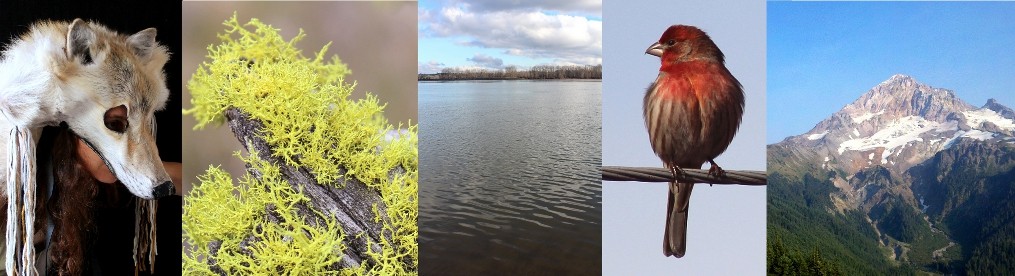
Progress! And the Spirits are Ganging Up On Me….

First off, a quick note to the good folks on the Livejournal feed for this blog: I welcome comments; however, I do not get comment notifications for comments made to the LJ feed postings. Please click through to the blog itself at therioshamanism.com and make your comments there; that way I know you had something to say! Thank you muchly ๐Ÿ™‚

I also tweaked the FAQ again, specifically the question about whether you can call yourself a therioshaman. To be honest, I’d really prefer people didn’t use that term as a self-signifier. A lot of it is because therioshamanism, at least at this stage of the game, is my personal path, created from a very specific perspective and using very specific resources (though that may change later on–read on to find out why). While it is flexible and fluid, at least let me get it into some semblance of a formalized path! *grin*

I’ve been at this for over two months now, and while that may not seem like a long time, again keep in mind that I already have a significant amount of material from over a decade of study and practice to work with. At this point I have a pretty good idea of what my basic training for the next four and a half months will be–more focus on specific elements, and then a month of work with all four traditional elements again, as I did last month, though with the experience of single-element months taken into account.

I’m better at holding to a schedule, and I will say that I have learned and developed a lot just in the time I’ve been doing this. The Earth month, as you’ve probably read, has been exceptionally important for getting me to pay attention to both the internal and external environments, though the focus seems to be more on the internal–getting my body and health into shape. I’m thinking that while the first six months’ focus on elements is meant to increase focus on the elements inside and out, that it’s important for me to get my own house into order, as it were, before moving outward to a greater extent.

A lot of the changes are little things that I notice on a day to day basis, too many to list systematically here on a blog. Needless to say, I feel more grounded and focused, and more confident as well. I’m calmer, and more likely to catch myself in the act of re-acting, rather than letting my re-actions get the best of me. I’m working to be healthier, and taking active steps to do so. And there’s so much more…and it all adds up! I’m patching the holes that I’ve noticed in my practice, and feeling less like spiritual Swiss cheese.

On another note, I received an initially alarming request from the totems and other spirits I work with recently. I was kicking around the idea of eventually putting this all into book format (not that this should surprise anyone who know this bibliophile well). I figure I’ve already had a few people tell me that they’ve gotten quite a bit out of what I’ve written here, that it really resonates with them, all of which makes me happy–if my journey can include aiding others along their paths, so much the better. Granted, a book would be a few years in the future, most likely, since this is still in the growing stages. But it’s a possibility for somewhere down the line.

So I was bouncing ideas around in my head as I was walking from work to the train station, when I got that familiar *ping* that tells me the spirits want my attention, so I listened to what they had to say.

“We want to you to teach students the way we’re teaching you”.

(This is why I added the “OMGWTFBBQ” category to this blog.)

I know people who have taken on students. It’s a ton of work. Not necessarily a horrible thing, though I have heard horror stories of student-teacher relationships that went very wrong (and didn’t even involve sex!). Aside from the time commitment, though, I don’t even have therioshamanism complete as a path yet!

So I grilled them for more information (as well as calling my mate and talking to a few friends online about the whole thing). Basically, it appears that I wouldn’t even have to think about starting this process until after my six months were done (i.e., after I get done with the months of elemental work ahead of me). And I, of course, wouldn’t stop my own training and learning, particularly since the first six months are designed to be largely self-directed. The closest I can come to a comparison would be the grad student who student-teaches a freshman course while continuing to do hir own graduate work. I also wouldn’t have to worry about long-distance students–local, in-person students only. This would cut down on the number of potential people I might have to wrangle to make this work ๐Ÿ˜‰

The spirits were quite insistent about this whole thing. It does make sense, though. The spirits have been exceptionally generous in helping me along the past decade and change; they’ve given me quite a lot and asked for very little in return. I’ve always felt, though, that I owed them something for it, and this would be a good opportunity to repay them. They want this material out there, and while I have some trepidation about the whole thing, this is a vote of confidence in my favor.

I’m still going to be cautious; while the *ping* I received was one I’ve gotten used to over the years, I’m going to revisit this topic with them once my six months are over with. I want to be very sure it isn’t just my ego speaking, though I was pleased to note that my first reaction was “You want me to do WHAT?” rather than “Oh, people will think I’m so great!”. And the more I thought about it, the more I realized that it would be a good opportunity to pass on some things that both I and the totems and other spirits see as very important, and which at least a few people have expressed interest in. Still, I realize that this is a major commitment for a long period of time (of course, so is therioshamanism in general) and not to be addressed lightly. Just to be sure, I’m going to include some reading and other research on pagan teaching with the rest of my reading material over the next few months.

At this point, it’s a “Let’s see where I am in four and a half months” rather than a “Yes, I’ll do it!” situation. However, I figure that if the spirits have this sort of confidence in me at this point, it’s a good sign that I’m doing something right, at least. All the warning flags seem to be in the arena of things that I’ve seen screwed up in other peoples’ experiences, rather than a deep, intuitive/instinctual “STAY AWAY!!!”. But, as I said, we’ll see in four and a half months.

Totems and Taboos (No Relation to Freud)

A private post on someone else’s journal got me thinking about the nature of the totems I work with. While I don’t consider totems to be the exact same thing as deities, I see them as the theriomorphic counterpart in a lot of ways. And while I have worked with a few deities over the years, my work with totems has been much more extensive.

The thing that I’ve noticed with totems, in my experience, is that relatively speaking they’re pretty laid back when working with me. By this I mean they don’t make difficult demands of me. They’ll make requests, but they seem to have a rather large amount of patience with my inconsistencies and mistakes. Rather than punishing me, they let me pick myself up, dust myself off, and go on–and may even give me help if I’m struggling.

I know, for my part, that there’s really only so much I’m willing to take as far as demands go. If I’m going to work within the parameters of a particular religion, spirituality, or deity/totem/etc., there has to be a good reason for it; it has to contribute to my growth without adversely affecting other areas of my life. I have had experiences where I thought my life was falling apart, but they always turned out to be for the best in the end–appearances may be deceiving. Still, I have my limits on how much I’ll take. While I definitely see the need for boundaries and respect those who go through some pretty intense experiences with some severe boundaries, that’s not where my personal allowances lie. I’m willing to compromise myself, but only to a certain extent. And I tend to prefer a primarily self-directed experience; the situation I’m in with therioshamanism and with the Animal Father is a first for my pagan path. There’s more discipline (though again, primarily self-directed, but with more outside structure) and I’m putting in more effort that’s not directed solely at myself, and learning more about generosity without being guilted into it. Even then, it’s more a partnership than anything; we all give something, and we all get something. I don’t feel like I’m being inconvenienced, only shown where I may give a little more than I originally thought I was capable.

I believe the totems respect my self-direction, and have for the duration of our relationship. They’ve sometimes nudged me to one side or another in an attempt to keep me from going too far over the edge, but they’ve not really openly interfered. Rather, they’ve trusted that I would end up at this point on my own power, a point at which I’m becoming much more receptive to working with them more regularly and with their needs as well as my own in mind. I’ve needed a lot of room, time and growth to get here, and they’ve been generous and patient in allowing me that space.

However, I also have to wonder how subjective the relationship is. How do we know that we’re doing it “right”, regardless of what we’re doing? For instance, I know some pagans who have pretty intense relationships with their gods, with a number of proscribed taboos and other restrictions. Yet other pagans work with the same deities and report a much more laid-back experience. Sometimes there are disagreements about how to “properly” worship a particular deity, with accusations of “You’re doing it wrong!”

I’ll admit I tend towards the more laid-back, free-form approach with both totems and deities. Honestly, a few of the situations I’ve seen or heard of make the gods seem more like the Boogey-man–“If you don’t do this *just* so, I’m gonna GETCHA!” (Or at least this is the sense I get from some of their more stringent devotees, who have conniptions over the antics of eclectics.) Granted, this is me looking from an outsider’s perspective, but I know that I wouldn’t be up for a relationship of any sort, deity or otherwise, that puts so many conditions and expectations on any of the participants.

However, I’m not here to judge others’ experiences; if this is what spiritually fulfills people, then that’s what’s right for them; different people have different needs. This includes when working with the same deity or other entity. But how do we tell who’s doing it right and who isn’t? Does the person with the more intense, sacrificial relationship automatically get more points with the Divine than the one who has a bunch of statues of deities from around the world on an eclectic altar?

I think my biggest question would be: what effect does a relationship have on an individual basis? Does the person get something out of the relationship, regardless of its nature, and is it worth the cost? For instance, people in very intense relationships may appear to be in the spiritual equivalent of an abusive relationship–yet this may be a positive experience for them (the same could be said of lifestyle submissives or slaves in a healthy BDSM context). And the aforementioned eclectic may have very close relationships with a diversity of deities, without ever worrying about whether it’s being done according to the correct breed of dogma. Yes, there needs to be room to give back as well; that’s been an important lesson for me of late. But I don’t want that gift to be wrested from my hands. Just as I do not make demands of the totems, so they do not make demands of me; we make requests of each other.

To bring this back home, my relationship with the totems is decidedly unorthodox, and almost entirely created of UPG. I work with totems from different ecosystems. Granted, I haven’t met much in the way of those who have intense-to-the-point-of-distress relationships with totems (with the exception of those who go on shamanic journeys which may in themselves be intense). The closest I’ve seen have been proscribed taboos regarding not eating the meat or otherwise using the remains of the physical version of one’s totem–and many times that seems to be taken on by the person, not demanded by the totem.

So why is this? Are animal totems naturally gentler? Or is it because the majority of people who work with them today (in a neopagan context, at least, which is my context) don’t expect them to be anything but helpful, or at the most, neutral? If more people expected totems to be taskmasters, would there be more pagans making huge sacrifices of time, effort and convenience for the sake of totemic relationships?

Furthermore, am I doing something wrong because I’m not getting these great demands placed upon me as conditions of my relationships? Am I not giving enough because I still enjoy giving, or because I haven’t given to the point where it hurts, or because we make polite requests of each other? I don’t think so. I think we all end up with the relationships we need, though they may not be the ones we initially *think* we need. We may start out thinking we need A, but when we get A we may find that B is actually closer to what works for us, despite initial impressions. And we age and change over time, which may necessitate revised or even new relationships.

While I don’t think spirituality is all about what we can get out of it, I do think that our relationships to Spirit are a lot more subjective than sometimes assumed. Perhaps we are attracted to paths that appeal to us aesthetically; I have had success, for instance, with paths other than neoshamanism, but this is the one that has been best for me. I don’t think it’s a flaw in the systems, so much as it is finding my little slice of infinity. To limit the gods and other entities only to one way of perceiving them does a disservice to them. After all, our relationships with other people isn’t based on a single model. Perhaps the totems are kind to me, and perhaps with other people who expect a harsher relationship, they may bite more.

All I am sure of is that, in this moment, I have found what is most effective, practically and spiritually, for me AND for the beings I work with. That, to me, is the surest proof in the pudding. So I’ll continue with my request-based relationships unless/until the time comes to renegotiate.

Badger, Badger, Badger, Badger (But No Mushroom)*

A significant part of my practice over the years has been working with skin spirits. This is my term for the spirits (or residual energy, if you prefer) that are in skins, bones and other animal remains. I have found that I can communicate intuitively with these spirits (whee, animism!). Generally I use this to help determine how to incorporate the remains into my artwork. I do this to give these spirits a better afterlife than hanging on someone’s wall, as well as to help them move past the almost invariably traumatic deaths they experience.

While most of the skins and bones end up with other people post-art, I do have some that stay with me. This includes a collection of skins I use for dancing and other forms of invocation and evocation; I have one particular section of my half of the ritual room where they all hang out. The way my altar is set up, the skins are always to my right when I’m facing it, keeping them in nice, close proximity. The walls in the alcove where the altar sits are also covered in animal skulls that have decided to camp out in my home for the time being, and the spirits therein tend to act as general guardians and spiritual company.

This past Sunday I decided to do a ritual for prosperity in conjunction with a particular project I have in the works. So I pulled out a deck of totem cards that I use specifically for determining good totems to ask for help for specific situations. However, before I’d even gotten the cards shuffled, I “heard” (obviously not with my physical ears) two of the skin spirits speak up to my right. “Me! Pick me! I can help!” each one said. So I went over to the lineup of skins, and both the badger and otter skins I have “jumped” out (again, not physically!). I won’t go into the details of how each one would help me, since it’s still a rather personal project. However, needless to say I was quite appreciative that they volunteered.

I decided to use one of my favorite forms of magic–the humble, often taken for granted, candle burning. Out of all of the various types of magic I’ve used, and the numerous objects I’ve charged with energy for a specific purpose, I admit that I have a definite fondness for those little two-hour candles as receptacles for collecting and focusing energy and intent, and subsequent release thereof. With skin spirits, I’ll generally dance with the skin and the spirit in it, and sometimes the corresponding totem will also join in, and then take the energy of the dance and place it in the candle. And that’s exactly what I did. Since I was a bit tired, I opted to just work with one of the skins that day, so I chose Badger–Otter would wait til the following weekend.

When I called on the directional totems, I tried something a little different to tie in with my elemental work as of late–rather than speaking out the evocations, I called up the element corresponding to whatever direction I was in, as well as shifting my energetic body to the form of the corresponding totem, and used that to evoke the totems. I found that this actually produced the strongest evocations I’ve ever had. It also worked for the various spiritual Friends, Family and Guardians that I routinely evoke for ritual attendance. This isn’t surprising, given that I’ve spent the past week and a half attuning myself to the elements on a several-times-per-day basis, and that I’ve been working with these directional totems through energetic shifts for years. Still, it was a nice reminder that my current elemental work does have practical applications beyond reminding me that the elements can be found everywhere, even in downtown Portland.

The “main course” of the ritual involved me laying the candle for badger energy on the floor in the center of my ritual space, draping the badger skin over my right shoulder, and dancing in a circle around the candle, invoking both the skin spirit and Badger the totem. Each species I dance has a distinctive way of dancing, and Badger/badger ended up giving me a sort of scuff-step-scuff-step pattern. As the dance progressed, I danced faster and faster, feeling my energetic body take on a distinctive badger shape. At the height of the dance, I stopped, “grabbed” the column of energy I’d raised, and “pushed” it down into the candle, condensing it into that container, sealing it in. I then placed the candle in a holder on the altar, set the badger skin near it (but far away enough to avoid accidental flaming badger skin) and lit it to release the energy in a more focused manner.

I said farewell to all the beings I’d evoked, again wordlessly, to great success, grounded, and went and ate since I needed it after all that dancing. The ritual itself went wonderfully, and it also gave me a chance to work with a couple of skin spirits I don’t work with as much as I’d like (I’ve set aside the new moon and the time around it specifically for working with skin spirits). Plus the validation of my elemental work was a nice additional perk. Of course, the proof is in the pudding, but I’m confident that the badger skin spirit can help me manifest the prosperity and opportunities I need. I’m looking forward to working with Otter this coming weekend.

On a different note, my hands are feeling better. Since I spend a lot of time on the computer at work and at home, I sometimes end up with sore wrists and hands–not as bad as carpal tunnel, but I’d like to avoid worse complications. Part of this is because I never learned to type correctly, so for years I was a four-finger hunt and peck typist. Plus I tend to push the buttons down hard! So I took my ergonomic keyboard to work (my home laptop doesn’t seem to cause me problems on its own), along with new wrist splints. I’ve also been training myself to use all ten fingers for typing, as well as type more *softly*.

However, in addition to this, I’ve asked my husband, Taylor, to do some healing on me every evening. Taylor is quite the accomplished energy worker, and was one of the main reasons I can still walk after all the damage I did to my knees a couple of years ago. I was working as a meter reader reading utility meters in rural Pennsylvania, and 4-10 miles of walking, plus getting in and out of a truck a couple of hundred times a day, hurt a LOT. I also wasn’t eating all that well, so I’m sure my body was cannibalizing the connective tissues for protein. I didn’t want to go to a doctor because s/he’d just tell me to stop working for a while, and I was out of sick time.

I noticed a distinct difference once Taylor started doing daily healing on me. Along with improving my diet, he did energy work every evening when I got home. Within a couple of weeks I was pretty much off the Tylenol, and after a couple of months I only rarely had any trouble, even though the workload was the same. And once again, I’m noticing a drastic improvement in how quickly my hands are recovering with this combination approach. His healing is definitely one of the better pieces of proof (for me, personally) that magic *works*.

I’m thinking I should ask Taylor to teach me the more subtle uses of energy work. While I can certainly sense and work with energy, I don’t have the fine-tuned ability he does. This would be quite useful for extractions of unwanted entities/energies in healing work.

* If you don’t get the reference for the title of this post, check out this link and make sure your speakers are on.

Global Totemism

The other day in my post about omens, Ash made a good comment, asking about the geographic considerations of totemism. While I replied, I wanted to elaborate more on that in today’s post.

You can probably tell from some of my writing on totems that I already have a rather unorthodox view of them. I don’t interact with them in any indigenous cultural context, and my work has a decidedly neopagan flavor to it. Additionally, I like to experiment with magic in general, and so a lot of my recent magical activity has revolved around taking totemism in new directions. This includes working with a wide variety of totems, rather than limiting myself to Big, Impressive North American Birds and Mammals (BINABM).

I can definitely see the argument that it makes more sense to work with the animals native to your area. This sort of geographically-oriented totemism can be incredibly helpful in getting in touch with your local area, where you live and who shares that place with you. All four of my directional totems are BINABM that can reasonably be found near where I’ve lived (though they may be a few hundred miles away, depending). And the fact that they’re all found in North American temperate zones helps me to connect both with them, and with where I live. The daily elemental meditations I’ve been doing are a good demonstration of this connection.

However, I am not only a product of my geography, but also of my culture–and I live in a globally aware culture (relatively speaking). Americans may not know everything about every country outside the U.S. (and in fact may be criticized for international ignorance) but we are as a culture at least aware of the fauna of other places, from Australian marsupials to the creatures of the African Savannah. In my cosmology, every species of animal has a totem, regardless of whether that totem is widely acknowledged or not. And since learning about a new animal is literally a Wikipedia article away, having an odd creature we’ve never even heard of show up in totemic form isn’t cause for utter confusion.

Case in point: two of the totems I’ve worked with recently are Silver Dollar and Bachman’s Warbler. Both of these came up in meditations with an experimental system I’ve been developing. Silver Dollar is a fish commonly seen in tropical aquarium setups; before I got into contact with him totemically I had no idea he was of South American origin. As for Bachman’s Warbler, this little bird, either exceedingly rare or possibly (though not officially) extinct, is native to the Southeastern U.S. and Cuba, and I’d never even heard of that species until the totem came popping in one day. True, she’s still from the U.S., but the totally opposite corner and thousands of miles away. That’s a lot farther extent than the fauna knowledge of the indigenous people of the Pacific Northwest had for most of their history.

Additionally, as we become more globally aware, we can’t ignore what’s going on. A current example is the struggle in Burma–I’ve been watching this with interest for a variety of reasons I won’t get into, as I don’t want to start a political debate here (that’s what my personal blog is for ๐Ÿ˜‰ ). Needless to say, it’s an important thing, even if it isn’t happening here in the good ol’ U.S. of A. In the same way, my relationship with totems isn’t just me taking and taking from them; it also involves helping them. Part of my work with Bachman’s Warbler involved giving her aid in trying to locate any remaining physical representatives of her species were left. And one of my goals with therioshamanism is to be able to aid animals around the world with both mundane and magical actions. While there are plenty of endangered species right here at home, some of the most threatened live an ocean away.

Therefore, it behooves me to learn to make contact with totems in all places. Just as it’s important to know what’s going on with humans worldwide, so is it good for me to be aware of animals globally, to include on a totemic level. Totems can make requests of specific ways to help their physical “children”, and while this does not replace mundane actions such as donating to animal-based nonprofits, writing to political figures, and consuming consciously, it is one of several avenues I can take to help improve things.

I have talked to people who claim that working with spirits outside of their geographic location makes the local spirits angry. I haven’t had that problem; I primarily work with totems (particularly the global ones) in my own ritual area in the upstairs half of our apartment, and none of the “local” totems or others have complained. I do make sure to honor the locals (including the directional totems) before each evocation, which I would imagine helps. What I’ve found is that while, to an extent, totems do behave as, well, animals, I don’t end up with conflicts between them, such as Wolf attacking Deer. They realize why they’ve been called, and I haven’t seen any indication that predatory totems need to feed on prey totems, or that anyone feels the need to start a dispute when in what’s essentially *my* territory (which is essentially safe space for all I allow into it).

So this is why I work with such a variety of totems, rather than sticking to the BINABM. It works for me, though as always YMMV.

An Addendum to One of Yesterday’s Posts

I do have another post planned for today, but wanted to pop this up here while I was thinking about it:

When I talk about looking at the Otherkin concept from a metaphorical perspective, this is not to the exclusion of other angles, such as reincarnation. As I mentioned in my essay, I see the metaphorical angle as well as psychological and spiritual angles. While for me, personally, reincarnation isn’t a part of the spiritual aspects, it is for plenty of other people.

What I want to make clear is that multiple theories of explanation are not necessarily opposed to each other. It is quite possible to look at a situation from more than one perspective and have more than one explanation for what happened. For example, in regards to my therianthropy, from a purely psychological level it’s a product of early imprinting and conditioning, as well as ego-identification with Canis lupus. However, that doesn’t negate the spiritual/totemic aspects, or the mythological/metaphorical aspects. It’s not a situation of either/or. It’s one of both/and.

I think that one of the shortcomings of the Otherkin community is that as a group we’ve* too often bought into the rational OR metaphorical argument. Since what we believe about ourselves is often challenged anyway, we scramble for the most “solid” explanation we can come up with, which is usually reincarnation; those who don’t have past life memories often beat their heads against brick walls for years because they feel that’s what they *must* exhibit in order to be “legitimate”. And because we live in a society that demands as much literal proof as possible, and since reincarnation is the closest we have (since people with past lives almost always see them as literal, linear events that actually happened in this reality), people sometimes fear “diluting” what literal proof they do have.

However, that’s buying right into the overly literal/rational perspective that dominates modern post-industrial thought. Sometimes we want so badly to be accepted that we’re willing to play by the mainstream’s rules, even if it cuts us off from other possibilities.

When I espouse a metaphorical perspective on Otherkin, I am not saying that you have to give up whatever other views you have in order to embrace it. Rather, I encourage people to look at themselves on multiple levels–in fact, reincarnation can easily be seen as a part of one’s personal mythology, specifically the mythology we tell about ourselves. “Mythology” has unfortunately been given the connotation of “not true”, because it may not be literally “true”–but IMO, that doesn’t make that a correct assessment. Metaphor is true–it’s simply true on a different level of reality. Therefore, while reincarnation (as an example) can be literally true in that one believes that somewhere in linear time one was incarnated in another life, it can also be metaphorically true as a part of one’s personal mythology that helps one to understand the macrocosm in relation to the microcosm.

* Should also add that when I say “we” I mean the community in general, with the understanding that individuals’ mileages may vary.

Oooooomennnnssss, wooooooooo!

Heh–I’m feeling just a little silly. Sleep dep’ll do that to me now and then.

Just as a side note, while it is my amazing and great intention to post here every single day at least once, if it doesn’t happen, it’s not because I don’t love you ๐Ÿ˜‰ Mainly it’s going to be due to either A) too much stuff happening (e.g., work, taking a vacation from teh intarwebz) or B) not enough stuff happening (e.g., can’t think of anything to write about, ebb in spiritual/magical activity for a few days).

Now, to the post itself.

I’m nowhere near being the biggest fan of omens. I like Occam’s razor; it’s a good tool to have on hand when dissecting spiritual experiences. To put it very briefly, it states that the simplest answer is the most likely. Therefore I tend to look askance at the idea that because you see a crow outside your house every morning, that must mean that Crow is your totem. (Have you asked your neighbor where all that bird food is going?)

So when confronted with sightings of animals, I tend to look less at the esoteric meanings of said critters, and more at where their closest habitat might be, whether they’re known to be territorial, etc. A common example I like to use to illustrate this point is the hawk. Raptors in general have gained in numbers, especially in the past couple of decades, thanks to the ban on DDT. For those who aren’t aware, DDT was a pesticide in use until it was banned in the early 1970s. DDT would wash into the waterways where fish would absorb it. Certain species of raptor, including some hawks, which ate fish would absorb the DDT, which then caused thinning of egg shells, leading to fewer successful hatches. Hawks are territorial as well, and are somewhat adaptable to urban areas (or at least the suburbs, though I once saw a hawk down a pigeon near the baseball stadium in downtown Pittsburgh). So if you start seeing hawks regularly, chances are good you have a mated pair whose territory includes your home.

Ironically enough, it was a hawk that sparked this post. Since I moved to the Pacific Northwest, I’ve seen very few hawks–only one in Seattle, and until recently, none in Portland. I’ve actually seen more bald eagles than hawks. However, yesterday as I was walking from work to the train station, I saw what looked like a juvenile Northern harrier (marsh hawk) fly right overhead. Now, this isn’t surprising–though I work in a suburb of Portland, it still has a lot of greenspace, including some wetlands, perfect for more adaptable species. I’ve seen muskrats in the grass right next to the sidewalk, less than a yard away from me, and there’s a blue heron in the marsh near my building. So a hawk isn’t surprising.

However, the reason it made me take notice was that in my elemental totem ritual this past weekend, one thing that Hawk, my East/Air totem, specifically mentioned the fact that I hadn’t seen very many physical hawks here, compared to the Midwest, where I saw redtails all the time. It was a nice reminder that Hawk was still here, even though of all the directional totems, he’s the one I’ve worked with least on a magical level.

However, more importantly than that, it was a reminder of something from that ritual. I was told to spend some time this month (every day, preferably) observing the interplay of the elements (Earth, Air, Fire, Water) in my life in different environments. Now, while I mean well, I can be a procrastinator, and I also have a spotty memory–which means I don’t always do what I’m told, not because I’m being willfully argumentative, but because I either forget it or don’t get around to it. So the vivid vision of the first hawk I’ve seen in Portland was a good mnemonic for this.

Ordinarily, I would have just seen the hawk as a hawk, and considered it a cool thing. However, because of the temporal proximity to the ritual and the nature of Hawk’s conversation, and the fact that the sighting triggered a specific response (hello, Pavlov!) I considered it to be an extraordinary experience. Do I think that hawk materialized only to remind me of Hawk-like things? Nope. However, I do like the idea of synchronicity, and this was a vivid example.

It reminded me, reflecting on it at the bus stop this morning, of something I read in Lon Milo DuQuette’s The Chicken Qabalah of Rabbi Lamed ben Clifford*. DuQuette, speaking through the fictional (though no less entertaining and educational) Rabbi Lamed ben Clifford, makes the point that everything in the world is a message to him from G-d. Now, there are several ways this could be interpreted. One way is the “Everything is an OMEN!!!!” (in an omen-ous voice, no less!) method, in which anything even remotely out of one’s usual routine is seen as important (and often negative). Then, of course, there’s the option of just ignoring everything (but where’s the use in that? You need to pick up the phone at some point.)

I tend to see things as variable in importance. Looking at the beauty of Nature, that’s the Divine saying “Hey, look at me–I’m gorgeous! And balanced! And you’re a part of this, too, remember!” And being with my mate is “Love is a wonderful thing, and it bestows blessings (even if there are occasional curses)”. These are important, but relatively everyday. Occasionally there’s something more specific, a “Wake up and pay attention!” kind of thing. And that’s how I saw the hawk yesterday–not as something that was manifested solely for my benefit, but as part of the interwoven complexity that is the Divine.

This doesn’t mean I never get premonitions, of course. I’ve had those times when my intuition went *ping*, and I knew something big was in the offing. But I don’t generally get them through as indirect a means as seeing a hawk fly by–usually the experience is anything but ambiguous, and there’s no doubt in my mind.

And sometimes it’s nice to just enjoy watching a hawk wing its way across the marsh–that’s magic in its own right, as far as I’m concerned.

*Hell yes! I’m a Chicken Qabalist!

A Mythological Perspective on Therianthropy

I originally posted this to my personal blog, but I thought I’d crosspost it here as well since it does deal with spiritual beliefs. I’ve met several people who believe that therianthropy (and Otherkin in general) are just those who have an odd interpretation of animistic/shamanic concepts; while I don’t think that explains everyone who identifies as Otherkin/etc., I do think it’s an angle I want to explore more for my *personal* purposes.

*************

This is quite possibly one of the most difficult parts of my personal cosmology for people who aren’t Otherkin to grasp. On the surface, it seems entirely delusional and escapist–“You believe you’re a wolf? Have you looked in the mirror lately? Maybe we should get you to a psychiatrist…” And believe me, plenty of us have gone through the belief-doubt-belief cycle.

As I’ve gotten older, though, and this odd bit of my psyche hasn’t gone away (no matter how I’ve tried ignoring and even repressing it), I’ve started looking at it from different angles. The concept of therianthropy, the idea that a person is, on a certain psychological, spiritual, or other nonphysical level, a nonhuman animal, is the concept that best explains what’s going on in a *functional* manner. Telling me I’m crazy doesn’t make me more functional. I’m already quite functional; therianthropy doesn’t hinder my ability to live a perfectly normal life, with a husband, a job, and a decent social life. However, part of that functionality comes from being able to accept myself as I am and integrating everything about myself into my life, rather than trying to play the Pigeonhole Game.

Many therians see therianthropy as a psychological/neurobiological thing. Many Otherkin in general are enamored of the idea of reincarnation, that who and what we were in previous (or alternate, depending on your view of linear space/time) lives affects who and what we are now. For myself, though, I’m gravitating more and more towards a metaphorical perspective (in addition to psychological and spiritual layers).

I like Joseph Campbell’s work, warts and all. I’m particularly fond of the concept that people need mythology in order to have a complete worldview, that mythology answers a need we have on a very deep level. IMO, rationality appeals to the left brain, while mythology appeals to the right hemisphere (and keep in mind this is very generalized). Now, granted, I can’t speak for everyone. But for myself, spirituality, and by extension, mythology, are part of my psyche’s complete breakfast. Rationality answers my need for a physical, down-to-earth, left-brain explanation of things. However, if anything, I’m canted more towards the right brain (I’m even left handed, and I’m one of those damned artsy types ;). Therefore, in order to be happy, I need the mythological/metaphorical end of things as well. (I’d make an awful rational atheist/materialist.)

Mythology occurs on two levels, IMO/IME. It occurs on a collective/community level, where a group consensus of belief is arrived at. This is where the more outward trappings of religion and spirituality come into play, as well as the cultural mythology shared by an entire group, tribe or nation of people. It’s more commonly recognized in modern American society, though in a fragmented manner. We do not, as a nation, have a cohesive cultural mythology that permeates the fabric of our society in the same way that mythology shaped, say, the ancient Greek or Norse cultures. (And even then, the collective mythology could vary according to individual culture-within-a-culture, by region, etc.) However, we do not have a national mythology (or a national religion). We are a patchwork quilt made of a number of different cultures that arrived here over several centuries, and who are still arriving. Additionally, America as a whole is incredibly materialistic and possessed of a short attention span. The closest we have to heroes and other mythological entities are the denizens of pop culture, who (with rare exception) last a few weeks, months, or years, and then drop out of existence. We worship what we see on the T.V., though it’s not conventional worship and we don’t always realize what we’re doing. Additionally, we have a rather destructive relationship with that form of mythology–we create heroes, and then take malicious joy out of knocking them down. The evening news and “reality” T.V. are testaments to our cultural fetish for watching the mighty tumble back down to our level; rather than aspiring to become better people through their examples, we revel in dragging them down to our level, made rabid by our insecurity and fear of success.

There’s also the mythology inherent in religion to consider. The most common religion in America is Christianity, but the values of that religion are largely based in ancient Hebrew society, and in some ways don’t mesh particularly well with modern American culture. Not that it can’t be done, but many of the original values of Christianity and its predecessor, Judaism, have been dropped by liberal Jews and by Christians in general–how many Christians routinely slaughter cattle as per Leviticus, or throw stones at adulterers? My point, though, is not judging whether any particular religion is right or wrong–that’s up to the individual to decide. Rather, I want to make it clear that this is in no way a Christian nation, and although the motifs of Christian myth* do permeate society to an extent, it’s not the same as Native American or other indigenous cultures, or the pre-Christian cultures of Europe–or even primarily Christian societies prior to the past two centuries or so.

Still neither pop culture nor religions make for a cohesive *cultural* mythology in America. Additionally, more than any known society before us, modern America is incredibly individual-based. This has only really cropped up in the past several decades, and while it has had some definite benefits (such as encouraging people to challenge stereotypes, prejudices, and other negative elements traditionally accepted by the status quo), it has contributed to the lower possibility of cultural mythology.

However, the rise of the individual increases the exposure of *personal* mythology, something which has always existed but has been largely downplayed in more group-oriented societies. Personal mythology is understanding reality from the microcosmic view, determining one’s own perspective, and telling the story of what the world is from a single viewpoint. It often meshes with a cultural mythology (in some cases, more than one), though it may have completely unique elements as well (as in Unverified Personal Gnosis).

And this is where my therianthropy ties in to all that stuff above this point–it is a part of my personal mythology. Part of the story I tell about myself is that, inside me, there is a part of me that is a wolf–in that respect, I am a wolf. This is something that I’ve recognized in myself for most of my life, and have found different ways to explain it. When I was a child, I called Wolf my “favorite animal” because that’s what I was told it was. When I first learned about totems, I thought perhaps Wolf was my totem (and I was right). However, therianthropy fit my experiences even more, particularly the identification WITH Wolf.

There are no cultural motifs in modern America for explaining this feeling beyond classic lycanthropy (fiction) and clinical lycanthropy (insanity). We don’t have a system of animal totemism, nor is there widespread functional belief in animal spirit guides; our totems and spirits are relegated to children’s cartoons and sports mascots. Additionally, we are detached from the concept that we, humans, are animals–some people get incredibly offended by the assertion that we share the majority of our genetic material with all other mammals (and all vertebrates, for that matter). “But we’re special! We can reason! We’re (insert deity’s name here)’s chosen beings!” That may be, but other animals are pretty special, too–could you survive in the woods if you were thrown out there naked with no supplies? Can you smell a deer a quarter mile away? Our big brains, evolutionarily speaking, are our species’ adaptation, just as more olfactory glands are the adaptation of scent-based predators such as wolves. We have gained reason, but we have lost a healthy grasp of instinct.

I acknowledge I am an animal, a mammal, a primate. Because the basic human social structure, more pronounced in hunter-gatherer societies, resembles that of wolves, and because American culture often equates the Wild (instinct, wilderness, base emotions) with wolves (werewolves being the most common shapeshifter in American culture, and in many of the cultures that shaped modern America), it’s no surprise, then, that when the instinctual part of myself, the archetype of the Wild (Wo)Man, raises its shaggy, sharp-fanged muzzle, it manifests as a wolf.

This does NOT mean that therianthropy is ONLY “make-believe” for me, that it is only metaphorical–there are also psychological and spiritual levels to it as well. However, we live in a setting where “metaphor” is taken to mean “not real” because it doesn’t manifest literally on the physical/rational. Go beyond a certain level of abstractness, and people want to delineate between what is “real” and what is “imagination”. Yet in mythology–the study of myth–metaphorical is just as real as literal. It may be real in different ways–but it has a very real effect on people. Let me say that again: metaphor is real, because it has a very real, concrete effect on how people view the world around them and how they act on that world and its denizens. Whether it’s the ancient tribe that placates the spirits of the dead to keep them from harming the living, or the anti-abortion protester who believes wholeheartedly that God wants hir to protect unborn lives, or the person who believes s/he was an elf in a past life and that part of hirself still resonates with that, the mythology we believe in is very real for us–particularly on a personal level.

And this is part of why I identify as a therian–because it answers my need for mythology, and meshes with my personal mythology. It answers questions that the rational/literal reality denies even exist, and functionally, it helps me to feel I am a more complete person. My life is enriched by this belief. On a left-brain level, yes, it’s possible that I have a weird neurobiological quirk, or a strange bit of psychological imprinting/conditioning (it wouldn’t be the first time I’ve been called weird or strange ๐Ÿ˜‰ But on a right-brain level, this makes sense. And rather than trying to pick between the left/literal and right/metaphorical, I choose to embrace them both as possible explanations for myself–not just for therianthropy, but for everything that encompasses my life.

The left brain is the Earth–grounded, solid, physical; the right brain is the Sky–free of hindrances, open, with breezes that carry me ever higher. As long as I am between the Earth and the Sky, things can’t be all that bad.

* No, “myth” does not equal “fiction”. However, the current subjective treatment of myth, of declaring one myth to be more true than another, sometimes makes it difficult to speak of some religions in mythological terms for fear of offending adherents.

ETA: And an addendum to this post.

So, About Them Thar Totems…

Wheee, another “Add a New Category” post!

Actually, this is one of my favorite aspects of my spirituality. I suppose it should be no surprise to me that I ended up gravitating towards totemism and animal magic pretty much from the beginning of my pagan/etc. path. I’ve always loved animals, ever since I was shoulder-high to a German shepherd dog. Though I’m not sure the adoration was always mutual–one of my earliest memories was of catching roly-polies and playing with them (and when you’re a toddler you don’t always understand the meaning of “gentle”). In fact, that early predatory instinct kept on as I grew up, and one of my favorite past times was catching (and releasing after a few days of observation) box turtles and garter snakes. I also read voraciously (as I still do today, as evidenced by yesterday’s post) and checked out every book I could from the local library.

My first book on totems, like so many people, was Ted Andrews’ Animal-Speak (I was elated when I finally got it signed by him this past February, after dragging the thing around with me for a decade through half a dozen moves and a flood). While I didn’t follow it religiously, it was formative to my early practice.

I already knew what my primary totem was. When I was about two or three (or so I recall), I had an experience where Wolf “met” me and made hir presence in my life known. After that point, everything was about wolves–wolf this, wolf that, I want to be a wolf (this was before I discovered therianthropy, by the way). I think I must have done at least one book report apiece on Jack London’s White Fang and The Call of the Wild every year from first through about sixth grade. The teacher just sort of shrugged and let it go. While totemism didn’t explain everything about the presence of lupine influence in my life (particularly internally) it did make a lot of sense once I had a better idea of what Wolf actually was.

There have been other, secondary totems that have come into my life to help balance out some of Wolf’s not-so-great aspects. Horse took over for most of my junior high and high school years, helping me cope with the harsh reality of being incredibly unpopular; she helped to take the edge off of Wolf’s hyper-sensitivity to aggression-submission displays. Cat came in at one point to teach me to be more graceful and in touch with beauty, and Fox has helped me to be more focused on magic. And I have called on other, tertiary, totems for help with specific problems–Badger, for example, has helped me land the past couple of jobs I’ve had, though I’ve also asked Beaver and Otter for help there.

Again, most of what I do is UPG-based, including the primary/secondary/tertiary denotations. Additionally, my observations have led me to come up with three basic theories as to what totems are:

–Archetypal beings that embody all the qualities of a particular species, to include natural history and human lore and myth, as well as the interaction with humans. This somewhat resembles Joseph Campbell’s concept of the Animal Master.

–Individual animal spirits which may or may not have been in physical bodies at some point.

–Psychological aspects of the self that embody different chunks of the psyche; just as entire pantheons can be a map of the psyche, so can a group of totems.

I see the validity of each of these, though I personally tend towards a combination of the first and third (as within, so without).

Now, please keep in mind–I am referring to *neopagan* totemism here. Traditional totemism, in the majority of extant cultures that still utilize the concept, see it as largely a group-based phenomenon. Totems are meant for clans, families, tribes. etc., and one of their main functions (generally speaking) is exogamy–determining who can marry whom with a minimal chance for incest (something that’s much more likely in smaller overall populations). In neopaganism, the tendency of some totemic systems to act as guides for morals, as well as the general symbolic quality and identification purposes got mixed in with the idea of an individual animal spirit guide (particularly as taken from certain Plains Native American tribes, often in a bastardized manner). Additionally, the power animal of shamanic traditions got mixed in there as well, along with the “travel down the tunnel” method of finding said animal. So what passes for totemism in neopaganism today is actually a hybridized creation.

Not that it isn’t effective, of course. We live in a much more individual-based society, and lack the community cohesion that other cultures have had. Therefore it’s not surprising that we have a much more self-centered conception of totemism. And, in my experience, the totems I work with don’t seem to mind the “unorthodox” manners in which I’ve worked our relationships into a modern, middle-class urban American neopagan lifestyle.

So how do I work with them? I include some that I’m actively working with in my prayers in the evening (and morning, if I’m awake enough to remember). I also routinely evoke (and sometimes invoke) them in magical rituals for specific purposes, and I always invite them (or whoever’s willing to show up at that time) into my ritual area for general protection and aid. Sometimes when I do skindancing (shapeshifting dance involving animal skins) I’ll invoke the corresponding totem as well as the spirit of the skin. And, as I mentioned earlier, I have totems who work with me for specific purposes; I don’t do formal rituals with Lynx, but she helps remind me to watch my words and try to remain civil, especially in the event of internet-based stupidity. And Wolf is a constant presence in my life; sometimes I’m not even sure where s/he really affects me, because s/he’s always been there.

I’ve also been reaching out to less common totems as of late. For example, I’ve been working with “food totems”, the totems of animals that are generally perceived as food in American culture–Chicken, Pig, Crab, etc. (You can see two articles I’ve written on my results so far, here and here.) I’ve also done some work with paleolithic and earlier extinct totems, including dinosaurs; later posts may include my notes from these meditations and experiences. And I’ve been working with the totems of endangered species to give an added magical boost to mundane efforts to preserve the last remaining physical members of their species (along with activism and minding my footprint, of course).

I do like the “fly through the tunnel” flavor of meditation/journeying to meet with totems outside of a ritual context, though I do it freestyle rather than with any sort of script. It’s an effective way to meet on neutral ground, so to speak (not that I worry I’ll get eaten by Bear for no good reason, Siberian dismemberment rituals notwithstanding). And I like the setting better, especially if my ritual room is the only other choice at the time–while it’s comfy and warm, blue carpet and light bulbs aren’t the same as grass and sunlight. If I can do my work outdoors, I do, and generally get the best results that way.

The totems have appreciated the increased attention as of late, though they’re patient with me, and there’s still a lot more for me to do. I’m trying to figure out ways to allow them into my daily life more often, other than observation, general presence during ritual work, and hikes in the woods. While I’m doing some exploring with different groups of totems right now, I want to start deepening my relationship with certain ones, as well as the skin spirits I dance with. Additionally, I want to step up my efforts as far as magic for endangered species’ totems go.

So I think a lot of my practice will focus on that. I’ve already got ideas for what I want to do for the equinoxes and solstices (including rethinking the way I do rituals). But I would also like to utilize the full and new moons as well–I’ve been needing regular involvement, and I need to figure out what the special occasions are. Actually, I already have had the new moon set aside for work with skin spirits, so perhaps the full moon will be time for totems. Last night was the peak of the full moon, but I consider the day before and after to also be valid. And, in this case, it’s less about lunar energy and more about reminding me of what I need to do.

I’ve been blessed by the totems’ patience in my life, and I’m glad they’ve stuck with me even when I’ve demonstrated the ability to be a supreme procrastinator and excuse-maker.

Who is the Animal Father?

You’ll see references to “the Animal Father” throughout this blog. This is my personal conception of deity that I work with in Therioshamanism right now. Allow me to explain.

I believe that the Divine is infinite, or about as close to infinite as it gets. As a pantheist, I believe that the Divine is within all things, and that all things (physical and otherwise) compose the Divine just as cells compose a body. I also believe, as a polytheist, that there are numerous individual deities from pantheons around the world, and that they are individual, independent beings that reflect qualities of the cultures they come from*. Finally, I am an animist, and I believe that everything has a spirit of sorts (including deities); that spirit (or soul, if you will) is the spark of the Divine manifest in each thing.

I don’t believe the Divine can be limited to one human perception of it. We “create” or “discover” (depending on how you view mythology) individual deities that represent a very small facet of the Divine. We gravitate towards deities that resonate with our values, beliefs, and ways of seeing the world. Likewise, deities may call to people they resonate with. There’s no such thing as a one-size-fits-all religion–or a one-size-fits-all view of the Divine.

I also have no problem with UPG (Unverified Personal Gnosis). While I think it needs to be treated with care and a lick of salt, I do not believe that the only people who can converse with the Divine and have Divine revelations are clergy. I am a pantheist–everything is Divine–and the Divine is imminent, which means we all can talk with “God/dess”. IMO, the idea that Divine revelations are rare and reserved only for the holiest people is something that has been used to control the masses for centuries–if you don’t let people think for themselves (even if it’s to decide they want to stay within the parameters of a given religion) they’re much more malleable. As with anything, I think it’s important to question our perceptions, but I apply that to anything, from religion to politics to love to determining whether we want to live in a certain place or not.

I do think that Unverified PERSONAL Gnosis is, well, *personal*. It’s not about huge proclamations for everyone in the world, or even everyone in your apartment building. It’s a personal message from the Divine, and it’s important to question what we think we’ve perceived to make sure there wasn’t an error in communication somewhere along the line. So therefore my personal mythology about the Animal Father is something I limit to my worldview alone.

I do still, of course, acknowledge the Divine overall, and it is my relationship to the Divine (basically, everything that is) that determines things such as ethics. All people decide what their personal ethics are–even if it is a *choice* to follow a particular set of rules laid out by someone else. I simply take more into account than what one particular sliver of the Divine says.

So, anyway, the Animal Father–who is he? Well, this particular cave painting has always struck a very deep chord with me. It’s been speculated, by Joseph Campbell and others, that this is a representation of a paleolithic deity, the Animal Master (to use one of Campbell’s terms). He is the keeper of the animals, the deity that paleolithic hunters and/or shamans appealed to in order to have a successful hunt. You can still see this concept in various indigenous religions; a well-known example is Sedna from Inuit mythology. The shaman must travel down to her home deep in the ocean and comb her hair to convince her to release the whales, seals and fish to live on. So the concept of a deity that watches over the wild creatures isn’t so far-off, and while there’s no proof that such a deity existed all the way back to Paleolithic times**, my experiences say otherwise. The deity I speak to, whether he actually is a remnant of an older time, or simply a new mask of God that has been given to me by the Divine using ancient imagery, speaks to me on a fundamental level. Alternately known by people as the Sorceror, the Antler Shaman, Animal Master, etc., the name he gave me to use is the Animal Father.

“So aren’t you just making up a deity?” Maybe I am, though I prefer to think, as I mentioned above, that the Divine has simply given me a particular mask to understand it through. People have been “making up” deities for millenia. Again, allow me to remind readers of the correlation between the personalities of deities, and the cultures they come from. You can learn a lot about a culture by observing its pantheon, as well as its religious precepts. Anyway, I believe that this is an aspect of the Divine I have been given, rather than creating it myself, a process that has hardly originated with me.

Beyond that yes, I’m aware of the pitfalls of creating own’s own religion primarily from scratch. Yes, I’m aware of the possibility of self-delusion. Yes, I do keep close tabs on myself. No, I don’t think that my religion has to apply to other people. It is, after all, *personal*. However, this is something I’ve been actively working with for over a decade. I may not be perfect, but I’m not just leaping into this, either. I’m basically organizing things I have discovered are true for me, and this is a recent revelation that works in nicely with the rest. I don’t think I’m the first person to go through this process, though many people do so via committees. I’m not a committee kind of person.

This is what works for me, and while it may be incomprehensible to a lot of people, it makes perfect sense in my mind. (Reading Carl Jung and Joseph Campbell may help you understand my mind a little more, by the way.)

So enough of that–back to the Animal Father himself; he is personified by that particular cave painting, though he is NOT the cave painting itself, any more than Jesus *is* the cross with a statue of a person on it. There’s a difference between deity, and representation of deity. My primary focus in my spiritual path is with animal totems; I’ll explain my conception of them in more detail in a later post, but the short version is that totems are archetypal beings that represent all the qualities of a particular species–both the natural history, and the human mythology and lore created around the animals. I work with other animal spirits as well, but that’s the main group. So it’s not surprising that I ended up with a(nother***) deity that has a strong influence over wildlife in general.

From talking with him, I’ve found that the four animals that compose his image are: red stag, dire wolf, cave bear and cave lion, all paleolithic animals contemporary to his original time period. I’ve assigned each one to a solstice or equinox for the purpose of celebrating the turning of the seasons. Stag is Autumn, Wolf is Winter, Bear is Spring and Lion is Summer.

Our relationship is to mutual benefit. He’ll teach me what he has to share about working with totems and other animal spirits, as well as spiritual/shamanic practices in conjunction with a closer relationship with the land, and I provide him a connection in this world. As the wild has slowly declined (particularly in France, his place of origin), so has his influence over the physical realm. While I don’t see myself as some great propher or guru of the Nature God, I’m not adverse to a relationship with a deity that includes practical ways of helping this world as well as other layers of reality (without having to go around and tell other people that their religious beliefs are wrong/evil/etc.).

So that’s a very basic rundown of what’s probably one of the more (relatively) far-fetched parts of my religion. When it comes to deities, most people are comfortable going with one crowd or another–safety in numbers and collective consensus. I don’t believe that my quest to seek my own version of “truth”, to include my personal view of the Divine, is any less valid. Unorthodox in several ways, to be sure, but in the end, the best determinant of whether something is true for a person or not is how well it meshes with a *healthy* perspective. This view of the Divine supports my assertion that Nature (along with everything else) is sacred, and that it’s important to be aware of the impact I have on other living beings, to include nonhuman animals. In fact, being pagan in general has taught me that everything *is* interconnected, and that there needs to be a balance between my own needs and the needs of others. It’s also demonstrated that the connections others have with me can be harmful or helpful, and that just because I’m connected to a person, it doesn’t mean that I can’t weaken a harmful connection to lessen the damage.

* To repeat an anonymous quote, “You know you have created God in your own image when your God hates the same people you do”.

** Recent speculation about Neanderthal burial sites, in which specific items such as flowers were buried with the dead, indicates a very possible belief in the afterlife even that early.

*** My matron Goddess for the past decade has been Artemis; however, she has temporarily lessened her influence to allow the Animal Father to come in and work with me more.