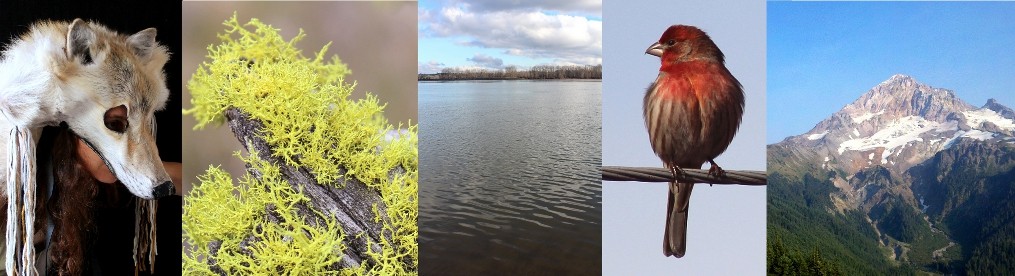
The Core of my Spirituality

I’ve been on a HUGE artwork tear the past few days, in prep for something nifty I’m unveiling this Monday–Lupa-calia (yes, there’s a hint–it’s art-related!) While I’ve been doing so, I’ve been watching a LOT of various nature documentaries on Netflix. I find it entertaining that they call the sorts of things I like to watch “cerebral”, especially as some of what I’ve been watching has been things about the evolution of Homo sapiens. However, it’s ranged from that, to disasters that shaped the Earth and made life here possible, to what the nature of death is and how it’s ultimately defined.

The more I find out about the world, and indeed, the universe we live in, the more I fall in love with it and the more precious it becomes. On an immediate level I worry for the very near future of this planet and its inhabitants. The only people denying climate change caused by humans are the most stubborn and least willing to listen, those who desperately grope for anything to support their continued denialism.

But on a broader scale, all this research–and it is a form of research–is making my perspective continually less anthropocentric, and more awe-struck by the immense scale of time and space. We are not all-powerful beings, though our ability to manipulate our environments and ourselves is impressive. For example, if another asteroid like the one at the K-T boundary at the end of the Cretaceous hits the Earth, we would be just as dead as the dinosaurs; the animals that survived the chain reactions of natural disasters that resulted were mostly small burrowers. And yes, the Earth and the existence of life on it have survived several mass extinctions, but the scale of time it has taken to recover from these has been almost unfathomable, measured in millions of years. Being relatively large, calorie-hungry critters would definitely be a hindrance to our survival as a species if a disaster on that scale occurred–and if we keep up our actions, we may cause enough global climate change to test that hypothesis.

I am also less and less enamored of the claim that the Earth loves us, and that Nature cares about us. We are but a tiny brief blip in history; on the one-year calendar that represents all of time, we exist in the last few seconds of New Year’s Eve. We’re really not all that important, and why should we be more important than species that lasted for many more millions of years than we have? But I also don’t think “Nature” is angry with us, either. We’re talking about a planet that routinely obliterates entire ecosystems with massive volcanic eruptions and the like. While the Earth isn’t in as much of a state of upheaval as it was a couple of billion years ago, it’s still not exactly the safest it could be.

We’ve gotten complacent in the past couple of hundred years as the Industrial Revolution has caused some of us to live longer and be more insulated against illness, injury, and other such problems. For me, being more mindful of where we are in all of this has contributed a certain level of humility to my perspective. On a short-term level, sure, we’re doing some neat things, and there’s no reason not to try to make human existence as universally good as it can be as long as we’re here. And yes, the fact that we are conscious, aware, observant on a level that perhaps no other animal has ever been, is a damned impressive thing.

But we are just one of a plethora of amazing, fascinating, and uniquely skilled species that have graced this planet. Most are gone now. But as I trace the lines of my ancestors and their relatives far, far back, all the way to tiny bacteria, and before that, perhaps, chemicals that gave rise to DNA–my sense of my place in all this is that I am a much smaller, younger, and less overarching being than many humans would claim.

And I’m alright with that. They say spirituality is about feeling one with something bigger than the self. All metaphysics and otherworldly things aside, knowing that I am a part of this ever-evolving macro-eco-system Planet Earth, in an impossibly vast Universe, is enough of a spiritual core for me.
First Hike of 2012

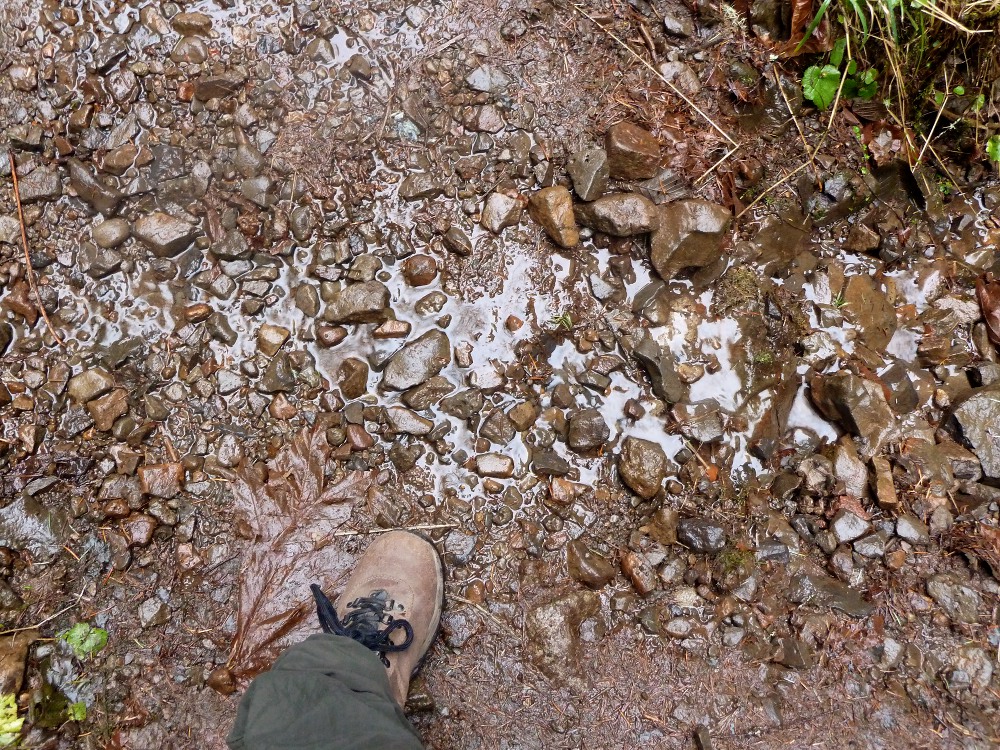
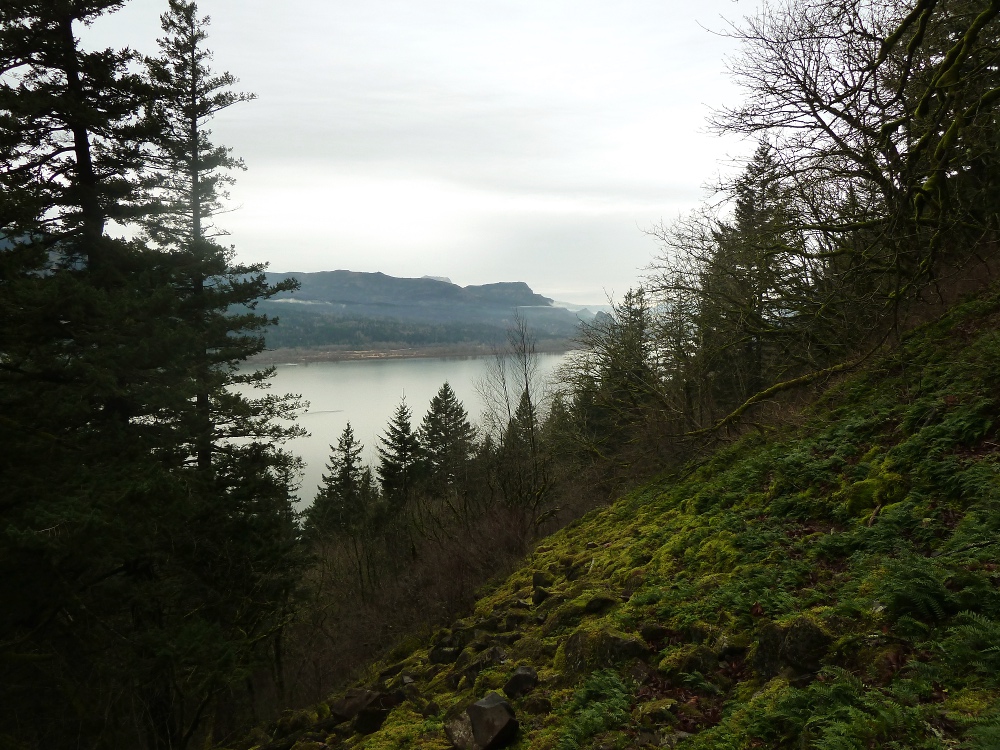
I have been stuck indoors too much as of late, between book revisions and artwork frenzies. So today we had a warm enough day (in the low 50s) that I decided to venture out to the Gorge for a hike. I had originally intended to do something relatively low-altitude like Triple Falls, since I wasn’t sure how far down the snowline would be out in the Gorge area. However, as I drove further out I didn’t see snow on the lower peaks, and so I decided my first hike of the year should be one of my very favorites–the Multnomah-Wahkeena Loop.

Now, I’ve rather out of condition. Up until this past September, I was running 5k three times a week. However, once I graduated with my M.A., I hit the ground running on some creative projects, and unfortunately let the running lapse (though I have been on some hikes in the meantime). So it’s only been in the past couple of weeks that I’ve started to run again, and I’m nowhere near the condition I was before. I was prepared to turn around and go back if necessary. Happily, not only did I make it around the entire loop in three hours, but a lot of my slow-down was due to adjusting my hip pack, taking entirely too many pictures, food/water breaks, etc. I actually did less resting than I normally do, probably due in part to the cooler air, as well as having been cooped up inside too long!

I’ve never done this hike later than late November, when it was still a bit fall-like, and if I recall correctly, sunny and warm. (Autumn likes to stay warm here for a while.) So it was a real treat getting to see what this place is like in full dormancy. The only (not-human and not-dog) animal I saw the entire time was a single female dark-eyed junco in some brush near the end. However, the plant life was incredible! The firs and other conifers were still spreading their branches for sun and mist, and the ferns had nothing left green except their newest fronds, so they were these spectacularly bright green arrays against the dark brown of dead leaves and soil.

One new development was that as I was hiking, and observing everything around me, my mind kept accessing information that I’ve been picking up from science-based TED Talks, Carl Sagan’s Cosmos, and other videos on YouTube from various scientists. I listen to these and watch what I can while I’m making artwork. Having enriched my store of knowledge about everything from geology to biology to physics and then some, I felt as I hiked that I had more of the backstory to this place I was a part of for that time. It wasn’t distraction, though. Rather, knowing things like just how long the processes of evolution have taken to get to this point only served to make me appreciate my fellow beings more. I could look at the canyons I hiked through and imagine how the rivers and streams had slowly cut down the earth over time, wearing these enormous grooves over thousands and even, in some cases, millions of years. I consciously shared breath with the trees, ferns, moss and other plants in this well of oxygen. I observed the formation of rain clouds in the sky. I knew the fleeting, short lifespan of the little songbird who greeted me so briefly before flitting away and was blessed even more by her presence.

The knowledge of this world is sometimes downplayed for sake of more ethereally “spiritual” interests. One of the points I made in Deep Ancestral Totemism, Part One over at No Unsacred Place is that so much of religion and spirituality is aimed at transcending or otherwise escaping this world, as though it has nothing to offer. The idea is that this world is so flawed that we are encouraged to look to a “perfect” world that comes next. Or, alternately, while we are here we are supposed to transcend and avoid anything of our more animal nature, trying to be “spiritual beings having a physical experience”. And, of course, there’s the very mundane practice of escaping “nature” for the comforts of human technology, which often distracts us from the needs of our bodies, or negates those needs temporarily.

The problem is that so many people are trying to escape the physical realm for various other places that our detachment causes us to take what is physical for granted. Because we can conveniently ignore the world around us, we lose that sense of connectivity. The idea of a polluted river or strip-mined mountain is so distant because most of us in the US don’t have to think about them. And so these actions are allowed to continue unabated because we’re more interested in our selves and our needs and the things that let us continue ignoring, transcending, ignoring, transcending, etc. The more we focus on the mind, too, and virtual reality, and spiritual reality, the more this reality suffers.

So it was a great relief to me to find that the knowledge I had absorbed through modern media had only deepened my connection to the physical Land. I had felt yearnings and appreciations even when I was holed up in my apartment listening to these things, but being out in the wilderness today really confirmed that knowing more = appreciating more.

Anyway–like any good trail, this essay rambles.

My favorite part of the hike was actually the last two miles, coming down the mountain alongside Wahkeena Stream. Why? Because it was raining! I love hiking in the rain, provided it’s not close to freezing. I admit that, selfishly, I like having the trail to myself when possible. But more than that, it reminds me that this area is a rain forest, and to only visit here when it’s clear is to miss out on what truly gives life to this place.

And so that was what grew within me as I hiked, and this is what it became:

Sometimes I think the Northwest is best
When it is being the Pacific Northwet.
The rain soaks into the sun-parched pigments of the soil,
And glazes the fern leaves in a hydrous kiln,
Until all the colors remember themselves more fully.
Even the sky cordially removes his blue cloak,
And gently wraps the sun in a sheet of gray
So that it is the rain forest who shines the most.

You can see more pictures from the hike here.

The Foxes of the Four Seasons

A long time ago, the world was a lot different than it is now. There were no seasons, no changes in the weather. If you wanted snow, you had to go to one part of the world. If you wanted sun, you had to go to another. And everybody had to bring back rain from the only place in the world that had it, though it got enough for everybody. Since the animals couldn’t only have rain or only sun, there was a lot of moving around, and you didn’t have so many animals who stayed in one place. Some animals hardly ever saw another of their kind, but others would organize reunions every so often so as to not get lonely.

So it was that every seven years, all the foxes of the world would come together in one place for one great conclave. Long-separated friends caught up with each other, families introduced their youngest kits, disputes were addressed and resolved, and at night there was much celebration to be had. It was all rather a busy affair, as one might imagine would happen with that many foxes in one place.

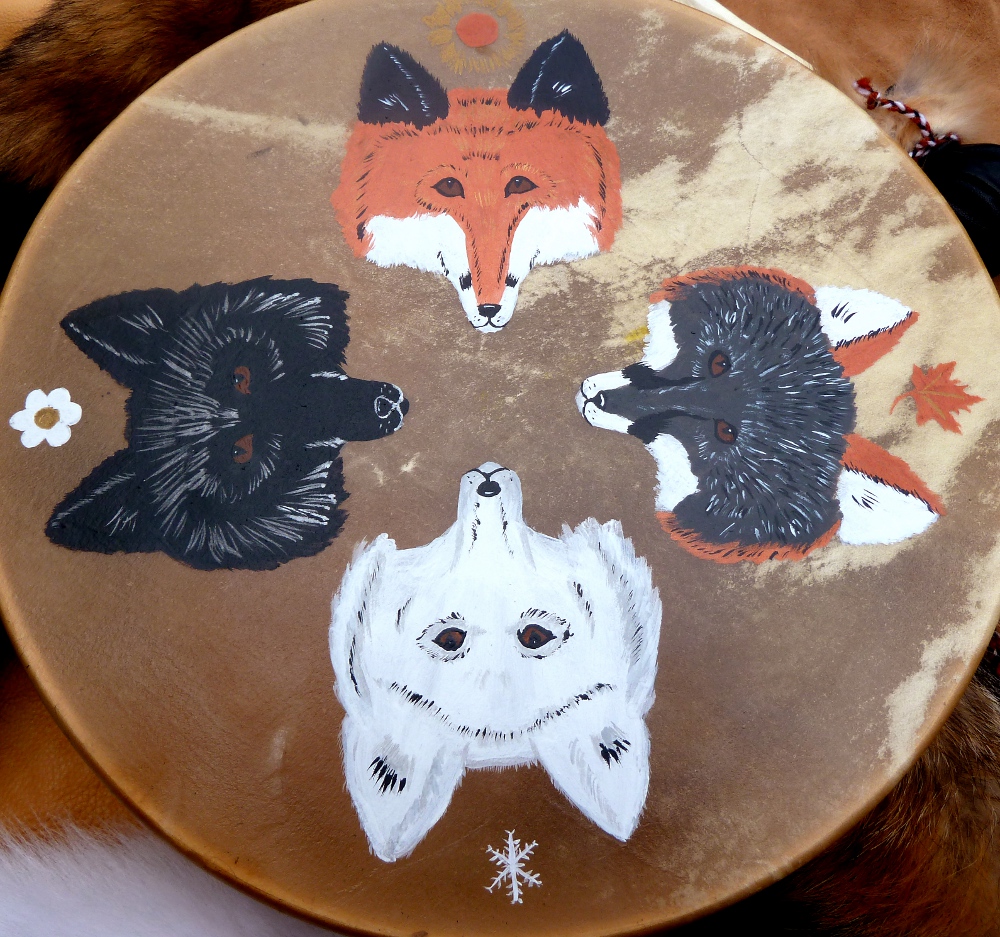
It just so happened that one year, there was a contest over which fox was most beloved by the Earth, who gave the foxes’ paws somewhere to go. Finally, it came down to White Fox from the North, Black Fox from the East, Red Fox from the South, and Gray Fox from the West. Everyone agreed that these were the very best, cleverest, swiftest and strongest foxes of them all. They spent an entire day debating who was going to be elected the best fox when the Earth would make her presence known that night. They had heard that the very best fox would receive a special gift from the Earth, and they each wanted to prove they deserved it.

“She’ll choose me,” White Fox said, “because I am the only one who holds the cold snow and ice with my tall, proud mountains!” And everyone agreed that his mountains were indeed quite impressive.

“Nobody likes being cold, silly thing,” said Black Fox. “She’ll choose me, because I carry the soft, warm winds that help new seedlings to grow.” And all the foxes assembled thought she made a very good point.

“Ha! Just a little warmth? I’ll give you all the warmth you need with all the sunshine you could ever want!” declared Red Fox. “That’s why I’ll be chosen!” There was a good deal of agreement with that, as basking in the sun was a favorite activity of foxes all over.

“Surely we cannot have any snow or plants or cooling off from the sun without rain,” said Gray Fox. “I have the most water, which means that I’m sure to be the one the Earth will choose.” And the other foxes licked their chops at the thought of cool, refreshing rain water to drink.

But who would be chosen? The four foxes fell to arguing amongst each other, and had almost come to blows when there was a great trembling beneath their paws, and the Earth made her spirit present as a great, glowing golden Fox. “Dear children, what are you doing?” she asked.

“We were trying to figure out who you were going to choose as your favorite fox, and we can’t all be your favorite!” the four foxes said.

The Earth thought a moment and looked at each of the little foxes at her feet, each one so strong and talented in her or his own way. Then she smiled.

“Of course you can all be my favorites. Why choose one among you when all four of you have so much to offer?

My lovely Black Fox, you are the deep, rich soil which allows all the plants to grow healthy and strong. You take what has died and rebirth it as new living things. Your warm winds help to bring life to the land. Therefore, I will give you the first part of the year, when my friend the Sun is on his journey back here.

And you, bright Red Fox, you give the Sun a place to show us his strength the best. You allow him a place to set down the burden of rays on his back, and unwrap them so that all of us may see them and enjoy their warmth. To you, I give the second part of the year so the Sun may share with us every year.

Dear Gray Fox, your rains are invaluable to us all; without water we would be parched. I give you the third part of the year, where your rains may be the tears that bid farewell to the Sun as he leaves again, and your bright colors will be reflected in the leaves of the trees as they wear their finery to see him off.

Oh, beautiful White Fox, I haven’t forgotten you! Your cold climate cries out to the Sun for what warmth he will give, and your snows reflect his rays so that he can see this land no matter where he goes. To you, I give the final part of the year, to remind the Sun of us when he is at the farthest part of his travels, while we await his return here.”

And so it was that every year after that, all the places of the world received the gifts of the four foxes, each one in turn. Of course, each Fox had her or his own favorite places where they might tarry a little longer. But the animals no longer had to travel so far just to get sunshine or rain, or to get out of the cold or the heat. And so all but the most adventurous were able to settle down and create nests and dens, and allow the seasons to come to them.

Fox drum, acrylic on deerskin with fox tails, by Lupa, 2011

Shapeshifting as Connecting to the Other

Just a quick note as I am busy with writing and art and family and holidays and, and, and–you get the idea.

But I wanted to share my two latest posts over at No Unsacred Place:

Shapeshifting into Kin: Part One (the theoretical bit)

Shapeshifting into Kin: Part Two (the practical bit)

A brief excerpt:

There are many purposes for shapeshifting—celebration, drawing on the power of the being you’re changing into, learning to change yourself, etc. There are also many techniques, some stationary, others involving dance and other movement. This version of shapeshifting is quieter, and is primarily for the purpose of creating connection with, and fostering awareness of, other beings. It’s a way to begin healing the rift we as a species have created between us and the rest of the beings we share this world with. It requires a certain level of intimacy; you can’t become a being without having some empathy for it, and the world could certainly do with more empathy all around.

I Am in Awe

This past weekend I set up a vending booth at the Yule Bazaar. The first day was held down at the Unitarian Universalist church in Salem, OR, and the branch of organizers there had arranged for a group of traditional Aztec dancers to come and share some of their dances. These weren’t white people “inspired by” the Aztecs; these were folks in the broader Hispanic community here in the area who had connections with people in Mexico who had still hung onto pieces of the indigenous Aztec lore. This was knowledge that had gone underground as a result of the genocide perpetrated by Spanish invaders, and over the past fifteen years or so there’s been more of an effort to try to combine what’s left and recreate the traditions.

One of the dancers spent a good amount of time giving a lot of context for how the knowledge had been revived, and what the importance of the practices was. I was especially fascinated by the assertion that each footstep, each move, in each dance had its own special meaning and piece of lore; the shell-covered ankle cuffs the dancers wore that made lovely ringing noises as they moved represented the various sounds that running water makes–not just THE sound, but many sounds. The spear that one of the dancers carried wasn’t a weapon, but a tool to pierce through to truth. And so forth. I paid close attention to each individual step and move, the voices, the conch shells and other tools, how everything flowed. I was awed and humbled.

It’s not my first time watching other cultures’ dances; I’ve seen dancers at powwows, for example, though it’s been many years. However, probably due to my age and better context this moved me even more than those earlier beautiful experiences.

What struck me the most was just how rich in symbolism and meaning every element of the dance was. I realized that what I am creating here in some ways pales by comparison, not because I’m not sincere or not trying hard enough, but because what I was watching had been developed from the observations, experimentations, and sheer creativity of thousands upon thousands of people over many generations. All of those people had contributed their day by day observation of the sounds of rivers, or the bright colors of bird feathers. These were woven into centuries of myth and legend, art and dance and other expression.

So many of us practicing neoshamanisms simply don’t have that sort of shared community support. Getting together once a week for a drum circle, or once a month for a full moon ritual, can’t compare to a community living on the same piece of land with the same people for many lifetimes. We can have good friends, and we can have good family, but so many of us live far away from our families, or have families who are not supportive of our paths. Friends move away; we move, too. I have moved an average of once a year since 2001, and am now in my fourth state. I can keep up with old friends online, but it’s not the same.

This is not to say that I am deterred. But it does offer me some idea of what is missing in much of neoshamanism, and some direction in further developing my own practice. I can’t necessarily create community, and it’s highly unlikely that I would given how much of a solitary I tend to be. But I can at least explore Meaning more deeply, and connect it to more than just intellectual understanding of “This is what North means”. Which is a lot of what I’ve been doing anyway, but I have more inspiration now. Not taking from the Aztec dancers, of course, but looking at my own relationships.

Art, storytelling, and shamanism my path

I have some half-formed thoughts about the recent integration of storytelling with my artwork, as well as the very deep, significant spiritual elements of the acts of creation. Yes, the coyote and wolverine are the most recent and obvious syntheses, given that each has a “new” myth to talk about its origin. But Anput was also a spiritual story, albeit one in which I featured as a main character, and which was not just a story that I created in my mind, but something that happened to me in working with that Goddess. Even Lady Red Riding Hood was story, rewriting the tale to better fit modern parameters, though maintaining its “once upon a time” feel.

I’ve long been a spirit-worker, evoking and invoking totems, animal spirits, deities and others. And the spirits have often spoken through my art, and not just the skin spirits that are in the remains themselves. I’ve even created numerous ritual tools and costumery over the years that could mesh with certain beings or energies in ritual.

However, this feels bigger. I feel like I’m adding to mythology, if that makes sense. The process of creation is simply the vehicle thereof. Perhaps it’s hubristic to say so, but it feels as though I am *adding to* these beings, with their consent and even invitation. Along with transforming the animal remains and their spirits, I feel I am also making a bigger transformation than before to the bigger beings, the totems and deities. If a totem, for example, is “made of” the natural history of the physical animal, its relationships with all other species, and the human observations as translated into legend, lore, and mythology, then I feel like I am making a bigger contribution to the ongoing, ever-developing mythology.

Like when I make a small pouch out of recycled rabbit fur, I am transforming the fur into something new, and I am rejuvenating the spirit with a new purpose–or releasing it from its container if it so wishes. But Domestic Rabbit stays largely the same; the pouch may be used to connect to Rabbit, but the change is only on this end. However, I look at my experiences creating the Anput headdress, and it definitely feels *bigger*. If you give me the generous allowance that my UPG is more than just something in my head, then I have been shown an element of this Goddess that may have been previously unknown, perhaps by even the ancient Egyptians. I don’t feel I’ve so much added something that wasn’t a part of her before, so much as I helped to shed light on it.

I’m not the only person to do this sort of thing; Ravenari has long been creating these inspired works. Her As Totems series largely comes from the individual totems pressing her into making portraits for them, or asking others to commission her (as with me and Steller’s Jay). She also learns more about the totems in the process of creating these works, hence her creating about the only totem animal dictionary I give any credence to. I give it more weight because I am aware of her process as well as her general familiarity with the animals and her shamanic skills, and I know how much effort goes into the contact with each. Whether she changes the totems, adds to them, or simply enhances the focus on certain parts, I can’t say. But it is very impressive to watch.

And it’s incredibly fascinating to be going through this process; the exchange of energy and ideas that I’m sharing with the deities and totems and spirits in this is beyond what I’ve done before. Whether you see me as connecting with independent beings, or being able to better access these archetypes and channel them through my work, I would appreciate your constructive feedback on what I’m trying to describe here. Anyone else been here?

How Wolverine Devoured the Sun

Wolverine was the fiercest animal in the forest. Even great Grizzly Bear ran away when Wolverine was angry. Wolverine was also the hungriest animal in the forest. He ate everything he could find that wouldn’t bite him back, and even most of the ones that would. All the animals of the forest told their young to stay away from Wolverine, lest he gobble them up for breakfast.

After a while, everyone learned to stay far away, and he found it harder and harder to find food to eat. One day, there was an enormous rumbling in his stomach, and he knew that if he did not eat soon his stomach might just try to eat him! So he left his den to go out and see whether some animal or another might be close enough for at least a snack.

Yet the snow covered the land so thickly that not even the tiny field mice with their enormous families could be found. And because all the animals had hidden away while it snowed, there were no tracks to be found anywhere.

Wolverine looked all around him. There was only snow, that melted in his stomach and did no good. And there were trees and rocks, but even his formidable stomach would reject them. Finally he looked up, and saw the Sun in the sky.

And he thought to himself, “All life comes from the Sun. She feeds the plants, who feed the animals, who feed me. So if I eat the Sun, then I’ll never be hungry again!”

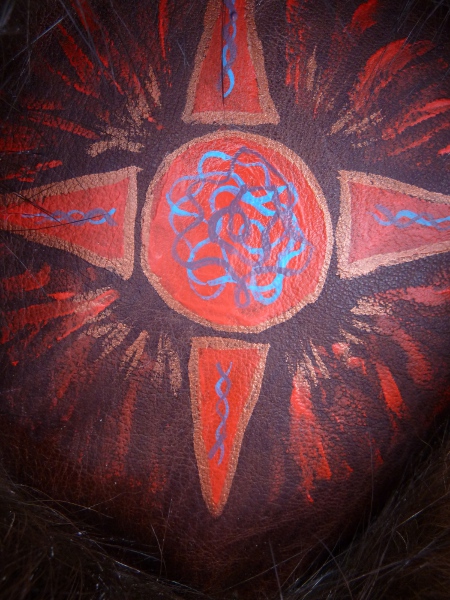
Sunburst, Lupa, 2011

Just then, the Sun was approaching the top of the highest mountain peak. So Wolverine ran as fast as he could, climbing the mountain with his sharp claws gouging gashes in the rocks, and shredding the boulders into rock slides. He destroyed the mountainside homes of the pikas, who to this day will still complain loudly and shrilly about it to anyone who comes near.

Right when the Sun was crossing over the tip of the mountain, Wolverine reached the summit. With a running leap, he opened his jaws just as wide as they would go—and he swallowed the Sun! The world was thrown into complete darkness, since the Moon was still slumbering on the other side of the world, and the Stars were too surprised to shine.

Down in the forest, the startled animals panicked, shoving their way through the cold and snow to see if their neighbors, too, had experienced this sudden nightfall. Some were lost in snowdrifts; others tripped over rocks or fell off cliffs or stumbled into rivers. The trees and other plants shook and wailed as their only source of food had disappeared. “We are lost!” they exclaimed.

Meanwhile, Wolverine attempted to pick his way down the mountain with a very round, very full, and very uncomfortable stomach. He was so busy trying to not roll down the mountain that he didn’t even stop to consider whether he was even hungry any more. And he certainly didn’t notice that he had, in his haste, swallowed the Sun quite alive.

For her part, the Sun had shaken off the indignity and inconvenience of having been eaten whole, and she began to look for a way out. First she looked up Wolverine’s throat, but she only saw his sharp teeth, and having avoided them once she did not wish to try her luck again. She then looked toward his tail, but she only saw his long, long tangle of intestines, and she did not wish to find herself lost in that maze. She even tapped at his ribs, but found the bones to make all too effective a cage.

Wolverine totem headdress, Lupa, 2011

So finally she decided she would stay right where she was and look for any possible way out. She began to roll around, testing every surface she touched for any sign of an opening. As the Sun pressed up against Wolverine’s insides, she burned him terribly. Wolverine, even so strong and stoic as he was, could not help but cry, and the pain was so great that he began to shed tears of blood that flowed down his body.

Finally, the Sun found a weak spot at the back of his belly. And she pushed, and she pushed, and Wolverine clawed the ground trying to keep her in, and his howls of fury and pain were so great that all the other creatures ran far away.

And then with a great tearing and rending, the Sun burst through Wolverine’s back. She scorched his fur as she escaped, and left an impression of her beams radiating out from the hole she created. She flew back up into the sky and brought the day to the land again.

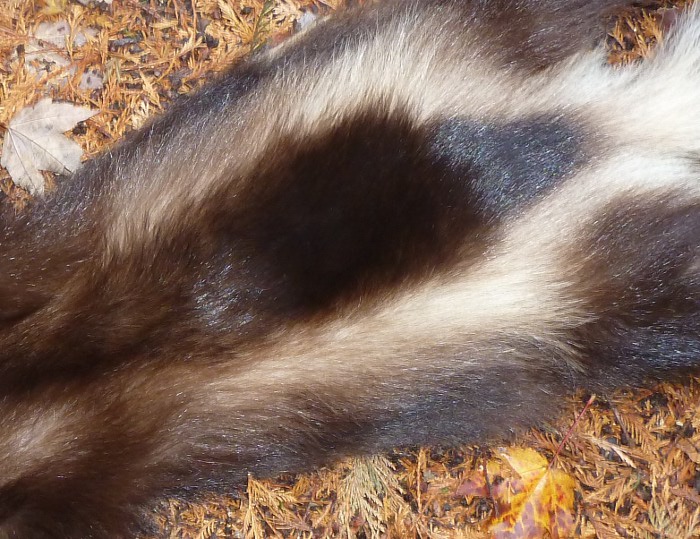
As she looked down upon Wolverine, who lay dead upon the ground, she took pity on him. And lifting him up into the sky, she breathed life back into him, and knit together his torn form. And Wolverine stood up, as healthy—and hungry—as ever. But as he looked back to see whether the hole still remained in his back, he saw a ring of pale sunbeams on his fur.

“These are to remind you of the consequences of your gluttony,” the Sun said. “You were only so very hungry, my fearsome child, but you are a creature of the earth, not the sky, and there are many things for you to eat where you came from.” And so she placed him back down right by his den.

And from that day forward, no matter how hungry Wolverine was, and no matter how far he had to travel to find food even in the middle of Winter, he had only to look at the Sun’s touch upon his back to remind him of the folly of his past.

Wolverine Fur, Lupa, 2011