How Coyote Lost His Hearing

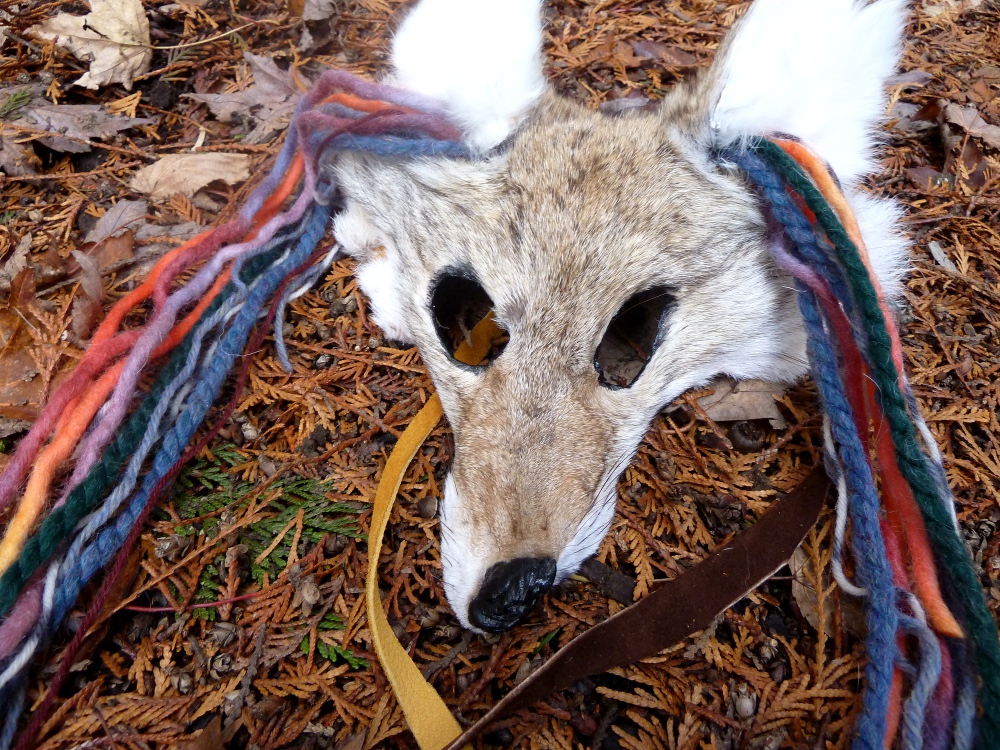
Coyote Fool Mask by Lupa, 2011

Now Coyote was a fine young man, if a little rough around the edges. And there came a day when he decided he was going to go courting, because no one had married him yet, and that was a rather sad state of affairs if he said so himself! So he went on down to the river, jumped in and swam around a while, came back out and shook himself dry in the sunshine. Then he put on his finest clothes, which were rather threadbare and shabby and a bit out of style, puffed his chest out, and went to go find someone to court.

Soon he ran into Rabbit, who was grazing in some clover at the edge of a buffalo wallow. “Look, there’s Rabbit! She’s not married, but she has a lot of children. I bet she’ll want to marry me!”

So Coyote sidled on up to Rabbit. “Why hallo there,” he said. “How might you be this lovely day?”

“I’m doing quite well, thank you! Would you care to join me for lunch? The clover here’s so luscious!” Rabbit replied. “This little patch right here is especially nice,” she said with a wink. So Coyote settled down next to Rabbit and began to mouth the clover, just to make Rabbit feel better and hopefully like him a little more.

But soon all that pretend eating made him hungry for real food. And Rabbit was looking mighty tasty. Of course, Rabbit had seen that look in Coyote’s eyes before. So before he could snap his teeth at her, she up and ran as fast as she could away from him. She even kicked a cloud of dust all over Coyote and his finery.

While he was sitting there in the dust, with his finest clothes filthy and his stomach growling, along came Scrub Jay. “What seems to be the problem?” Scrub Jay asked.

“I tried to court Rabbit so she’d think to marry me, but instead she ran away from me and left me here in the dirt!” Coyote complained.

Scrub Jay looked very grave. “Well, I see the problem here. You just don’t look enough like a rabbit. Now, we can’t very well shorten your tail, and we can’t round your nose off no matter how much you wiggle it, but we could make your ears fluffier, like hers are. Here, get some of this dandelion fluff and stuff it in your ears, just like so.” So Coyote tucked his ears full of fluff, and then went off in pursuit of Rabbit.

He never found where Rabbit went, but he soon ran into Crow, who was building her nest. “Well,” he thought to himself, “I don’t think Crow’s married either, and I think she’s just as nice as Rabbit, even if she is a gossip. I’ll court her instead!”

Coyote headed up to the tree where Crow was building her nest. “Good day!” he called to her, a little loudly since he was having a bit of trouble hearing himself, but everybody had that problem from time to time, didn’t they?

“Why, look, it’s Coyote—wait, what on earth do you have stuck in your ears?” Crow cawed.

“Oh, you won’t convince me of the worth of lucky hares—their feet never did me any good at cards anyway!” Coyote replied. “So, have you found any good carrion lately?”

Crow cocked her head to one side at him. “If I did, I wouldn’t tell you, you silly creature! I need to eat, and I don’t want you stealing my food!”

Coyote cocked his head right back at her, hoping maybe mimicking her would make her like him a little more, though he was also more than a little confused. “But my feet are just fine! Why do you think they had peeling grooves? Those cracks in the pads are natural-born, baby!”

“No! Not FEET! EAAAAAAAT!” Crow cawed as loud as she could. She flew down from her nest and flapped her wings in his face. “EAT! EAT! You fool, I said EAT! As in FOOD!”

Leather corvid wall hanging by Lupa, 2009

Coyote backed away from this mad black whirlwind, then turned tail and ran, feathers coating his dusty finery, leaving a trail of fluff in his wake. He eventually shook Crow off, and soon found himself in a panting heap right where he’d left Scrub Jay.

“How’s it going, Casanova?” Scrub Jay said. “You panting because Crow was just too much for you?”

“You could say that,” Coyote grumbled. “But she didn’t like the fluff! And I don’t think she’s going to marry me any time soon, either.”

“That’s because she doesn’t care about fluff, silly dog. She’s right in the middle of building a nest—and believe me, I know nests,” Scrub Jay bragged. “What you want to court her with is something pretty that she can decorate her nest with! In fact, I know just the thing! Follow me.”

So Scrub Jay and Coyote went east, and they went west, and maybe just a little north—but never south, not when courting. And they came to a place where humans lived, a little hut with fences all around it. By the door of the hut was a basket, and in the basket were many balls of brightly colored yarn.

“See that?’ Scrub Jay pointed to the basket. “That’s exactly what you need, right there! Crow would love that in her nest! Now, here’s what you do. You want her to definitely notice that you have yarn for her, even from a mile away, and maybe especially so since she’s all spooked now. So tuck some of that yarn into your ears so she can see it, and go find her! But you’d better put this fluff back in, too, because you might run into Rabbit instead, and then your problem will still be solved! I’ll just sit right here and keep an eye out for the humans.”

So Coyote stuffed the fluff back in his ears, then sneaked over to the house, grabbed some yarn, and went and hid in the back field by the pond while he tucked that in his ears, too. Just as he was finishing up, something big shoved him over onto his head! He turned around, and saw Cow, all black and white and surprised, looking down at him.

“Ohhhhhhh, my! What are you doing here? And what is that in your ears? Is that the new fashion, then?” she said.

“WHAT? I CAN’T HEAR YOU!!!!!!!” Coyote shouted at the top of his lungs.

“Ohhhhhhh, dear, now my husband will have heard you, and he’ll come and chase you away! You’d better run now, or else!” Cow looked around nervously.

Coyote was confused. “I STILL CAN’T HEAR A THING YOU’RE SAYING! WHAT WAS THAT AGAIN?”

Cow said again, “Ohhhhhhhh, goodness! My husband is coming! You’d better run away or he’ll get you!”

“I GIVE UP! YOU TALK TOO SOFTLY! I’M NOT COURTING YOU!” Coyote was about to turn and head home, when the ground began to shake, and Cow’s husband came barreling to a stop over him.

“WHO WERE YOU GOING TO COURT, LITTLE DOG?” Cow’s husband bellowed.

“WHO ARE YOU, AND WHAT ON EARTH ARE YOU ALL SAYING?” Coyote shouted right in Cow’s husband’s face.

“I SAID YOU’RE IN MY FIELD, TRYING TO COURT MY WIFE, AND I DON’T CARE FOR THAT, NOT AT ALL!”

“NO, I’M NOT THAT TALL, BUT WHAT DOES THAT HAVE TO DO WITH CARROTS, AND BORING YOUR EYES, AND THE COLOR TEAL?”

At which Cow’s husband snorted, caught Coyote and his finery and his fluff and his yarn and his dust and his feathers, and tossed it all into the pond with a mighty splash!

“Well, at least you’re clean again!” Scrub Jay shouted to poor Coyote, who still couldn’t hear anything anyone was saying as he dragged his muddy self to dry land.

And Scrub Jay flew away, laughing “Vweeeeet! Vweeeeet! Vweeeeet!”
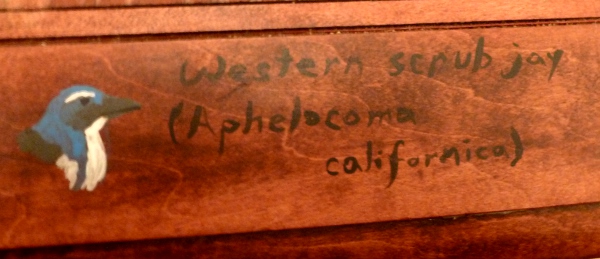
Scrub Jay painted by Lupa, 2010

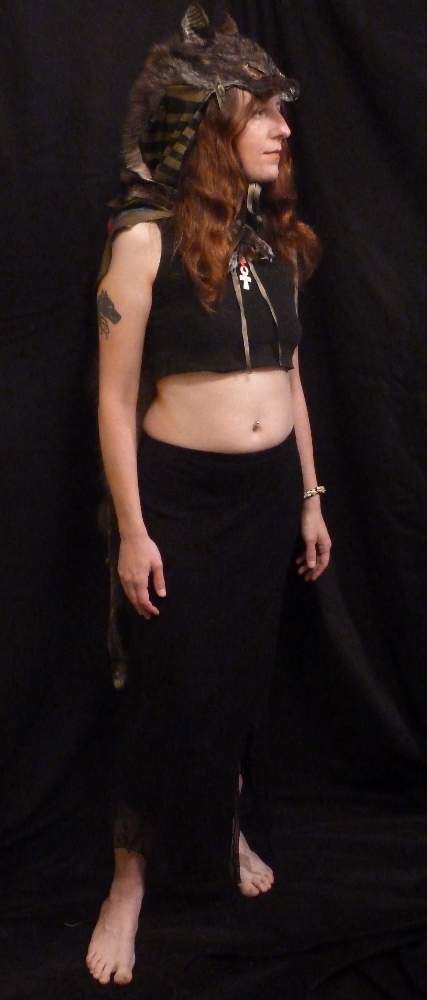
The Goddess Anput

While I’ve been creating ritual costumery and other tools out of hides, bones and the like for over a decade, more recently I’ve been getting into more elaborate projects. One of my most recent endeavors was a ritual costume in which I had a surprise spiritual experience–well, unexpected, but not entirely surprising. Here’s what I wrote about the experience at the time, just about a month ago:

Tonight, a Goddess found me.

For many years, I have acknowledged Anubis–Anpu–Yinepu–as the God of dead things, related to my art with the remains of animals. And he has watched over my work in the background, quietly, only occasionally coming forth to speak if he feels the need to add a bit of guidance. But still…so distant.

Then the day came when the hide of a black coyote came into my possession. Even having lived and died a half a world away and thousands of years past the jackals of Egypt that gave their form to the God, this coyote carried that energy, inexplicably and completely.

Almost.

Except this coyote was female, and held onto that beyond death almost defiantly. And through that skin spirit, Anput made Herself known to me. Where Anpu had been distant, though not uncaring, Anput settled Herself down in front of me, and in the same way Artemis had done so long ago when I was younger, She looked at me and said “Doesn’t something look familiar?”

Familiar? How could I even know what to look for, when I knew not Whom I beheld? I knew scant little of her, as did anyone today–the feminine aspect–some said wife–of the better-known Anpu, had had little surviving lore and few adherents today. “Goddess of the 17th nome of Egypt, with the standard of the jackal” told me little.

And so I returned to Her, perplexed. And before I could say a word, She saw my confusion, and She spoke. “I am the Goddess of funerary arts. When the stones were carved into the faces of pharaohs long-dead, My hand guided the chisel. When each set of canopic jars was formed, I shaped each detail and applied every stroke of the brush. And now, when you weave hide and bone into sacred art, My hands wrap around yours, and I see the work through your eyes”.

The black coyote then wrapped around my shoulders, wishing that I would prepare her to move on to the next person in her afterlife, for, as for so many, I am only a threshold, a transitional point. And so we enmeshed ourselves, for three days and nights, in the sacred preparation and creation of what would carry a piece of each of us.

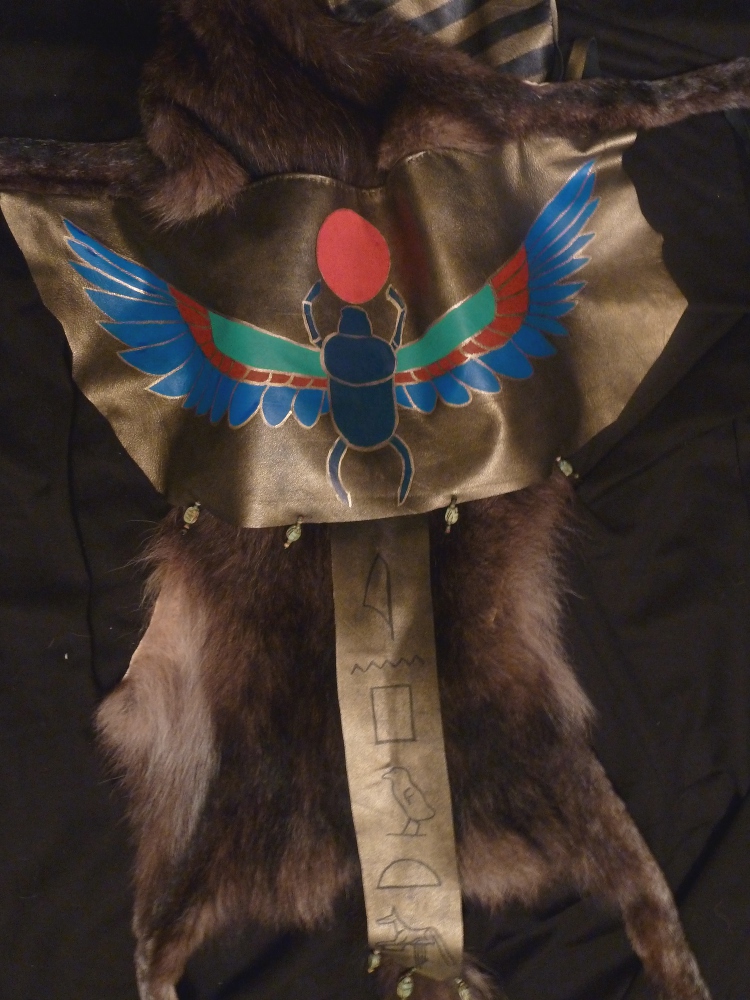
And at the end of the three days and three nights, I wore a cloak upon my shoulders, with the sacred mantle and hood as the Goddess directed me and as the black coyote concurred and as I created. Khepri stretched his wings wide, and the name and standard of Anpu—Input—cascaded in hieroglyphs.

This, then, was our inauguration, the Goddess and I. The black coyote would go forth as Her emissary while I would remain here and continue the sacred work as I always had, only with the consciousness of She who guided me.

***************

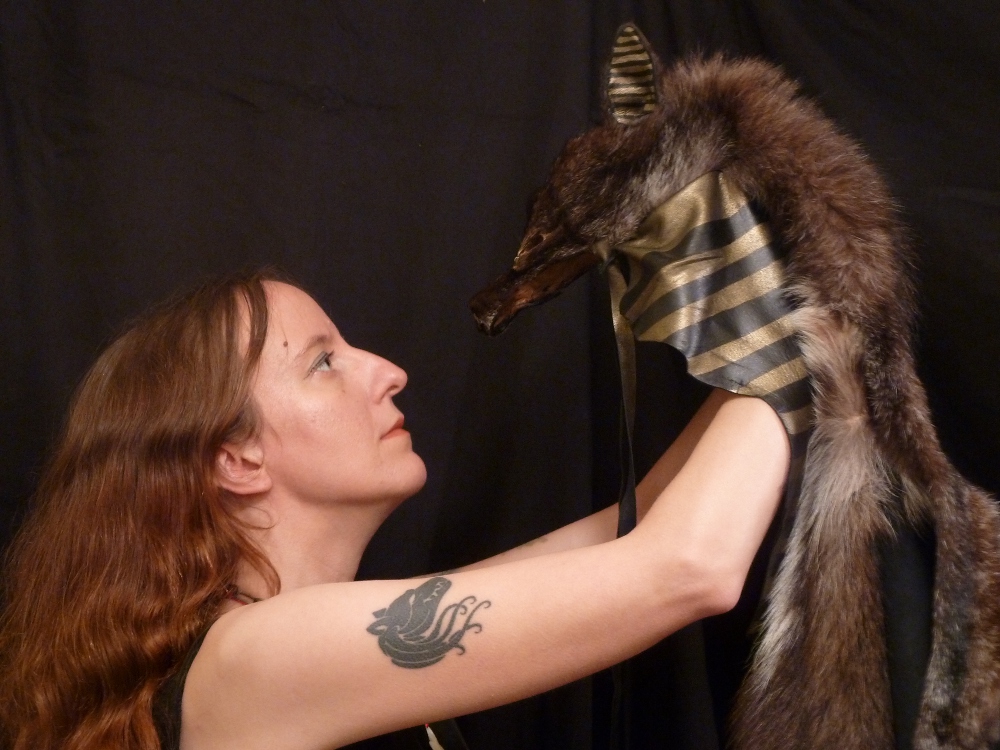
This headdress is dedicated to Anput, the female counterpart to Anubis. It is in no way meant to be an authentic replication of any traditional Egyptian creations, but is instead a hybrid of my own style mixed with elements inspired by a very general Egyptian aesthetic, guided by sacred inspiration (and many pictures of old statues and paintings from various dynasties!).

This headdress is based around a black (melanistic) coyote hide; this is a rare, but naturally occurring mutation in this species. This particular hide came from a small female, black with a white blaze on her chest. She is complete with all four paws and claws; the only piece missing is her lower jaw, which was removed for the purpose of this project. Her ears and face have been reshaped to a more natural appearance; they were originally rather flat and misshapen, as many hides are after tanning. Her face has been given painted details, to include hold around the eyes, and gold accents on her nose. I inserted gold and black leather in her ears to mimic the striping often found in the ears of depictions of Anubis.

The leather is one whole tanned lambskin hide, dyed black, and then with an overlay of gold on one side. It forms the side panels of the hood, again striped, as homage to the Nemes headdress that Anubis and other deities were commonly depicted wearing; there are very few images of Anput Herself that remain, and as I was working on this inspired piece this is what She indicated She wanted.

The mantle over the shoulders was the most difficult portion of this. I drew out the scarab and wings with a black fine tipped paint pen, and then colored it in with acrylic and oil paint pens in two shades of blue, green, and red, and detailed in gold. I tested all these on a scrap of the same leather to be sure of the colorfastness. The hieroglyphs descending from the mantle read “Input”, an alternate of Anput’s name, and below that is the standard of 17th nome (district) of Egypt, over which She reigned.

The beaded accents on these leather pieces are a combination of new (reproduction) faience scarabs, and genuine old Egyptian faience beads (exact dynasty unknown). Each one of these dangles is about 1 1/8” long.

The headdress ties on with straps under the chin, and the forelegs also are tied together with more leather strappage. It is one size fits most; for scale, I am 5’4” and 115 pounds.

This project did take me the better part of three days and nights with only small breaks. It is by far one of the most ambitious pieces I have done, and represents a shift to more elaborate and involved crafted artwork.

***************************

In the weeks since I created this headdress, Anput has been a quiet but strong presence in my workspace, and she has actually brought Anpu Himself forward more as well, not that I should be surprised. The feeling I get is that they are aspects of each other, rather than spouses, though perhaps the distinction isn’t so strict. Sometimes I work with them both, sometimes Her alone.

And as I work with the Divine in my art, I am beginning to feel the inklings of others who wish to have creations in their honor. I have long done this work with totems; every piece I create has been a tribute to the species’ totem as well as the individual animal spirit, whether a full dance costume, or a simple leather pouch. But there are other beings stepping forward now, adding yet another layer to what I am creating.

And I’m very much looking forward to seeing where this will take us all.

******************

Just as a side note, the Anput headdress is not meant to stay with me, nor are the rest of the creations I will be making. The Anput headdress may be found here on Etsy. If you are interested in giving this work a home, or in commissioning your own art, please feel free to contact me.

Why Basic Research Methodology Is Important To Magical Knowledge

Quick note–a couple of days after I wrote this but before it was scheduled to go live, I was interviewed regarding Otherkin on the Pagan Musings podcast with KaliSara and RevKess, as well as guest “Arthur”. It was a really good discussion; I jumped in about 45 minutes into the show as the special “surprise” guest. Take a listen if you’re interested; we get into what basics of what Otherkin are, but also some of the spiritual/religious and psychological elements of the phenomenon as well.

So. On to the intended post.

Recently on Livejournal I wrote a response to a post someone else wrote about proposed experiments to try to “prove” the objective existence of Otherkin. These experiments ranged from Kirlian photography to try to get pictures of phantom limbs, to using EEG to measure any neurological abnormalities in Otherkin compared to the general population. I feel it applies not only to proving Otherkin as something other than collective imagination, but also proving the objective existence of magic. Here’s what I wrote (with a couple of minor edits and some helpful links added):

With regards to experiments, most of the proposed quantitative experiments over time have been horribly flawed and have not been designed with solid research methodology. Here are a few particular potential flaws:

–Poor research design: A good piece of research starts with good design. What is the experiment meant to measure? How is it measured? Is it using any existing instruments, or is one created specifically for the purpose of that experiment? Is the instrument you’re using reliable–does it measure consistently? Is it valid–does it measure what you actually are trying to measure? Finally, the simpler, the better, especially in new territory such as this. Keep it to one independent variable and one dependent variable, if possible–and know which is which.
Confirmation bias: This is a BIG problem with anecdotal “evidence” of Otherkin, magic, etc. Confimation bias basically means seeing what you want to see, and excluding anything that doesn’t support your desired results. This is often done unconsciously. Example: I keep seeing signs that Tiger is my totem. I want Tiger to be my totem, so I give greater attention and value to things that support Tiger being my totem than not, even though, if the evidence is taken by the numbers, the evidence points toward Tiger not being my totem.
Sampling bias: This was a notable reason for why my surveys for the Field Guide were NOT formal research, and a big potential issue with trying to do any experimentation with Otherkin in general. Your sample is most likely going to be biased toward people who A) are willing to be identified in some manner as Otherkin and are not so paranoid as to assume even anonymous research may be used against them personally, and B) more often than not WANT for Otherkin/magic/etc. to be proven. It’s a small population to begin with, too, so you’re most likely going to have a small sample, which can heavily affect whether the research is even solid.
Confounds and Correlation vs. Causation: related to some of the earlier things I talked about, confounding variables are variables other than the identified dependent and independent variables that come into play and affect the results. Another, very closely related concept is “correlation does not equal causation”. Just because two variables seem to affect each other in one’s results does not mean that they automatically are causal to each other. There may be a confound or third variable that is the actual vehicle of causation, or the correlation may be coincidence. This is why multiple experiments need to be run, and the results thoroughly analyzed, before making any theoretical conclusions.
–Applying more significance to results than the statistics show: Statistics are how you analyse your results in various and sundry ways. They allow for a certain level of variation (such as standard deviations from the mean, or identifying outliers) and the statement thereof, and they also help you to rule out whether your results occurred by chance or not (whether your results are statistically significant or not). Through statistics you can use the hard data to determine whether or not you proved your hypothesis (or disproved the null hypothesis).

Because most “evidence” of Otherkin/magic/etc. is anecdotal, and experiments “proving” it often manipulate or inflate the significance of the results, and the best research so far has not supported the objective existence of magic and other spiritual things, any research done to try to “prove” Otherkin/magic/etc. on an objective level needs to be of the highest quality and avoid the above and other pitfalls.

I added one last postscript to my initial response:

(Or, tl;dr – a small handful of people who say “This happens when we do that” does not constitute proper research methodology and does not hold water when trying to prove anything objectively.)

Observing “Well, every time I do this, this happens” is fine if all you want to do is self-confirm a subjective experience. But if you’re trying to prove that magic really works as an independent, objective force (rather than your results being from your own psychological biases, or other external factors that are not “magic”), then you need more rigorous testing then just a handful of people doing the same spell, ritual, or meditation once or twice and comparing their results over coffee. Just because you claim you can replicate your results doesn’t mean that you can prove that your independent variable and your dependent variable are causative as well as correlated. Are you constructing your experiments with a large enough sample to make a statistical difference? Are you doing your best to rule out confounds and confirmation bias? Would your results hold up to heavy statistical analysis?

Every shoddily constructed experiment and instrument, every poorly interpreted or deliberately manipulated set of results, every anecdote held up as firm “evidence” across the board–all these things do absolutely nothing to further your cause, and in fact do much to harm it. This is one example of what happens when people push bad research into the general consciousness. (And before you say “Well, bad magical research never killed anybody!”, here’s a sizable collection of recorded instances of people being injured or killed by the misapplication of everything from faith healing to dream interpretation (and, apparently, also GPS systems.)

And before anyone tries to start a science vs. magic debate, or argue that there’s no such thing as objective reality, both derailments of which are going to get killed before they get on their feet because I do control the comments here*–my point that I am making is that if you are going to claim that magic can be proven through experimentation, then your methodology needs to not be half-assed. If you are going to claim that you have any authority on anything that involves proving something exists objectively, then you need to be literate in the methods used in proving something exists objectively. Finally, understanding the basics of research methodology is an incredibly valuable part of critical thinking skills, skills that are woefully under-represented in magic and spirituality, and really are a necessary part of being human.**

That last paragraph that I just wrote right up there? THAT’S the intended take-away. You want to prove magic (or any other similar force or concept) exists in an objective, consistently measurable manner? Then have the correct tools, and be willing to be wrong, if that’s where the evidence and statistics end up taking your research.

* I’m not avoiding them because I don’t think they’re good topics of debate, but I want to keep things focused on the actual topic I’m discussing here, rather than getting derailed. Thank you for respecting that.

** Even people who have never, and will never, run a formal experiment still benefit from knowing the basics of research methodology so that they can have a better idea of what the people who do those experiments tell the general public through their published results (and why that’s important to everyday life). Yes, people who are experts in their field and have access to knowledge and training the rest of us don’t do have an advantage and authority. But knowing the basic processes by which they acquire their knowledge, to include research methodology, can help those of us on the general level of “consumer” of information and products to have a better understanding of why, for example, “studies show Brand X is the best!” or parse out whether a news story on “This food/medication/material COULD KILL YOU” is worth paying attention to.

Douglas Fir as a Plant Totem

Note: This is part of the Animist Blog Carnival issue TREES, hosted by naturebum.

Most of the totemic work people do is with animal totems, and admittedly I am biased in favor of them. It’s not that I haven’t done work with others, but I just think to talk about the critters more. That, and the plants tend to be more subtle in their communications. Animals–we’re loud, and impatient, and move around a lot. (Well, most of us. Sea anemones and sloths are on the low end of that curve.) Plants, on the other hand, are more deliberate and patient. And they often whisper. Volume didn’t really have to be much of a thing until there were beings that didn’t send their roots into the great, intertwined network under the surface.

And I’ve found plant totem work to be focused on different priorities than the animals’ ideas. Animal totems seem to want to be dynamic, bringing change and motion and growth. Plant totems, from my experience, tend more toward rooting the self deeper in the now, what you have to work with right this moment, maximizing the use of immediate resources before expending the self to find more. Not that this particularly surprises me; these preferences in focus mirror the very nature of the beings and their totems themselves.

Douglas Fir is one of the most prominent plant totems in my life right now, and as I’ve been working with it I’ve been reminded that I haven’t really written about this part of my spiritual experience. In a way I’ve treated the plant totem work like a long hike in which I ooooh and aaaah at the occasional sighting of an animal, but see the trees and other plants as merely the backdrop. (Which isn’t the case when I’m actually hiking; I take lots of pictures of flora that fascinate me.) I’d like to start changing that and talking more about the plant work I’ve been doing over time. So allow me to introduce you to Douglas Fir.

I am not a native of Oregon. I was a military brat, and did much of my growing up in the Midwest, not arriving in the Pacific Northwest until early 2006. And, beyond that, I am not even a native of this continent; my family primarily emigrated here in the second half of the 1800s, and I was born on an army base in Germany–technically US territory, but not of this continent.

Occasionally this non-native status rankles a bit. I am well aware of the impact that European immigration and invasion of this continent had on the peoples who were here before (and are still here, despite attempts to erase their presence and acknowledgement). And I have heard the complaints from native Oregonians about the influx of people from out of state flooding this area in the past couple of decades as it’s become more popular a place to move (even though right now the job market here is still pretty well tanked).

Yet I am acculturated to this place. I didn’t have a choice in my upbringing, and although there is certainly something to be said for being an ex-pat, it is easiest for me to simply stay in the country where I have citizenship. And I like it here, especially Oregon. The Midwest wasn’t nearly as nice a fit culturally (though the Land liked me a good deal, and I love when I get to go back to visit family as well as places).

This mixed relationship to the place and the people may be part of why one of the first plant totems I connected to out here was Douglas Fir. Douglas Fir is a native species, but the trees’ relationship to the Land here has changed dramatically since the arrival of Europeans. As people began to clear the forests more for agriculture and farming, the opportunistic firs replaced other trees in the succession of forest regrowth. And because the firs grow so quickly, they’re a common seedling chosen for replanting logged areas to maximize profit, making their presence much more pronounced than before.

Both of these factors have homogenized much of Oregon’s forest land to one degree or another. While other native conifers such as Western hemlock or red cedar do still grow here, in many places they’re out-competed by the fir. Even some oak savannahs, highly rare any more in this state, experience firs as an increasingly invasive species.

This, of course, was not solely the doing of Douglas Fir, even with the trees’ competitiveness for resources after forest fires and other nonhuman disasters. The intervention of humans has often resulted in much more dramatic effects on ecosystems. And in the same way, I did not choose the accident of my birth, though I have decisions as to where I live and how I act as an adult, to include attempting to integrate into a different culture (even if I can never completely lose the markings of the culture I was raised and socialized in).

So Douglas Fir has been helping me to not only adjust to living in this place that I have decided to make my long-term home, but also to explore the various ramifications of that decision. There’s a certain level of responsibility that I need to keep in mind as I am here, and what it means that I have consciously made this my home. Who have I affected in this decision? How can I be a part of the community without being obnoxious and even harmful? And, more abstractly, how can I combine my work with social justice with my spiritual path?

These are just some of the things that Douglas Fir and I have worked together on. Fir is more of a presence than an active guide, providing a steady energy to tap into and a quiet reminder of connectivity, but it’s all very grounding to my little animal mind.

And so you have just one example of how my totemic work has extended beyond my fellow critters. I’ll try and talk more about it as time goes on.

(P.S. My friend Paleo has done a bit of writing on more domestic plant totems over here.)

Finally, Something For Myself

So–there’s a new post I did over at No Unsacred Place, about my work with skin spirits both as art, and as a funereal process. Go, take a look, and then come back here.

For someone who works with dead critters as much as I do, I really don’t have very many that I keep for myself. My job has primarily been to help these sacred remains and skin spirits to a better “afterlife”, generally with other people.

But I do have a few. I have my wolf skins, and a few other hides and ritual tools I’ve made. I even have the old antler-handled knife I bought as a ritual blade way back at the beginning of my paganism in the mid-90s. And I have my tail.

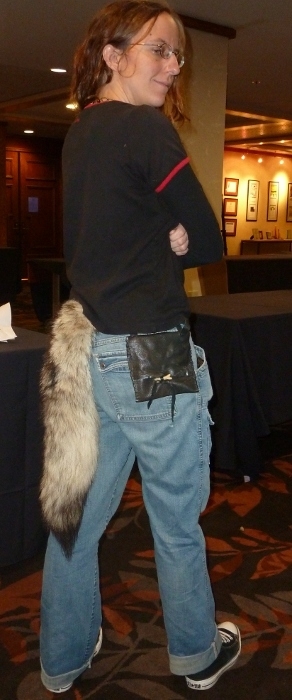
Well, okay. It’s one of two tails. I have an Arctic wolf tail that’s part of my formal shamanic costumery. But then I also have my “wear-ever” tail, a big grey wolf tail that I’ve had for years. And despite the increasingly varied sorts of attachments I’ve been making for tails over the years, my poor wolf tail’s been stuck with a couple of straps of leather that I stitched on hastily, and which have broken several times (hence why the belts I make for tails I sell are braided).

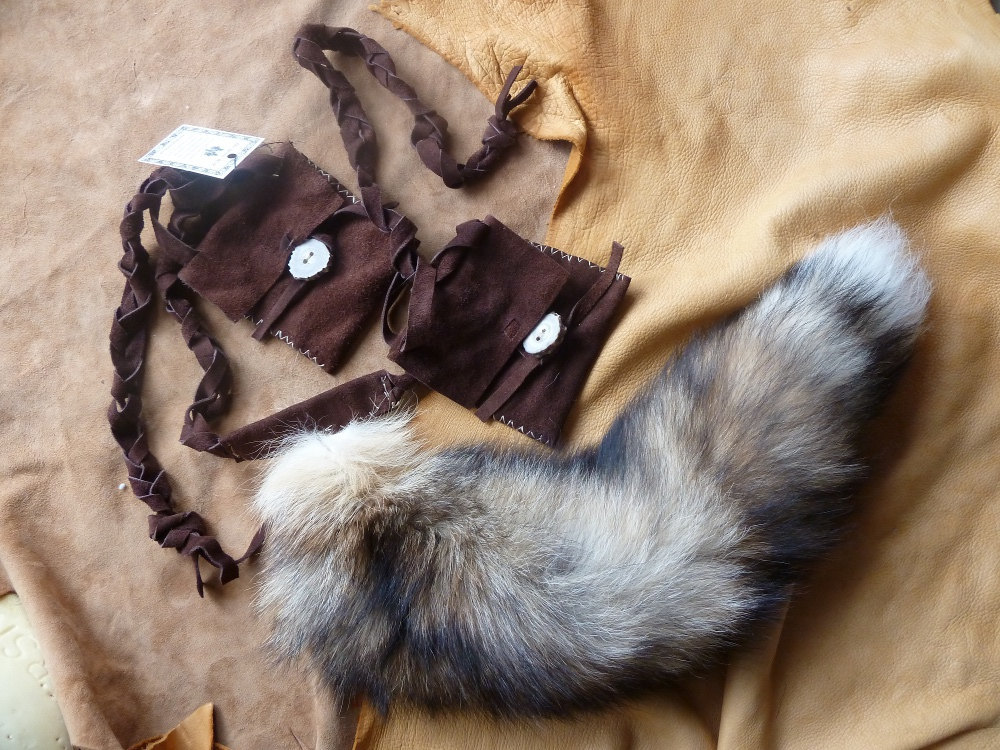
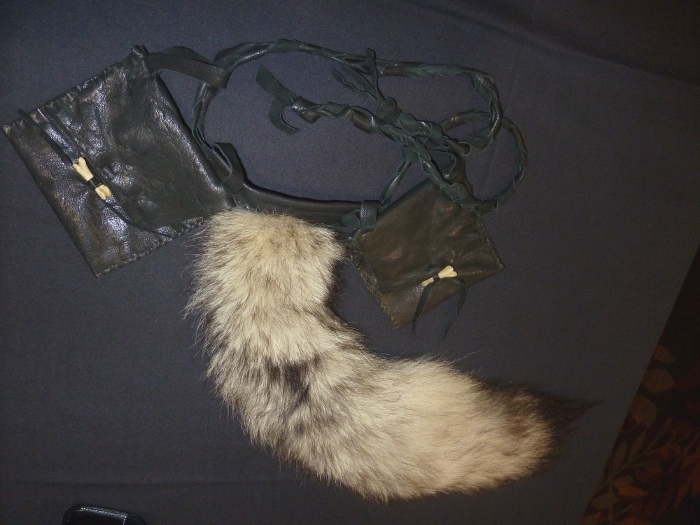
My most recent “flavor” of tail has been a belt tail with a matched pair of belt pouches. I decided that I liked this design so much that I wanted my own tail to have that setup.

But I didn’t want to use just any leather. Instead, I decided to make use of my old, beat-up, now-retired-and-replaced leather biker jacket that I’ve been wearing around–and wearing out–for over a decade (after getting it from Goodwill, mind you). I saved the painted panel on the back, which is going to get hung up on the wall with the various pins I wore on the coat. And then I went to town with the leather shears.

And, a couple of hours later, I had this:

I’m rather pleased with it. I used a pair of wolf toe bones for the toggle-clasps on the pouches, and all the leather is from that old coat. Given that the coat had been damaged and repaired so often as to be unwearable, I was happy to be able to keep making use of the leather for such a special project–and my own wolf tail no longer had to go around with just a couple crappy strips of worn out leather 🙂

I’ve been wearing it all weekend at vending events and OryCon, and have already gotten compliments. Plus it’s just a fun thing to wear about. If I decide I want to wear a skirt, I can still have pockets. If I want to incorporate it into festival garb, I get pockets AND a tail! I’m all pleased an’ stuff, in case you couldn’t tell 😉

I don’t keep very much for myself, but when I do, it has to be something very dear to me. This definitely counts.

Two Quick Things!

Today is my birthday, so I’m on minimal computer use today whilst I go to birthday-type things. However, I wanted to pass on a couple of neat things!

First–I am now one of two new staff writers over at No Unsacred Place! This is the wonderfully eco-centric branch of the Pagan Newswire Collective; you can find out more about the PNC’s mission here, and you can read the archives of No Unsacred Place here! I am very, very grateful to be added into the roster there; I will be linking to my posts from there over here on Therioshamanism, though there’ll still be other things posted here as well. Meanwhile, look for a post on ecopsych and paganism as my first contribution over there later this week.

Also, as if the above announcement wasn’t a great enough thing in and of itself, here’s an easy way to make my birthday not only happy, but AWESOME! Why yes, that is a flaming artichoke!

A Brief Note on Diversity

Over at the Pagan Princesses blog, there was raised an interesting prompt: The Magic of Many Voices – What Does Diversity Mean To You?

Here’s my reply, for those interested:

Diversity means accepting not only the fact that there are people of numerous races, sexes, genders, sexualities, cultures, politics, spiritualities (to include none at all), physical and mental abilities and challenges, economic and educational levels, and other social locations; but also that not everyone has equal standing, here in the U.S., and privilege may be given to some simply by virtue of the accident of their birth. True acceptance of diversity is not just acknowledging the differences, but facing the hard truth that pretending to be racially color blind or culturally neutral does not erase discrimination, oppression, or social injustice.

Here in the States, those of us with privilege are all too keen to pretend that oppression is behind us–that racism no longer exists except in rare freak incidents on the six o’clock news; that Native Americans are no longer suffering from genocide; that women really are equal and that the streets are safe for us; that the ADA has taken away all barriers anyone with any disability may face; that no teenager exploring a spiritual path other than what they were raised with has to worry about being thrown out of the family and home; that America is a grand place of equal opportunity for all immigrants; and so forth. “Why can’t we just move on from it? Isn’t this all in the past?” Well, yes. We want it to all be in the past. But the reality is that it’s still very much a sad and anger-inducing part of the present.

To embrace diversity is not only to say “Yes, there are people different from me”, but also to say “Yes, there are people different from me, and they are beautiful amazing people, and many of them face terribly ugly experiences that I may be a participant in, even without intending to be”. To embrace diversity doesn’t just mean the quick glance at colorful cultures, or the brief peck on a cheek of a different color, but to wrap one’s arms around the realities of diversity, receiving not only the warm caress, but also feel the sharp thorns sink into the flesh.

And when we are fully aware of those realities, without turning inward into the guilt which is just more self-focus–our awareness changes our thoughts, our choices, and our actions, and that is where the larger social change is born.

The “S” Word

Recently I got into a Twitter conversation with a few awesome folks about the use of the word “shaman” for distinctly non-indigenous (and non-Evenk) practitioners. I’ve also read a couple of recent blog posts talking about the issue, or at least mentioning it.

I do use the term “shaman” self-referentially. I do not see what I do as being the same as what an Evenk shaman does, or what the holy person/medicine person/etc. of another indigenous culture does. Everything I do, I do with the conscious realization that I am a white chick from the Midwest, whose closest cultural appelation might be “neopagan progressive geek urban dweller who escapes to the woods when she can”. What I do is self-created and self-taught, honed by experience, but also by trading notes with other, largely non-indigenous practitioners. I am also aware that using a term that was cultivated in form and context in a largely collective, communal culture a half a world away, with largely male practitioners, and a decidedly not-urban landscape. I am quite familiar with the word’s roots.

But language is fluid. It grows, and it shifts, and it evolves over time. No matter how much we may rage against it, the current of language change can’t be stopped. It’s why I speak modern English, not any of the previous variants used by Shakespeare or Chaucer, or even earlier writers. English is especially notorious for nabbing whatever words it likes–as the infamous quote by James Nicoll goes, “We don’t just borrow words; on occasion, English has pursued other languages down alleyways to beat them unconscious and rifle their pockets for new vocabulary”. Which really does speak to the violence that English-speaking populations have done to others, admittedly.

And I do carry that knowledge of how the term “shaman” came to be assimilated into English with a broader set of definitions than the original. We first came by it through the work of anthropologists who were largely working from a Eurocentric perspective, studying people who were being oppressed, and sometimes contributing to that oppression, even if unwittingly at times, through patronizing or otherwise inaccurate portrayals. Later, the word was “borrowed” by neoshamanic practitioners, some of whom misrepresented what they were doing as indigenous. This helped the term “shaman” go from referring to a very specific practitioner in the Evenk culture, to being applied to just about anything that looks primitive (just try searching for “shaman” on Etsy sometime!).

Despite all this, I still use the term “shaman” for myself. In part, it’s because of familiarity. Just like “totem”, a lot of people in this culture have at least some vague idea of what a shaman is (in the broad sense), and it’s just easier than trying to use a new word and then explain it to everyone I talk to about this stuff, who will then most likely go “Oh, you mean like SHAMANISM!”

However, I will admit that I also feel a kinship to shamanic practitioners of various cultures. Note that I am not saying I feel that what I am doing is exactly what they’re doing. Many indigenous practitioners go through trials and training I can’t even imagine. Hell, even the non-shamanic rites of passage of some cultures would have me running hard in the other direction, happy to embrace my cowardice and childishnes (Google “bullet ant ritual” and you’ll see what I mean. Yikes.). But I have gone through my own challenges as well. Anyone who has been through graduate school knows that it’s meant, in part, to weed out those who aren’t quite a good fit for their chosen field. And the program I went through to get my counseling psych degree was both intellectually and emotionally challenging on a regular basis; there’s a reason one of the requirements for completing the program was getting at least ten hours of counseling as a client. All these things also contributed to my own growth as a shaman, parallel to their “mundane” purposes.

I choose the term “shaman” to acknowledge that I have been through these and other passages, even before the grad school process, that I have spent years cultivating relationships with the spirits, and doing work on the behalf of both them and my community (and I have a very broad idea of community, and it’s not all human). I don’t feel that it’s too proud to acknowledge the work I have shown, and to connect that to my efforts to be as close to a shamanic figure in this culture as I can be. We don’t have a single “shaman” role in this culture; it simply was never there. But I have chosen to live out roles that I feel are analogous, as much as they can be. I am doing the very best that I can with what I have on hand–and what I have is fifteen years of experience, reading, practice, mistakes, and a whole host of other day to day factors that have all built up into this path I am continuing to form as I go.

I feel that sometimes refusing to use the term “shaman” is a subtle way of saying–or fearing that someone will say–that what we do in this culture isn’t as good, or as effective, or as spiritually connected, as what indigenous people do. I am tired of the unspoken value judgement that says that non-indigenous shamanisms can’t be as good or as effective for the cultures they are created in because they aren’t as old or as well-traveled as indigenous shamanisms, that a non-indigenous person who goes and trains in Peru or Brazil or Siberia or even here in the states on a reservation is automatically practicing a path that is superior. Maybe that fear started out as a check on those who didn’t think about things like cultural appropriation, or who just read a book or two and called themselves “shamans”.

But I am tired of it being off-limits to people who have put in the work, just because that work may have been from a lot of solo trial and error instead of from a teacher of a long-standing tradition. And so as a way of acknowledging the work I’ve put into this path over the years, I use the term “shaman” in its broader context, with an awareness of its roots, a caution surrounding its weaknesses, and an eye toward its healthier cultivation in relation to a variety of traditions.

I am a shaman.

Deconstructing the Totemic Guided Meditation

I’m still finishing up the book manuscript, but I wanted to take a break from writing to do some writing.

…wait, what?

Anyway, had this post idea come up and since it’s not going to take long to write it out, it gets to be my break from the much bigger, longer piece of writing.

I’ve been thinking about the structures within modern non-indigenous–neopagan, as I prefer to call it–totemism. One of the most common structures is that of the totemic guided meditation. There are countless examples of this; almost every book on animal totemism seems to have some version of it, and even Michael Harner included his own take in The Way of the Shaman in the chapter about finding a singular power animal. And yes, I wrote my own iteration of it several years ago which you can see in its entirety (and even use if you wish) here; it ended up as an Appendix in Fang and Fur, Blood and Bone, my very first book.

So–this thing gets around a lot. Why? because it’s effective. As I have maintained in numerous places, the guided meditation gets a person in direct contact with a totem, but without suggesting a specific animal from the get-go. It’s better than totem cards because you’re not limited just to the animals in the deck. It’s an improvement over having someone else “read” you, because there’s no intermediary to potentially miss something in the translation or add in their own biases. And it allows you and the totem to explore and establish your own unique ways of interacting with each other from the beginning.

The totemic guided meditation also offers you a relatively “safe” place to visit with totems. One thing I discovered early on in this whole Therioshamanism thing is that unlike proper journeying, which takes you deep into the spirits’ territory itself (which can be quite dangerous), guided meditation creates a sort of neutral zone that’s more mediated and less likely to present any dangers. However, it still allows for free-form exploration and communication, assuming it’s not such a rigidly structured thing that even the dialogue is scripted!

And while most totemic guided meditations are supposed to only have you meet your totem, I have found that the same meditation, slightly tweaked, is also quite effective for continuing to use the “neutral zone” to meet with the totem for ongoing work together. It’s simply a matter of going into the meditation with the intent of talking to a specific totem, instead of leaving yourself open to meet any totem, if that makes sense.

So let’s look at the different parts of the basic structure of the totem guided meditation:

The Entrance: This is usually a hole of some sort, either in the ground or a tree, but I have also had people that I led through the meditation travel through a hole in the clouds, or in ice or other water; these were their creations, not my suggestions, as I don’t specify exactly what the entrance should look like. The entrance is the starting point, the threshold between this world and the next. Once you’ve taken that first step in, you’re on your way.

The Tunnel: Traveling through the tunnel is a transition; it allows both the mind and the spirit to make the changes from the waking world to the neutral zone the person is going to visit. The tunnel may be in the ground, through trees, water, etc. It may look the same the whole way through, although the interior has also been known to shift in appearance and even size the further one gets from the waking world. The tunnel is a necessary component in the meditation, because it allows for a gradual and smooth adjustment in consciousness and spiritual state, rather than a sudden, jarring shift. For someone brand new to guided meditation, just spending time traveling down the tunnel, turning around, and then coming back can be good practice in maintaining a basic meditative focus, without the additional pressures of being in a complex new environment. The tunnel is relatively simple, and generally only goes two ways, so it’s easy to come back home as needed.

The Neutral Zone: This is an open arena where the person can explore the environment and see what totems may present themselves in first time through, as well as a known location for continued work. It is nonphysical in form, but it is a midway point between the person’s psyche, and the external spiritual world (though the boundaries between the two are often very blurred). While Harner has people stay in the tunnel, or rather, the tunnel becomes the neutral zone, I like to have people come out into an open environment where they can meet their totems. Again, as with the entrance, I allow people to picture it for themselves, rather than suggesting a specific place. This is because I don’t want them to have expectations of what animals they should or shouldn’t meet; for example, if I tell them to come out in a Pacific Northwest rain forest, but their totem is Koala, then they’re less likely to make the necessary connection. I also suggest that people explore while they’re there so that they can find the place again later. Additionally, since it is a mediated setting, people do have more control over what happens there; for example, I tell people I’m leading in meditation that if they ever lose the tunnel and need to go back quickly, all they have to do is look down at the ground at their feet and the mouth of the tunnel will appear there, and they can go right back home. Finally, it’s important to note any changes made to the neutral zone, whether within a given meditation, or over time. They may reflect changes in the totemic relationship, or even the location of the place in relation to the spiritual world (for example, if the neutral zone starts slipping deeper into spiritual territory, it may take on a wilder, more chaotic nature).

The Animal Totems: In the deconstructed guided meditation, the totem is the goal, the manifestation of the intent. Finding your totem often implies success, though I wouldn’t interpret things that strictly, personally–there’s a lot that can go wrong even if you find your totem, and a lot that go right even if you don’t. I’ve elaborated almost ad infinitum elsewhere about what your totem can be, but it basically boils down to: pretty much any animal species has a totem, you’re not limited to a certain set number of totems, the number of totems you have throughout your life can change, not every totem is permanent, and yes, I consider extinct, domestic, and mythological animals to still have totems, albeit totems with a much different perspective on the world we live in. A totem is an intermediary between its species and the rest of reality, to include human beings, though contrary to some approaches to totemism, we are not necessarily the center of a totem’s purpose for existing! (In other words, totemism isn’t just about “Get a totem to make your life AWESOMER!”) What role the totem plays in a person’s life varies from individual to individual; some see them as primarily symbolic, while others spend their lives working totemism as a daily spiritual practice. Again, this meditation can be used to either find a totem for the first time, or continue meeting with it. Just start each meditation with the appropriate intent, even perhaps saying something like “I am going to travel to meet my totem for the first time,” or “I am going to go meet with [name of totem]” before going through the entrance.

The Tunnel Back: The trip back to the waking world is just as important as the trip down the tunnel in the first place. It allows the person to integrate their experiences during the meditation, as well as readjust to being “awake” again. Most people tend to come out of the meditation too quickly, and spend their time grounding in this world with food and other physical things. While this is not bad, I feel it speaks of impatience, and doesn’t take full advantage of this important transitional stage of the totemic guided meditation. I recommend that if you do this sort of meditation, try to spend as much time coming back through the tunnel as you did heading down it.

Troubleshooting: If you’re new to meditation, or if you aren’t a very visual person, you may have trouble staying “in” the meditation long enough to find your totem. If that’s the case, try (as I mentioned above) just exploring the tunnel for a while, then graduate to just exploring the neutral zone a few times without the intent of looking for a totem. Stay in as long as you can before you feel you can’t focus any more, though do try to give yourself time to travel back through the tunnel and make a smooth transition back to being awake. If you’re doing a meditation to find a totem for the first time, and no totem shows up, or isn’t clearly your totem, give yourself a break for a couple weeks at least, then try again. If you are unsure of whether an animal is a totem, and you can get close enough to talk to it, you can always try asking whether it’s your totem or not. Also, while most people only encounter one totem at a time, it’s not at all unheard of to meet more than one in one meditation, and in fact there are some meditation structures, such as The Personal Totem Pole Process, that are created around meeting and working with multiple totems at once. If you end up with a totem you’re not comfortable with, don’t fear the worst. Sometimes it’s the animals that scare us that can really teach us; same thing goes for the ones we think are gross, or not particularly flashy. Conversely, if you get one of the “popular” totems like Grey Wolf or Tiger, don’t assume that you’re just being egotistical. Let things play out as they will no matter what totem shows up; in the end, you’re the one who gets to determine whether an experience was valid for you, not some internet peanut gallery.

…and there you have it–a basic explanation not only of totemic guided meditations, but part of what makes them work. There’s a lot more I could say, but this is just a quick break to give my mind some rest from the big, long, kinda scary book manuscript I need to finish up! I’m open to any questions about this post, if ya got ’em 🙂