Spring Cleanup on the Columbia

This past Monday I had a great time out on my adopted beach on Sauvie Island along the Columbia River. I’ve been going out there about once a month to pick up litter and get myself out of the city for a while, but this week’s trip also included my quarterly report. This includes feedback on the flora and fauna I noticed, the quality of the water, human activity, weather, and other such things. I had intended to spend most of my time making notes and taking photos for this report, and then do a little bit of cleanup before I headed home.

It was not meant to be that way. In addition to fishermen (who vary in their ability to clean up after themselves), my beach is frequented by people out to party. Unfortunately, such people have a tendency to get drunk off their asses and then leave gigantic messes for others to clean up. I usually find the remnants of a couple of these any time I come out, and I’m guessing other visitors to the beach take the time to do a little cleanup whenever I’m not around, too.
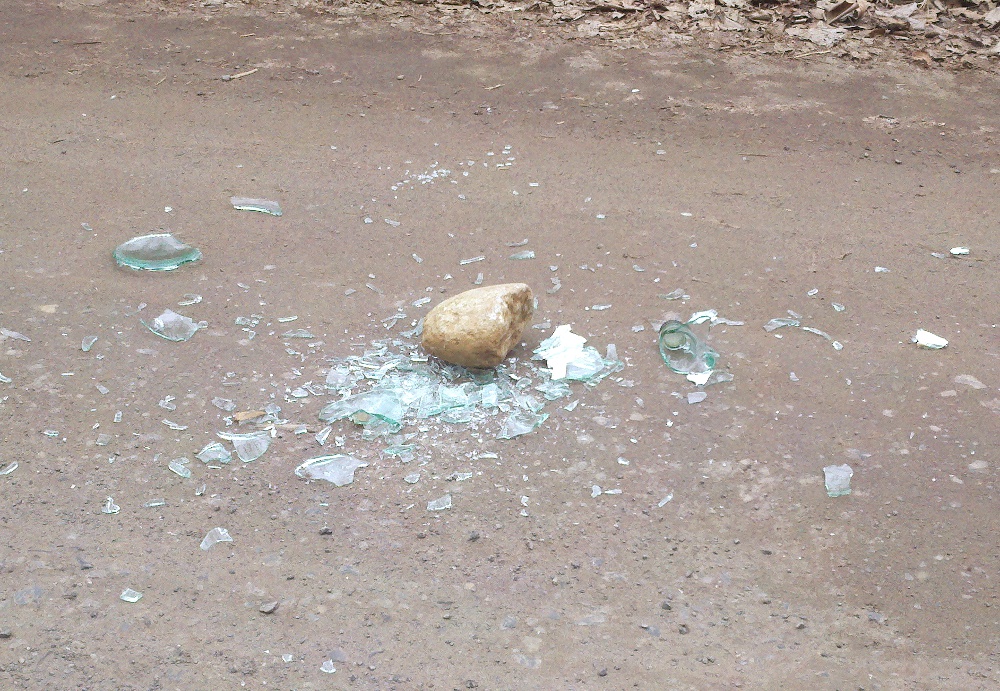
Broken glass is no fun for anyone. Photo by Lupa, 2013.

Broken glass is no fun for anyone. Photo by Lupa, 2013.

However, when I arrived today, the road down to the parking lot, and the lot itself, were both swathed in a trail of garbage. One group of drunken partiers, not content with just leaving a pile of refuse along the river, decided to take an entire yard waste bag full of trash and “decorate” their way back out to the main road. An almost perfect circle of cans, used diapers, and broken glass adorned the lot, and more scattered its way down the road. This wasn’t just someone accidentally forgetting an open garbage bag in the bed of a truck; it was intentional vandalism. And to add the rotten cherry to this messy cake, someone took a glass wine jug and deliberately smashed it with a rock right in the middle of the road.

I didn’t get pictures of most of it because the beach was fairly busy with people fishing, and I wanted to get things cleaned up as soon as I could. I did get one picture of the broken glass with my phone before I scraped it into the bag, just because it was so unbelievable to me that someone would do something like that. By the time I was done, I had two large SOLV bags full of trash–and I hadn’t even made it down to the beach!

Having completed that onerous task, I decided to reward myself by getting out the camera and snapping some shots for my report. It gave me a chance to slow down, pay more attention to things that weren’t litter, and get to know my neighbors there a bit more. It was a really rewarding day in that respect. The snowy egrets have been returning from down south and were taking up residence in the marshes nearby, and while the snow geese had left for the season, their Canada cousins were still around. Juncos, robins, Steller’s jays, and other smaller birds flitted around the tops of the black cottonwood trees, singing out their assorted territorial and “hey, look at me, I’m fabulous!” songs. Along the beach, clamshells dotted the sand next to deer tracks and the pawprints of visiting dogs.
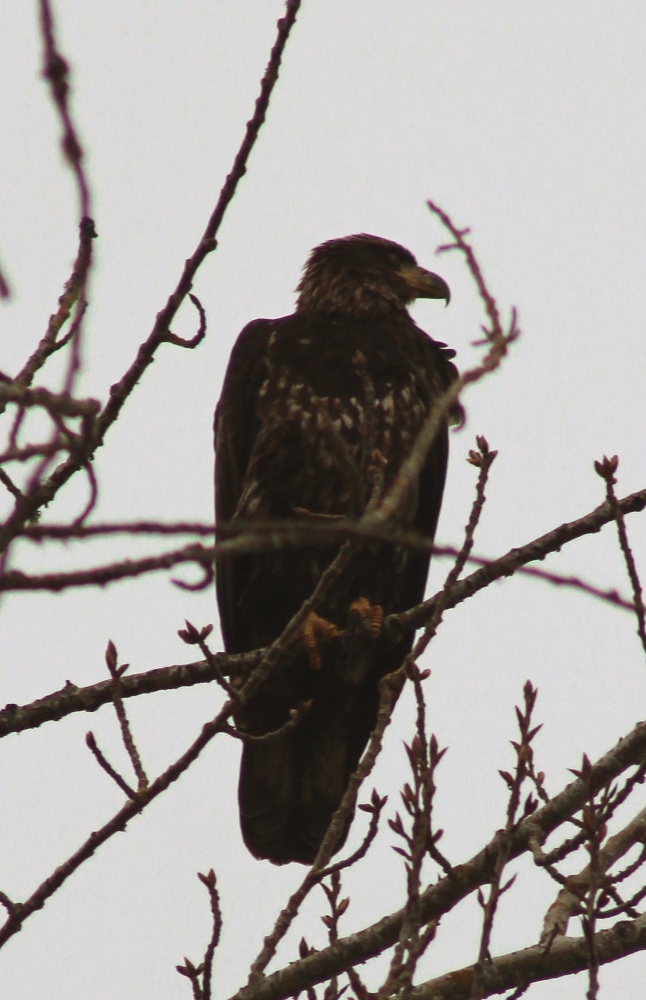
Juvenile bald eagle. Photo by Lupa, 2013.

Juvenile bald eagle. Photo by Lupa, 2013.

The highlight of my day, though, was getting to take pictures of a juvenile bald eagle high up in a tree! I’d seen an adult earlier in the day, cruising over the wetlands. As I was cleaning along the beach, though, this earthy-colored young raptor settled into the branches of a cottonwood a little ahead of me. Thinking to myself “Oh, please don’t fly away!” I ran back to my car and got the camera, and then hurried back. Thankfully, the eagle was in no hurry to head off, and stuck around long enough for me to get a few photos. It didn’t even head off until I’d headed back to drop the camera off. Lucky me!

I’m not that great a wildlife photographer, since they don’t usually hold so still, but I fare somewhat better with plants and fungi. I had to add bull thistle and white clover to my list of invasives; while the clover is pretty innocuous as far as introduced species go, the thistle is painful in several different ways. This got added to the widespread plague of Himalayan blackberries and Scotch broom as “problematic”. On the other hand, the native plants were in abundance. Down among the cottonwoods, the snowberries were starting to put forth a few small green leaves amid the last of their white berries, and honey bees buzzed in the fresh flowers of Indian plum shrubs. Fuzzy-leafed mullein peeked out from around sword ferns and new growth of poison hemlock. Trees live and dead hosted lichens of all kinds, from reindeer moss to hammered shield and even some powdery-fine gold dust.

When I went back to pick up along the beach, I found that some of the day’s fishermen had left the usual mess of cigarette butts, cans, and fishing line strewn around. This even included the ones that had asked me what I was up to, and I told them I was taking pictures for an environmental report and then picking up litter. I have to wonder if they deliberately left their trash there because I was there, either because they assumed I’d just get it for them, or whether they deliberately wanted to make more work for me. This made me think about my last trip out to the beach, where I jumped right into cleanup and the first any of the people fishing saw of me was a small, skinny woman with a trash bag and a kitty litter scoop, sifting cigarettes and styrofoam out of the sand. That day people not only told me about how they cleaned up after others, too, but even offered to help me out.

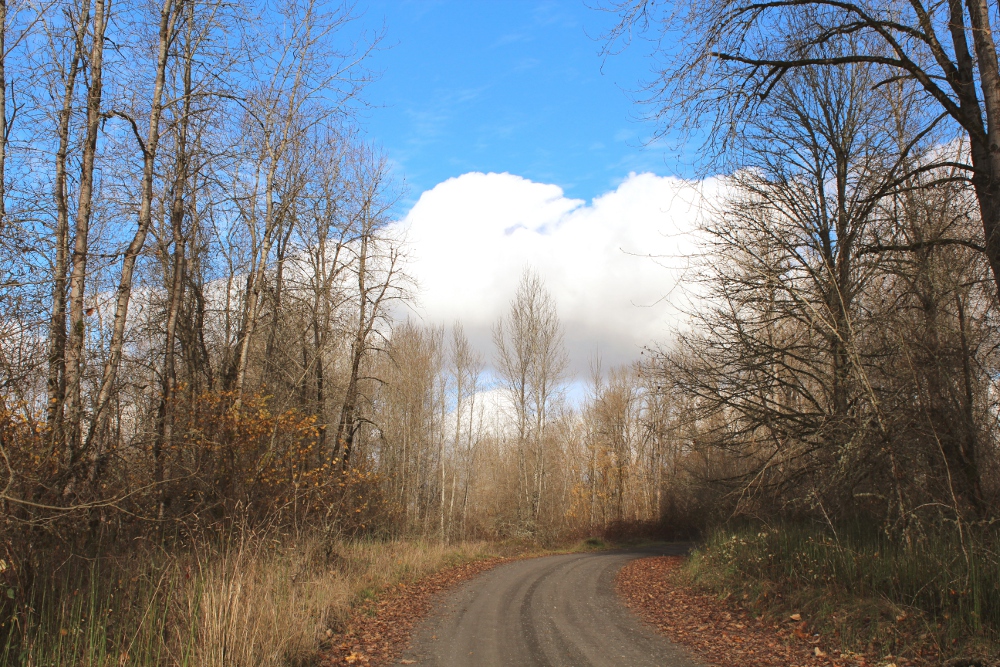
Looking upriver. Photo by Lupa, 2013.

Looking upriver. Photo by Lupa, 2013.

It confirmed something I’ve known for a while, and backed up by research in conservation psychology: modeling a behavior works better than telling it. I could have gone to each of those fishing parties, with cans in the sand and food wrappers by their chairs, and lectured them on how important it was for them to make sure they picked everything up before they left. I bet there would have been a lot of junk left behind after that. Yet by modeling the sort of behavior I wanted my fellow humans to emulate, I got better results. Last time, people saw me taking the time to clean up the beach, and followed suit. While a few of them may have been doing it out of a desire to not get in trouble, or some sense of guilt, I saw a number of them expressing genuine appreciation for the fact someone cared enough about that place to attend to it, and being inspired to pitch in themselves. I don’t think anything would have changed the behavior of those who left their detritus behind anyway, but I’m sure that telling them how horrible they were for making more work for me wouldn’t have been at all effective.

By the end of the day I was feeling pretty good. I’d collected an additional bag of trash that was now going to avoid going into the water. I’d taken some good photos and formulated ideas for my report to SOLV. I had shown my fellow human beings that someone did care enough to clean up after those less responsible. And, most importantly, I got to know my beach and its nonhuman denizens a little better than before. Volunteering is often promoted as a rewarding experience in and of itself. I have to say I agree; adopting this place, feeling responsible for it–it’s one of the best decisions I’ve made.
Why Plant and Fungus Totems Are Important to Animal Totem Work

In every spiritual system there are specialists and there are generalists. I’ve been turning more into a generalist over the years, as I’ve gone from just working with the animal totems to expanding my work throughout the totemic ecosystem. It doesn’t make my work less important to me, but as a fan of systems theory I’m finding that understanding the complex relationships among the various components of a system is just as important as knowing those parts in and of themselves.

And so it is with animal totems. There are plenty of practitioners who prefer to specialize in animal-based spirituality, and there’s nothing wrong with that. However, one of the most important ways to learn about an animal totem is to observe its physical counterparts’ relationships with the plants and fungi in their environment as well. For omnivores and herbivores the reasons are pretty obvious; plants and fungi are food, and if the food no longer grows, the animals must move on, adapt, or starve. But the plants and fungi affect all animals in other ways, too. The presence or lack of trees, for example, can affect the weather patterns and overall climate of a place. Sometimes the relationship between an animal and a plant is so intricate that the species cannot live without each other. Some populations of sycamore fig rely completely on one species of parasitic wasp for pollination, and numerous other animal species need the fig tree to survive as well. Plants and fungi can present physical obstacles (as in a rabbit ducking into a thicket to escape a fox). If algae overgrow a pond, they can choke out animal life (sometimes literally, as in algae blocking the gills of fish); some algae are also sources of toxins that can harm or kill aquatic life.

These are all important things to note, because they shape the natural history and behavior of animal species and thereby their totems. How an animal develops physically, mentally, and otherwise is due in part to its environment and the plants, fungi, and other animals in that environment. So it is important that if you’re going to get more than a cursory understanding of a particular animal totem, it’s a good idea to get to know the plant and/or fungus totems also associated with them, even just a bit.

The first thing to do, of course, is to observe. You may be fortunate enough to be able to watch an animal totem’s physical counterparts in their natural habitat. Pay attention to how they respond to the plants and fungi around them, and see if any in particular stick out to you. If that’s not an option, you can always fall back on the observations of others, through books, documentaries, websites, and the like. The key is to have a good understanding of these natural relationships.

Just observing and knowing these things may already have given you some insights. However, you can also use guided meditation to get to know the plants and fungi important to the animal totem as well. In your meditation, ask the animal to introduce you to the plant and fungus totems it’s most connected with, and then ask all of them why they rely on each other, what each gets out of it, and what else they might like you to know about their work together. And if you like, you can go back and just visit with the plant/fungus totems on their own, if that’s something you wish to pursue.

Again, you don’t have to abandon your animal totem work in favor of a broader practice. Even if your goal is just to find out more about an animal totem, even brief visits with the connected plant and fungus totems can be incredibly valuable.

I Don’t Get To Say This Enough To You People Out There…

To my dear readers,

Being as open a person as I am about my art, spirituality, and the like, it’s inevitable that I take flak from haters (as the kids are calling it these days) now and then. I know it happens to a lot of you, whether you’re a fellow artist/collector of hides and bones and the like, or a member of a minority religion, or just someone who had the misfortune to be targeted by a pack of bullies feeling their actions are justified by their ideals. If you’ve ever had to deal with that, I’m incredibly sorry; it’s not something I’d wish on anyone, even someone I disagree with.

Do you know how we can counter this? Kindness. As Ian Maclaren said, “A thought to help us through these difficult times: Be kind, for everyone you meet is fighting a hard battle.”

And that brings me to what I want to say to you folks out there: thank you for being kind to me.

Thank you for every kind word, every compliment about my art or writing or anything else I share with you.

Thank you for every time you’ve thanked me when I’ve been able to help you, and along with that thank you for extending me the opportunity to be of assistance.

Thank you for giving up a few moments of your time to express appreciation and to brighten my day a little more.

Because it really does help. I know human beings are more likely to speak up (loudly!) when we’re upset about something. It’s more of a challenge to say something kind, not because the act is difficult in and of itself, or because we’re bad people, but because we tend to be complacent when things are going well. It just doesn’t occur to us to say anything then.

But it does make a huge impact on the person you say it to. We do get really used to only hearing from others when things are wrong, so when we do say kind things to each other, that one small moment can have a lot of power. I know there have been times when I’ve been pulled out of some really dark places in my life simply because somebody took the time to say something nice. When I’m having a tough time of things, I do go back and look at some of those appreciative emails, comments, messages and the like that you all have sent me over time.

So please do keep that in mind. If you know somebody who’s in a bad place, consider taking a few moments to show them some kindness and appreciation. You never know just how much a couple of sentences at the right time can help a person out.

Yours truly,

Lupa

The Human Body as a Bioregion

We humans like to think of ourselves as individual entities, moving autonomously through a world populated with other individual entities. We think of our skins as the boundaries between ourselves and everything that isn’t us. Symbiotic living is left to the like of the Portuguese man-of-war and lichens, colonies of group minds are for bees and ants. We might recognize consciously that we rely on other living beings for our food, oxygen, and the like, but we view ourselves as rugged individualists.

Or so we think.

Truth be told, our bodies aren’t entirely our own. Take bacteria, for example. We have plenty of human cells and the like, but for every cell in our bodies there are at least ten bacteria. As Anne Maczulak said, “Microbiologists are fond of pointing out that if all of a person’s DNA were mixed with the body’s entire bacterial DNA, that person would be genetically more bacterial than human” (1). Thousands of species of bacteria live in and on our bodies, creating films that coat pretty much every surface inside and out. Most of these live more or less in harmony with us, as we have co-evolved over time. For the most part, scary-sounding bacteria like Eschericia coli and Staphyllococcus aureus occur naturally in our bodies, and they are not the evil enemies that they’re often made out to be in the media. Problems predominantly arise when one sort of bacteria ends up in a place where it shouldn’t be (such as gut bacteria entering the abdominal cavity at large through an intestinal perforation) or overpopulating and causing infections (such as tooth decay caused by an overabundance of certain mouth flora).

Along with bacteria, we have various tiny fungi and protozoa throughout our systems. Many women know the hell that is a yeast infection, when Candida albicans and other fungi that normally inhabit the vagina along with a host of other living beings suddenly overpopulate and create a rather unpleasant result. We usually only think of amoebas as the little single-celled beings that often represent asexual reproduction in basic biology textbooks, or as the cause of amoebic dysentary (which in truth is solely due to an invasion of Entamoeba histolytica). Yet several non-pathogenic species of amoeba make up part of our internal communities; E. histolytica‘s cousins Entamoeba coli and Entamoeba dispar are rather benign. While eyelash mites (Demodex folliculorum and Demodex brevis) usually don’t cause a problem, their overpopulation can cause itching, swelling, redness, and other symptoms of the eye.

And these are just the welcome (or at least neutral) neighbors. We also host outright parasites. Tapeworms (several species in multiple genera) and hookworms (Ancylostoma duodenale and Necator americanus) are some of the better-known ones, along with the inaccurately-named fungus, ringworm. Some unfortunate people have had to deal with the joys of scabies mites (Sarcoptes scabiei), head lice (Pediculus humanus capitis), and the bedbugs (Cimex lectularius and their kin) who only come calling for a late-night snack.

(How many of you are feeling itchy and squirmy right about now? Sorry about that.)

My point is that we are the setting for a variety of tiny ecosystems, each with its own daily drama of eat or be eaten. So are numerous other animals and plants. Like Russian nesting dolls, the world is made of ecosystems within ecosystems (it may be ecosystems all the way down!) In fact, we can potentially think of each part of our bodies as a small bioregion. Each one is defined by its unique physical features, and the common flora and fauna that inhabit it. There aren’t watersheds, per se, but there are flows of various necessary ingredient to life, particularly food. So you can think of your stomach as one unique bioregion with its own resident critters who feed on the food we eat in one stage of digestion, while the small intestine is another bioregion whose inhabitants wouldn’t survive in the stomach and couldn’t live on what’s in there so well. Even different areas of the skin have discrete populations of bacteria and the like; the armpits have a different set of tiny beings than, say, the sole of the foot, and in some ways the former place is a much easier living arrangement for the bacteria than the latter.

So what’s all this mean for bioregional totemism? For one thing, it’s a chance to expand your idea of what a bioregion is, as well as to remind yourself that you don’t just live in an ecosystem–you host them, too! It’s a different way to look at our place in the world and how we relate to other living beings. While we’ve caused some species to go extinct through our actions, our extinction would cause the extinction of other species of tiny being that can only survive in or on a human body. We may not mourn their loss in the same way we would regret the extinction of the giant panda or the Siberian tiger, but it’s a bit sobering to realize that there are entire species that would cease to exist without us.

It’s also an opportunity to connect with other beings, including their totems. I’ve had people over the years tell me “Oh, I can’t connect with the elements of Fire or Earth, I’m an Air and Water person!” Yet the easiest way to make a connection to all of these is through our bodies: the minerals of Earth, the water in our blood and elsewhere, the air in our breath and the gases in our blood, and the fire of metabolism. In the same way, if you can’t reach outward to totems, seek the ones inside of you. After all, every species of living thing, even protozoa and bacteria, has a totem watching over the connections between its species and everything else in the world.

How do you do that? As always, I’m a fan of meditation. Visualize your consciousness traveling deeper into your body, into a particular part of your form. Try going to your stomach and exploring the communities there. Or travel along your skin and see how the ecosystems change across distances, like a forest changing to a plain and then into a desert on a long road trip. Explore all the places, or make a detailed study of one. It’s entirely up to you. You may find that working with the tiny critters mixed among your cells and nestled in your organs have a rather different view on life than Gray Wolf, Box Turtle, or Dandelion. Bit I’ve found it’s worth it to at least check out the scenery.

It’s especially entertaining to do this when I’m sick with an infection. Even as miserable as I feel when I get a cold, I get a bit of a kick out of the idea that an invading virus is sacking my respiratory system, and that my resident immune system will come along like a line of defenders and rout the nasties, letting the local residents come back to their hamlets and farms in my nostrils. (I know, that’s a rather ridiculous thing to think about. But I have to do something to keep my spirits up when I’m sick!) I’ve tried asking them to quiet down and let me sleep, but it generally doesn’t work and I have to wait til my immune system does its job; mind over matter only goes so far.

And, as with any ecosystem, nothing goes to waste. The bacteria and other things living in and on my body mostly leave me well enough alone beyond whatever they need to survive. And yet when I die, who do you think is going to be the first to start turning my body into food? You guessed it–the resident microcritters. It’s not that they’re waiting around for me to kick the bucket; after all, once I’m dead their populations have a limited lifespan, too. But there’s a certain comfort in knowing that the tiny beings who have been with me my entire life–a sort of giant cadre of primary totems, if you will–will be the ones to start the process of returning my body back to the Earth. They greeted me when I was born, have been with me through thirty-four years of life so far, and they’ll be there to see me off, too. In this I tend to work with them more as a colonial totem than the many thousands of individuals, but they’re no less important.

(Apologies if you’re still feeling itchy.)

1. Maczulak, Anne (2011). Allies and Enemies: How the World Depends on Bacteria. Upper Saddle River, NJ: FT Press.

The Grand Dance of the Cosmos

I’m a little bit late to the Animist Blog Carnival, but better late than never, yes?

This month’s theme is Time. I have a strange relationship with time. One of the things that brings me such wonder is the sheer vastness of the Universe we live in, to include its fourth dimension. I suppose it’s in part because, as I’ve grown older, it’s taken larger amounts of time to impress me. When I was young, the idea that I was seven whole years old was a Big Deal! I couldn’t even conceive of my parents being in their thirties; it was just a bigger number with no context. In my late teens and twenties, as I started contemplating my mortality, the average lifespan of seventy-two years was a bit of an obsession. “Wow, I’m a quarter of the way to there!” was a sobering thought at eighteen. But I made peace with that, and the possibility that I might end up not even seeing seventy-two, and so I had to move on to other numbers to be bewildered by.

Which that brings me to now, in my mid-thirties. I am a huge fan of history documentaries. Ancient petroglyphs here in the United States, stone circles in England that are thousands of years old, the march of humanity out of (and back into, and sometimes out again) Africa and across the globe–these things entangle my mind and make me wish for a time machine so that I could observe more closely these people who were just as alive and real then as I am now. And extending beyond that, the evolution of species of animals, fungi, plants, and more over millions upon millions of years. And then the planet itself, how I wish I had a piece of the oldest rocks known on the Earth, thinking of how Earth’s sister planet Theia might crashed into it so long ago and two became one, how once all of this was star-stuff and cosmic dust and before that one very big bang. To these, seventy-two years doesn’t even register.

They say that one of the purposes of spirituality is to inspire awe and wonder and reverence, connection to something greater than yourself. This bigger-picture approach to time is one of the things that’s helped me to move toward a more naturalistic spirituality, one very embedded in the physical world and the wonders thereof. The lines between spirits, and what those spirits are supposed to represent, have become much more blurred, and I feel as much reverence and joy in observing a scrub jay on the power line outside my home as I do for the totem Scrub Jay. It’s made being in this world a much more joyful place, and more than ever I strongly disagree with those who claim there is no magic in this world.

Additionally, this cosmic dance has given me peace over the fact that I have just a tiny blip in the grand scheme of things. The very fact that I was honored with a place in this dance, even for a brief time, is in and of itself a privilege and a blessing. I will continually be frustrated that I can neither peer backward into what came before me, nor will I be able to see how the story continues to unfold once I am gone. I may not even leave a mark that lasts much beyond my passing. But in the end it is enough that I was here, that a little piece of time unfolded just for me, as it has for all of us–pill bugs, Cooksonia, stromatolites, the continental shield of North America, and every single human being that has ever and will ever breathe the air.

The small things count, too. Every moment that I live and breathe and exist is important. I blink, I exhale, I turn my head. A word is spoken, a thought flickers and is brought into the open, a goal is completed. Each is stitched to the next by the passing of time, but not one can be taken away without the whole thing collapsing. Every moment is important both in and of itself, and as part of the overall continuation.

So even the worst moments in my life have meaning. They may not have happened for some extraordinary cosmic reason; I don’t need to make sense of them in the manner of “Well, you’re working off bad karma” or “it was meant to be”. But I don’t have to add extra meaning to these just to justify their existence. The fact that each moment exists is justification enough. Each one is a stepping stone from one to the next, and I couldn’t have just jumped from the best thing that happened to me last week to the great event I’ll get to experience in a few days. That’s why I can realize, even at my darkest moments when my anxiety has me convinced the worst is here and everything is horrible, that it’s just a temporary condition. I may not be very good at being in the moment and being okay with that when life falls apart, but I’m getting better at remembering that the bad moments are stitched to the good ones and sometimes I just need to be patient and let time continue to unfold apace. Eventually I come to a place of respite and safety again.

I’m not at all alone in this experience. I have moments that are knitted into years and an ever-expanding network of lifetimes, mine and others’, and we in turn are woven into the very latest threads of a much greater cloth, billions of years old and countless strands large. Time weaves no holes, only ever-expanding patterns. It doesn’t even matter whether there’s a conscious weaver behind it all or not. Just being here in time’s continual unfolding–that’ll evoke more than enough wonder, awe, and reverence for the remainder of my lifetime, I think.

A Quick Follow-up and Thank You

First, I want to say thank you to everyone who’s contributed to the outpouring of support the past couple of days regarding my last post. The kerfuffle ended up not amounting to more than a couple of snarky emails and one mildly suspicious reply to the blog post I wrote–no protesters or flyers at the event, no droves of animal rights activists descending upon Seattle, etc. Which is about what I expected. People are generally much braver online than in person, and of the sum total of two (maybe three?) people who contacted me this weekend with harsh criticisms, not a single one used an email address that showed anything when searched on Google or any other identifiable information.

More importantly, though, I was reminded over the past few days, both through this and through the many people who I did meet face to face at my booth at FaerieCon West, that there are a LOT of people who have my back. I got emails, I got blog responses, I got hugs and support in person, and every one of them was from someone who wanted to let me know that they appreciate my work, physically and spiritually. I always appreciate when people take the time to send me a nice note or give me a thank you for something I’ve done that’s helped them, but there was a small flood of that this weekend! For that I am incredibly grateful.

Moreover, you are always welcome to ask me questions about what I do and why. I normally don’t get frustrated with people just asking me “So where do you get your stuff?” This was an isolated case in which it seemed the anonymous person wasn’t actually interested in the answer for any reason other than protest fodder and had made a clear threat to act on it. I don’t want this situation to make people to feel they can’t ask me perfectly reasonable questions about my art, or my (neo)shamanism, or how to start an Etsy shop, or anything else I might be able to help with. I like questions, and I like helping others, and while it may take me a couple of days to respond depending on how busy I am, I do check emails and Tumblr inbox messages and deviantArt notes and Facebook PMs and blog comments and the like. I’m even okay with people asking me questions in person when I’m vending, presenting workshops, etc. I just ask that you be respectful about it, that’s all.

And if we end up at loggerheads over something and we simply don’t agree (assuming you haven’t been so utterly caustic in your delivery that I decide to delete the message instead of engage), the worst I’m likely to do is to agree to disagree and end the conversation. I’m not going to go to my Tumblr brigade and say “Go get ’em!” or talk about how horrible a person you are and try to make everyone else hate you. I don’t pull that sort of junior high dramatics. I can disagree with a person and still respect them otherwise. Truth be told, a lot of the people who disagree with me on certain details (the use of animal parts in my art, my choice to use the word “totem”, etc.) are people with whom I’d probably agree on most other things surrounding the more general topic.

Alright. Time for me to head on back down to Portland. I’ve stuff and things aplenty to accomplish!

A PSA About Dead Critters

I’m vending at an event this weekend and not getting a lot of sleep. Yesterday morning, I woke up to this email, which I assume is from someone who saw me setting up at the event and decided they needed to Take Action:

How are your fox pelts obtained? I cannot think of an ethical method. Plz respond, I intend to protest / flyer your booths.

I’m not proud of my initial brief, terse, and frankly snarly reply to this email, which was born of little rest and a short temper because of that fatigue. I get a lot of these sorts of messages, and they’re usually from people who don’t seem to do any research about who I am and what I do before they decide to take offense at my chosen medium. Still, “Turbowag” did ask a question, and I’m glad he(?)’s at least that curious.

The short answer is that my materials come from a network of suppliers and channels that I’ve cultivated over most of twenty years. Some of these are secondhand pelts recovered from old taxidermy, rugs, coats, museum specimen collections, and the like. Some of them come from subsistence hunters–people who live close to the land, eat what they kill (assuming it’s edible), and sell the furs to pay for essentials like heating fuel. Some are the remains of animals that had to be put down for legal/medical reasons, and some are from food animals.

The last category, and the one you’re probably the most concerned about, is the fur that comes from upholstery and garment discards. When an animal, like a fox, is killed to line a parka (or whatever), the whole hide is tanned, but only the torso is used. The paws, faces, and tails are landfilled or incinerated, unless someone like me reclaims those pieces. Whatever you think of fur farming, bear in mind that unhappy animals don’t have attractive pelts, and that I’ve spent most of twenty years vetting these people.

So why do I dirty my hands like this? Two main reasons: first, because if these animals are going to die, I’d like their deaths to stand for more than somebody’s fashion statement or mantlepiece ornament. My wearable art brings these animals’ existence into a more vivid reality for people who may otherwise tend to misunderstand and abstract them. If you purchase one of my coyote headdresses, for example, you have to embrace the fact that it’s not an disconnected, romanticized representation of “coyoteness” but the skin of an individual creature that felt cold, warmth, hunger, satisfaction, curiosity, and fear. The more people are confronted with these relics of the animals we share the planet with, the more (I hope) they consciously consider the responsibilities that come with our de facto stewardship of Earth’s biosphere*.

The other reason is more direct and personal: a significant portion of the money this art brings in, in excess of rent and bills and business expenses, gets donated to organizations that support wildlife and their habitats. I’ve been able to make frequent, somewhat substantial donations to organizations including but not limited to the Defenders of Wildlife, Wolf Haven International, the Natural Resources Defense Council, and other institutions doing meaningful work, because I retrieve the remains of dead animals from (sometimes literally) our culture’s dustbins and send them to a new “afterlife” where they are cherished and respected. In fact, just a couple of days ago I posted about my most recent donation to the Monterey Bay Aquarium, and I have been telling people at the event I am at this weekend that a portion of the funds I make will go to the Oregon Aquarium; both these organizations put in a significant amount of energy and time and money into the preservation of oceans and their inhabitants.

Now that I’ve addressed your questions, “Turbowag”, I’d like to explain why I was annoyed at your email when I was still groggy and cranky this morning, and why I’m still annoyed: because I’ve said all this before. I said it on the internet here, here, here, here, and here (and a whole bunch more times here). I said it in the artist statement that’s posted and distributed at the events where I show and vend. I said it two days in a row in this online workshop. I said it in workshops and panels at numerous pagan and related events over the years. I say it in many of my books, and it’s the central theme of my fourth book, Skin Spirits. Let me repeat that: I wrote an entire book explaining how and why I make the art I do, including how to ethically source reclaimed materials.

I’m annoyed because I keep having to answer this question despite bending over backwards to make the answers available to anyone who looks since 2006, and furthermore, I’m annoyed because I don’t think you’re asking because of an honest curiosity. I think you’re another one of the LEGION of bored internet trolls who is briefly making me your hobby, because I look like an easy target and you think you can turn the kneejerk outrage over OMG DEAD FOXES into however many reblogs and attaboys.

You are not a righteous crusader for the fuzzy critters, and I am not the face of careless wilderness exploitation. I make this art because I care about these creatures, and people pay for it because they care just as much. What’s more, they’ve learned, over years of patronizing my booth at events, buying my work online, consulting with me to do custom work for artistic, personal, and spiritual projects, and asking me for advice in working with their own hides, bones, and other remains, that they can trust my motives and my sources.

And that, “Turbowag”, is why you got me out of the wrong side of the bed this morning.

*As Frank Herbert said through Paul Muad’Dib in Dune, “He who can destroy a thing controls it”.

PNW Ritual Participants Wanted; Also, Free Workshops on YouTube!

Pacific Northwest pagans, listen up! I am facilitating the rituals at this year’s Sunfest (in Oregon, between Portland and the coast) in June; the theme is “Journey to the Sun”, and the main ritual this year will be a neoshamanic walking pathworking (think of the Alice in Wonderland ritual a few years back if you were there). I am looking for folks who want to be a part of this ritual through invocation and embodiment of the sacred nature beings attendees will be meeting along the way. This is the most elaborate group ritual I’ve ever facilitated, and I’d love to make it one of the best Sunfest has ever seen! Want to know more? Details at http://www.thegreenwolf.com/sunfest.html.

Additionally, I’ve done a few free video workshops on various pagan topics over the past several weeks. The initial workshops are held live via my Livestream account (two sessions of each, allowing for different time slots so people have more flexibility in choosing a time that works for them). They’re then archived on my YouTube channel. So far I’ve covered Introduction to Animal Totems, Skin Spirits (working with the skins in hides, bones, and the like), and an animal totem guided meditation, and I also made separate videos of just the meditations themselves for those who want to use them for totemic work. The next round of workshops will be about the pagan publishing industry; here are the pertinent links to the Livestreams:

Saturday, March 9, 7pm – 8:30pm Pacific Standard Time

Sunday, march 10, 11am – 12:30pm Pacific Standard Time

And if there are any topics you’d like to see me do a workshop on, just let me know! In the meantime, I’ve got a full roster at PantheaCon this weekend, and I’ll be presenting workshops AND vending at FaerieCon West the following weekend. (You can see other places I’ll be on my calendar.)

My Writing Process; Or, How Lupa Makes This Blog Happen

Over the years I’ve had people ask me about my writing process, since I’m fairly prolific and have a few books under my belt. I’m not a writing coach and this isn’t intended as advice, so just take this as my own personal experience presented for curiosity’s sake.

A little background: I grew up in a household of people with excellent English skills. Both my parents are incredibly intelligent, as is my sister, and conversation was a big thing in our home. We ate supper at the dining room table every night instead of in front of a television, so I got used to having a time of day to connect with everyone through words. And my extended family is that way, too; family gatherings were mostly hours and hours of people chatting and even debating over assorted and sundry topics.

Moreover, I got a good education in how to write, and it all started with reading. Back when I was still a toddler in a crib my parents would put books in there with me. Sure, at first I’d just tear the pages out because hey–it sounded cool! But they also read to me a lot, and pointed out each word as they said it. By the time I was in preschool I was a book ahead of everyone else in our language skills module. Later on, from first through eighth grade I was put in a small private Catholic school that focused more on a solid education than on indoctrinating religion (though there were certainly religion classes, and Mass on Fridays). There was a very big emphasis on reading and writing as core skills, and the small class sizes helped, too. Plus when I went home at night my parents would check my homework and point out errors and how to correct them. So I was very, very fortunate in that I got a pretty good head start in basic language skills, and I can’t overemphasize that fact.

So that’s the background I came out of. What about my process itself? Well, first of all, I percolate–a lot. I can sit with a general idea for weeks, months, or even years before I finally let it out onto the page. When I’m out walking, or working out, or curling up to sleep at night, I’m often thinking about things I want to create, to include writing projects. It varies, of course, as to how long it takes me to get to the point where I feel ready to write about something. On the one hand, my totem stories usually come to me as I’m working with particular art projects, and as soon as the seed for the story appears, I put down the project and sit and write the whole thing out. At the other end of the spectrum, my totemic work can take years to develop before I feel it’s ready to share. I started working with animal magic in the mid-1990s, but didn’t start writing Fang and Fur, Blood and Bone until late 2004. And while I’ve only been writing about the plant and fungus totems for a year and change, I’ve been working with them to one degree or another since I moved to Portland in 2007. Part of why I haven’t written about that work as much is because it tends to be more subtle, and like the plants in my environment I’ve sometimes taken it for granted. But it’s also because, like the animal totems, I needed a few years of work before I felt comfortable writing with any authority.

There’s no set amount of time, of course, between when I think of or observe something and when I’m ready to write about it. But I am really lucky in that all that percolation makes it easier to write when it does come time to pick up the keyboard. Some people write multiple drafts on paper and in word processors, and that’s how they make the words happen. For me, all that percolation may not necessarily give me a set of words ready to go, but it does give me a whole image of what I want to express–it’s as pretty right-brained way of preparing to write, really. I percolate over impressions and ideas, and I visualize things quite a bit. Even if I imagine trying to explain something to an audience, in my imagination I’m showing rather than telling. This all means that when I start writing, I have a pretty clear idea of what I want to write, and at that point it’s mostly a matter of choosing specific words and organization.

One other thing I’m very, very grateful for is that when I do write something, I can usually get most of what I wanted onto the page on the first try. I don’t remember ever having removed entire pages from something I wrote, and if you were to compare a first draft of one of my books with the final product, you’d probably recognize a lot of that first draft in it. I generally only do one full revision/editing session before I turn in a manuscript (or post to the blog here), because I’m generally pretty happy with what I’ve written. I do admit that I’m not as Type-A about my blog posts as I am about my books; I rarely have someone else look over something I write here, partly because it’s more personal, informal writing, but also because it’s not going to go too far beyond here–and no one else’s job is involved with it. With a book going to a publisher, I’m more than happy to play catch with the manuscript with my editor, though even then my book manuscripts have historically not needed too much back and forth. A lot of that is having had really good editors who make a LOT of good suggestions the first time through, so by the time we’ve both gone over the manuscript thoroughly, once is usually enough for all but some small details. I know some writers feel really antagonistic toward editors because some writers tend to be very protective of their baby manuscripts, but a good editor is there to help make your writing better, and even as happy as I am with my initial drafts I’m always happier with the post-editing version.

Setting’s also important. It’s easier for me to write when it’s quiet, and I get really easily distracted if there’s a movie with dialogue going on in the background or if someone keeps interrupting me. On the other hand, I can be happy at a busy coffee shop where there are several different conversations going on at once, none of which involve me. I don’t need music or tea or aromatherapy, but I absolutely have to have a computer–ever since I got my first typewriter in the 1980s hand-writing just became too slow, and it’s easier to process my thoughts with a laptop now.

Finally, I have to time bigger writing projects carefully. If I’m on a roll I can type out a couple of good articles in an evening, but books are obviously more complicated than that. And when I do get into a longer writing project, I want to be able to focus all my spare time on it in one big block with as few distractions as possible. Because I’m self-employed my schedule has both more flexibility and more variability than it did when I had a regular 8-5 day job. But I also put in more time each week on “work” than I used to; 70 hour weeks aren’t uncommon for me, especially at the height of the festival season. And while I still love to write, my artwork is a big part of my income so I can only afford to take so much time away from it. So I basically have to orchestrate big blocks of time where I can get away without making art and focus only on the writing. (This also isn’t factoring in things like cooking, housework, errands, taking time off to keep from going crazier than I already am, etc.)

When I do make this time, though, I’m a marathon writer. It’s kind of an awesome thing to experience. You know the concept of Flow? It’s like that. Everything boils down to that project, and I can spend literally weeks tunnel-visioned on it. To be very honest, it’s one of those things that I live for, and when I get to have it, it’s one of the most blissful states I can achieve. I wake up in the morning with my ideas waiting to turn into words, and I go to bed that night knowing that I get to do it all over again the next day.

So there you have it–the amazing secrets of how I write! You’re welcome to ask me any questions; as I said, I’m not much of a writing coach so I don’t know how much I can help you with your writing, but I’m happy to share more about my process if you have questions.

Black Cottonwood as Plant Totem

By far the most common tree at the riverside beach I volunteered to keep clean is the black cottonwood (Populus trichocarpa), also known as the western poplar. A young-ish forest of these tall, lanky trees crowd up almost to the edge of the river, stopped only by the sandy beach itself. I’m used to hiking through forests of aged conifers, Douglas fir and Western hemlock and the like. The energy of these fast-growing poplars was almost frenetic in comparison (though certainly conifers can contend well in the upward race to the sun).

Photo by Lupa, 2012

Photo by Lupa, 2012

I spoke to the totem Black Cottonwood about this, and found that because these trees are relatively short-lived, they tend to be more “sped-up” than some others. It’s worked to their advantage in several ways, to include in competition with other plants. A stand of new cottonwoods can create a young canopy in less than decade, quickly (and literally) overshadowing smaller, slower-growing trees and shrubs.

This comes at a price, of course. Black cottonwoods are, as mentioned, short-lived, averaging a lifespan of 125 years or so. Not that this is an uncommon trend in nature, of course, but we so often think of trees as being potentially ancient that it’s a bit startling to realize a black cottonwood we plant when we’re young may not outlive us by much.

And it’s a reminder to look at the effects of competition. Beneath the canopy of black cottonwoods, the forest along the beach is filled with invasive Himalayan blackberry and Scotch broom. From a self-centered perspective, these plants are doing great–they’ve edged out the competition in the undergrowth and settled themselves in firmly. Some humans are content to have a similar worldview, elbowing their way into a situation and shoving everyone else out no matter the cost. There’s nothing wrong with healthy competition, of course. It can be a good motivator to get people to create new and amazing things. But when it does damage to the overall system, whether an ecosystem or a human community, that’s cause to pause, reflect, and change the situation.

Finally, life isn’t just about racing to be the fastest or the best. I admit that I drive myself really, really hard. I have a lot of things that I’m working on and sometimes I feel overextended, stretched too thinly. I like what I create, but sometimes it can be exhausting. So I often need to remind myself to slow down and enjoy the scenery; even if I’m not as tall as a cottonwood tree, the view’s still pretty good from where I am and I oughtn’t miss it on my way up.

Black Cottonwood also pointed out that because her children grow so close to the water they’re directly affected by the pollutants therein. She told me that if I were to take root samples from the trees closest to the river, and then further away from the water, the closer ones would have absorbed more of the pollutants already found in the water. However, even the trees closer in to the island weren’t completely safe; agricultural runoff, and pollutants from the roads encircling the island also ended up in the soil and roots. She told me that in the same way it was important to monitor the toxins in my own self, physical and otherwise, and to be aware of what I take in. And, as I’ll be training later this year to test the water quality of the Columbia River along the beach, so do I need to be paying attention to what I’m absorbing.

Photo by Lupa, 2012.

Photo by Lupa, 2012.

It made me think about what I can’t help but allow into my body. Because I live in an urban environment, I’m constantly breathing in all sorts of toxins from vehicles and other sources. Most of the time it’s hard for me to consciously pay attention to it, but all it takes is walking through one cloud of exhaust or cigarette smoke to realize my respiratory system is being constantly assaulted. Even in the wilderness I’m not safe, as air pollution knows no boundaries. I can have some more control over what I choose to eat, though unfortunately I’m not at a point where I can grow my own food or afford to only buy organic, free-range food all the time. Still, I can make changes where I’m able.

It’s not just physical toxins, either. Emotional and psychological toxins are everywhere. My anxiety is a pretty frequent internal source thereof, and I have to take a little time out here and there to check the outflow of stressful, anxious thoughts and get myself back to a healthier homeostasis. That doesn’t change the fact that other people can be pretty toxic, too. Sometimes it’s people being mean for the sake of being mean (or “for the lulz”, its own special brand of bullying). Other times it’s folks who have a good message to convey, but a rather ineffectively caustic manner of conveying it. These toxins, too, need to be monitored, and if possible their sources cut out of my life. Failing that, good coping skills and defenses are called for.

So it seems I have quite a bit in common with the black cottonwood trees, and much to learn from their totem. I’m curious to see where this goes as I continue making my visits to clean their habitat up on this island in the Columbia, but I’d say we’re off to a good start.

As a side note, as I was researching the black cottonwood I found out that it was the first tree to have its genome sequenced. It genome is described as “compact”, about 1/50 that of the size of a pine tree. Nothing’s jumped out at me totemically regarding that just yet, but hey–maybe something about new levels of usefulness to others, since the cottonwood is already used for lumber, fiber and the like. (Might there also be something about speaking out against being used, perhaps? We shall see.)